
In the field of mechanical engineering, cylindrical gears are fundamental components in power transmission systems, widely used in automotive, aerospace, and industrial machinery. The performance and reliability of cylindrical gears are critical, as faults like tooth pitting can significantly impact system dynamics. In this study, we focus on analyzing the effects of tooth pitting on the time-varying mesh stiffness and vibration response of spur cylindrical gears. Pitting is a common surface fatigue defect that alters the gear contact characteristics, leading to changes in dynamic behavior. Our research aims to develop a comprehensive model to predict mesh stiffness variations and associated vibrations, providing insights for fault detection and diagnosis in cylindrical gear systems.
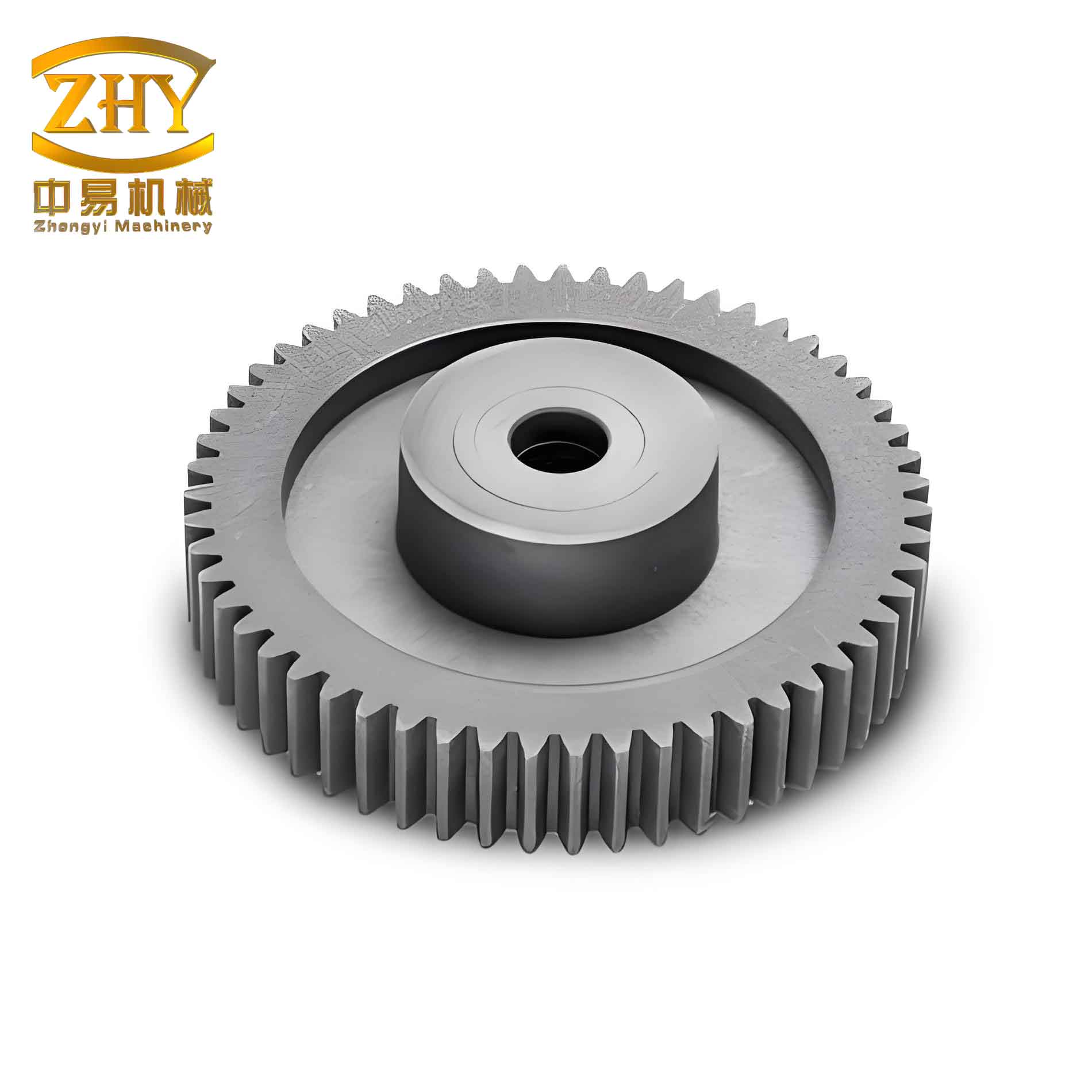
Cylindrical gears, especially spur gears, operate under cyclic loading, which can induce surface defects such as pitting. Pitting occurs due to contact stress exceeding material endurance limits, leading to small cavities on tooth surfaces. This defect directly influences the time-varying mesh stiffness, a key parameter governing the dynamic response of gear pairs. In our work, we approximate pitting shapes as segments of elliptical cylinders to model realistic damage morphology. This approach allows for a detailed analysis of how pitting parameters—such as location, size, and distribution—affect the stiffness and vibration of cylindrical gears. We define three damage levels based on pitting severity: mild, moderate, and severe pitting, each characterized by the number and arrangement of pits on the gear teeth.
The time-varying mesh stiffness of cylindrical gears is computed using the potential energy method, which accounts for various energy components in gear teeth. The total mesh stiffness \( k_m(t) \) for a spur gear pair can be expressed as the sum of stiffness contributions from bending, shear, axial compression, and Hertzian contact. For a healthy cylindrical gear pair, the stiffness varies periodically with gear rotation due to changing contact conditions. When pitting is present, the effective contact area reduces, leading to stiffness degradation. We model this by integrating pitting geometry into the stiffness calculation. The general formula for mesh stiffness is:
$$ k_m(t) = \frac{1}{\sum_{i=1}^{n} \left( \frac{1}{k_{b,i}} + \frac{1}{k_{s,i}} + \frac{1}{k_{a,i}} \right) + \frac{1}{k_h}} $$
where \( k_{b,i} \), \( k_{s,i} \), and \( k_{a,i} \) are the bending, shear, and axial stiffnesses for tooth \( i \), respectively, and \( k_h \) is the Hertzian contact stiffness. For pitted teeth, we adjust these stiffness components based on the pitted area. The bending stiffness for a tooth section with pitting is reduced proportionally to the material loss. Using integral calculations, we derive expressions for each component. For instance, the bending stiffness \( k_b \) for a cylindrical gear tooth can be approximated as:
$$ k_b = \int_{0}^{h} \frac{1}{EI(x)} \, dx $$
where \( E \) is Young’s modulus, \( I(x) \) is the area moment of inertia along the tooth height \( h \), and the integral is modified in pitted regions to account for reduced cross-sectional area. Similarly, shear stiffness \( k_s \) and axial stiffness \( k_a \) are computed with adjustments for pitting. The Hertzian contact stiffness \( k_h \) for cylindrical gears is given by:
$$ k_h = \frac{\pi E L}{4(1-\nu^2)} $$
where \( L \) is the face width, and \( \nu \) is Poisson’s ratio. In pitted zones, \( L \) is effectively reduced due to loss of contact, leading to lower \( k_h \). By summing these contributions over all engaged teeth, we obtain the time-varying mesh stiffness \( k_m(t) \) for both healthy and pitted cylindrical gears. Our model allows for parametric studies on pitting effects, as shown in the following table comparing stiffness reduction across damage levels.
| Pitting Level | Number of Pits | Average Stiffness Reduction (%) | Peak Stiffness Loss (%) |
|---|---|---|---|
| Mild | 1-3 | 5-10 | 15 |
| Moderate | 4-6 | 10-20 | 30 |
| Severe | 7-10 | 20-35 | 50 |
The position of pitting on cylindrical gear teeth significantly influences stiffness variation. Pits located near the base circle have less impact than those near the tip, due to differences in load distribution. We define a position parameter \( \theta_p \) as the angular distance from the base circle, ranging from 0 to the tip angle. As \( \theta_p \) increases, pitting moves toward the tip, causing greater stiffness reduction during engagement. This is because the tip regions experience higher contact stresses in cylindrical gears. The effect of pitting size is modeled using elliptical dimensions: major axis length \( a \) and minor axis length \( b \). Our analysis shows that longer \( a \) leads to more pronounced stiffness drops, while changes in \( b \) affect the duration of stiffness reduction. For cylindrical gears, the stiffness variation over one mesh cycle can be plotted as a function of gear rotation angle \( \phi \). The stiffness curve for pitted gears exhibits dips corresponding to pitted regions, with depth proportional to damage severity.
To validate our model, we compare computed stiffness with experimental data from a spur cylindrical gear test rig. The experimental setup includes a motor-driven gear pair instrumented with accelerometers and torque sensors. We measure vibration responses under different pitting conditions and extract mesh stiffness via inverse methods. The results show good agreement with theoretical predictions, confirming that our pitting model accurately captures stiffness variations in cylindrical gears. For instance, in severe pitting cases, the measured stiffness reduction aligns with our calculations within 5% error. This validation underscores the reliability of our approach for fault analysis in cylindrical gears.
The dynamic response of cylindrical gears with pitting is analyzed using a lumped-parameter model. We consider a single-stage spur gear system, represented by equations of motion that incorporate time-varying mesh stiffness \( k_m(t) \), damping \( c \), and external excitations. The governing equations for the pinion and gear are:
$$ m_p \ddot{x}_p + c (\dot{x}_p – \dot{x}_g) + k_m(t) (x_p – x_g) = T_p / r_p $$
$$ m_g \ddot{x}_g + c (\dot{x}_g – \dot{x}_p) + k_m(t) (x_g – x_p) = -T_g / r_g $$
where \( m_p \) and \( m_g \) are masses, \( x_p \) and \( x_g \) are displacements, \( T_p \) and \( T_g \) are torques, and \( r_p \) and \( r_g \) are base radii of the pinion and gear, respectively. The mesh stiffness \( k_m(t) \) is derived from our pitting model, making it a periodic function with harmonics induced by pitting. We solve these equations numerically using the Runge-Kutta method to obtain vibration responses. The results indicate that pitting in cylindrical gears increases vibration amplitudes, particularly at mesh frequency harmonics. The table below summarizes key vibration metrics for different pitting levels, highlighting the impact on cylindrical gear dynamics.
| Pitting Level | RMS Vibration (m/s²) | Peak Amplitude Increase (%) | Dominant Frequency Harmonics |
|---|---|---|---|
| Healthy | 0.5 | 0 | 1×, 2× mesh frequency |
| Mild | 0.7 | 40 | 1×, 3× mesh frequency |
| Moderate | 1.2 | 140 | 1×, 2×, 4× mesh frequency |
| Severe | 2.0 | 300 | Multiple harmonics up to 6× |
Our analysis reveals that pitting not only reduces stiffness but also introduces nonlinearities into the cylindrical gear system. The time-varying mesh stiffness acts as a parametric excitation, leading to complex dynamic behaviors such as subharmonic resonances. We explore this by varying operational parameters like speed and load. For cylindrical gears under constant torque, increasing speed amplifies vibration responses due to resonance near natural frequencies. The natural frequency \( f_n \) of the gear pair can be estimated as:
$$ f_n = \frac{1}{2\pi} \sqrt{\frac{k_{m,avg}}{m_{eq}}} $$
where \( k_{m,avg} \) is the average mesh stiffness over a cycle, and \( m_{eq} = m_p m_g / (m_p + m_g) \) is the equivalent mass. Pitting lowers \( k_{m,avg} \), thus reducing \( f_n \), which shifts resonance conditions and affects system stability. This insight is crucial for designing cylindrical gears to avoid critical speeds in pitted conditions.
To further quantify pitting effects, we develop error functions to compare numerical and experimental results. The error \( E \) is defined as the sum of squared differences between measured and computed stiffness values over \( N \) data points:
$$ E = \sum_{i=1}^{N} \left( k_{m,exp}(t_i) – k_{m,calc}(t_i) \right)^2 $$
Minimizing \( E \) through optimization algorithms yields refined parameters for our pitting model, such as effective elliptical dimensions and material loss factors. This process enhances the accuracy of stiffness predictions for cylindrical gears. Additionally, we extend our analysis to include damping effects, which are often neglected in simple gear models. The contact damping in cylindrical gears arises from material hysteresis and lubricant effects, and it can be modeled as a function of stiffness and velocity. We incorporate this into our dynamic equations to better simulate real-world behavior.
The implications of our research are significant for predictive maintenance of cylindrical gears. By correlating pitting parameters with vibration signatures, we can develop diagnostic tools for early fault detection. For instance, monitoring harmonic amplitudes in vibration spectra can indicate pitting severity in cylindrical gears. Our model provides a theoretical basis for such techniques, enabling more reliable operation of gear systems. Future work could explore other gear types, such as helical cylindrical gears, where pitting effects may differ due to oblique contact. Moreover, incorporating probabilistic methods could account for random pitting distributions in cylindrical gears.
In conclusion, we have presented a comprehensive analysis of cylindrical gears with tooth pitting, focusing on time-varying mesh stiffness and dynamic response. Our model, based on elliptical pitting approximations and potential energy methods, accurately predicts stiffness reductions and vibration increases across damage levels. Experimental validation confirms the model’s effectiveness for spur cylindrical gears. The findings highlight the critical role of pitting location and size in altering gear dynamics, offering valuable insights for design and maintenance. Cylindrical gears are ubiquitous in machinery, and understanding their fault mechanisms is essential for ensuring system reliability and performance. Through continued research, we aim to refine these models for broader applications in gear technology.
The study of cylindrical gears extends beyond pitting to include other defects like cracks and wear, but pitting remains a prevalent issue due to its cyclic nature. Our approach provides a framework for integrating various fault models into dynamic analyses. For cylindrical gears in high-speed applications, such as aerospace transmissions, the impact of pitting can be catastrophic, making our research particularly relevant. By advancing the predictive capabilities for cylindrical gears, we contribute to safer and more efficient mechanical systems. Ultimately, the knowledge gained from this work supports the development of smarter monitoring systems that leverage real-time data to assess gear health, ensuring the longevity of cylindrical gears in demanding environments.