
In the rapidly evolving automotive industry, precision forming of gears has become an inevitable trend in the forging sector. Forging the tooth profile ensures complete and continuous metal flow lines, resulting in superior strength compared to machining, while also saving material and reducing production costs. However, for large module and large size cylindrical gears, challenges such as poor filling of tooth corners, difficulty in demolding, and low die life have traditionally led to a process where gears are first forged as blanks and then machined to final tooth shape. In this article, I will share my experience in developing a precision forming process for a specific large module and large size spur cylindrical gear used in heavy-duty vehicles, ultimately achieving precision forming of the external straight teeth. This development focuses on overcoming the aforementioned challenges through innovative design, simulation, and practical validation.
The gear in question is a typical large specification cylindrical gear with significant dimensions. To provide a clear overview, the key parameters of this cylindrical gear are summarized in the table below.
| Parameter | Value |
|---|---|
| Number of Teeth | 46 |
| Normal Module (mm) | 5.22 |
| Pressure Angle (°) | 20 |
| Helix Angle (°) | 0 |
| Pitch Circle Diameter (mm) | 238 |
| Normal Tooth Thickness (mm) | 7.75 |
These parameters define a spur cylindrical gear with a module exceeding 5 mm, classifying it as a large module gear. The outer diameter is approximately 248 mm, and the tooth width is 58 mm, making it a substantial component requiring careful process design.
The first step in the precision forming process for these cylindrical gears is the design of the forging blank. To ensure a high yield rate, allowances must be strategically applied. For the tooth profile, a unilateral allowance of 1 mm is reserved, while other areas have a unilateral allowance of 1.3 mm. Additionally, considering demolding difficulties, a draft angle of 0.5° is applied to the outer cylindrical surface. This design aims to facilitate metal flow during forging and ease ejection after forming. The forging blank essentially represents the near-net shape of the final gear, with minimal machining required only on the tooth flanks and other critical surfaces.
Selecting the appropriate forging equipment is crucial for successfully forming these large cylindrical gears. The forming force must be accurately estimated to prevent machine overload and ensure complete filling. A common empirical formula for calculating deformation force in closed-die forging is:
$$ P = k \cdot F $$
where \( P \) is the deformation force in kN, \( F \) is the projected area of the forging in cm², and \( k \) is a coefficient ranging from 50 to 70, depending on the complexity of the part. For complex shapes like these cylindrical gears with intricate teeth, the higher end of the coefficient range is chosen, so \( k = 70 \). The projected area \( F \) for this gear is calculated based on its maximum dimensions. Given the outer diameter of approximately 248 mm and considering the full face, the area is:
$$ F = \frac{\pi}{4} \times (24.8)^2 \approx 483 \text{ cm}^2 $$
Therefore, the deformation force is:
$$ P = 70 \times 483 \approx 33810 \text{ kN} \approx 3.38 \times 10^4 \text{ kN} $$
In practical terms, this translates to approximately 3450 metric tons of force. Based on experience, the nominal force of the press should be about 1.2 times the calculated deformation force to account for variations and ensure robust operation:
$$ P_{\text{press}} = 1.2 \times P \approx 1.2 \times 3450 \approx 4140 \text{ t} $$
To provide a safety margin and accommodate potential peak loads, a 6300 t hot forging press was selected for production. This choice ensures sufficient capacity to handle the high stresses involved in forming large module cylindrical gears.
The design of the forging dies is a critical aspect of this process. For large cylindrical gears, a two-stage forging operation—pre-forging and finish-forging—is typically employed. However, a key insight from this development is that the pre-forging stage should not include the tooth profile. Although it might seem intuitive to pre-form the teeth, doing so presents several issues. The pre-forged gear blank with teeth would be difficult to position accurately and quickly into the finish-forging die cavity, leading to excessive cooling of the tooth areas. This temperature drop negatively impacts metal flow and filling during the final strike. Therefore, my design approach simplifies the pre-forging operation to merely distribute the material appropriately without forming the teeth. The pre-forged blank is shaped to guide metal into the tooth cavities in the finish die while using the root circle diameter for precise positioning between stages.
The finish-forging die incorporates a floating structure to ensure uniform pressure distribution and employs a large central ejector pin (or alternatively a ring ejector) for stable demolding. This ejector system is essential because the large contact area between the gear teeth and the die can create significant friction, making ejection challenging. A central or ring ejector provides balanced force, preventing tilting or damage during ejection. The die assembly includes various components such as stress rings, insert blocks, and pressure plates to enhance durability and manage the high forming loads. The following table summarizes the key design considerations for the dies used in forming these cylindrical gears.
| Die Component | Design Feature | Purpose |
|---|---|---|
| Pre-forging Die | Simple shape without tooth profile | Facilitates quick placement, reduces cooling |
| Positioning | Root circle diameter alignment | Ensures accurate transfer from pre- to finish-forging |
| Finish-forging Die | Floating structure with tooth cavity inserts | Improves filling and reduces stress concentration |
| Ejection System | Large central pin or ring ejector | Provides stable demolding for large contact area gears |
| Die Material | High-hot-strength tool steel (e.g., H13) | Withstands high temperatures and cyclic loading |
To validate the die design and process parameters, I employed Deform-3D simulation software. This finite element analysis tool is invaluable for predicting metal flow, temperature distribution, forming loads, and potential defects. The simulation model included the billet, pre-forge die, and finish-forge die, with material properties defined for typical gear steel at forging temperatures. The initial billet temperature was set to 1200°C, and the process simulated the transfer and forming stages.
The simulation revealed that with the designed pre-forge shape, material distribution toward the outer periphery was adequate to fill the tooth cavities. The positioning via the root circle was stable, and the finish-forging operation achieved complete tooth filling at a simulated press force of approximately 4896 t. The force progression during simulation can be described by the following relationship, which correlates effective stress, strain, and contact area:
$$ \sigma_{eff} = K \cdot \epsilon^n $$
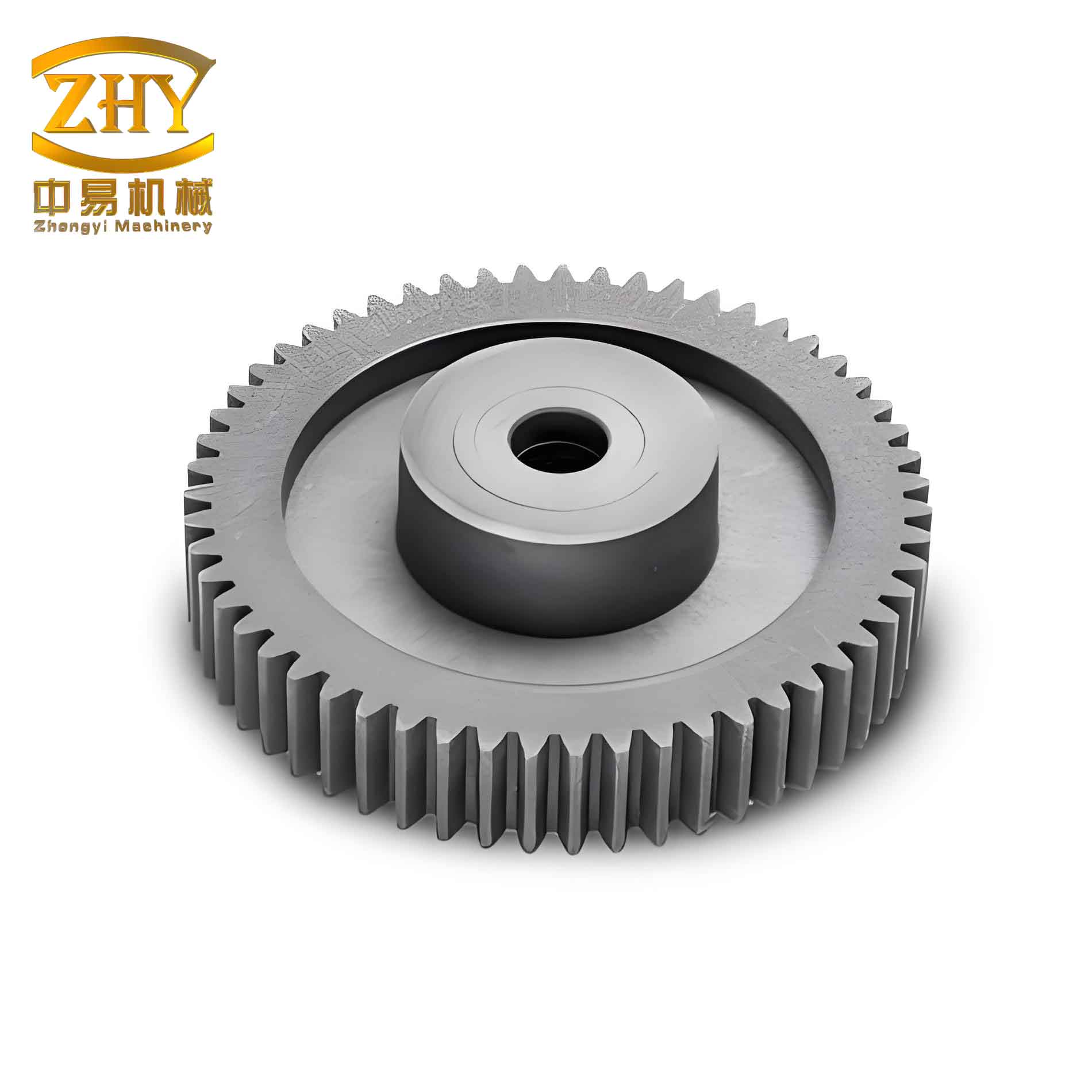
where \( \sigma_{eff} \) is the effective stress, \( \epsilon \) is the strain, \( K \) is the strength coefficient, and \( n \) is the strain-hardening exponent. For hot forging conditions, these parameters are temperature-dependent. The simulation results confirmed that the tooth corners, often problematic in large module cylindrical gears, were fully filled without any folds or underfills. The image below, inserted here, provides a visual reference for such cylindrical gears, though the specific simulation snapshots are not shown to avoid referencing original figures.
The filling efficiency \( \eta \) for the tooth cavity can be quantified as the ratio of filled volume to total cavity volume. In the simulation, this approached 100% for the optimal design. The press force during the final stage as a function of stroke \( s \) showed a sharp increase as the teeth filled, plateauing near the maximum. This behavior is typical for closed-die forging of complex shapes like cylindrical gears. The simulation also allowed optimization of the billet volume to minimize flash and ensure net-shape forming.
With the design and simulation finalized, the process moved to actual production on the 6300 t hot forging press. The billet material was heated to 1200°C ± 20°C using an induction heater, and graphite-based lubricant was applied to the dies to reduce friction and facilitate ejection. The pre-forging operation produced a blank with a central hub and a flanged outer section, designed to flow into the tooth cavities during finish forging. The transfer from pre-forge to finish-forge die was smooth, with the root circle positioning ensuring accurate alignment.
The finish-forging stroke produced gears with excellent tooth profile definition. As predicted by simulation, the lower section of the tooth width showed slightly better filling than the upper section, attributable to the 0.5° draft angle which naturally provides more material in the lower regions. This differential filling is acceptable as it aligns with the machining allowance strategy. The actual forging force measured during production was consistent with the simulation, around 4900 t, validating the FEA model. The forged cylindrical gears were then air-cooled and subjected to initial inspection.
The success of this precision forming process for large cylindrical gears hinges on several factors. First, the billet temperature must be tightly controlled. If the temperature drops below 1150°C, the flow stress increases significantly, leading to incomplete filling and higher press loads. The relationship between flow stress \( \sigma \) and temperature \( T \) can be approximated by:
$$ \sigma = \sigma_0 \cdot \exp\left(\frac{Q}{RT}\right) $$
where \( \sigma_0 \) is a material constant, \( Q \) is the activation energy for deformation, \( R \) is the gas constant, and \( T \) is the absolute temperature. Maintaining 1200°C ensures lower flow stress, aiding the filling of intricate tooth geometries in these large module cylindrical gears.
Second, die life is a critical economic consideration. The tooth insert in the finish die experiences high thermal and mechanical cycling stresses. Using high-performance die steels like H13 with proper heat treatment and surface coatings (e.g., nitriding) extends die life. The wear volume \( V_w \) over \( N \) forging cycles can be modeled as:
$$ V_w = k_w \cdot N \cdot \sigma_c \cdot A_c $$
where \( k_w \) is a wear coefficient, \( \sigma_c \) is the contact stress, and \( A_c \) is the contact area. For cylindrical gears with large tooth contact areas, reducing \( \sigma_c \) via optimal lubrication and die design is crucial.
Third, the ejection system proved vital. The central large-diameter ejector pin provided uniform force, preventing distortion or sticking. For even larger cylindrical gears, a ring ejector might be preferred to distribute force across a broader area. The ejection force \( F_e \) can be estimated from the friction and thermal shrinkage:
$$ F_e = \mu \cdot P_c \cdot A_c + \alpha \cdot E \cdot \Delta T \cdot A_c $$
where \( \mu \) is the friction coefficient, \( P_c \) is the contact pressure, \( \alpha \) is the coefficient of thermal expansion, \( E \) is Young’s modulus, and \( \Delta T \) is the temperature difference between gear and die. Proper lubrication reduces \( \mu \), easing ejection.
In conclusion, the development of a precision forming process for large module and large size cylindrical gears requires a holistic approach integrating design, simulation, and practical know-how. The key takeaways from this project are:
1. Pre-forging Simplicity: For large cylindrical gears, pre-forging should not include the tooth profile. A simple shape that aids material distribution and uses the root circle for positioning is more effective. This avoids cooling issues and placement inaccuracies.
2. Ejection Design: A robust ejection system—central pin or ring ejector—is necessary to demold gears with large tooth contact areas without damage.
3. Equipment Sizing: The forging press should have a nominal force at least 1.2 times the calculated deformation force to handle peak loads and ensure complete filling for complex cylindrical gears.
4. Temperature Control: Maintaining billet temperature around 1200°C is critical for metal flow. Lower temperatures increase flow stress and reduce fillability, raising scrap rates.
5. Die Material Selection: Tooth inserts undergo severe conditions; high-hot-strength steels with coatings are essential to prevent premature failure and maintain dimensional accuracy over production runs.
This process has demonstrated that precision forging of large module cylindrical gears is feasible and offers significant advantages in strength and material efficiency. Future work could explore further optimization of die geometries for even larger gears, integration of in-process cooling control, and advanced simulations to predict microstructural evolution. The journey of developing such processes underscores the importance of combining theoretical analysis with practical experimentation in the forging industry, particularly for challenging components like large cylindrical gears that are pivotal in heavy-duty automotive applications.
Moreover, the economic impact of precision forming cylindrical gears cannot be overstated. By reducing machining allowances, material savings of 15-20% are achievable for these large gears. The enhanced mechanical properties due to continuous grain flow translate to longer service life and reliability in demanding applications. The formula for material savings \( S_m \) as a percentage of initial volume \( V_i \) is:
$$ S_m = \frac{V_i – V_f}{V_i} \times 100\% $$
where \( V_f \) is the final forged volume after precision forming. For the cylindrical gear in this study, \( S_m \) was approximately 18%, a significant reduction in raw material cost.
Another aspect worth discussing is the scalability of this process. While developed for a specific large module cylindrical gear, the principles apply to other gear types, such as helical or bevel gears, though with modifications for their unique geometries. The core idea of avoiding pre-forming complex profiles in early stages holds generally. Additionally, the use of simulation tools like Deform-3D allows for rapid iteration and risk reduction before physical trials, which is especially valuable for expensive die sets required for large cylindrical gears.
In terms of quality assurance, the precision forged cylindrical gears were subjected to non-destructive testing (e.g., ultrasonic inspection) to verify internal integrity. The tooth profile accuracy was measured using coordinate measuring machines (CMM), showing that the forging process could achieve tolerances within IT10-IT11, reducing subsequent grinding operations. The surface finish on the tooth flanks was also superior to cast gears, enhancing lubrication and wear resistance in service.
Finally, this development highlights the trend toward near-net-shape manufacturing in the automotive sector. As environmental and cost pressures increase, processes that minimize waste and energy consumption become paramount. Precision forging of cylindrical gears aligns perfectly with this trend, offering a sustainable alternative to traditional machining. The continued advancement in die materials, lubrication technology, and press automation will further propel the adoption of such processes for large and complex components. Through this detailed exploration, I hope to have provided a comprehensive insight into the intricacies and benefits of precision forming for large module and large size cylindrical gears, a cornerstone in modern heavy vehicle manufacturing.