
As critical components within power transmission systems, cylindrical gears have secured pivotal roles across diverse sectors such as automotive, high-speed rail, and aerospace equipment, showcasing expansive market prospects. Historically, the predominant manufacturing route for cylindrical gears has involved machining processes—specifically combinations of gear hobbing and shaving or gear shaping and shaving. While these methods yield components with high dimensional accuracy and stable quality, they are inherently burdened with significant drawbacks including low material utilization, the creation of discontinuous grain flow lines, relatively low production efficiency, and consequently higher overall costs. The advancement of precision plastic forming technologies and mold manufacturing has enabled the adoption of extrusion forming for producing cylindrical gears with various modules and tooth counts. This approach offers the potential for superior tooth profile accuracy, enhanced surface finish, and improved load-bearing capacity, positioning it as a promising alternative in gear manufacturing.
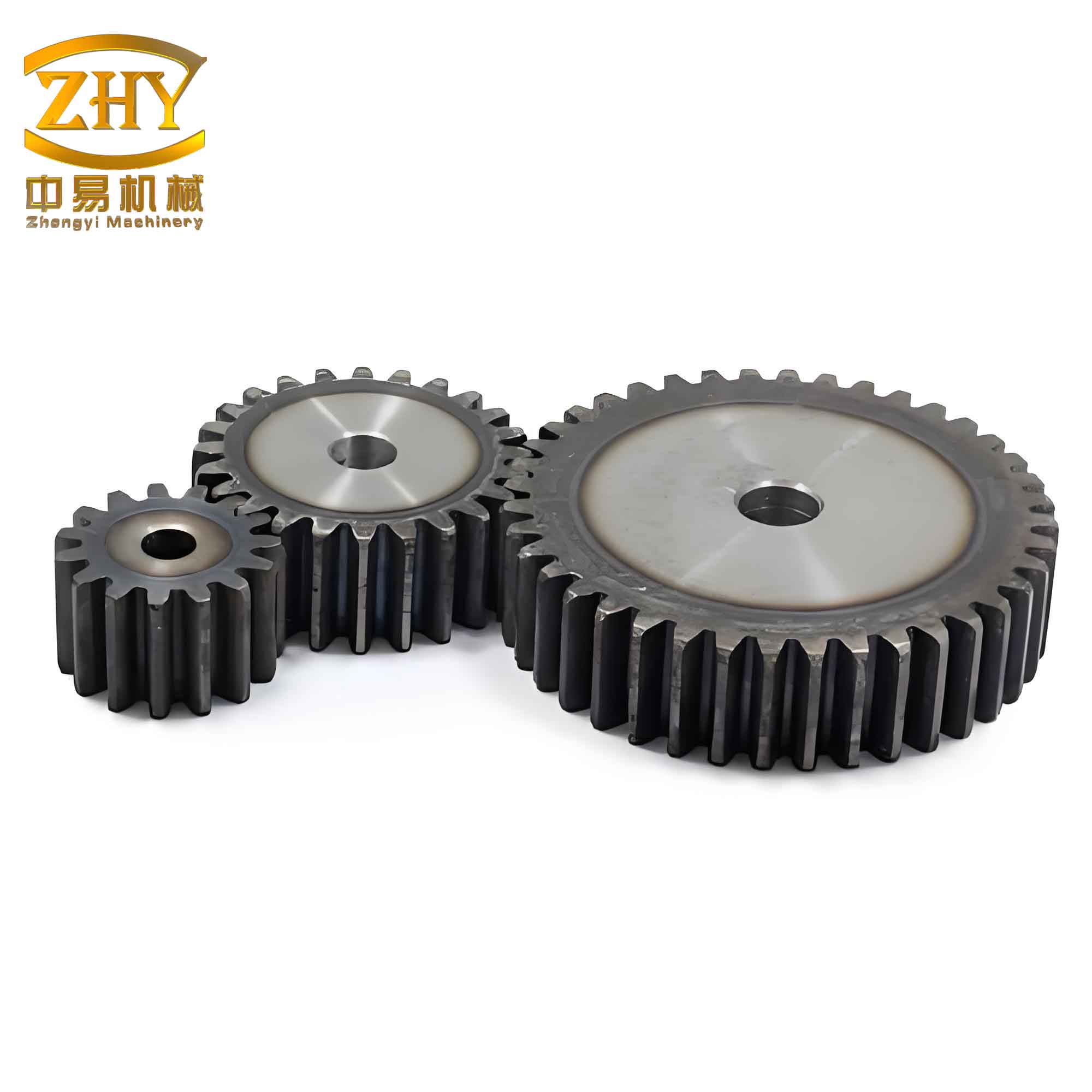
This study addresses the critical need to improve the forming precision of extruded cylindrical gears. To achieve this, a novel optimization strategy integrating Principal Component Analysis (PCA) and Grey Relational Analysis (GRA) is designed. This methodology effectively transforms a complex multi-objective optimization problem into a more manageable single-objective optimization based on a composite grey relational grade. By constructing a predictive model that maps process parameters to this grade, an optimal parameter set is identified and subsequently validated through experimentation, demonstrating the efficacy of the proposed approach for enhancing the quality of extruded cylindrical gears.
Process Analysis of Cylindrical Gear Extrusion Forming
The subject of this study is a cylindrical gear manufactured from 20CrMnTi steel, with key specifications including a module of 4, a pressure angle of 20°, and 16 teeth. The manufacturing sequence for these cylindrical gears involves several stages. Initially, a ring-shaped preform is produced via hot die forging. This preform undergoes annealing, followed by shot blasting to remove surface oxides. It is then machined to create a precision blank. Prior to extrusion, a polymer-based lubricant is applied to the surface. The core and most challenging step in this sequence is the extrusion operation itself.
To maximize material utilization and production efficiency, a forward extrusion process is employed. The forming is accomplished using a punch and a die, where the punch is fabricated from W18Cr4V high-speed steel and the die from H13 hot-work tool steel. The extrusion is performed on a 100-ton hydraulic press operating in an intermittent mode at a constant speed, corresponding to a strain rate of approximately 0.01 s-1. The workpiece is heated to 350°C in a resistance furnace and held at this temperature for 6 minutes to ensure uniform heating before undergoing extrusion with a total compressive deformation of 60%.
Experimental Design and Multi-Objective Optimization Framework
2.1 Design of Experiments and Grey Relational Analysis
In this investigation, four key process parameters are selected as control factors: die land length (L), taper angle (μ), corner radius at the tooth tip in the die (R), and the thickness of the splitter section (T). The optimization aims to minimize three critical response characteristics that define the quality of the extruded cylindrical gears: the underfill or sink mark at the lower tooth tip (δ), the outward bulge at the lower end face (h), and the maximum forming load (F). The levels for each factor are detailed in Table 1.
| Control Factor | Level | ||||
|---|---|---|---|---|---|
| 1 | 2 | 3 | 4 | 5 | |
| Corner Radius, R (mm) | 1.0 | 1.2 | 1.4 | 1.6 | 1.8 |
| Taper Angle, μ (°) | 35 | 40 | 45 | 50 | 55 |
| Splitter Thickness, T (mm) | 1 | 2 | 3 | 4 | 5 |
| Die Land Length, L (mm) | 5 | 10 | 15 | 20 | 25 |
A Central Composite Design (CCD) for four factors at five levels was executed, comprising a total of 31 experimental runs. The experimental layout along with the measured responses for δ, h, and F are presented in Table 2.
Grey Relational Analysis (GRA) is a technique adept at handling systems with partial or uncertain information. It operates by comparing the geometric similarity between data sequences to determine their relational degree. For this multi-objective problem, each experimental run generates a sequence of three responses. The first step in GRA is data pre-processing, or normalization, to make sequences comparable. Since the goal is to minimize δ, h, and F, the “lower-is-better” criterion is applied for normalization using Equation (1):
$$x_i^*(k) = \frac{\max x_i(k) – x_i(k)}{\max x_i(k) – \min x_i(k)} \quad (1)$$
where \(x_i(k)\) is the original value of the k-th response in the i-th experiment, and \(x_i^*(k)\) is the normalized value. Following normalization, the grey relational coefficient \(\xi_i(k)\) for each response in each experiment is calculated using Equation (2). This coefficient expresses the relational degree between the comparative sequence (experimental results) and the reference sequence (ideal optimal values, which are 1 after normalization for “lower-is-better”).
$$\xi_i(k) = \frac{\Delta_{\min} + \rho \Delta_{\max}}{\Delta_{0i}(k) + \rho \Delta_{\max}} \quad (2)$$
Here, \(\Delta_{0i}(k) = |x_0^*(k) – x_i^*(k)|\) is the absolute difference between the reference and comparative sequences for the k-th response. \(\Delta_{\min}\) and \(\Delta_{\max}\) are the global minimum and maximum of these differences, respectively. \(\rho\) is the distinguishing coefficient, typically set between 0 and 1, with \(\rho=0.5\) being a common choice to moderate the influence of \(\Delta_{\max}\). The calculated grey relational coefficients for δ, h, and F are listed in Table 2.
2.2 Determination of Weighting Factors Using Principal Component Analysis
To synthesize the three grey relational coefficients (\(\xi_\delta, \xi_h, \xi_F\)) into a single comprehensive grey relational grade (γ), weighting factors must be assigned to reflect the relative importance of each objective. Simply assigning equal weights may not align with practical engineering priorities. Principal Component Analysis (PCA) is employed to objectively determine these weights based on the contribution of each response’s variance to the overall system variation.
PCA begins by constructing the correlation matrix \(R\) of the normalized response data. The eigenvalues (\(\lambda_k\)) and corresponding eigenvectors (\(\alpha_k\)) of this matrix are then computed. Each eigenvalue represents the variance accounted for by its corresponding principal component (PC). The first principal component (PC1) captures the maximum variance in the data, with subsequent PCs capturing remaining orthogonal variance. The contribution rate (\(C_k\)) of the k-th PC is calculated as:
$$C_k = \frac{\lambda_k}{\sum_{j=1}^{3} \lambda_j} \times 100\% \quad (3)$$
The results of the PCA are summarized in Table 3. The analysis reveals that the first principal component, which is heavily loaded on the underfill (δ), accounts for approximately 85% of the total variance. The second component, associated with the bulge (h), accounts for about 11%, and the third, related to forming load (F), accounts for the remaining 5-6%. This indicates that for the extrusion of these cylindrical gears, achieving complete tooth fill (minimizing δ) is the dominant concern, significantly more influential on the overall process outcome than minimizing bulge or forming load. Therefore, the contribution rates are normalized to sum to 1 and used as the weighting factors \(\beta_k\) for the grey relational grade calculation.
| Principal Component | Eigenvalue (λ) | Contribution Rate (%) | Assigned Weight (β) |
|---|---|---|---|
| PC1 (δ) | 2.5834 | 85.0 | 0.83 |
| PC2 (h) | 0.3421 | 11.2 | 0.11 |
| PC3 (F) | 0.1485 | 4.9 | 0.05 |
The overall grey relational grade γ for each experimental run is then computed as the weighted sum of its individual grey relational coefficients, as shown in Equation (4). A higher γ value indicates that the corresponding experimental parameter set yields a response profile closer to the ideal optimal profile.
$$\gamma_i = \beta_1 \xi_i(\delta) + \beta_2 \xi_i(h) + \beta_3 \xi_i(F) \quad (4)$$
where \(\beta_1 + \beta_2 + \beta_3 = 1\). Using the weights derived from PCA (\(\beta_1=0.83, \beta_2=0.11, \beta_3=0.05\)), the grey relational grade for each of the 31 experiments is calculated and presented in the final column of Table 2.
| Run | R (mm) | μ (°) | T (mm) | L (mm) | δ (mm) | h (mm) | F (kN) | ξ(δ) | ξ(h) | ξ(F) | γ |
|---|---|---|---|---|---|---|---|---|---|---|---|
| 1 | 1.2 | 40 | 2 | 10 | 0.285 | 1.996 | 2141.4 | 0.934 | 0.908 | 0.981 | 0.926 |
| 2 | 1.6 | 40 | 2 | 10 | 0.283 | 1.934 | 2136.1 | 1.000 | 0.997 | 0.934 | 0.993 |
| 3 | 1.2 | 50 | 2 | 10 | 0.299 | 2.678 | 2195.3 | 0.827 | 0.506 | 0.918 | 0.791 |
| 4 | 1.6 | 50 | 2 | 10 | 0.285 | 2.346 | 2126.8 | 0.998 | 0.615 | 1.000 | 0.935 |
| 5 | 1.2 | 40 | 4 | 10 | 0.396 | 2.757 | 2254.8 | 0.534 | 0.554 | 0.839 | 0.560 |
| 6 | 1.6 | 40 | 4 | 10 | 0.348 | 2.432 | 2204.9 | 0.666 | 0.593 | 0.983 | 0.684 |
| 7 | 1.2 | 50 | 4 | 10 | 0.456 | 3.135 | 2367.4 | 0.395 | 0.583 | 0.857 | 0.431 |
| 8 | 1.6 | 50 | 4 | 10 | 0.292 | 3.022 | 2241.6 | 0.489 | 0.487 | 0.994 | 0.507 |
| 9 | 1.2 | 40 | 2 | 20 | 0.318 | 2.013 | 2171.5 | 0.924 | 0.285 | 0.938 | 0.852 |
| 10 | 1.6 | 40 | 2 | 20 | 0.299 | 1.958 | 2146.1 | 0.878 | 0.285 | 0.785 | 0.797 |
| 11 | 1.2 | 50 | 2 | 20 | 0.336 | 2.547 | 2196.8 | 0.702 | 0.835 | 0.948 | 0.734 |
| 12 | 1.6 | 50 | 2 | 20 | 0.303 | 2.369 | 2142.2 | 0.813 | 0.294 | 0.837 | 0.746 |
| 13 | 1.2 | 40 | 4 | 20 | 0.392 | 2.423 | 2254.4 | 0.457 | 0.583 | 0.877 | 0.496 |
| 14 | 1.6 | 40 | 4 | 20 | 0.388 | 2.398 | 2223.3 | 0.522 | 0.475 | 0.795 | 0.522 |
| 15 | 1.2 | 50 | 4 | 20 | 0.462 | 3.134 | 2303.6 | 0.723 | 0.982 | 0.925 | 0.762 |
| 16 | 1.6 | 50 | 4 | 20 | 0.458 | 2.948 | 2247.4 | 0.886 | 0.749 | 0.998 | 0.870 |
| 17 | 1.0 | 45 | 3 | 15 | 0.377 | 2.394 | 2234.6 | 0.485 | 0.937 | 0.927 | 0.560 |
| 18 | 1.8 | 45 | 3 | 15 | 0.318 | 1.957 | 2164.9 | 0.876 | 0.485 | 0.854 | 0.827 |
| 19 | 1.4 | 35 | 3 | 15 | 0.301 | 3.002 | 2249.7 | 0.334 | 0.289 | 0.774 | 0.343 |
| 20 | 1.4 | 55 | 3 | 15 | 0.402 | 2.023 | 2329.9 | 0.445 | 0.859 | 0.974 | 0.519 |
| 21 | 1.4 | 45 | 1 | 15 | 0.299 | 2.978 | 2126.5 | 0.283 | 0.970 | 0.832 | 0.416 |
| 22 | 1.4 | 45 | 5 | 15 | 0.485 | 2.887 | 2253.5 | 0.449 | 0.475 | 0.739 | 0.463 |
| 23 | 1.4 | 45 | 3 | 5 | 0.239 | 2.365 | 2201.5 | 0.903 | 0.579 | 0.903 | 0.858 |
| 24 | 1.4 | 45 | 3 | 25 | 0.384 | 2.335 | 2235.9 | 0.653 | 0.567 | 0.876 | 0.662 |
| 25 | 1.4 | 45 | 3 | 15 | 0.275 | 2.348 | 2241.9 | 0.678 | 0.582 | 0.873 | 0.684 |
| 26 | 1.4 | 45 | 3 | 15 | 0.448 | 2.486 | 2233.4 | 0.738 | 0.596 | 0.823 | 0.726 |
| 27 | 1.4 | 45 | 3 | 15 | 0.375 | 2.756 | 2275.9 | 0.639 | 0.593 | 0.835 | 0.652 |
| 28 | 1.4 | 45 | 3 | 15 | 0.334 | 2.674 | 2258.7 | 0.641 | 0.589 | 0.865 | 0.655 |
| 29 | 1.4 | 45 | 3 | 15 | 0.375 | 2.981 | 2245.4 | 0.644 | 0.584 | 0.836 | 0.655 |
| 30 | 1.4 | 45 | 3 | 15 | 0.362 | 2.485 | 2234.7 | 0.682 | 0.595 | 0.877 | 0.690 |
| 31 | 1.4 | 45 | 3 | 15 | 0.359 | 2.550 | 2236.9 | 0.629 | 0.595 | 0.898 | 0.648 |
Development of the Predictive Optimization Model
With the grey relational grade γ serving as the comprehensive performance index, the next step is to establish a quantitative relationship between the process parameters (R, μ, T, L) and γ. Response Surface Methodology (RSM) is utilized to fit a second-order polynomial regression model to the experimental data. This model has the general form:
$$\gamma = b_0 + \sum_{i=1}^{4} b_i x_i + \sum_{i=1}^{4} b_{ii} x_i^2 + \sum_{i < j} b_{ij} x_i x_j + \epsilon \quad (5)$$
where \(b_0\) is the constant term, \(b_i\) are the linear coefficients, \(b_{ii}\) are the quadratic coefficients, \(b_{ij}\) are the interaction coefficients, \(x_i\) represent the coded values of the process parameters, and \(\epsilon\) is the error term. Based on the data from Table 2, the fitted regression model in terms of actual factors is derived as follows:
$$\gamma = 0.22156 + 0.01395R – 0.02498\mu – 0.05797T – 0.01595L \\
\quad – 0.00197R^2 + 0.00038\mu^2 + 0.00248T^2 – 0.000692L^2 \\
\quad + 0.00195R\mu – 0.0038R T + 0.00692R L \\
\quad + 0.00384\mu T – 0.00273\mu L – 0.00722T L \quad (6)
$$
The adequacy and significance of this regression model are rigorously assessed. The Analysis of Variance (ANOVA) results are presented in Table 4. The extremely low p-value (0.0001) for the model, which is far less than the common significance level of 0.05, confirms that the model is statistically significant and that the relationship it describes is not due to random chance.
| Source | Sum of Squares | Degrees of Freedom | Mean Square | F-Value | p-value (Prob > F) |
|---|---|---|---|---|---|
| Model | 0.109375 | 12 | 0.009115 | 103.57 | < 0.0001 |
| Residual | 0.001934 | 22 | 8.79E-05 | ||
| Lack of Fit | 0.001528 | 17 | 8.99E-05 | 1.06 | 0.5085 |
| Pure Error | 0.000406 | 5 | 8.12E-05 | ||
| Total | 0.111309 | 34 |
Furthermore, the lack-of-fit test yields a p-value of 0.5085, which is not significant. This indicates that the quadratic model is sufficiently complex to capture the underlying relationship without systematic error, and any residual variance can be attributed to pure experimental error. Key goodness-of-fit statistics are summarized in Table 5. The high R² value of 0.9827 signifies that the model explains 98.27% of the variability in the grey relational grade. The adjusted R² (0.9732) and predicted R² (0.9274) values are in reasonable agreement, indicating the model is not overfitted and has good predictive capability. The low standard deviation (S) of 0.00928 also points to a precise model.
| Statistic | Value |
|---|---|
| R-Squared (R²) | 0.9827 |
| Adjusted R² | 0.9732 |
| Predicted R² | 0.9274 |
| Standard Deviation (S) | 0.00928 |
Optimization Results and Validation
Using the established and validated regression model (Equation 6), numerical optimization techniques can be applied to find the set of process parameters that maximizes the grey relational grade γ within the defined experimental domain. The optimization goal is set to “Maximize γ”. The solution provided by the response optimizer yields the following optimal parameter combination:
- Corner Radius, R: 1.6 mm
- Taper Angle, μ: 40°
- Splitter Thickness, T: 1.5 mm
- Die Land Length, L: 10 mm
The predicted grey relational grade for this optimal setting is γ_opt = 0.373. To validate the model’s prediction, a confirmation experiment was conducted using this recommended parameter set. The results of the confirmation experiment and a comparison with the predicted values are shown in Table 6. The close agreement between the predicted and experimental results, with an average relative error of only 3.13%, strongly validates the accuracy and reliability of the PCA-GRA integrated optimization approach and the ensuing predictive model. This optimal parameter set represents the best compromise for simultaneously minimizing underfill, bulge, and forming load for the extrusion of the studied cylindrical gears.
| Parameter Set | Predicted γ | Experimental γ | Relative Error (%) |
|---|---|---|---|
| R=1.6mm, μ=40°, T=1.5mm, L=10mm | 0.373 | 0.385 | 3.13 |
Discussion and Conclusion
This study successfully demonstrates the application of an integrated Principal Component Analysis and Grey Relational Analysis (PCA-GRA) methodology for the multi-objective optimization of the cylindrical gear extrusion forming process. The inherent challenge of balancing multiple, often conflicting, quality objectives (tooth fill, geometric accuracy, and forming load) is effectively addressed. GRA provides a robust mechanism for normalizing disparate response scales and aggregating them into a single, comparable grey relational grade. However, the arbitrary assignment of weights in traditional GRA can be subjective. The incorporation of PCA elegantly resolves this by extracting objective weighting factors from the experimental data itself, based on the proportional contribution of each response’s variance to the total system variance. For these cylindrical gears, PCA revealed that achieving complete tooth fill (minimizing δ) was the paramount concern, accounting for 85% of the decision information.
The transformation of the multi-objective problem into a single-objective optimization of the grey relational grade enabled the use of Response Surface Methodology to develop a precise predictive model. The second-order polynomial model exhibited excellent fit (R² > 0.98) and high statistical significance (p < 0.0001). The optimal process parameters identified through this model—specifically a corner radius of 1.6 mm, a taper angle of 40°, a splitter thickness of 1.5 mm, and a die land length of 10 mm—were experimentally validated. The confirmation run showed strong agreement with model predictions, with an average error of just 3.13%, underscoring the practical reliability of the approach.
In conclusion, the PCA-GRA-RSM framework presents a systematic, objective, and effective strategy for optimizing complex forming processes like the extrusion of cylindrical gears. It provides engineers with a data-driven method to determine parameter sets that ensure superior product quality—characterized by excellent tooth profile fill and minimal defects—while considering process efficiency. This methodology can be readily adapted and applied to the optimization of other multi-response manufacturing processes for cylindrical gears and similar mechanical components.