
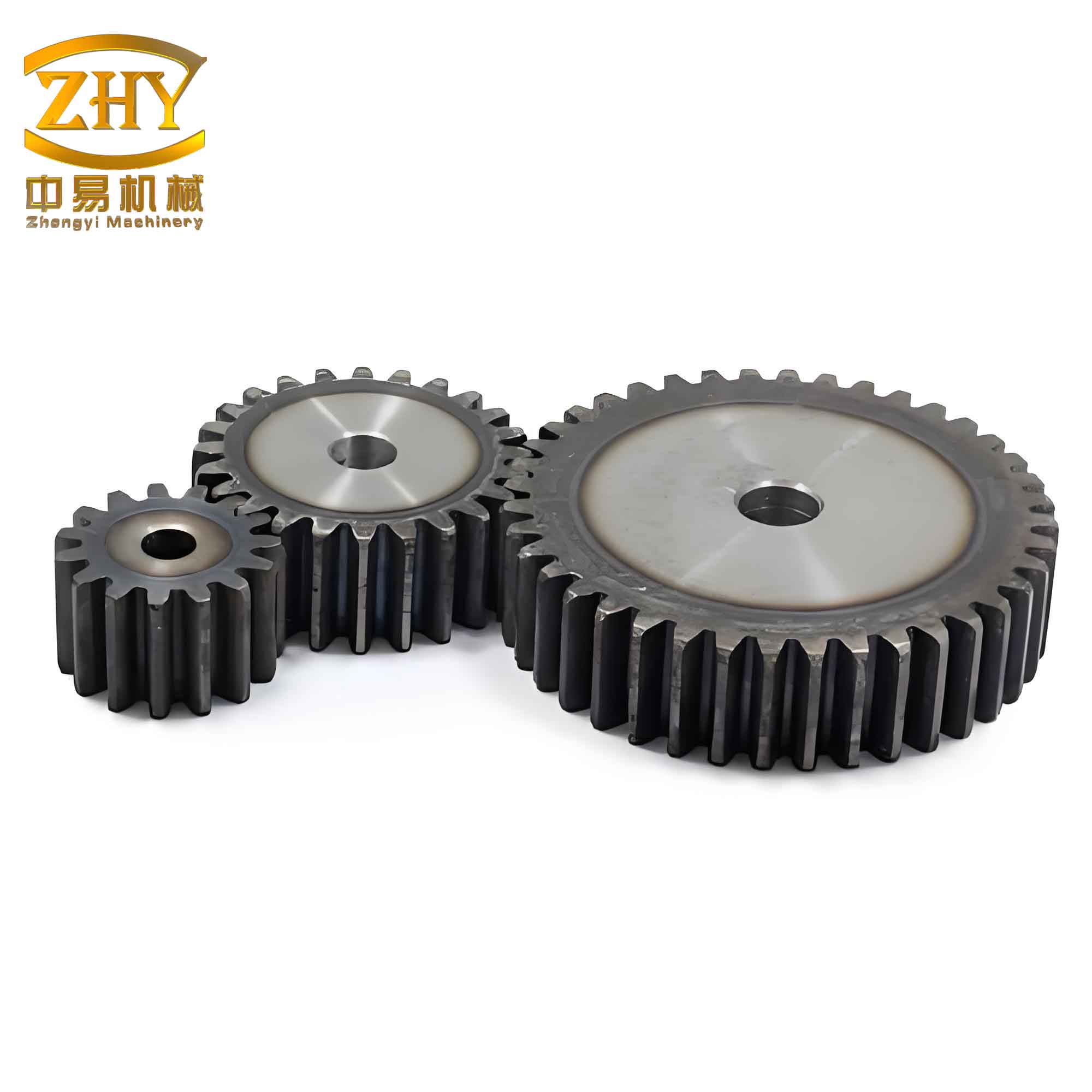
In practical power transmission systems, cylindrical gears are fundamental components whose performance is critically dependent on the lubrication state at the tooth contact interface. A significant portion of their operational life is spent under mixed lubrication conditions, where the applied load is shared between a thin lubricant film and direct contact between surface asperities. This regime presents unique challenges, as the concurrent action of viscous shear within the fluid and friction between interacting roughness peaks directly influences the friction coefficient, which is a paramount parameter governing power loss, transmission efficiency, and the onset of surface failures like scuffing and wear. Therefore, developing an accurate computational model to analyze the friction characteristics and predict the transmission efficiency of cylindrical gears under mixed lubrication is essential for optimizing their design, enhancing durability, and improving the overall efficiency of mechanical systems.
This article delves into the tribological analysis of cylindrical gears operating in the mixed lubrication regime. It begins by establishing the necessary geometrical and kinematic framework for contact analysis. Subsequently, a comprehensive mixed lubrication model is formulated, integrating real surface topography. From this model, a methodology for calculating the instantaneous friction coefficient is derived. Finally, a transmission efficiency model is constructed, and the influence of key operational and design parameters—such as rotational speed, lubricant viscosity, applied load, and surface roughness—on friction behavior and efficiency is thoroughly investigated.
Contact Analysis for Cylindrical Gears
Accurate determination of the contact conditions is the foundation for any tribological analysis. For cylindrical gears, this involves calculating the instantaneous geometry, kinematics, and load distribution at the tooth contact point throughout the meshing cycle.
The relative motion between a gear pair can be described using a spatial coordinate system. Let \(S_m (O_m – x_m, y_m, z_m)\) be the fixed frame connected to the gear housing. Coordinate systems \(S_p\) and \(S_g\) are attached to the driving and driven cylindrical gears, respectively, rotating with them. The instantaneous contact point \(M\) must satisfy the condition of continuous tangency, meaning the position vectors and unit normal vectors from both gear surfaces coincide at \(M\).
The absolute velocities of point \(M\) as it moves with each gear, \(\mathbf{v}_p^{(m)}\) and \(\mathbf{v}_g^{(m)}\), in the fixed frame are given by:
$$ \mathbf{v}_p^{(m)} = \boldsymbol{\omega}_p^{(m)} \times \mathbf{r}_p^{(m)} $$
$$ \mathbf{v}_g^{(m)} = \boldsymbol{\omega}_g^{(m)} \times \mathbf{r}_g^{(m)} $$
These velocities are decomposed into components normal and tangential to the tooth surface. The relative sliding velocity \(\mathbf{v}_r\) and the entrainment or rolling velocity \(\mathbf{u}_e\), which is crucial for lubricant film formation, are then calculated as:
$$ \mathbf{v}_r = \mathbf{v}_{pT}^{(m)} – \mathbf{v}_{gT}^{(m)} $$
$$ \mathbf{u}_e = \frac{\mathbf{v}_{pT}^{(m)} + \mathbf{v}_{gT}^{(m)}}{2} $$
Cylindrical gear tooth contact is theoretically a point contact. Under load, elastic deformation causes this to expand into an elliptical contact area. The dimensions of the contact ellipse semi-major axis \(a\) and semi-minor axis \(b\) are determined by the local principal curvatures and the applied normal load \(w\):
$$ a = k_a \left[ \frac{3w}{2E'(A+B)} \right]^{1/3} $$
$$ b = k_b \left[ \frac{3w}{2E'(A+B)} \right]^{1/3} $$
where \(A\) and \(B\) are related to the principal relative curvatures, \(E’\) is the equivalent elastic modulus, and \(k_a\), \(k_b\) are coefficients dependent on the ellipticity ratio. The load distribution across multiple tooth pairs in contact is also vital. For a standard spur or helical cylindrical gear, the total load is shared among the teeth in simultaneous contact according to their mesh stiffness. The load per tooth pair varies periodically throughout the engagement cycle. Typical parameters for a cylindrical gear pair analysis are summarized below:
| Parameter | Driving Gear | Driven Gear |
|---|---|---|
| Number of Teeth, \(z\) | 20 | 30 |
| Module, \(m_n\) (mm) | 4 | 4 |
| Pressure Angle, \(\alpha\) (°) | 20 | 20 |
| Face Width, \(B\) (mm) | 30 | 30 |
| Young’s Modulus, \(E\) (GPa) | 206 | 206 |
| Poisson’s Ratio, \(\nu\) | 0.3 | 0.3 |
Mixed Lubrication Model
Under mixed lubrication, the total normal load \(F_n\) on the contacting teeth is supported partly by the pressurized lubricant film (\(F_h\)) and partly by the contact of surface asperities (\(F_a\)):
$$ F_n = F_h + F_a $$
To model this regime, a system of equations governing the fluid flow, film geometry, material properties, and force equilibrium must be solved concurrently.
The lubricant flow is described by the Reynolds equation, which for a transient, point contact with piezoviscous effects is:
$$ \frac{\partial}{\partial x}\left(\frac{\rho h^3}{12\eta}\frac{\partial p}{\partial x}\right) + \frac{\partial}{\partial y}\left(\frac{\rho h^3}{12\eta}\frac{\partial p}{\partial y}\right) = u_e \frac{\partial (\rho h)}{\partial x} + \frac{\partial (\rho h)}{\partial t} $$
where \(p\) is pressure, \(h\) is film thickness, \(\rho\) is density, \(\eta\) is viscosity, and \(u_e\) is the entrainment velocity.
The film thickness equation accounts for the macro-geometry, elastic deformation \(v(x,y)\), and the measured surface roughness amplitudes \(\delta_1\) and \(\delta_2\):
$$ h(x,y) = h_0(t) + \frac{x^2}{2R_x} + \frac{y^2}{2R_y} + v(x,y) + \delta_1(x,y) + \delta_2(x,y) $$
The viscosity-pressure relationship is given by the Roelands equation:
$$ \eta = \eta_0 \exp\left\{ (\ln(\eta_0) + 9.67) \left[ \left(1 + 5.1 \times 10^{-9}p\right)^{0.68} – 1 \right] \right\} $$
where \(\eta_0\) is the atmospheric viscosity. The load carried by the fluid film is found by integrating the pressure over the contact domain \(\Omega\):
$$ F_h = \iint_{\Omega} p(x,y) \, dx \, dy $$
The load carried by the asperities, \(F_a\), is calculated using a statistical contact model, such as the Greenwood-Williamson (GW) model, which requires surface topography parameters like asperity height distribution, density, and tip radius derived from measurements.
Friction Coefficient Calculation under Mixed Lubrication
The total friction force \(F\) in mixed lubrication is the sum of the shear force from the lubricant film \(F_{\tau}\) and the asperity contact friction force \(F_c\):
$$ F = F_{\tau} + F_c $$
Consequently, the friction coefficient \(\mu\) is:
$$ \mu = \frac{F_{\tau}}{F_n} + \frac{F_c}{F_n} $$
The asperity friction force is often modeled as a product of an average boundary friction coefficient \(f_c\) and the load supported by asperities:
$$ F_c = f_c \cdot F_a $$
The lubricant shear force is calculated by integrating the shear stress \(\tau\) over the nominal contact area \(A_E\). Considering the non-Newtonian behavior of lubricants under high pressure and shear rate, the Ree-Eyring model is frequently used:
$$ \tau = \tau_0 \cdot \text{arcsinh}\left( \frac{\eta \cdot u_s}{h \cdot \tau_0} \right) $$
where \(\tau_0\) is the Eyring stress, \(u_s\) is the sliding speed, and \(h\) is the local film thickness. The viscous shear force is then:
$$ F_{\tau} = \iint_{A_E} \tau_0 \cdot \text{arcsinh}\left( \frac{\eta \cdot u_s}{h \cdot \tau_0} \right) \, dA $$
Substituting these into the friction coefficient equation yields the complete mixed lubrication friction model for cylindrical gears.
Transmission Efficiency Model
The instantaneous power loss due to sliding friction at a specific meshing position \(\varphi_i\) is the sum of the losses at all discrete contact points \(j\) across the contact ellipse:
$$ P_f(\varphi_i) = \sum_{j=1}^{n(\varphi_i)} F_{f, j}(\varphi_i) \cdot u_{s, j}(\varphi_i) $$
where \(F_{f, j} = \mu_j \cdot F_{n, j}\) is the sliding friction force at point \(j\), and \(u_{s, j}\) is the local sliding velocity. The instantaneous meshing efficiency \(\eta_m(\varphi_i)\), considering only sliding friction losses, is:
$$ \eta_m(\varphi_i) = 1 – \frac{P_f(\varphi_i)}{P_{in}} $$
where \(P_{in}\) is the input power. The average transmission efficiency over a complete mesh cycle provides a key performance metric for the cylindrical gear pair.
Parametric Influence on Friction and Efficiency
The friction and efficiency characteristics of cylindrical gears are highly sensitive to operating conditions and surface properties. Analysis typically involves examining the Stribeck curve, which plots the friction coefficient against a dimensionless parameter like \(\eta_0 u_e / F_n’\) (where \(F_n’\) is load per unit length), effectively showing the transition between lubrication regimes.
Influence of Operational Parameters
During a single mesh cycle for cylindrical gears, the friction coefficient typically shows a characteristic “V” shape. It is highest near the tip and root where sliding is predominant, and reaches a minimum near the pitch point where pure rolling occurs. The effect of key parameters is summarized below:
| Parameter | Effect on Friction Coefficient | Effect on Stribeck Curve & Lubrication Regime |
|---|---|---|
| Rotational Speed ( \(u_e\) ) | Friction coefficient generally decreases with increasing speed due to thicker elastohydrodynamic (EHD) films. | Curve shifts rightward; system moves from boundary/mixed towards full-film EHL. |
| Applied Load ( \(F_n\) ) | At low speeds, higher load increases asperity contact, raising friction. At high speeds, effect is minimal. | Primarily affects the boundary-to-mixed transition. Higher load shifts the mixed lubrication region to higher speeds (curve shifts right). |
| Lubricant Viscosity ( \(\eta_0\) ) | In the EHL regime, higher viscosity increases viscous shear, raising friction. In the mixed regime, it can reduce asperity contact, lowering friction. | Higher viscosity promotes film formation, shifting the curve leftward (mixed lubrication occurs at lower speeds). The EHL friction level increases. |
Influence of Surface Topography
The statistical parameters of surface roughness—root mean square roughness \(R_q\) (or \(\delta\)), asperity slope, and asperity density—profoundly impact mixed lubrication performance.
- Roughness Amplitude (\(R_q\) or \(\delta\)): Increased roughness height expands the mixed lubrication regime towards higher speeds (Stribeck curve shifts right). It raises the friction coefficient at a given speed due to more severe asperity interactions.
- Asperity Density and Radius: A smoother surface with lower asperity density or larger tip radius facilitates easier lubricant entrapment and promotes earlier formation of a protective film, shifting the Stribeck curve leftward.
The combined effect of these roughness parameters dictates the extent of the mixed lubrication region and the minimum achievable friction.
Influence on Transmission Efficiency
The transmission efficiency of cylindrical gears follows clear trends based on the discussed friction behavior:
- Speed: Efficiency increases with rotational speed as the system transitions from high-friction boundary/mixed lubrication to lower-friction mixed/EHL conditions, eventually stabilizing at a high-efficiency plateau.
- Lubricant Viscosity: At low speeds, higher viscosity oils can improve efficiency by reducing asperity contact. At high speeds, lower viscosity oils often yield higher efficiency by minimizing viscous shear losses in the now-thick fluid film.
- Surface Roughness: Smoother tooth surfaces significantly improve efficiency, especially in the low-to-mid speed range where mixed lubrication dominates. The benefits diminish at very high speeds where a full fluid film is established regardless of roughness.
The performance of cylindrical gears under mixed lubrication is a complex interplay of geometry, kinematics, lubricant rheology, and surface topography. The models presented herein for contact analysis, mixed lubrication simulation, friction calculation, and efficiency prediction provide a robust framework for understanding and optimizing these critical machine elements. Key findings indicate that friction is minimized near the pitch point and generally decreases with speed. The Stribeck curve is a vital tool for visualizing how parameters like load, viscosity, and roughness shift the operational lubrication regime. For optimal transmission efficiency, gear design must consider the intended operating speed: smoother surfaces and appropriately selected lubricant viscosity are crucial for low-speed operation, while at high speeds, minimizing viscous shear becomes paramount. This analysis underscores the importance of a holistic, tribology-centered approach to the design and application of cylindrical gears for enhanced performance and longevity.