
The mechanical performance of cylindrical gears, particularly the contact behavior between meshing tooth surfaces, is fundamental to ensuring the stability, efficiency, and longevity of power transmission systems. Traditional analysis workflows, which rely on the Finite Element Method (FEA), are often hindered by a fundamental design-simulation disconnect. The high-fidelity Computer-Aided Design (CAD) model of a smooth gear tooth must be approximated by a mesh of low-order elements for analysis. This meshing process introduces geometric approximation errors and complicates the contact calculation, as the discretized surfaces lack the high-order continuity beneficial for accurate contact force transfer and convergence.
To address these challenges, this work proposes an integrated framework that combines parametric modeling and Isogeometric Analysis (IGA) for the design and simulation of cylindrical gears. IGA resolves the design-analysis gap by employing the same high-order Non-Uniform Rational B-Splines (NURBS) basis functions used in CAD geometric modeling as the basis for analysis. This unified approach enables a seamless transition from design to high-fidelity simulation. This article details a methodology for constructing parameter-driven NURBS models of involute cylindrical gears and performing accurate, frictionless contact analysis using IGA, demonstrating superior convergence compared to conventional FEA.
Geometric Foundation of Involute Cylindrical Gears
The tooth profile of a standard involute cylindrical gear is defined by a sequence of four distinct curve segments. The fundamental design parameters include: the number of teeth $z$, module $m$, pressure angle $\alpha$, addendum coefficient $h_a^*$, dedendum coefficient $c^*$, and face width $B$.
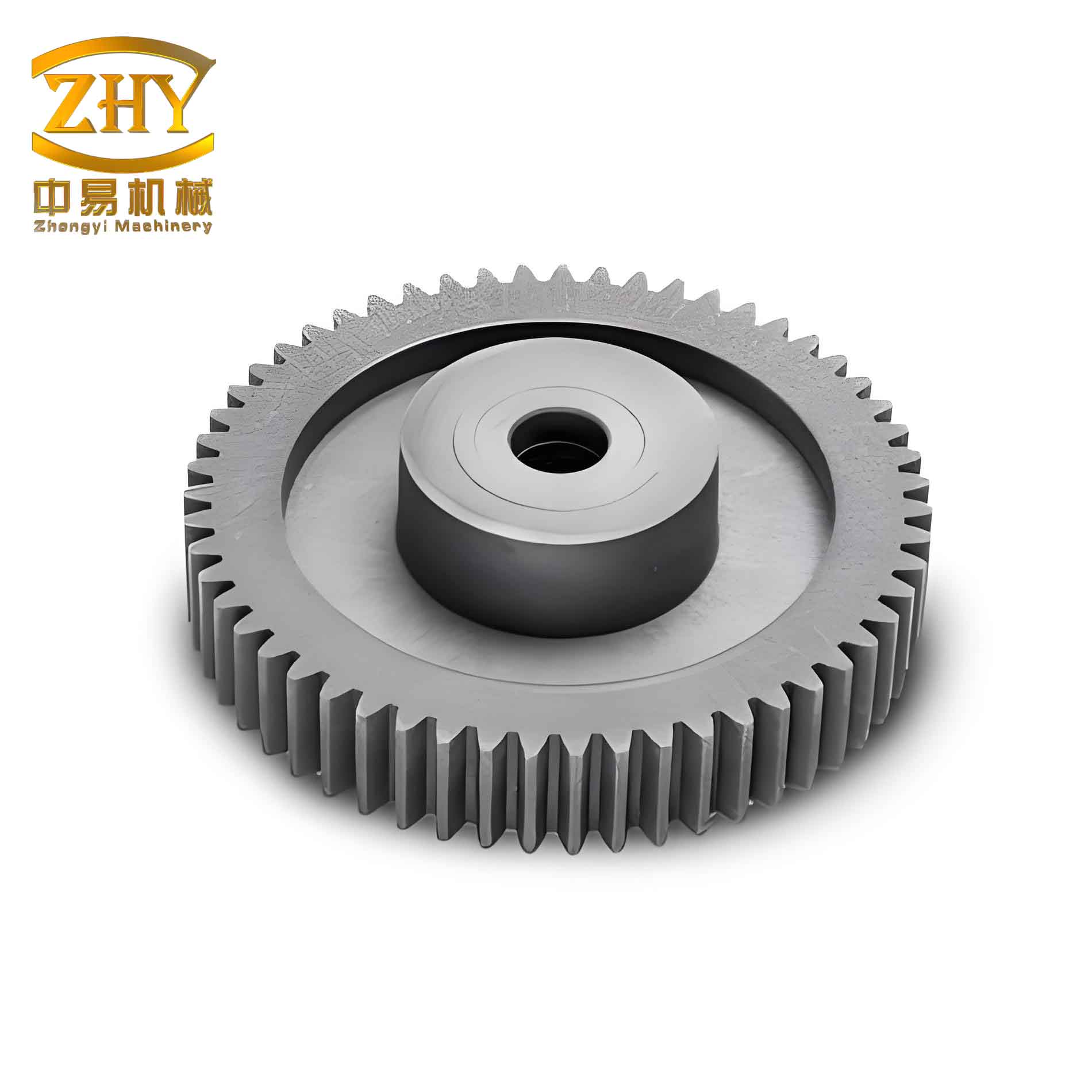
The profile segments and their parametric equations are:
1. Addendum Arc (AB): A circular arc defined by the addendum radius $r_a$.
$$ x = r_a \sin\psi, \quad y = r_a \cos\psi $$
where $\psi \in [0, \varphi_a]$, $r_a = \frac{m}{2}(z + 2h_a^*)$, and $\varphi_a = \frac{\pi}{2z} + \text{inv}\alpha – \text{inv}\alpha_a$.
2. Involute Curve (BC): The active tooth flank generated from the base circle.
$$ x = r_K \sin\varphi_K, \quad y = r_K \cos\varphi_K $$
Here, $r_K = r_b / \cos\alpha_K$, $\varphi_K = \xi + \text{inv}\alpha_K – \text{inv}\alpha$, and the parameter $\alpha_K$ varies between the limits at points C and B. The base radius is $r_b = r \cos\alpha$, with $r = mz/2$ being the pitch radius.
3. Fillet/Transition Curve (CD): The trochoid generated by the tip of the generating rack cutter.
$$
\begin{aligned}
x &= r \sin\varphi – \frac{a \sin(\psi – \varphi) + \rho \cos(\psi – \varphi)}{\sin\psi}, \\
y &= r \cos\varphi – \frac{a \cos(\psi – \varphi) – \rho \sin(\psi – \varphi)}{\sin\psi}
\end{aligned}
$$
The parameters $a$, $\rho$, and $b$ are derived from the cutter geometry, and the parameter $\psi$ varies from $\alpha$ to $\pi/2$.
4. Dedendum Arc (DE): A circular arc defined by the dedendum radius $r_f$.
$$ x = r_f \sin\psi, \quad y = r_f \cos\psi $$
where $r_f = \frac{m}{2}(z – 2h_a^* – 2c^*)$.
NURBS-Based Parametric Modeling of Cylindrical Gears
To perform IGA, a watertight NURBS representation of the gear’s volume is required. This process begins with the reconstruction of the profile curve using NURBS.
NURBS Representation
A $p$-th degree NURBS curve is defined by:
$$ \mathbf{C}(\xi) = \sum_{i=0}^{n} R_{i,p}(\xi) \mathbf{Q}_i, \quad \text{with} \quad R_{i,p}(\xi) = \frac{N_{i,p}(\xi)\omega_i}{\sum_{j=0}^{n} N_{j,p}(\xi)\omega_j} $$
where $\mathbf{Q}_i$ are control points, $\omega_i$ are weights, and $N_{i,p}(\xi)$ are the $p$-th degree B-spline basis functions defined on a knot vector $\boldsymbol{\Xi}=[\xi_0, \xi_1, …, \xi_{n+p+1}]$. This formulation extends naturally to surfaces and volumes.
Profile Curve Reconstruction
While the circular arcs (addendum and dedendum) can be represented exactly by quadratic NURBS, the involute and fillet curves require fitting. A least-squares fitting algorithm is employed. Given a set of ordered data points $\{\mathbf{q}_k\}_{k=0}^{M}$ sampled from the exact curve, the objective is to find the control polygon of a $p$-degree NURBS curve that minimizes:
$$ f = \sum_{k=1}^{M-1} \|\mathbf{q}_k – \mathbf{C}(\bar{\xi}_k)\|^2 $$
subject to end-point interpolation ($\mathbf{C}(\bar{\xi}_0)=\mathbf{q}_0$, $\mathbf{C}(\bar{\xi}_M)=\mathbf{q}_M$). The parameters $\bar{\xi}_k$ are obtained via chord-length parameterization, and the knot vector is determined using averaging techniques. The fitting error is monitored, and the number of control points is adaptively increased until a specified tolerance is met. For typical gear geometries, a cubic NURBS curve with 5 control points accurately represents both the involute and fillet segments.
From Curve to Solid Volume
The construction of the 3D NURBS solid model proceeds in a structured manner:
- Single Tooth Profile: The four reconstructed NURBS curve segments for the right half of a single tooth are assembled.
- Planar Surface Patches: The domain of the single tooth is decomposed into five four-sided patches. The control points for each NURBS surface patch are calculated, ensuring $C^0$ continuity across patch boundaries. For patches adjacent to the complex profile (e.g., the involute side), the internal control points are derived to maintain a structured parameterization.
- Solid Extrusion: The 2D surface model is extruded along the gear axis ($z$-direction) over the face width $B$. This is achieved by duplicating the control net of the surface model, offsetting the $z$-coordinates of the duplicate, and defining a linear knot vector in the $z$-direction. This creates a trivariate NURBS solid representation of a single gear tooth.
- Full Gear Assembly: The single-tooth solid is copied and rotated around the gear axis by angles of $2\pi/z$ to construct the complete cylindrical gear solid model.
Isogeometric Contact Formulation for Cylindrical Gears
The contact between two deformable bodies, such as meshing cylindrical gears, is formulated within the IGA framework. We consider two bodies, master ($m$) and slave ($s$), in their current configurations $\Omega^m_t$ and $\Omega^s_t$ with boundaries $\Gamma^m_t$ and $\Gamma^s_t$. The potential contact boundaries are $\Gamma^{m,c}_t$ and $\Gamma^{s,c}_t$.
Kinematic Contact Description
For a slave point $\mathbf{x}^s \in \Gamma^{s,c}_t$, its closest-point projection onto the master surface $\Gamma^{m,c}_t$ is $\mathbf{x}^m$, with unit outward normal $\mathbf{n}^m$. The normal gap $g_N$ is defined as:
$$ g_N = (\mathbf{x}^s – \mathbf{x}^m) \cdot \mathbf{n}^m $$
The frictionless contact constraint is a Hertz-Signorini-Moreau condition:
$$ g_N \geq 0, \quad t_N \leq 0, \quad g_N \, t_N = 0 $$
where $t_N$ is the normal contact pressure. This represents non-penetration and compressive-only contact forces.
Penalty Method and Weak Form
The penalty method is used to enforce the contact constraint approximately. A penalty parameter $\varepsilon_N \gg 0$ is introduced, and the contact pressure is defined as $t_N = \varepsilon_N \, \langle -g_N \rangle_{+}$, where $\langle \cdot \rangle_{+}$ denotes the Macaulay brackets (positive part). The contact contribution to the weak form of the equilibrium equations is the virtual work due to contact forces:
$$ \delta \Pi_c = \int_{\Gamma^{s,c}_t} t_N \, \delta g_N \, d\Gamma $$
For numerical implementation, this integral is evaluated over the slave contact surface using Gauss quadrature.
Linearization and Contact Search
Solving the nonlinear contact problem via the Newton-Raphson method requires the linearization of $\delta \Pi_c$:
$$ \Delta(\delta \Pi_c) = \int_{\Gamma^{s,c}_t} \left[ \delta g_N \, \varepsilon_N \, \Delta g_N + t_N \, \Delta(\delta g_N) \right] d\Gamma $$
The variations and increments of the gap, $\delta g_N$ and $\Delta g_N$, as well as the term $\Delta(\delta g_N)$, depend on the variations of the geometries of both slave and master surfaces. Their derivation involves the surface parameterizations $\mathbf{S}^s(\xi^s, \eta^s)$ and $\mathbf{S}^m(\xi^m, \eta^m)$ and uses concepts from differential geometry. For a 2D case (plane strain/stress gear analysis), the expressions simplify. The variation of the gap is:
$$ \delta g_N = (\delta\mathbf{x}^s – \delta\mathbf{x}^m) \cdot \mathbf{n}^m $$
For 3D analysis of cylindrical gears, more complex terms involving the curvature of the master surface appear.
A robust contact algorithm requires an efficient search for active contact pairs. A Gauss-point-to-surface approach is used:
- Global Search: For each integration point on the slave surface, identify a candidate master segment.
- Local Projection (Newton Iteration): For a slave point $\mathbf{x}^s$, find its parameters $(\xi^m, \eta^m)$ on the master NURBS surface $\mathbf{S}^m$ such that the distance is minimized. This is solved by finding the root of $\mathbf{r} \cdot \mathbf{S}^m_{,\xi} = 0$ and $\mathbf{r} \cdot \mathbf{S}^m_{,\eta} = 0$, where $\mathbf{r} = \mathbf{x}^s – \mathbf{S}^m(\xi^m, \eta^m)$. A Newton-Raphson iteration is employed for efficiency.
- Contact Check: Compute $g_N$. If $g_N < 0$, the point is considered active, and its contribution to $\delta \Pi_c$ and $\Delta(\delta \Pi_c)$ is added to the global stiffness matrix and residual vector.
Numerical Validation and Results
The proposed methodology is validated through several benchmark problems, comparing results from the developed IGA code against commercial FEA software (Abaqus).
Convergence Study: Linear Elastic Deformation
A single gear tooth is analyzed under a vertical distributed load at its tip, with the base fully fixed. The material is linear elastic (Steel: E=207 GPa, $\nu$=0.25). The model is refined by knot insertion (IGA) or mesh refinement (FEA).
2D Plane-Strain Model: The convergence of the maximum displacement magnitude is compared.
| Method | Number of DOFs | Max Displacement (mm) | Relative Error* |
|---|---|---|---|
| IGA (Coarse) | 1,688 | 1.5500E-4 | 0.17% |
| IGA (Medium) | 6,752 | 1.5525E-4 | 0.01% |
| IGA (Fine) | 27,008 | 1.5527E-4 | 0.00% |
| FEA (Fine) | ~40,000 | 1.5527E-4 | Reference |
*Error relative to the finest IGA solution. IGA demonstrates significantly smoother and faster convergence with fewer degrees of freedom (DOFs).
Contact Analysis of Meshing Cylindrical Gears
A pair of spur gears (Driver: $z_1=19$, Driven: $z_2=38$, $m=2$ mm, $\alpha=20^\circ$) is analyzed at a prescribed single-tooth-mesh position. The driver is rotated by a small angle ($\theta = \pi/600$ rad) while the driven gear is fixed. A penalty parameter of $\varepsilon_N = 1\times10^7$ N/mm³ is used.
| Quantity | Unit | IGA Result | Abaqus FEA Result | Relative Difference |
|---|---|---|---|---|
| Max. Displacement Magnitude | mm | 0.0324 | 0.0324 | 0.0% |
| Max. von Mises Stress | MPa | 2215.7 | 2212.9 | 0.13% |
The contour plots of stress and displacement from both methods show excellent visual agreement. The convergence of the maximum contact stress with respect to DOFs again shows the superior performance of IGA for contact problems involving cylindrical gears.
Extension to 3D Solid Models
The 2D plane-strain model is extruded to a 3D solid model (face width B=1 mm). The same contact simulation is performed.
| Quantity | Unit | IGA Result | Abaqus FEA Result (Averaged) | Abaqus FEA Result (Unaveraged) |
|---|---|---|---|---|
| Max. Displacement Magnitude | mm | 0.0324 | 0.0324 | 0.0324 |
| Max. von Mises Stress | MPa | 2200.3 | 1776.9 | 2152.3 |
The displacement results remain consistent. The notable difference in maximum stress highlights a key aspect of IGA: the stress field is computed directly from the high-order smooth solution, whereas in FEA it is often subject to averaging and recovery techniques at nodes or integration points, which can significantly alter peak stress values. The IGA result aligns more closely with the unaveraged FEA stress, underscoring IGA’s inherent advantage in delivering accurate, high-resolution stress fields directly from the analysis.
Conclusion
This work presents a comprehensive framework for the integrated design and analysis of involute cylindrical gears. By leveraging the principles of Isogeometric Analysis, we bridge the gap between geometric modeling and numerical simulation. The methodology involves:
- A parameter-driven algorithm for constructing watertight, high-order NURBS solid models of cylindrical gears directly from standard design parameters.
- A detailed formulation for frictionless contact analysis using the point-to-surface approach and penalty method within the IGA framework.
- Numerical validation demonstrating that IGA provides superior convergence characteristics and more accurate stress resolution compared to traditional FEA, especially for contact problems.
The proposed approach eliminates the geometry approximation error inherent in meshing and leverages the high continuity of NURBS for robust contact handling. This makes it a powerful tool for the accurate evaluation of contact mechanics in cylindrical gears, paving the way for more reliable design optimization and strength verification. Future work will focus on extending the formulation to include frictional contact, dynamic analysis, and the modeling of manufacturing imperfections such as profile errors in cylindrical gears.