
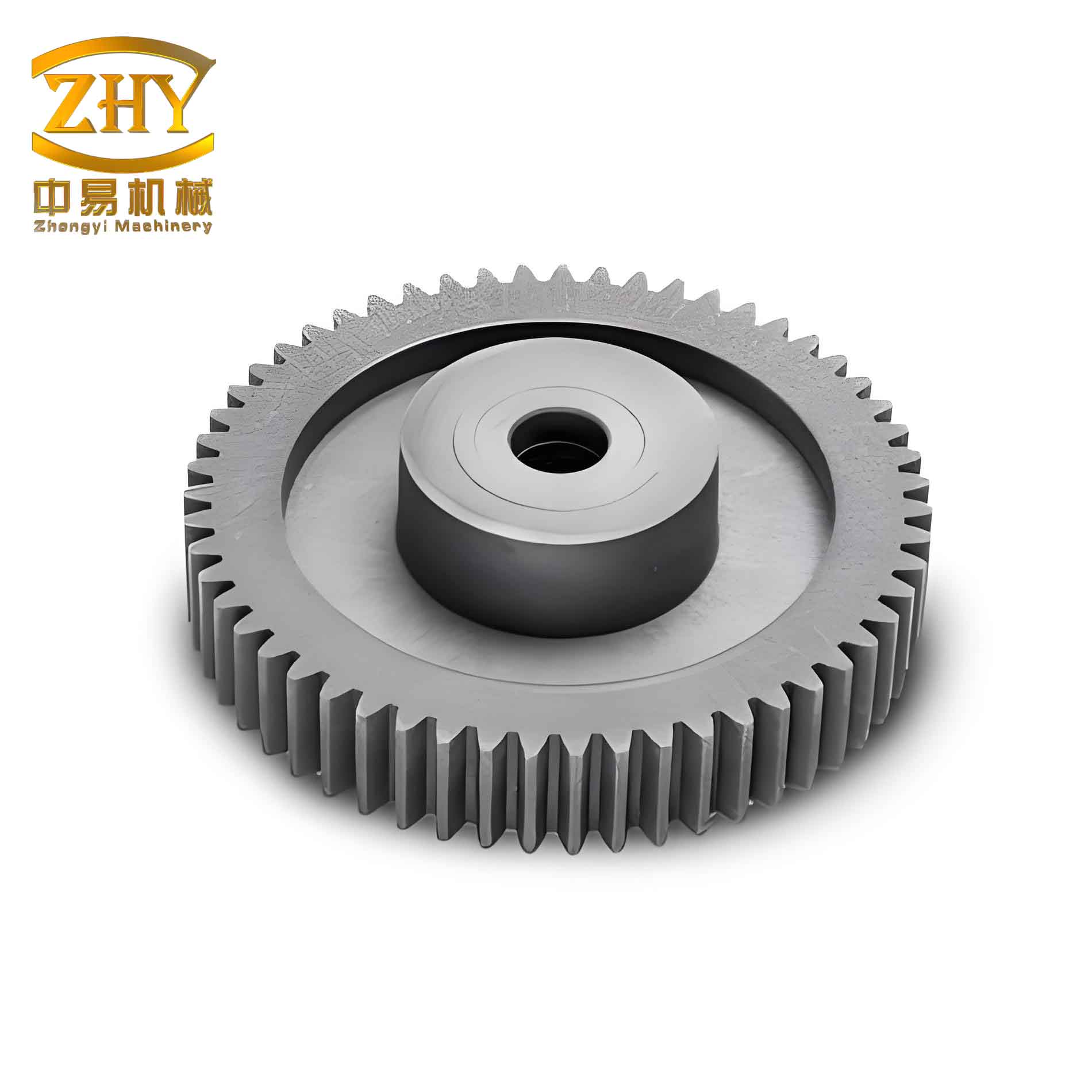
The pursuit of higher performance, efficiency, and durability in power transmission systems has perpetually driven innovation in gear design. Among the novel concepts emerging in this field are curvilinear cylindrical gears, a distinct family of parallel-axis gears characterized by their arcuate or curved tooth traces. These gears represent a significant departure from traditional spur or helical cylindrical gears, offering unique contact patterns and load distribution characteristics. The design of these cylindrical gears can be bifurcated based on the nature of contact between mating tooth surfaces: point-contact and line-contact geometries. While point-contact versions have been explored, achieving a theoretically perfect line contact along the entire tooth flank presents a formidable challenge in both design and manufacturing, promising superior load-bearing capacity and stability. This article delves into a pragmatic and efficient methodology for realizing these advanced line-contact curvilinear cylindrical gears, leveraging existing industrial infrastructure to bridge the gap between theoretical promise and practical manufacturability.
The core challenge with line-contact curvilinear cylindrical gears has not been their conceptual design but their practical fabrication. Traditional gear cutting machines are ill-suited for generating the complex, spatially curved tooth flanks required. Previous research has proposed specialized mechanisms, such as parallel-linkage systems or dedicated planetary cutters, but these often suffer from limitations in stiffness, material compatibility, or processing efficiency. Other methods involving ball-nose end mills on standard machining centers offer flexibility but are notoriously slow and struggle to achieve the necessary surface finish for high-performance gear applications. The proposed method in this discourse circumvents these hurdles by adapting a well-established technology from bevel gear production: the six-axis CNC face-milling machine equipped with single-edged cutter heads. This approach eliminates the need for bespoke, expensive machine tool development, instead utilizing proven, high-stiffness platforms to generate the precise conjugate surfaces of line-contact cylindrical gears.
The foundation of any manufacturing process for complex gears is a robust and accurate mathematical model of the tooth surfaces. For line-contact curvilinear cylindrical gears, this model is derived from the principles of gear generation via a simulated crown gear, represented by the cutting edges of the single-edged face-mill cutter. The process involves two distinct cutter heads: one with an outer cutting edge for generating the concave side of the gear tooth, and another with an inner cutting edge for generating the convex side. The fundamental kinematic relationship, or the “roll” between the imaginary generating gear (the cutter) and the workpiece, is what defines the final tooth geometry. Establishing the coordinate systems for the cutter and the gear blank is the first critical step. Let us define a coordinate system \( S_b(u, \lambda) \) fixed to the cutter blade, where the straight cutting edge and the fillet (transition curve) are described. The coordinates of a point on the blade profile, whether on the straight portion (parameter \(u\)) or the fillet (parameter \(\lambda\)), are given in this system.
The geometry of the single-edged cutter head is central to defining the tool profile. Key parameters include the module \(m\), the normal pressure angle \(\alpha_n\), the addendum coefficient \(a\), the dedendum coefficient \(b\), and the edge radius coefficient \(\rho\). For a cutter with a nominal point radius \(R\), the coordinates of a point on the straight portion of the outer (o) and inner (i) blade profiles within \(S_b\) can be expressed as:
$$
\mathbf{r}_b^o(u) = \mathbf{r}_b^i(u) =
\begin{bmatrix}
\pm u \sin\alpha_n \pm \frac{\pi m}{4} \\
u \cos\alpha_n \\
0 \\
1
\end{bmatrix}
$$
The upper signs typically correspond to the outer blade geometry. The coordinates for a point on the fillet or transition arc of the blade are given by:
$$
\mathbf{r}_b^g(\lambda) =
\begin{bmatrix}
\pm\frac{\pi m}{4} \mp \tan\alpha_n (bm – \rho m + \rho m \sin\alpha_n) \mp \rho m (\cos\alpha_n – \cos\lambda) \\
\rho m – bm – \rho m \sin\lambda \\
0 \\
1
\end{bmatrix}
$$
where \(g\) denotes either the inner (i) or outer (o) blade. To generate the tool surface, this blade profile is rotated about the cutter axis. This is achieved by transforming the coordinates from the blade system \(S_b\) to a cutter coordinate system \(S_c(\theta)\), where \(\theta\) is the rotation angle parameter of the virtual generating surface. The transformation matrix \(\mathbf{M}_{c,b}(\theta)\) performs this operation:
$$
\mathbf{M}_{c,b}(\theta) =
\begin{bmatrix}
\cos\theta & 0 & -\sin\theta & -(R \pm \frac{\pi m}{4})\cos\theta \\
0 & 1 & 0 & 0 \\
\sin\theta & 0 & \cos\theta & -(R \pm \frac{\pi m}{4})\sin\theta \\
0 & 0 & 0 & 1
\end{bmatrix}
$$
Thus, the family of surfaces generated by the straight blade and the fillet in the cutter system are:
$$
\mathbf{r}_c^{g,line}(u, \theta) = \mathbf{M}_{c,b}(\theta) \cdot \mathbf{r}_b^g(u)
$$
$$
\mathbf{r}_c^{g,arc}(\lambda, \theta) = \mathbf{M}_{c,b}(\theta) \cdot \mathbf{r}_b^g(\lambda)
$$
The final tooth surface of the workpiece is obtained by imposing the generating motion between the cutter and the gear blank. The gear blank coordinate system \(S_1(\psi)\) rotates with an angle \(\psi\) relative to the machine framework. The relative positioning involves the cutter’s nominal radius \(R_c = R \pm \pi m / 4\) and the pitch radius of the gear \(r_p\). The transformation from the cutter system \(S_c\) to the gear blank system \(S_1\) is governed by the matrix \(\mathbf{M}_{1,c}(\psi)\):
$$
\mathbf{M}_{1,c}(\psi) =
\begin{bmatrix}
\cos\psi & \sin\psi & 0 & x_p \\
-\sin\psi & \cos\psi & 0 & y_p \\
0 & 0 & 1 & 0 \\
0 & 0 & 0 & 1
\end{bmatrix}
$$
where \(x_p = r_p(\sin\psi – \psi \cos\psi) + R_c \cos\psi\) and \(y_p = r_p(\cos\psi + \psi \sin\psi) – R_c \sin\psi\). Applying this transformation gives the family of surfaces in the gear coordinate system:
$$
\mathbf{r}_1^{g,line}(u, \theta, \psi) = \mathbf{M}_{1,c}(\psi) \cdot \mathbf{r}_c^{g,line}(u, \theta)
$$
$$
\mathbf{r}_1^{g,arc}(\lambda, \theta, \psi) = \mathbf{M}_{1,c}(\psi) \cdot \mathbf{r}_c^{g,arc}(\lambda, \theta)
$$
To obtain the final envelope surface—the actual tooth surface of the cylindrical gear—the condition of tangency between the family of tool surfaces and the generated surface must be satisfied. This is encapsulated in the equation of meshing. For the straight-line generating section, the meshing function is:
$$
f^{line}(u, \theta, \psi) = \left( \frac{\partial \mathbf{r}_1^{g,line}}{\partial \theta} \times \frac{\partial \mathbf{r}_1^{g,line}}{\partial u} \right) \cdot \frac{\partial \mathbf{r}_1^{g,line}}{\partial \psi} = 0
$$
For the fillet-generating section, the meshing function is:
$$
f^{arc}(\lambda, \theta, \psi) = \left( \frac{\partial \mathbf{r}_1^{g,arc}}{\partial \lambda} \times \frac{\partial \mathbf{r}_1^{g,arc}}{\partial \theta} \right) \cdot \frac{\partial \mathbf{r}_1^{g,arc}}{\partial \psi} = 0
$$
Solving the system of equations formed by the surface family and its corresponding meshing equation yields the double-parametric representation of the active tooth flank (\(u\) or \(\lambda\), and \(\psi\)) and the root fillet surface. This mathematical model is the blueprint for both simulation and tool path generation. A summary of the key coordinate systems and their roles is provided below.
| Coordinate System | Symbol | Description & Purpose |
|---|---|---|
| Blade System | \(S_b\) | Fixed to the cutter blade. Defines the basic tool profile geometry (straight edge and fillet) using parameters \(u\) and \(\lambda\). |
| Cutter System | \(S_c\) | Fixed to the rotating cutter head. The blade profile is rotated about the cutter axis via parameter \(\theta\) to form the tool surface. |
| Gear Blank System | \(S_1\) | Fixed to the rotating gear workpiece. The tool surface family is expressed here via parameter \(\psi\), representing the generating roll motion. |
For practical implementation, a virtual model of the gear is essential for simulation and verification. Using the derived mathematical model, coordinates of points on the concave and convex tooth flanks, as well as the root fillets, are calculated (e.g., in MATLAB). This point cloud data is then imported into CAD software (like Siemens NX or CATIA) where surfaces are fitted, solidified, and patterned around the gear axis to create a precise 3D solid model. This model serves as the reference “gold standard” against which the machined part will be compared.
The proposed machining strategy harnesses the capabilities of a standard six-axis CNC face-milling gear machine, commonly used for spiral bevel and hypoid gears. The machine’s architecture typically provides three linear axes (X, Y, Z) and three rotational axes (A, B, C). For machining curvilinear cylindrical gears, the setup is specific: the workpiece is mounted on the A-axis (controlling the generating roll, \(\psi\)), and the cutter spindle is mounted on the C-axis (providing the cutting speed, \(\theta\)). The B-axis is used to establish and maintain orthogonality between the cutter and workpiece axes and is then locked during cutting. The X-axis positions the cutter center at the correct distance from the workpiece center, corresponding to the nominal radius \(R_c\), and is also fixed during the cut. The Y and Z axes facilitate the initial setup and tool change positioning.
The machining of a single gear requires two distinct operations with two different cutter heads, as outlined below.
| Operation | Cutter Type | Target Surface | Key Setup Parameter |
|---|---|---|---|
| 1 | Single-edged face-mill with outer cutting edge | Concave (hollow) side of all gear teeth | Cutter center located at machine center, or a defined work offset. |
| 2 | Single-edged face-mill with inner cutting edge | Convex (filled) side of all gear teeth | Cutter center offset in the X-direction by exactly \(\pi m / 2\) relative to Operation 1. |
During each operation, the CNC program synchronizes the A-axis (workpiece rotation \(\psi\)) and the C-axis (cutter rotation \(\theta\)) to maintain the precise generating roll relationship derived from the gear theory, while the cutter feeds along its axis. After completing one tooth flank, the workpiece indexes by \(360^\circ / Z\) (where \(Z\) is the number of teeth) and the process repeats until all teeth on that side are machined. The machine then automatically changes to the second cutter (or the workpiece is moved to a second setup with the offset), and the process repeats for the opposite flanks. This method ensures that the generated convex and concave surfaces are perfectly conjugate, leading to the desired line contact when the gear pair meshes.
To validate this methodology, a comprehensive digital manufacturing simulation was conducted using VERICUT software. A digital twin of a six-axis CNC gear mill was constructed, including its kinematic chain and a Fanuc-style control system. Models of the outer and inner single-edged cutters were created based on the mathematical definitions. The 3D solid model of the target gear (e.g., with \(Z=31\), \(m=4\) mm, \(R=60\) mm) served as the stock material. CNC code, derived from the toolpath calculations based on the meshing model, was executed to simulate the entire milling process. The simulation confirmed the absence of collisions and the correct material removal sequence.
Following the virtual machining, the resulting in-process stock model (the simulated machined gear) was compared to the imported reference CAD model. A comprehensive deviation analysis was performed. The results indicated a high degree of accuracy. The concave tooth flanks showed a slight undercut in the root area not exceeding 60 μm and surface deviations within ±40 μm. The convex flanks showed minor material remnants in the root area up to 100 μm, with the active flank profile deviations generally below 60 μm. It is important to note that these deviation values include the inherent approximation error from fitting CAD surfaces to the theoretical point cloud data in the reference model. Therefore, the actual machining error attributable to the process itself is likely even smaller, confirming the viability of the method. The table below summarizes a typical deviation analysis outcome.
| Tooth Surface Region | Deviation Type | Typical Magnitude | Potential Cause / Note |
|---|---|---|---|
| Concave Active Flank | Undercut & Residual | -0.04 mm to +0.06 mm | Within acceptable tolerance for pre-finish gear cutting. |
| Concave Root Fillet | Undercut | Up to -0.06 mm | Controlled by tool fillet geometry and setup. |
| Convex Active Flank | Residual Material | Up to +0.06 mm | Can be eliminated by final finishing/honing. |
| Convex Root Fillet | Residual Material | Up to +0.10 mm | Largest deviation area; requires process optimization. |
The successful simulation demonstrates that producing functional line-contact curvilinear cylindrical gears is entirely feasible with existing, high-end CNC gear manufacturing technology. This approach offers several significant advantages. Primarily, it eliminates the substantial cost and lead time associated with developing and building a dedicated, special-purpose machine tool for these novel cylindrical gears. By using proven, rigid platforms and standard cutter heads, the process inherits the reliability, precision, and dynamic performance of industrial bevel gear machining. Furthermore, the ability to machine hardened materials and achieve good surface finishes is intrinsically built into the method. While the two-cut process (outer and inner blade) may be less efficient than a hypothetical single-cut solution for point-contact variants, it guarantees the theoretically correct line-contact geometry, which is paramount for achieving the anticipated performance benefits in terms of load capacity, stress distribution, and transmission error. This pragmatic fusion of advanced gear theory with established manufacturing practice provides a clear and implementable pathway for the prototyping and potential future production of high-performance line-contact curvilinear cylindrical gears.