
In modern aerospace engineering, the relentless pursuit of enhanced performance metrics—higher power density, greater reliability, reduced weight, and lower noise and vibration—continually drives the evolution of transmission system components. Among these, gears are fundamental, serving as the critical link in power transfer within helicopter main and tail rotor drives. They operate under exceptionally demanding conditions, subjected to complex multi-axial stress states, severe dynamic loads, and stringent requirements for durability and efficiency.
While helical or herringbone cylindrical gears offer certain advantages in smoothness and load capacity, the simplicity, inherent absence of axial thrust, and associated potential for weight reduction in support structures make spur cylindrical gears a prevalent choice, particularly in planetary stages of helicopter main gearboxes. However, conventional spur cylindrical gears, characterized by a standard contact ratio (or overlap ratio) typically between 1 and 2, are increasingly challenged to meet the escalating demands for higher torque transmission within constrained envelopes and weight budgets.
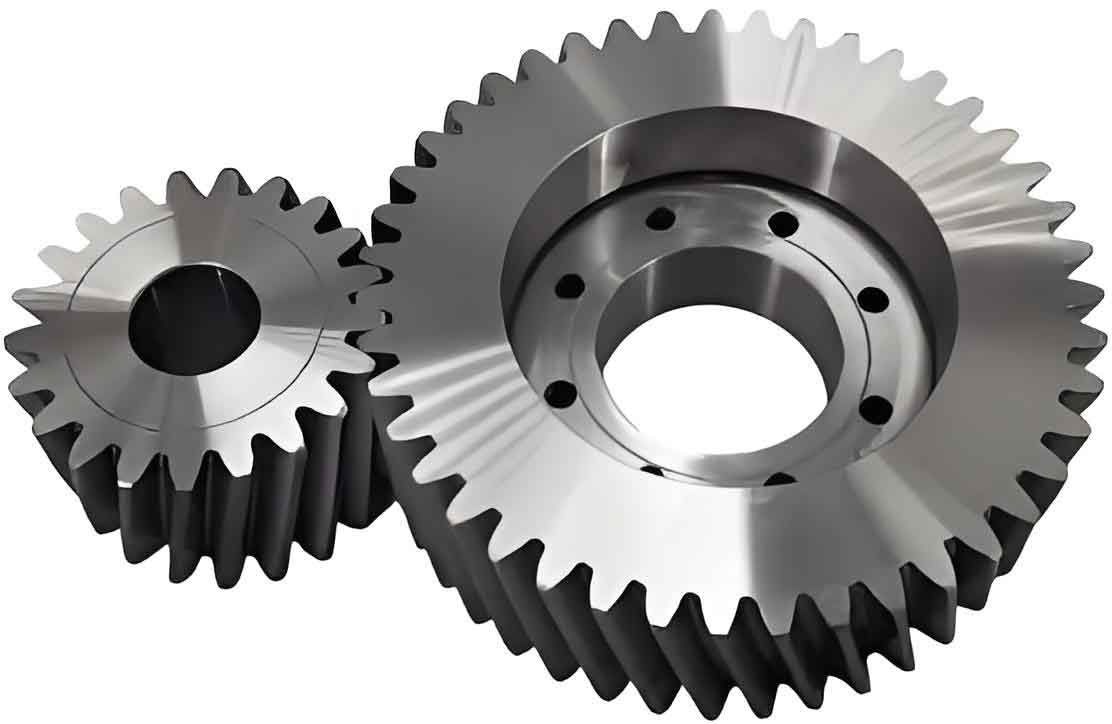
This challenge has directed significant attention towards a specialized variant: high contact ratio (HCR) spur cylindrical gears. These cylindrical gears are designed to achieve a transverse contact ratio (εα) greater than 2, ideally falling within the range of 2.0 to 3.0. This fundamental characteristic means that two or even three pairs of teeth are theoretically in contact simultaneously along the path of action, as opposed to the one or two pairs in conventional low contact ratio (LCR) cylindrical gears. The implications of this design philosophy are profound, offering a promising avenue to overcome traditional limitations without resorting solely to new materials or exotic geometries, though these cylindrical gears introduce their own unique set of design and application challenges.
Fundamental Principles and Theoretical Advantages of HCR Cylindrical Gears
The enhanced performance of HCR cylindrical gears stems directly from the mechanics of load sharing. For a pair of meshing spur cylindrical gears, the total transmitted load is distributed among the teeth pairs that are simultaneously in contact. The contact ratio, εα, is a geometric parameter defined as the ratio of the length of the path of contact to the base pitch. It can be expressed as:
$$ \varepsilon_\alpha = \frac{\sqrt{r_{a1}^2 – r_{b1}^2} + \sqrt{r_{a2}^2 – r_{b2}^2} – a \sin\alpha_t}{p_b} $$
where \( r_{a1}, r_{a2} \) are the addendum circle radii, \( r_{b1}, r_{b2} \) are the base circle radii, \( a \) is the center distance, \( \alpha_t \) is the operating transverse pressure angle, and \( p_b \) is the base pitch.
In HCR designs, this ratio is pushed above 2.0. This is typically achieved through deliberate modifications to standard gear parameters:
- Increased Addendum Coefficient: Using values greater than the standard 1.0 (e.g., 1.25 to 1.4) to extend the active tooth profile.
- Reduced Pressure Angle: Employing pressure angles lower than the common 20° (e.g., 14.5°, 16°, 17.5°) to lengthen the path of contact.
- Strategic Profile Shifting: Applying positive profile shifts to increase effective tooth thickness and contact length.
- Increased Number of Teeth: While maintaining a practical module, more teeth contribute to a smoother mesh.
The primary mechanical benefits can be summarized as follows:
| Aspect | Low Contact Ratio (LCR) Gears (εα≈1-2) | High Contact Ratio (HCR) Gears (εα>2) | Mechanism & Impact |
|---|---|---|---|
| Load Sharing | 1 or 2 tooth pairs share load. Peak load per tooth is higher. | 2 or 3 tooth pairs share load. Peak load per tooth is significantly reduced. | Reduced bending and contact stress at the most critically loaded point on the tooth flank. |
| Bending Strength | Critical root stress located near the highest point of single tooth contact (HPSTC). | Critical load point moves away from the thin, vulnerable tip region towards a more robust section of the tooth. | Effective bending strength can be increased, sometimes allowing for narrower face widths or higher transmitted power. |
| Dynamic Load & Noise | Larger variation in mesh stiffness as number of contact pairs alternates, exciting vibrations. | Smaller variation in mesh stiffness due to more consistent number of contacting pairs. Smother transition of load. | Lower dynamic load factor (Kv), reduced vibration excitation, and consequently lower noise emission—a critical factor for helicopter comfort. |
| System Resilience | Loss of a single tooth often leads to immediate failure or severe damage propagation. | System can potentially continue to function (at reduced capacity) even with a missing tooth, as εα remains >1. | Enhanced inherent safety and damage tolerance, a highly valuable attribute for flight-critical systems. |
The static and dynamic load distribution among the simultaneously engaged tooth pairs is the cornerstone of HCR gear performance. The load per pair is not equal due to the varying compliance of teeth along the path of contact. The total mesh stiffness \( k_{mesh}(t) \) as a function of roll angle is more complex for these cylindrical gears but exhibits lower amplitude fluctuation. The dynamic model often incorporates a time-varying stiffness function. A simplified equation of motion for a gear pair can be written as:
$$ I_p \ddot{\theta}_p + c_m (\dot{\theta}_p r_{bp} – \dot{\theta}_g r_{bg}) + k_m(t) ( \theta_p r_{bp} – \theta_g r_{bg} + e(t) ) = T_p $$
$$ I_g \ddot{\theta}_g – c_m (\dot{\theta}_p r_{bp} – \dot{\theta}_g r_{bg}) – k_m(t) ( \theta_p r_{bp} – \theta_g r_{bg} + e(t) ) = -T_g $$
where \( I \), \( \theta \) are mass moment of inertia and angular displacement, \( c_m \) is mesh damping, \( k_m(t) \) is time-varying mesh stiffness, \( r_b \) is base radius, \( e(t) \) is static transmission error, and \( T \) is torque. The reduced fluctuation in \( k_m(t) \) for HCR cylindrical gears directly leads to lower dynamic transmission error and force.
International Application Landscape and Research Focus
The potential of HCR spur cylindrical gears has been recognized and exploited by leading aerospace manufacturers for decades, moving from research concepts to serial production components in helicopter transmissions.
Historical and Contemporary Applications:
Western helicopter manufacturers have been pioneers in integrating HCR cylindrical gears. Initial applications date back to the 1970s. Significant development occurred under programs like the Advanced Rotorcraft Transmission (ART) initiative sponsored by NASA and the U.S. military in the 1990s. These efforts systematically compared HCR planetary stages against conventional designs, quantifying benefits in weight, noise, and life.
Subsequently, HCR technology has been incorporated into production helicopters and used in upgrade programs. For instance, its adoption in input stages has led to documented increases in transmitted power alongside reductions in gearbox weight and, most notably, radiated noise—with measured reductions in A-weighted sound pressure level on the order of 10 dB or more. This makes the cabin environment significantly quieter. The primary application has been within planetary stages of main gearboxes, where the benefits of load sharing and smoothness are most valuable for the high-speed reduction ratios required.
Research Thrusts:
Global research has evolved from proving basic feasibility to addressing the nuanced challenges of implementation. Key areas of focus include:
- Strength Prediction and Load Distribution: Developing accurate models to calculate tooth root bending stress and surface contact (Hertzian) stress under multi-pair contact conditions. Finite Element Analysis (FEA) is extensively used to model the complex stress state, as traditional standards (like AGMA or ISO) often lack precise methods for εα > 2. Research has validated that HCR cylindrical gears can offer a 20% or greater increase in root bending strength capacity under optimal conditions.
- Dynamic Modeling and Vibration Analysis: Creating lumped-parameter and finite element models to predict dynamic response, mesh forces, and stability. Studies confirm the superior dynamic behavior of HCR cylindrical gears, showing reduced parametric instability regions and lower vibration amplitudes compared to their LCR counterparts.
- Tooth Profile Modification (Tip and Root Relief): This is arguably the most critical area of research for practical HCR gear design. Unmodified HCR cylindrical gears, while strong, can suffer from edge loading at the entry and exit of mesh due to manufacturing errors, deflections, and thermal distortions. Strategic profile modifications are essential to optimize load distribution, prevent premature contact at the tip or root, and minimize transmission error. The form and magnitude of this relief for HCR cylindrical gears differ from those for standard gears and are a subject of intensive study, often involving multi-objective optimization targeting minimized stress and vibration.
- Thermal Management and Scuffing (Scoring) Resistance: A significant challenge for HCR cylindrical gears is the increased sliding velocity at the tooth tip and root regions. The extended addendum increases the length of the sliding action, which can lead to higher friction losses, elevated flash temperatures, and a heightened risk of scuffing failure—a sudden adhesive wear mode. Research investigates advanced lubrication strategies, coatings, and specific profile designs (including non-involute profiles in some studies) to mitigate this risk.
Critical Technical Challenges for Widespread Adoption
Despite the demonstrated advantages and successful applications abroad, the deployment of HCR spur cylindrical gears in domestic aerospace programs faces several interconnected technical hurdles that must be systematically overcome. These challenges form the current frontier for research and development.
| Challenge Category | Specific Issues | Consequences & Current Gaps |
|---|---|---|
| 1. Design Standards & Analysis | Lack of dedicated strength calculation standards for εα > 2. Inadequate treatment of multi-pair load sharing in general standards (AGMA, ISO). | Designers rely on conservative approximations or extensive, costly FEA. Hinders rapid, reliable design iteration and certification. Uncertainty in life prediction. |
| 2. Precision Manufacturing & Heat Treatment | Thin, pointed tooth tips are vulnerable during carburizing/nitriding. Risk of excessive carbon/nitrogen concentration leading to brittleness and tip-chipping. Requires precise masking (e.g., copper plating). | Increased process complexity and cost. The unprotected tip region has lower hardness, posing a wear challenge. Demands exceptional control over manufacturing and thermal processes. |
| 3. Optimal Profile Modification Strategy | Standard LCR relief profiles are suboptimal. The optimal form, extent, and amount of tip/root relief for HCR cylindrical gears to balance stress, vibration, and scuffing resistance are not codified. | Sub-optimal modifications can negate the dynamic benefits or inadvertently increase stress. Requires sophisticated analysis and experimental validation for each new application. |
| 4. Lubrication & Efficiency | Higher sliding velocities increase friction losses and heat generation. Risk of localized high temperatures leading to lubricant film breakdown and scuffing. | Potentially lower transmission efficiency compared to optimized LCR designs. Necessitates advanced cooling systems and high-performance lubricants, adding system complexity. |
These challenges are deeply interrelated. For example, the heat treatment issue (Challenge 2) directly impacts the surface durability of the tip, which is already a region of concern due to lubrication challenges (Challenge 4). The solution likely lies in a systems engineering approach rather than isolated improvements.
Analytical Deep Dive: Stress and Load Distribution
To appreciate the complexity behind Challenge 1, let’s examine the core calculations. For bending stress, the fundamental Lewis/ISO formula is:
$$ \sigma_F = \frac{F_t}{b m_n} Y_F Y_S Y_\beta Y_\varepsilon K_A K_V K_{F\beta} K_{F\alpha} $$
For HCR cylindrical gears, the factors \( Y_\varepsilon \) (contact ratio factor) and \( Y_F \) (form factor) require significant adaptation. The form factor for a tooth loaded at the highest point of single tooth contact (HPSTC) is not valid when 2-3 pairs are sharing load. The critical load is applied at a lower, thicker part of the tooth. The effective load per tooth, \( F_{t, eff} \), must be derived from a detailed load distribution model along the path of contact. A simplified representation of the load per pair can be modeled based on relative stiffness:
$$ F_i = \frac{k_i}{\sum_{j=1}^{n} k_j} F_t \quad \text{for } i = 1 \text{ to } n \text{ (contacting pairs)} $$
where \( k_i \) is the stiffness of the i-th tooth pair in contact. The total mesh stiffness is \( K_{total} = \sum k_i \).
Similarly, for contact (pitting) stress, the fundamental equation is:
$$ \sigma_H = Z_H Z_E Z_\varepsilon Z_\beta \sqrt{\frac{F_t}{b d_1} \frac{u+1}{u} K_A K_V K_{H\beta} K_{H\alpha}} $$
The zone factor \( Z_H \) and the contact ratio factor \( Z_\varepsilon \) are heavily influenced by the geometry of HCR cylindrical gears. The reduced curvature at the contact point due to the lower pressure angle affects \( Z_H \), while \( Z_\varepsilon \) must account for the load being shared over a greater portion of the path of contact.
The dynamic factor \( K_V \) is typically lower for HCR cylindrical gears due to their smoother mesh. Empirical and analytical models for \( K_V \), such as the ISO 6336-1 method B, need recalibration for high εα values, as the excitation characteristics change.
Path Forward and Concluding Synthesis
The journey towards routine and optimized use of high contact ratio spur cylindrical gears in advanced helicopter transmissions involves a multi-pronged effort focused on bridging the gap between proven potential and reliable, certifiable application.
Priority Development Areas:
- Development of Specialized Analysis Tools and Guidelines: There is a pressing need to extend existing international standards or create supplemental guidelines specifically for HCR cylindrical gears. This includes standardized methods for calculating accurate load-sharing ratios, dynamic factors, and corrected form/zone factors. Computational tools that integrate these specialized calculations with multi-body dynamic simulation and FEA will be indispensable.
- Advanced Manufacturing and Process Chains: Investing in processes like precision grinding after heat treatment (to remove the brittle tip layer), developing alternative case-hardening techniques with shallower gradients, or exploring high-performance through-hardened steels for certain applications can mitigate the tip-treatment challenge. The goal is to achieve a robust, wear-resistant tooth tip geometry.
- Systematic Experimental Validation: Comprehensive test programs on full-scale power-transmitting gearboxes are essential. These tests must validate not only fatigue strength under high-cycle loading but also scuffing resistance under peak load conditions, efficiency measurements, and noise/vibration characteristics. Data from such tests is the foundation for refining analytical models and building designer confidence.
- Integrated Lubrication and Thermal Design: The design of HCR gear stages must be coupled with their lubrication system from the outset. This includes optimization of oil jet placement, flow rates, and possibly the use of lubricants with enhanced extreme pressure (EP) additives. Advanced cooling strategies may be necessary to manage the additional heat generated by sliding friction.
In conclusion, high contact ratio spur cylindrical gears represent a sophisticated and powerful evolutionary step in gear technology for aerospace applications. Their ability to distribute load more evenly, operate more smoothly, and provide inherent damage tolerance aligns perfectly with the critical requirements of helicopter transmission systems. The international aerospace community has demonstrated their viability and benefits in service.
The path to their broader domestic adoption is now clearly defined, though not trivial. It hinges on conquering the intertwined challenges of predictive design methodology, precision manufacturing, tailored profile optimization, and thermal management. Success in these areas will unlock the full potential of HCR cylindrical gears, enabling the next generation of helicopter transmissions to achieve unprecedented levels of power density, quiet operation, and reliability. The focus must therefore remain on developing a deep, fundamental understanding of these unique cylindrical gears and translating that knowledge into robust, practical, and certifiable engineering solutions.