
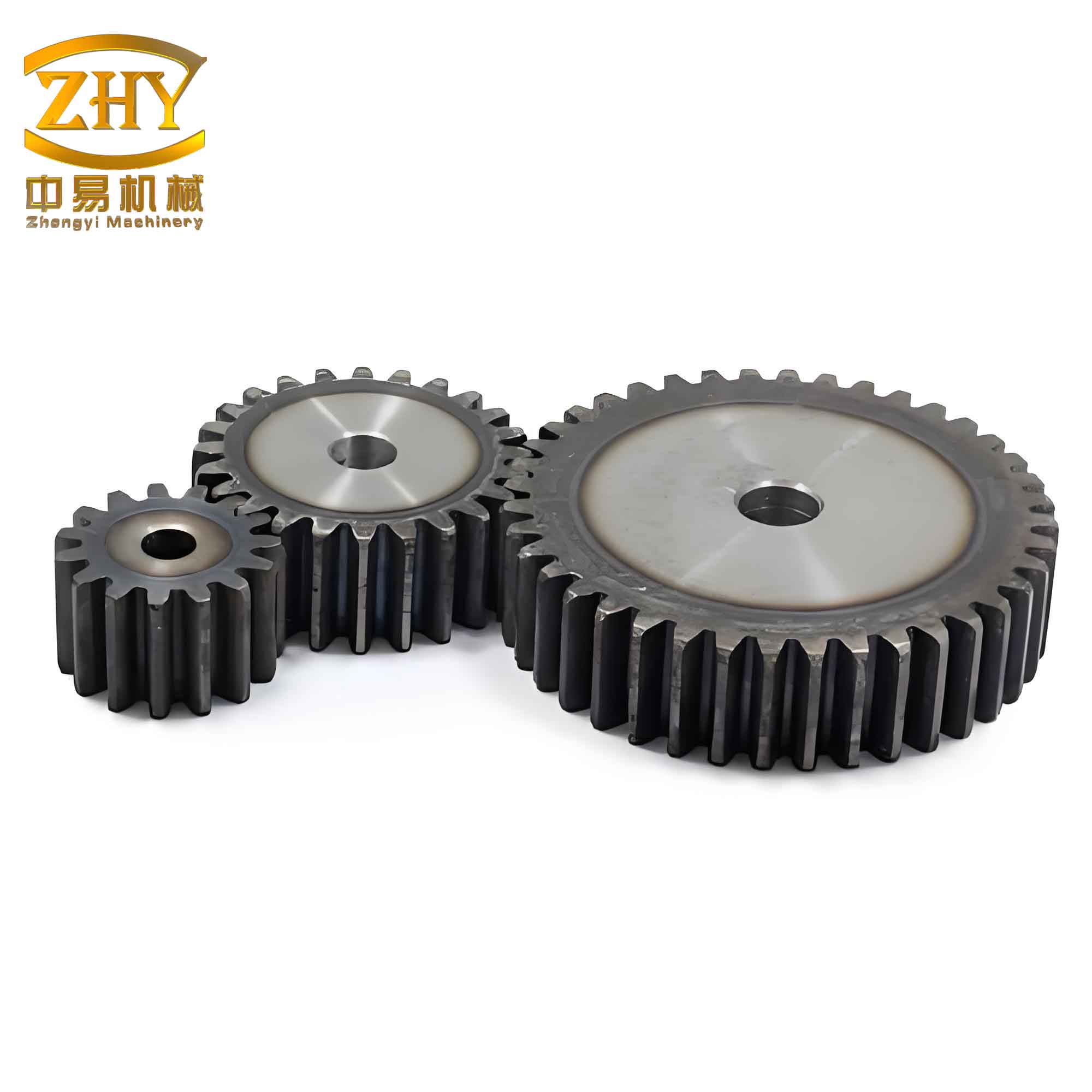
This article presents a detailed exploration into the design, mathematical modeling, and innovative manufacturing process of a novel type of gear: the cycloidal cylindrical gear. Traditional cylindrical gears, including spur, helical, and double-helical (herringbone) gears, have been the backbone of power transmission for centuries. However, each type presents inherent compromises. Spur gears, while simple to manufacture and assemble, suffer from a low contact ratio, leading to increased noise and vibration. Helical gears offer smoother operation due to their gradual engagement but introduce axial thrust forces that complicate bearing selection and housing design. Double-helical gears cancel this axial thrust but require a wide central groove for tool run-out, which wastes a portion of the potentially usable face width and introduces manufacturing complexities for aligning the two opposing helices.
The proposed cycloidal cylindrical gear aims to address these limitations. Its fundamental innovation lies in the shape of the tooth in the axial direction. Instead of a straight line (spur) or a helix (helical), the tooth flank follows a cycloidal curve. This geometric characteristic unlocks two primary advantages: superior meshing performance characterized by a smooth, gradual load transfer and the absence of net axial force, and most importantly, the capability for highly efficient, continuous-index machining. This manufacturing method, akin to a milling process with a rotating disc cutter, eliminates the need for traditional stop-and-index cycles, promising a significant leap in production rates for cylindrical gears. This work delves into the theoretical foundation, the geometric construction, the tooling design, and the practical implications of this promising gear technology.
Theoretical Foundation and Mathematical Modeling
The development of the cycloidal cylindrical gear is rooted in the theory of gearing and the principle of generation using an imaginary rack. The process begins with defining the geometry of this generating rack, whose tooth profile will ultimately shape the gear.
Geometry of the Generating Cycloidal Rack
The axial profile of the rack tooth is a cycloid. A cycloid is the curve traced by a point on the circumference of a circle as it rolls without slipping along a straight line. In our case, we consider a point located at a fixed distance from the center of the rolling circle, generating a curtate or prolate cycloid depending on its position.
Let us establish the coordinate system. A fixed coordinate system $S_0(O_0, x_0, y_0)$ is defined with its origin at the center $O_0$ of the rolling circle $C$ of radius $R_b$. A point $M$ is fixed at a distance $R_t$ from $O_0$. A moving coordinate system $S_t(O_t, x_t, y_t)$ is attached to the straight line (the future rack pitch line) and coincides with $S_0$ at the initial moment. The circle $C$ and point $M$ are fixed within $S_t$. As the circle rolls along the line, the locus of point $M$ describes the cycloid.
The position vector of point $M$ in $S_t$ is simple:
$$ \mathbf{r_t} = \begin{pmatrix} 0 \\ -R_t \\ 1 \end{pmatrix} $$
After the circle has rolled through an angle $\theta$, the transformation from $S_t$ to the fixed frame $S_0$ involves a translation of $R_b\theta$ along the line and a rotation of $\theta$. The transformation matrix $\mathbf{M}_{0t}$ is:
$$ \mathbf{M}_{0t} = \begin{bmatrix}
\cos \theta & -\sin \theta & 0 & R_b\theta \\
\sin \theta & \cos \theta & 0 & -R_b \\
0 & 0 & 1 & 0 \\
0 & 0 & 0 & 1
\end{bmatrix} $$
The coordinates of the cycloid in $S_0$ are given by $\mathbf{r_0} = \mathbf{M}_{0t} \cdot \mathbf{r_t}$, yielding the parametric cycloid equation:
$$ \begin{cases}
x_0 = R_b\theta – R_t \sin \theta \\
y_0 = -R_t \cos \theta
\end{cases} $$
To position this curve as a rack tooth flank, we shift the coordinate system to the rack’s mid-plane, denoted as $S_1(O_1, x_1, y_1)$. The final expression for one flank of the generating rack surface $\Sigma_1$, now extended along the width direction (parameter $u$), becomes:
$$ \mathbf{r_1}(u, \theta) = \begin{pmatrix}
R_b\theta – (R_t + u \tan \alpha) \sin \theta + L_2 \\
R_b – (R_t + u \tan \alpha) \cos \theta \\
u \\
1
\end{pmatrix} $$
where $\alpha$ is the pressure angle (defining the tooth profile inclination in the transverse section), and $L_2$ is a constant offset to correctly position the cycloid segment as a usable tooth flank. The term $(R_t + u \tan \alpha)$ effectively varies the distance from the rolling circle center as we move across the gear face width, creating the three-dimensional rack surface.
Meshing Theory and Generation of the Gear Tooth Surface
The gear tooth surface $\Sigma_2$ is generated as the envelope of the rack surface $\Sigma_1$ as it moves relative to the gear blank. This requires solving the meshing equation, which ensures continuous tangency between the surfaces.
We introduce a fixed reference frame $S_f$ and a frame $S_2$ attached to the gear. The rack translates with a velocity $v = r_p \omega$, where $r_p$ is the gear’s pitch radius and $\omega$ is its angular velocity. The gear rotates with $\omega$. The relative velocity $\mathbf{v}_{12}$ at a potential contact point must be orthogonal to the common surface normal $\mathbf{n}$:
$$ \mathbf{v}_{12} \cdot \mathbf{n} = 0 $$
This is the fundamental meshing condition.
The rack surface in the fixed frame $S_f$ at time $t$ is:
$$ \mathbf{r_f}(u, \theta, t) = \begin{pmatrix}
R_b\theta – (R_t + u \tan \alpha) \sin \theta + L_2 + r_p \omega t \\
R_b – (R_t + u \tan \alpha) \cos \theta \\
u \\
1
\end{pmatrix} $$
The surface normal $\mathbf{n_f}$ is calculated from the partial derivatives of $\mathbf{r_f}$ with respect to $u$ and $\theta$. The relative velocity at a point on the rack is $\mathbf{v}_{12} = (0, 0, \omega) \times \mathbf{r_f} = (-\omega y_f, \omega x_f, 0)$ in this context. Substituting into the meshing equation yields a relationship between the parameters $u$, $\theta$, and time $t$:
$$ A u^2 + B u + C = 0 $$
where:
$$ \begin{aligned}
A &= -\sin \theta (\tan^3 \alpha + \tan \alpha) \\
B &= \tan^2 \alpha \left[ L_2 + r_p \omega t + R_b\theta – R_t \sin \theta – \sin \theta (R_t – R_b \cos \theta) \right] – R_t \sin \theta \\
C &= \tan \alpha (R_t – R_b \cos \theta) \left( L_2 + r_p \omega t + R_b\theta – R_t \sin \theta \right)
\end{aligned} $$
Solving this quadratic equation gives $u = u(\theta, t)$, representing the line of contact between the rack and the gear at instant $t$:
$$ u(\theta, t) = \frac{-B \pm \sqrt{B^2 – 4AC}}{2A} $$
The $\pm$ indicates two conjugate contact lines, typically corresponding to the two sides of a gear tooth space.
Substituting $u(\theta, t)$ back into $\mathbf{r_f}(u, \theta, t)$ gives the instantaneous contact line in the fixed frame. Finally, transforming this line into the gear coordinate system $S_2$ via the rotation matrix $\mathbf{M}_{2f}(\phi = \omega t)$ yields the family of lines that sweep out the gear tooth surface $\Sigma_2$:
$$ \mathbf{r_2}(\theta, t) = \mathbf{M}_{2f}(\omega t) \cdot \mathbf{r_f}(u(\theta, t), \theta, t) $$
By varying time $t$ over the generation period, the complete tooth surface is defined. This mathematical model allows for the precise calculation of discrete points on the gear tooth, enabling CNC machining or 3D model construction.
Design and Modeling of Cycloidal Cylindrical Gears
To translate the theory into a tangible design, a specific set of parameters must be chosen. The following table outlines the parameters for a sample gear pair and its generating rack.
| Item | Gear 1 | Gear 2 | Generating Rack |
|---|---|---|---|
| Number of Teeth | 30 | 20 | – |
| Module (mm) | 5 | 5 | 5 |
| Pressure Angle (°) | 20 | 20 | 20 |
| Reference Helix Angle (°) | 16.2 | 16.2 | 16.2 |
| Center Distance (mm) | 125 | 125 | – |
| Addendum Coefficient | 1.0 | 1.0 | 1.25 |
| Dedendum Coefficient | 1.25 | 1.25 | 1.25 |
| Pitch Diameter (mm) | 150 | 100 | – |
| Face Width (mm) | 50 | 52 | 60 |
The cycloid parameters $R_b$ and $R_t$ are critical. They are chosen based on the desired nominal helix angle, face width, and considerations for tool design. For this example:
$$ R_b = 30 \text{ mm}, \quad R_t = 105 \text{ mm} $$
The nominal helix angle $\beta$ at the pitch cylinder is related to these parameters by $\tan \beta = R_b / r_p$, where $r_p$ is the pitch radius.
Using the mathematical model, discrete points on the tooth surface are calculated by varying parameters within their ranges (e.g., $\theta$ from 52° to 92°, $u$ across the face width). This point cloud is then imported into CAD software (e.g., SolidWorks) to generate smooth surfaces via spline interpolation, from which solid models of the rack cutter and the gears are constructed. A pair of such conjugate cycloidal cylindrical gears meshing with their imaginary generating rack is conceptually shown in the models. The tooth contact pattern under load would be a complex three-dimensional curve, offering favorable load distribution.
High-Efficiency Continuous-Index Machining Principle
The most significant practical advantage of the cycloidal cylindrical gear is its compatibility with a highly efficient machining process: continuous-index milling with a disc cutter.
Disc Cutter Design
The machining tool is a specially designed disc milling cutter. Its core components are a disc body and a set of indexed, replaceable cutting inserts.
| Cutter Component / Parameter | Description and Purpose |
|---|---|
| Disc Body | Provides the main structure and mounting interface to the machine spindle. |
| Cutting Inserts | Indexable carbide inserts. Two types: “inner” and “outer” inserts, which generate the left and right flanks of the gear tooth space, respectively. |
| Insert Geometry | Defined by pressure angle $\alpha$, cutting edge height $h$, and widths $b_1$, $b_2$. Typically, $b_1 + b_2 \approx 1.35h$. |
| Radial Adjustment ($d_r$) | Allows precise positioning of inserts to control tooth depth and root diameter. |
| Circumferential Adjustment ($d_c$) | Allows precise angular positioning of inserts to control the tooth thickness and backlash. |
| Disc Diameter ($D_d$) | Primary diameter of the cutter body. Must be sufficiently large to avoid interference with the gear blank. |
| Number of Inserts ($Z_b$) | Determines the spacing of cutting edges. More inserts allow for a finer finish but a thinner effective chip load per insert. |
The genius of this tool lies in its adjustability and standardization. One disc cutter body can be used to machine cylindrical gears of the same module but with different numbers of teeth by simply adjusting the insert positions $d_r$ and $d_c$. Furthermore, by changing the inserts themselves, the same disc body can potentially machine gears of a different module, greatly enhancing tooling flexibility and reducing cost.
The Continuous-Index Milling Process
The machining process simulates the kinematic relationship between the generating rack and the workpiece gear. The motions are continuous and synchronized:
- Cutter Rotation ($\omega_c$): The disc cutter rotates about its own axis at a constant speed.
- Workpiece Rotation ($\omega_w$): The gear blank rotates about its axis in precise synchronization with the cutter rotation.
- Radial Infeed ($v_f$): The cutter is fed radially into the blank to the full tooth depth. Often, this may be a combined radial and axial feed motion.
The synchronization is governed by the ratio derived from the rolling condition of the base circle of radius $R_b$ on the pitch line of the imaginary rack, which is equivalent to the gear’s pitch circle of radius $r_p$:
$$ \frac{\omega_w}{\omega_c} = \frac{R_b}{r_p} $$
This relationship is the key to the “continuous-index” nature. As the cutter spins, its multiple inserts successively engage the workpiece. Because the workpiece is rotating at the correctly synchronized speed, each new insert begins cutting the next tooth space seamlessly, without the need to stop the workpiece, index it to a new angular position, and restart the cut. The process continues uninterrupted until the entire gear is milled. This eliminates non-productive time associated with indexing, leading to dramatically higher productivity compared to conventional gear hobbing or shaping of specialty profile cylindrical gears.
Advantages, Analysis, and Application Potential
The cycloidal cylindrical gear, paired with its dedicated machining method, presents a compelling set of advantages across performance, manufacturing, and economics. The following table provides a comparative analysis.
| Aspect | Cycloidal Cylindrical Gear | Spur Gear | Helical Gear | Double-Helical Gear |
|---|---|---|---|---|
| Meshing Action | Gradual, multi-point contact along a curved path. | Sudden line contact, single-tooth engagement at low ratios. | Gradual line contact. | Gradual line contact on both sides. |
| Axial Thrust | None. The axial force components from the engaging cycloid flanks cancel out. | None. | Significant, requiring thrust bearings. | Canceled internally. |
| Noise & Vibration | Low (High contact ratio, smooth engagement). | High (Low contact ratio, impact). | Medium-Low | Low |
| Face Width Utilization | Full face width is active. | Full | Full | Reduced due to central groove. |
| Manufacturing Efficiency | Very High. Continuous-index milling. | High (e.g., hobbing). | High (hobbing). | Lower (requires two setups or special machines). |
| Tooling Standardization | High. One disc body for one module, adjustable inserts. | Standard hobs or shapers. | Standard hobs. | Specialized hobs or two setups. |
Detailed Advantage Analysis
1. Performance Superiority: The fundamental geometry of the cycloidal tooth provides a high contact ratio not just in the transverse plane (like a spur gear with larger addendum) but through a three-dimensional contact zone that evolves during mesh. This distributes the load over a larger area of the tooth surface at any given instant, reducing contact stress and bending stress at the root. The cancellation of axial force is a direct geometric consequence of the symmetrical, non-helical but curved tooth alignment. This makes these cylindrical gears exceptionally suitable for applications where high torque and smooth operation are required without imposing axial loads on supporting structures, such as in heavy-duty industrial gearboxes, wind turbine stages, or marine propulsion.
2. Manufacturing Revolution: The continuous-index milling process is a paradigm shift for producing this class of gears. By eliminating the index cycle, the machine tool’s duty cycle approaches 100% for the cutting operation. The metal removal rate can be optimized by selecting the number of inserts on the cutter, the rotational speeds, and the feed rate. This method is particularly advantageous for medium-to-high volume production runs where the setup time for the adjustable cutter is amortized over many parts.
3. Economic and Standardization Benefits: The modular design of the disc cutter—a permanent body with replaceable, adjustable inserts—lowers tooling costs and inventory. A workshop can stock a few standard disc bodies and a range of insert sets to cover various modules and profile modifications. This contrasts with needing a full set of dedicated hobs for different gear specifications. The ability to easily adjust tooth thickness via $d_c$ also simplifies controlling backlash to precise tolerances.
Considerations and Limitations
No technology is without its trade-offs. For cycloidal cylindrical gears, the primary considerations are:
- Design Complexity: The gear design is not defined by simple standard formulas (like for involute gears). It requires specialized software to calculate the tooth surface coordinates, perform stress analysis (likely via FEM), and simulate meshing.
- Tooling Specificity: While the cutter body is standard, the process requires a dedicated machine tool or a highly adaptable CNC milling center capable of precise synchronized rotary motion (C-axis for workpiece, spindle rotation).
- Size Limitation: As noted in the source material, the disc milling method may become impractical for very large diameter gears (e.g., >1 meter). The required disc cutter diameter to avoid interference with the gear blank would become excessively large, heavy, and costly. For such large cylindrical gears, alternative generating methods would need to be developed.
- Inspection: Measuring the complex three-dimensional tooth surface form requires advanced coordinate measuring machines (CMM) or specialized gear metrology equipment, unlike the relatively straightforward measurement of involute profiles and lead angles.
Conclusion and Outlook
This study has presented a comprehensive overview of the cycloidal cylindrical gear, from its theoretical underpinnings in gear meshing theory to its practical implementation via an innovative continuous-index milling process. We derived the mathematical model of the generating cycloidal rack and the conjugate gear tooth surface, illustrating the power of modern computational design in gear engineering. The design of the adjustable disc milling cutter and the principle of continuous synchronized machining were explained, highlighting the breakthrough in production efficiency this enables.
The cycloidal cylindrical gear demonstrates clear potential to overcome longstanding compromises in cylindrical gear design. It combines the axial-force-free operation of spur and double-helical gears with the smooth, high-contact-ratio performance of helical gears, while uniquely offering the possibility of vastly more efficient manufacturing. This makes it a strong candidate for next-generation power transmission systems where reliability, compactness, and cost-effectiveness are paramount.
Future work in this area is essential for widespread adoption. Research should focus on:
1. Developing standardized design procedures and rating standards for load capacity (bending and contact fatigue).
2. Optimizing the cycloid profile parameters ($R_b$, $R_t$, $\alpha$) for specific applications (high-speed, high-torque, etc.).
3. Further refining the cutter geometry and machining strategies to improve surface finish, tool life, and enable hard-finishing processes.
4. Exploring alternative manufacturing methods, such as precision forging or additive manufacturing, for mass production or for large-scale cylindrical gears beyond the scope of disc milling.
In conclusion, the cycloidal cylindrical gear represents more than just a new tooth form; it represents a holistic re-imagination of gear design and manufacturing, promising significant advancements in the performance and production of cylindrical gears for the future.