
In the pursuit of higher efficiency and sustainability across various industries, the study of power loss in gear transmission systems has become paramount. As a researcher deeply involved in mechanical engineering and tribology, I find that cylindrical gears, particularly those with advanced geometries like the Variable Hyperboloid Circular-Arc-Tooth-Trace (VH-CATT) design, present unique challenges and opportunities for optimizing energy use. This article delves into a comprehensive investigation of power loss mechanisms in VH-CATT cylindrical gears, focusing on churning and windage losses under splash lubrication conditions. Through theoretical modeling, numerical simulation using the Smoothed Particle Hydrodynamics (SPH) method, and experimental validation via an FZG test bench, we aim to unravel the influence of operational parameters such as rotational speed, oil immersion depth, and lubricant viscosity. The insights gained here are crucial for designing more efficient cylindrical gears, which are ubiquitous in applications ranging from automotive drivetrains to wind turbines, where even marginal improvements in efficiency can lead to significant energy savings globally.
The power loss in cylindrical gears during operation is a critical factor affecting overall transmission efficiency. It primarily consists of load-dependent losses, such as those from gear meshing friction, and load-independent losses, including churning (or stirring) losses due to lubricant interaction and windage losses from air-oil mixture drag. For VH-CATT cylindrical gears, which feature a variable hyperbolic curvature along the tooth trace for enhanced load distribution and noise reduction, understanding these losses is essential for their industrial adoption. In this study, we combine fluid dynamics theory with advanced simulation techniques to analyze the power loss characteristics. We first establish theoretical models for churning and windage losses, then develop a three-dimensional model based on an FZG gearbox for SPH-based multiphase flow simulations. This allows us to visualize the flow and velocity fields of lubricant and air within the gearbox and quantify power loss under various conditions. Finally, we validate our findings through physical experiments, ensuring the practical relevance of our results. The overarching goal is to provide a framework for minimizing power loss in cylindrical gears, thereby contributing to more energy-efficient machinery.
To lay the groundwork, let us delve into the theoretical calculations of power loss for cylindrical gears. Churning power loss arises from the viscous drag and agitation of lubricant by rotating gear surfaces. It can be decomposed into three components: loss associated with the gear periphery (P1), loss from gear side faces (P2), and loss due to the squeezing effect in the meshing zone (P3). Based on empirical and analytical approaches, these can be expressed as follows:
$$
P_1 = \frac{7.37 f_g v n^3 d^{4.7} L}{A_g \times 10^{26}}
$$
$$
P_2 = \frac{1.474 f_g v n^3 d^{5.7}}{A_g \times 10^{26}}
$$
$$
P_3 = \frac{7.37 f_g v n^3 d^{4.7} B R_f / \tan \beta}{A_g \times 10^{26}}
$$
The total churning power loss is then:
$$
P_{\text{churning}} = P_1 + P_2 + P_3
$$
In these equations, \( f_g \) represents the gear immersion factor (ratio of immersion depth \( h \) to tip diameter \( d_a \)), \( v \) is the kinematic viscosity of the lubricant, \( n \) is the rotational speed, \( d \) is the pitch diameter, \( L \) is the shaft length exposed to lubricant, \( A_g \) is a gear arrangement constant (taken as 0.2 here), \( B \) is the face width, \( R_f \) is the tooth surface roughness factor, and \( \beta \) is the helix angle. For VH-CATT cylindrical gears, the variable tooth trace geometry may influence these parameters, but the fundamental relationships hold.
Windage power loss, on the other hand, stems from the friction between gear surfaces and the surrounding air-oil mixture. Using Anderson’s model, the windage loss for the driver gear (\( P_{\text{driver}} \)) and follower gear (\( P_{\text{follower}} \)) can be calculated as:
$$
P_{\text{driver}} = C \left(1 + 2.3 \frac{B}{R_{\text{driver}}}\right) \rho^{0.8} n^{2.8} R_{\text{driver}}^{4.6} v^{0.2}
$$
$$
P_{\text{follower}} = C \left(1 + 2.3 \frac{B}{R_{\text{follower}}}\right) \rho^{0.8} \left(\frac{n}{u}\right)^{2.8} R_{\text{follower}}^{4.6} v^{0.2}
$$
Thus, the total windage loss is:
$$
P_{\text{windage}} = P_{\text{driver}} + P_{\text{follower}}
$$
Here, \( C \) is a proportionality constant (\( 2.4 \times 10^{-8} \)), \( \rho \) is the density of the air-oil mixture, \( u \) is the gear ratio, and \( v \) is the kinematic viscosity of the mixture. The mixture properties are derived from the lubricant and air properties:
$$
\rho = \frac{\rho_0 + 34.25 \rho_a}{35.25}, \quad v = \frac{v_0 + 34.25 v_a}{35.25}
$$
where \( \rho_0 \) and \( v_0 \) are the density and kinematic viscosity of the lubricant, and \( \rho_a \) and \( v_a \) are those of air. These theoretical models provide a baseline for understanding how parameters affect power loss in cylindrical gears. To illustrate, Table 1 summarizes the key parameters used in our study for VH-CATT cylindrical gears.
| Parameter | Driver Gear | Follower Gear |
|---|---|---|
| Number of Teeth | 21 | 29 |
| Module | 4 mm | 4 mm |
| Pressure Angle | 20° | 20° |
| Face Width (B) | 80 mm | 80 mm |
| Cutter Radius (RT) | 400 mm | 400 mm |
| Young’s Modulus (E) | 203 GPa | 203 GPa |
| Poisson’s Ratio (μ) | 0.3 | 0.3 |
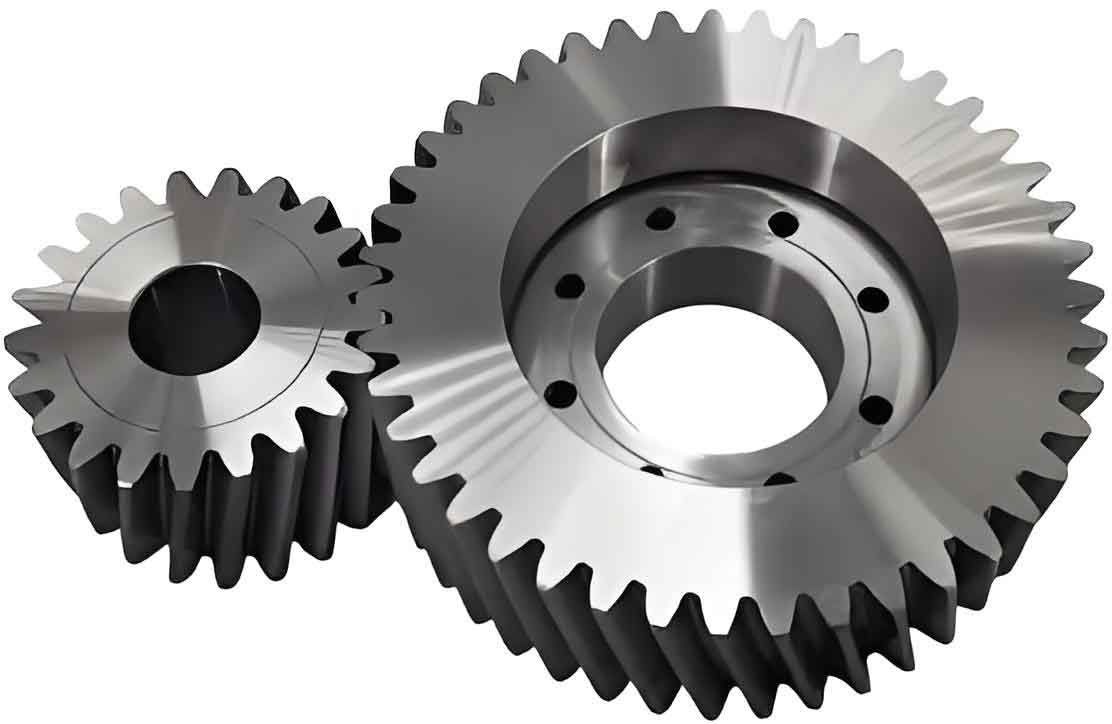
These cylindrical gears are designed with a variable hyperbolic circular-arc tooth trace, which enhances meshing performance but complicates fluid interaction. To visualize a typical cylindrical gear, consider the following image, which illustrates the general geometry relevant to our discussion.
Building on theory, we proceed to numerical simulation to capture the complex multiphase flow dynamics in a gearbox. Traditional Computational Fluid Dynamics (CFD) with fixed grids struggles with moving interfaces and complex geometries, leading to mesh distortion and convergence issues. Therefore, we employ the Smoothed Particle Hydrodynamics (SPH) method, a meshless Lagrangian approach that uses discrete particles to represent fluid phases. SPH is well-suited for simulating splash lubrication, where lubricant and air interact dynamically. The governing equations for fluid flow in SPH are derived from the Navier-Stokes equations and discretized using kernel interpolation. For a particle \( i \), the continuity, momentum, and energy equations are:
$$
\frac{d\rho_i}{dt} = \sum_j m_j (\mathbf{u}_j – \mathbf{u}_i) \cdot \nabla_i W_{ij}
$$
$$
\frac{d\mathbf{u}_i}{dt} = \sum_j m_j \left( \frac{\mathbf{S}_j}{\rho_j^2} + \frac{\mathbf{S}_i}{\rho_i^2} \right) \nabla_i W_{ij} + \mathbf{g}_i
$$
$$
\frac{de_i}{dt} = \frac{1}{2} \sum_j m_j \left( \frac{\mathbf{S}_j}{\rho_j^2} + \frac{\mathbf{S}_i}{\rho_i^2} \right) : (\mathbf{u}_j – \mathbf{u}_i) \nabla_i W_{ij} – \sum_j m_j \left( \frac{\mathbf{q}_j}{\rho_j^2} + \frac{\mathbf{q}_i}{\rho_i^2} \right) \nabla_i W_{ij}
$$
Here, \( \rho \) is density, \( \mathbf{u} \) is velocity, \( m \) is mass, \( W_{ij} \) is the smoothing kernel function, \( \mathbf{S} \) is the stress tensor, \( \mathbf{g} \) is gravity, and \( \mathbf{q} \) is heat flux. The stress tensor includes pressure and viscous terms: \( \mathbf{S} = -p\mathbf{I} + \boldsymbol{\sigma} \), with \( \boldsymbol{\sigma} = \mu (\nabla \mathbf{u} + \nabla \mathbf{u}^T) + (\xi – \frac{2}{3}\mu)(\nabla \cdot \mathbf{u})\mathbf{I} \), where \( \mu \) and \( \xi \) are shear and bulk viscosity coefficients. These equations are solved numerically to simulate the transient behavior of lubricant and air particles in the gearbox.
Our simulation model is based on an FZG gearbox, widely used in gear testing, to ensure practical relevance. We created a detailed 3D model using CAD software, focusing on the cylindrical gears and essential components while simplifying auxiliary parts to reduce computational cost. The mesh was generated with a particle diameter of 1 mm, balancing accuracy and simulation time. The initial condition includes lubricant filled to a specified immersion depth, with air occupying the remaining volume. We conducted a series of simulations by varying key parameters: rotational speed, oil immersion depth, and lubricant viscosity. Table 2 outlines the simulation cases designed to isolate each parameter’s effect on power loss.
| Case | Immersion Depth (mm) | Driver Speed (rpm) | Lubricant Viscosity (m²/s) | Lubricant Density (kg/m³) |
|---|---|---|---|---|
| 1 | 0 | 600 | 7.95 × 10⁻⁵ | 831.2 |
| 2 | 0 | 1200 | 7.95 × 10⁻⁵ | 831.2 |
| 3 | 0 | 1800 | 7.95 × 10⁻⁵ | 831.2 |
| 4 | 0 | 3000 | 7.95 × 10⁻⁵ | 831.2 |
| 5 | 0 | 1200 | 7.95 × 10⁻⁵ | 831.2 |
| 6 | -10 | 1200 | 7.95 × 10⁻⁵ | 831.2 |
| 7 | -20 | 1200 | 7.95 × 10⁻⁵ | 831.2 |
| 8 | -20 | 200 | 7.95 × 10⁻⁵ | 831.2 |
| 9 | -20 | 200 | 3.01 × 10⁻⁵ | 812.1 |
| 10 | -20 | 200 | 1.52 × 10⁻⁵ | 792.8 |
Note: Immersion depth is measured relative to the gear centerline (0 mm). Negative values indicate lower oil levels. These cylindrical gears operate under splash lubrication, where the rotating gears agitate the lubricant, creating a mist that lubricates meshing surfaces. The SPH simulations allow us to observe transient lubricant distribution and velocity fields. For instance, at the start, lubricant particles are stationary, but as the cylindrical gears rotate, they impart momentum, causing splashing and oil film formation on gear surfaces. The air-oil mixture develops vortices and bubbles, especially near the meshing zone, due to squeezing effects. Velocity fields show higher speeds close to the gear teeth, decreasing toward the gearbox walls due to viscous damping. This dynamic behavior is critical for understanding power loss mechanisms in cylindrical gears.
We now analyze the simulation results to quantify power loss trends. Power loss is computed from the torque required to overcome fluid drag on the cylindrical gears. First, considering rotational speed (Cases 1-4), we observe that higher speeds lead to increased power loss. This is expected because inertial forces dominate, enhancing lubricant agitation and viscous dissipation. The torque \( T \) due to power loss can be related to speed \( n \) through empirical correlations. For example, from our data, the torque roughly follows a power-law relationship:
$$
T \propto n^{\alpha}
$$
where \( \alpha \) is around 2.5 to 3, consistent with theoretical models. At low speeds, torque fluctuations are minimal, but at high speeds (e.g., 3000 rpm), oscillations become pronounced due to turbulent flow and gear vibration. This underscores the importance of speed control in minimizing losses in cylindrical gears.
Second, oil immersion depth (Cases 5-7) significantly affects power loss. Deeper immersion increases the wetted surface area of the cylindrical gears, resulting in higher drag torque. Our simulations show that when the oil level is at the gear centerline (0 mm), lubricant distribution is moderate, but at -20 mm (lower level), splashing is more vigorous, yet the overall drag decreases because less lubricant is engaged. The relationship between immersion depth \( h \) and torque can be approximated as:
$$
T \approx k_1 + k_2 h
$$
where \( k_1 \) and \( k_2 \) are constants. Thus, selecting an optimal oil level is crucial: too high increases churning loss, while too low may impair lubrication. For VH-CATT cylindrical gears, we recommend immersion depths slightly below the centerline to balance lubrication and efficiency.
Third, lubricant viscosity (Cases 8-10) plays a key role. Higher viscosity oils exhibit greater drag, leading to higher power loss. The torque varies linearly with viscosity \( v \) in laminar regimes, but in turbulent conditions, the dependence may be weaker. For cylindrical gears, using lower-viscosity lubricants can reduce churning loss, but this must be weighed against film thickness requirements for wear protection. The trade-off can be expressed as:
$$
T \propto v^{\beta}
$$
with \( \beta \) typically between 0.2 and 1, depending on flow regime. Our simulations confirm that low-viscosity oils (e.g., 1.52 × 10⁻⁵ m²/s) result in up to 30% lower torque compared to high-viscosity oils under the same conditions. This highlights the need for viscosity optimization in gearbox design for cylindrical gears.
To validate our simulations, we conducted experiments on an FZG test bench, a standard apparatus for gear efficiency measurements. The setup includes a closed-loop power circulation system with a drive motor, torque sensors, and the test gearbox containing the VH-CATT cylindrical gears. Lubricant is supplied via splash lubrication, and torque loss is measured under no-load conditions to isolate churning and windage effects. We tested various speeds and immersion depths, matching the simulation cases. The experimental torque data show similar trends to simulations: torque increases with speed and immersion depth. However, experimental values are generally higher due to additional losses from bearings, seals, and other components not modeled in simulations. The correlation between experimental (\( T_{\text{exp}} \)) and simulated (\( T_{\text{sim}} \)) torque can be modeled as:
$$
T_{\text{exp}} = T_{\text{sim}} + T_{\text{base}}
$$
where \( T_{\text{base}} \) represents baseline losses from other sources. Despite this offset, the relative changes align well, confirming the accuracy of our SPH approach for cylindrical gears. For instance, at 1200 rpm and 0 mm immersion, simulated torque was 0.85 Nm, while experimental torque was 1.12 Nm, indicating a 24% difference attributable to ancillary losses. This validation reinforces the utility of SPH simulations in predicting power loss behavior in cylindrical gears.
In conclusion, our study provides a comprehensive analysis of power loss in VH-CATT cylindrical gears under splash lubrication. Through theoretical modeling, SPH simulations, and experimental tests, we have elucidated how rotational speed, oil immersion depth, and lubricant viscosity influence churning and windage losses. Key findings include: (1) Higher rotational speeds exponentially increase power loss due to enhanced fluid inertia and turbulence; (2) Deeper oil immersion raises drag torque linearly, necessitating careful oil level management; (3) Higher viscosity lubricants incur greater power loss, suggesting a balance between lubrication performance and efficiency. These insights are vital for optimizing the design and operation of cylindrical gears in various industrial applications. Future work could explore the impact of gear geometry modifications, such as tooth profile adjustments, on fluid dynamics and loss reduction. By advancing our understanding of power loss mechanisms, we contribute to the development of more efficient and sustainable cylindrical gear transmission systems, ultimately driving energy savings across multiple sectors.
From a broader perspective, the methodologies employed here—integrating theoretical formulas, meshless SPH simulations, and empirical validation—offer a robust framework for analyzing complex fluid-structure interactions in cylindrical gears. As industries continue to demand higher efficiency and lower environmental impact, such studies will become increasingly important. We encourage further research into adaptive lubrication systems and smart gear designs that dynamically minimize power loss based on operating conditions. Ultimately, the pursuit of optimal efficiency in cylindrical gears is not just an engineering challenge but a step toward global energy conservation and reduced carbon footprints.