
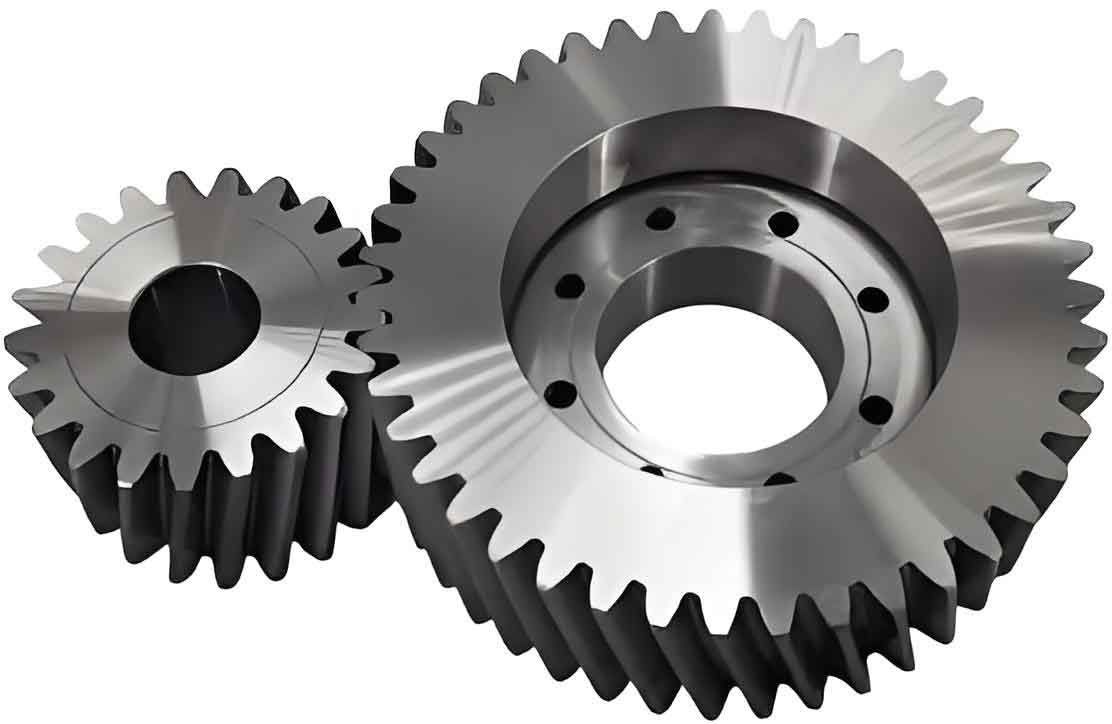
The pursuit of higher power density, reduced noise, and improved reliability continuously drives innovation in gear transmission systems. Among various advanced gear geometries, the Variable Hyperbolic Circular-Arc-Tooth-Trace (VH-CATT) cylindrical gear has emerged as a promising candidate. Unlike conventional spur or helical gears, these cylindrical gears feature tooth traces that are arcs of circles lying on hyperbolic surfaces, offering significant advantages such as increased overlap ratio, better load distribution, absence of axial thrust forces, and superior lubrication conditions. A critical aspect in the design of any gear, including these specialized cylindrical gears, is the management of root bending stress to prevent fatigue failure. While the standard VH-CATT gear has been studied, the influence of profile modification, or “addendum modification,” on its bending strength remains a less explored territory. Profile modification is a well-established technique in conventional gear design to avoid undercutting, improve strength, and adjust center distance. This article presents a detailed investigation into the bending stress characteristics of equal-addendum modification VH-CATT cylindrical gears. A comprehensive mathematical model for the tooth surface of the modified gear is first derived. Subsequently, using the finite element method, a systematic analysis is conducted to elucidate the impact of the modification coefficient and other key design parameters—such as cutter radius, module, face width, and cutter tip fillet radius—on the maximum root bending stress. The findings provide foundational insights for the parameter optimization and selection of these high-performance cylindrical gears.
The manufacturing of VH-CATT cylindrical gears is typically accomplished using a dual-cutter head machining method. To introduce profile modification, the principle of tool offset is applied. The fundamental coordinate systems for machining a modified VH-CATT gear are established. Here, the cutter coordinate system is denoted as \( O_1 – x_1y_1z_1 \), the workpiece static coordinate system as \( O_2 – x_2y_2z_2 \), and the workpiece rotating coordinate system as \( O_d – x_dy_dz_d \). The key modification involves displacing the basic rack tool (represented by the cutter head) by a distance \( x m \) relative to the standard pitch line, where \( x \) is the addendum modification coefficient and \( m \) is the module.
The surface of the dual-cutter head can be described in its fixed coordinate system. For the convex side (generated by one cutter) and concave side (generated by the other), the cutter surface vector \( \mathbf{r}_1 \) and its unit normal vector \( \mathbf{n}_1 \) or \( \mathbf{e}_1 \) are given by:
$$ \mathbf{r}_1 = \begin{bmatrix} -\left(R \mp \frac{\pi}{4}m \pm u \sin\alpha\right) \cos\theta \\ -\left(R \mp \frac{\pi}{4}m \pm u \sin\alpha\right) \sin\theta \\ u \cos\alpha \end{bmatrix} $$
$$ \mathbf{e}_1 = \cos\theta \cos\alpha \, \mathbf{i} + \sin\theta \cos\alpha \, \mathbf{j} \pm \sin\alpha \, \mathbf{k} $$
where \( R \) is the nominal cutter radius, \( \alpha \) is the cutter pressure angle (equal to the gear normal pressure angle), \( u \) and \( \theta \) are the surface parameters of the cutter cone, and the upper/lower signs correspond to the convex and concave sides, respectively.
According to the theory of gearing, the necessary condition for conjugate tooth surface generation is the null scalar product of the relative velocity vector and the common normal vector at the contact point. This condition, \( \phi = \mathbf{n}_1 \cdot \mathbf{v}^{(12)} = 0 \), leads to the equation of meshing. The relative velocity \( \mathbf{v}^{(12)} \) is derived from the kinematics of the machining process, where the cutter rotates and the gear blank rotates with an angular velocity \( \omega_2 \). Solving the meshing condition yields the relationship between the cutter surface parameters \( u \) and \( \theta \), and the motion parameter \( \psi \) (the rotation angle of the gear blank):
$$ u = \frac{ \mp \sin\alpha \cos\theta \left( R \mp \frac{\pi}{4}m \right) \pm \sin\alpha (R_1 \psi + R) }{\cos\theta} + x m \cos\alpha $$
Here, \( R_1 \) is the pitch radius of the gear being generated. Substituting this expression for \( u \) back into the cutter surface equation \( \mathbf{r}_1(\theta, u) \) provides the family of contact lines in the cutter coordinate system. Finally, by applying successive coordinate transformations from \( O_1 \) to \( O_2 \) and then to the rotating coordinate system \( O_d \) attached to the gear, the mathematical model of the modified VH-CATT gear tooth surface is obtained:
$$ \begin{aligned}
x_d &= \left[ -\left(R \mp \frac{\pi}{4}m \pm u \sin\alpha\right) \cos\theta + R + R_1 \psi \right] \cos\psi + (u \cos\alpha – R_1 – x m) \sin\psi \\
y_d &= \left[ \left(R \mp \frac{\pi}{4}m \pm u \sin\alpha\right) \cos\theta – R – R_1 \psi \right] \sin\psi + (u \cos\alpha – R_1 – x m) \cos\psi \\
z_d &= \left(R \mp \frac{\pi}{4}m \pm u \sin\alpha\right) \sin\theta \\
u &= \frac{ \mp \sin\alpha \cos\theta \left( R \mp \frac{\pi}{4}m \right) \pm \sin\alpha (R_1 \psi + R) }{\cos\theta} + x m \cos\alpha
\end{aligned} $$
This set of equations, with parameters \( \theta \) and \( \psi \), defines the working flanks of the modified VH-CATT cylindrical gear. The root fillet surface, generated by the tip rounding of the cutter, is equally crucial for stress analysis. Following a similar derivation, the equation for the transition surface (fillet) can be established, involving the cutter tip fillet radius \( r \).
To analyze the bending stress, three-dimensional solid models of a gear pair are created based on the derived mathematical surface model. A standard gear pair configuration for equal-addendum modification is considered, where both gears have the same magnitude of modification coefficient \( x_1 = x_2 = x \), and the center distance remains unchanged. The primary design parameters for the baseline analysis are listed in the table below.
| Parameter | Symbol | Value |
|---|---|---|
| Normal Pressure Angle | \( \alpha \) | 20° |
| Normal Module | \( m_n \) | 3 mm |
| Number of Teeth (Pinion/Gear) | \( z_1 / z_2 \) | 21 / 37 |
| Addendum Modification Coefficient | \( x_1 = x_2 = x \) | Variable (-0.2 to 0.2) |
| Cutter Radius | \( R \) | 80 mm |
| Face Width | \( B \) | 45 mm |
| Cutter Tip Fillet Radius | \( r \) | 0.2 mm |
| Addendum Coefficient | \( h_a^* \) | 1.0 |
| Dedendum Coefficient | \( c^* \) | 0.25 |
A seven-tooth segment model for both the driving and driven cylindrical gears is employed for the finite element analysis to balance computational accuracy and efficiency. The model is meshed with second-order tetrahedral or hexahedral elements, with refined mesh in the contact region and the root fillet area where high stress gradients are expected. The material is defined as typical gear steel with a Young’s modulus of 210 GPa and a Poisson’s ratio of 0.3. A static structural analysis is performed. The pinion is considered the driving member. A torque of 100 Nm is applied to the driven gear shaft. The contact between meshing teeth is defined as frictional surface-to-surface contact. Boundary conditions constrain the inner bore surfaces of both gears, coupling them to reference points at their centers of rotation to apply loads and constraints. The analysis solves for the stress state through the mesh cycle, and the maximum principal stress at the root fillet (often considered proportional to bending stress) is extracted for both gears.
The primary influence of the addendum modification coefficient \( x \) on the root bending stress of the VH-CATT cylindrical gears is investigated first. The coefficient is varied from -0.2 (negative modification) to 0.2 (positive modification) while keeping all other parameters constant as per the baseline table. The results clearly demonstrate a significant trend: the maximum root bending stress decreases monotonically for both the pinion and the gear as the modification coefficient increases. This behavior aligns with the fundamental principle of profile modification in conventional gears. Positive modification effectively thickens the tooth in the root region by moving the addendum outward, thereby increasing the area of the critical root section and its section modulus. Consequently, for a given load, the induced bending stress is reduced. The following table summarizes the stress values at the extremes of the studied range.
| Component | Bending Stress at \( x = -0.2 \) (MPa) | Bending Stress at \( x = 0.2 \) (MPa) | Reduction |
|---|---|---|---|
| Pinion (Driver) | 110.03 | 90.06 | ~18.2% |
| Gear (Driven) | 100.48 | 85.64 | ~14.8% |
The pinion, having fewer teeth, generally experiences higher stress and also shows a slightly greater percentage reduction in stress with positive modification. This establishes that positive addendum modification is a beneficial strategy for enhancing the bending strength of VH-CATT cylindrical gears.
Building upon the understanding of the modification coefficient’s effect, we now explore how other fundamental design parameters interact with this effect and influence the root bending stress. The analysis involves varying one parameter at a time while keeping the modification coefficient as a variable.
1. Influence of Cutter Radius (R): The cutter radius is a defining parameter for the curvature of the tooth trace in VH-CATT cylindrical gears. Analyses are conducted for \( R = 60 \) mm, \( 80 \) mm, and \( 100 \) mm. The overarching trend—decreasing stress with increasing \( x \)—remains consistent across all cutter radii. However, the absolute level of stress is affected by \( R \). For any given modification coefficient, a larger cutter radius results in lower root bending stress. The underlying mechanism is related to the contact pattern and load sharing. A larger \( R \) creates a gentler curvature of the tooth trace, which can lead to a larger theoretical contact area and potentially better load distribution along the face width. A more distributed load reduces the peak stress intensity at the root. Therefore, when designing for high bending strength, selecting a larger nominal cutter radius is advantageous, albeit within practical manufacturing and assembly constraints. The stress reduction with increasing \( x \) is slightly more pronounced for larger \( R \).
2. Influence of Module (m): The module is perhaps the most direct parameter influencing gear tooth size and strength. Analyses are performed for modules \( m = 3 \) mm, \( 5 \) mm, and \( 7 \) mm. The results reveal a powerful effect: increasing the module drastically reduces the root bending stress. This is expected as the tooth dimensions scale linearly with the module; a larger tooth has a substantially larger root cross-section to resist the bending moment. Quantitatively, increasing the module from 3 mm to 5 mm reduces stress by approximately 74%, and a further increase to 7 mm reduces it by another 60%. Furthermore, the beneficial effect of positive modification is amplified with larger modules. As seen in the table below, the percentage reduction in stress over the range \( x = -0.2 \) to \( x = 0.2 \) increases with the module.
| Module \( m \) (mm) | Stress Reduction from \( x=-0.2 \) to \( x=0.2 \) |
|---|---|
| 3 | ~18.2% |
| 5 | ~18.4% |
| 7 | ~18.9% |
This indicates that for larger, more heavily loaded cylindrical gears, the application of positive addendum modification becomes even more critical for optimizing bending strength.
3. Influence of Face Width (B): The face width determines the axial length of the gear teeth. Analyses consider \( B = 30 \) mm, \( 45 \) mm, and \( 60 \) mm. The results show a non-linear relationship. Increasing the face width from 30 mm to 45 mm leads to a noticeable decrease in root bending stress. This is due to the increased load-carrying capacity and the distribution of the total load over a larger area. However, a further increase from 45 mm to 60 mm yields a much smaller reduction in stress, effectively causing the stress to plateau. This phenomenon can be attributed to the specific geometry of VH-CATT cylindrical gears. The effective contact zone is largely governed by the cutter radius and the gear geometry. Beyond a certain face width (which in this case is related to the cutter radius \( R \)), additional material at the ends of the teeth contributes minimally to carrying the load because the contact does not fully extend across the entire width. Thus, simply increasing face width beyond an optimal point (often related to \( R \)) leads to diminishing returns in stress reduction and adds unnecessary weight and cost. The beneficial effect of positive modification is observed consistently across all face widths.
4. Influence of Cutter Tip Fillet Radius (r): The fillet radius at the tool tip directly shapes the root transition curve of the gear tooth, a region of high stress concentration. Analyses are conducted for \( r = 0 \) mm (sharp corner), \( 0.2 \) mm, and \( 0.4 \) mm. A sharp root (\( r=0 \)) leads to the highest stress due to a theoretical stress singularity. Introducing a fillet radius (\( r=0.2 \) mm) significantly reduces the maximum stress by alleviating the concentration. Increasing the fillet radius further to \( 0.4 \) mm provides an additional, though smaller, reduction in stress. However, there is a trade-off: an excessively large fillet radius can reduce the effective thickness of the tooth at the root and, more importantly for gears, may cause premature contact or a reduction in the true involute active profile, potentially affecting the contact ratio and tooth strength in a complex way. Therefore, the selection of \( r \) requires a balance. Positive addendum modification remains effective in reducing stress for all fillet radii studied. The combined use of a reasonable fillet radius and positive modification offers a synergistic effect for minimizing root bending stress in these cylindrical gears.
The comprehensive finite element-based study on equal-addendum modification VH-CATT cylindrical gears leads to the following key conclusions regarding their root bending stress:
- Addendum Modification Coefficient: Positive addendum modification (\( x > 0 \)) is highly effective in reducing the maximum root bending stress for both the pinion and gear. The stress decreases monotonically as \( x \) increases from -0.2 to 0.2, with the pinion showing a slightly more sensitive response. This provides a clear design directive for enhancing bending strength.
- Cutter Radius: A larger nominal cutter radius (\( R \)) contributes to lower bending stress across the range of modification coefficients. This is attributed to favorable changes in load distribution associated with the altered tooth trace curvature.
- Module: The module has the most pronounced effect on bending stress. Larger modules drastically reduce stress due to the scaling of tooth dimensions. Furthermore, the benefit of positive addendum modification is marginally enhanced for gears with larger modules.
- Face Width: Increasing face width reduces bending stress, but the effect exhibits diminishing returns. Beyond an optimal width related to the cutter radius, additional width yields minimal stress reduction, indicating that simply widening the gear is not an efficient strategy after a certain point.
- Cutter Tip Fillet Radius: Incorporating a fillet radius at the tool tip is crucial for mitigating stress concentration. The stress decreases as \( r \) increases from zero, though the rate of decrease slows. The selection of \( r \) must consider its interaction with the active tooth profile.
In summary, the bending strength of VH-CATT cylindrical gears can be effectively managed through a combination of design choices. A strategy employing a positive addendum modification, a suitably large module, an appropriately chosen cutter radius, and an optimized face width and fillet radius will yield a gear with minimized root bending stress. These findings establish a foundational framework for the parametric design and optimization of this advanced class of cylindrical gears, guiding engineers toward more reliable and efficient power transmission solutions. Future work may involve multi-objective optimization considering contact stress, dynamics, and manufacturing constraints.