
The pursuit of manufacturing efficiency, material savings, and enhanced mechanical performance has driven the development of near-net-shape forming technologies for gear production. Among these, the rolling forming process for cylindrical gears stands out as a transformative technique. Unlike traditional cutting methods which sever the metal grain flow, rolling induces controlled plastic deformation, causing the metal to flow into the desired tooth profile. This preserves the continuity of the grain structure, resulting in components with significantly improved fatigue strength and service life. This article delves into the numerical simulation of the hot rolling process for spur cylindrical gears, analyzes the underlying deformation mechanics, and focuses on the critical issue of lug defect formation and its control through process parameter optimization.
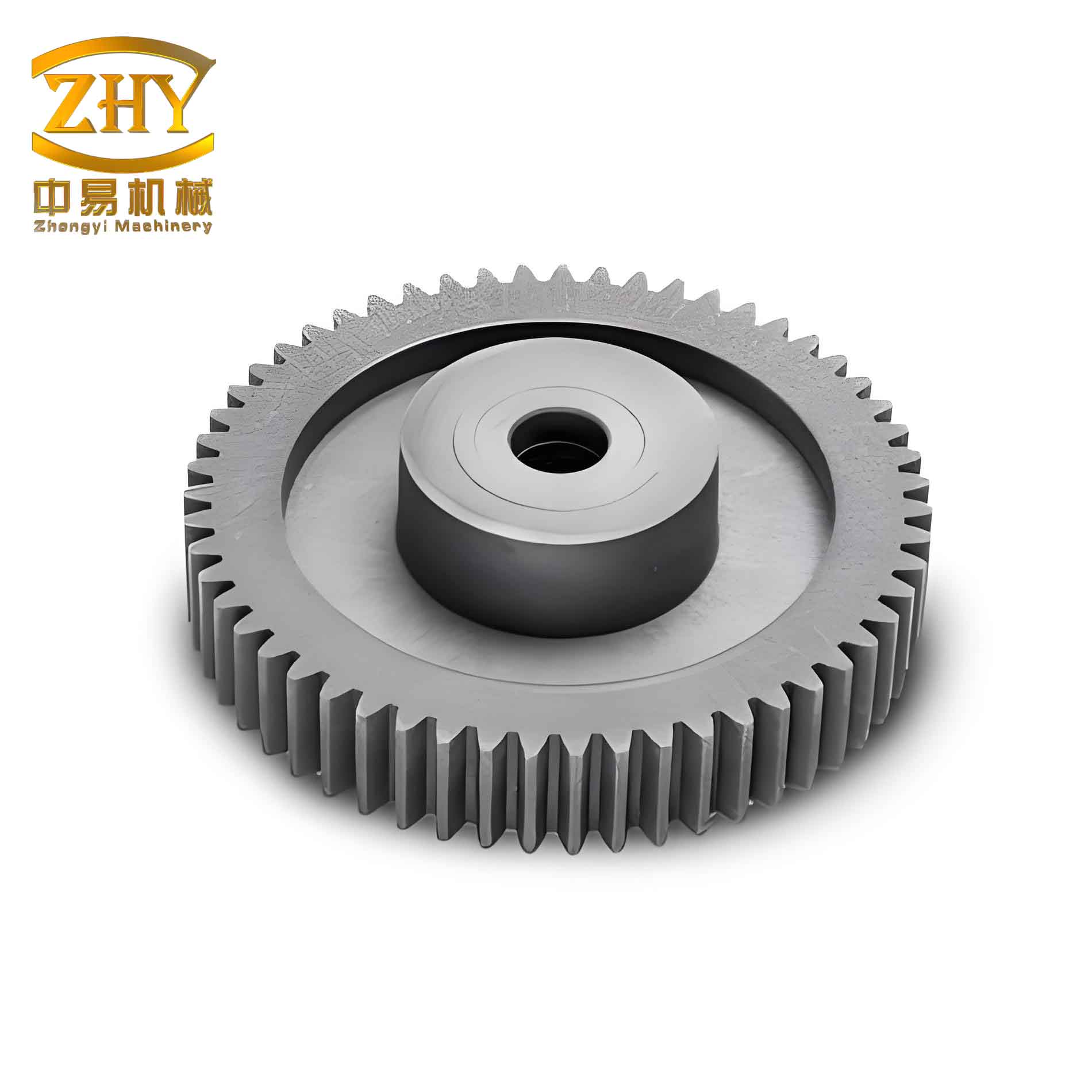
The rolling forming of cylindrical gears is a complex, three-dimensional metal forming process involving large plastic strains, nonlinear material behavior, and evolving contact conditions. Numerical simulation, primarily through the Finite Element Method (FEM), has become an indispensable tool for understanding this complexity. It allows for the detailed analysis of stress-strain fields, material flow patterns, and forming loads without the cost and time associated with extensive physical trials. A core challenge in this process is the formation of “lugs” or flash—excess material that protrudes from the tooth tip—which detrimentally affects dimensional accuracy and necessitates secondary finishing operations. Therefore, simulating the process to understand and mitigate lug formation is paramount for industrial adoption.
Theoretical Foundation and Geometric Modeling
The accurate definition of the gear geometry is the foundation for both tooling design and simulation. For a standard involute spur cylindrical gear, the tooth flank can be mathematically described. Considering an involute generated from a base circle of radius $r_b$, a point $M$ on the involute is defined by the roll angle $\theta_s$. The position vector $\mathbf{r_a}$ of this point in the transverse plane coordinate system $X_aO_aY_a$ can be derived as follows for the left and right flanks:
$$ \mathbf{r_a}(\theta_s, u_a) = \begin{bmatrix} X_a \\ Y_a \\ Z_a \\ 1 \end{bmatrix} = \begin{bmatrix} \pm \left[ r_b \sin(\theta_0 + \theta_s) – r_b\theta_s \cos(\theta_0 + \theta_s) \right] \\ -\left[ r_b \cos(\theta_0 + \theta_s) + r_b\theta_s \sin(\theta_0 + \theta_s) \right] \\ u_a \\ 1 \end{bmatrix} $$
where $u_a$ is the axial coordinate parameter along the gear width, and $\theta_0$ is the initial angle of the involute. The $\pm$ sign corresponds to the right (+) and left (-) flanks, respectively. This equation allows for the precise calculation of points along the tooth surface, which is essential for generating the 3D CAD model of the rolling tool (the die wheel) and the target gear. The fundamental parameters for the target gear and the corresponding die wheel are summarized in Table 1. The die wheel, typically with a higher tooth count, enforces the rotational motion and tooth formation on the workpiece blank.
| Parameter | Target Gear | Die Wheel | Parameter | Target Gear | Die Wheel |
|---|---|---|---|---|---|
| Module (mm) | 2 | 2 | Addendum Coefficient | 1 | 1 |
| Pressure Angle (°) | 20 | 20 | Dedendum Clearance Coefficient | 0.25 | 0.25 |
| Number of Teeth | 19 | 53 | – | – | – |
The initial blank diameter is determined using the volume constancy principle, a fundamental axiom in plastic forming. Assuming axial length remains constant, the cross-sectional area of the finished gear teeth is calculated. The initial cylindrical blank is then designed to have a cross-sectional area equal to this finished area plus the area of the final web/core section. This ensures no excess material is required from the axial direction, aligning with the plane-strain-like conditions often assumed in simulations of this process stage.
Finite Element Simulation Model Setup
To computationally analyze the hot rolling of cylindrical gears, a thermomechanically coupled 3D FEM model is established. The following simplifying assumptions are commonly made to balance accuracy and computational cost: the die wheels are treated as rigid bodies, the workpiece material is modeled as rigid-plastic or elastic-plastic, and the interfacial friction follows a constant shear factor or Coulomb’s law. The simulation of a full multi-tooth engagement is computationally intensive. Therefore, a symmetric model is often employed, leveraging the periodic symmetry of the process. Only a sector of the workpiece (e.g., 180 degrees containing several teeth) is modeled with appropriate symmetry boundary conditions. The die wheels are positioned accordingly. The mesh is critically refined in the deformation zones—primarily the outer layer of the blank where tooth formation occurs—to capture high strain gradients accurately. An example of such a model setup is characterized by the parameters in Table 2.
| Process Parameter | Value / Setting | Material & Interface Property | Value / Setting |
|---|---|---|---|
| Workpiece Initial Temperature | 950 °C | Workpiece Material Model | AISI-1045 (Plastic) |
| Die Wheel Temperature | 20 °C (Room) | Die Wheel Model | AISI-H13 (Rigid) |
| Initial Feed (Bite) | 0.3 mm | Friction Factor (Shear) | 0.3 |
| Radial Feed Rate | 0.1 mm/s | Heat Transfer Coefficient | 11 N/(s·mm·°C) |
| Die Wheel Rotation Speed | 2.25 rad/s | Mesh Elements (Workpiece) | >100,000 (local refinement) |
The process kinematics involve the die wheels rotating about their own axes while also revolving around the workpiece axis (planetary motion) and feeding radially inwards. The workpiece is constrained from translational movement but is allowed to rotate freely, its motion enforced solely by the meshing action with the die wheels.
Analysis of the Rolling Stages and Deformation Mechanics
The simulation reveals the progressive formation of teeth on the cylindrical gear blank, which can be categorized into three distinct stages:
1. Initial Tooth Division Stage: The die wheels first penetrate the blank surface, creating preliminary grooves. Material begins to flow laterally and upward, initiating the separation between nascent teeth.
2. Tooth Forming Stage: This is the main plastic deformation phase. With continued radial feed, the die wheels progressively push material into the tooth spaces, building up the tooth flank profiles. Metal flow is most intense during this stage.
3. Tooth Finishing Stage: After reaching the final full tooth depth, the radial feed stops. The die wheels continue to rotate, often with direction reversal, to calibrate the tooth profile, smooth surfaces, and homogenize strains through further plastic deformation without changing the overall volume.
The equivalent (von Mises) strain and stress distributions provide deep insight into the deformation mechanics. Throughout the forming stage, the maximum equivalent strain consistently localizes in the region around the mid-height of the tooth profile, slightly偏向 the tooth root. This is the zone of most severe plastic deformation as material is compressed and extruded by the die wheel tip. The strain distribution is not uniform along the tooth profile, which has implications for microstructural evolution and hardness.
The equivalent stress field shows that the maximum contact pressure, and thus stress, occurs at the interface between the die wheel flanks and the deforming workpiece material. The stress magnitude increases with feed depth, from approximately 300 MPa in the early division stage to around 350 MPa near full depth. During finishing, the stress levels drop significantly (~250 MPa) as the contact becomes more conformal and the material work hardens. The evolution of the rolling force, a critical parameter for machine design and process stability, can be directly extracted from the simulation. The force components (Fx, Fy, Fz) increase non-linearly with feed depth. The radial force component is dominant, while the axial component (Fy) is negligible for spur cylindrical gears. The force vs. time curve exhibits fluctuations corresponding to the sequential engagement and disengagement of individual die wheel teeth.
Mechanism of Lug Defect Formation and Quantitative Analysis
A significant defect in gear rolling is the formation of lugs or fins at the tooth tips. Simulation is exceptionally effective in visualizing the genesis of this defect. The mechanism is rooted in the direction of frictional forces on the workpiece tooth flanks. As a die wheel tooth (e.g., Tooth A) finishes its action on one flank of a workpiece tooth and begins to disengage, the normal force decreases. However, the frictional force on that flank, which opposes relative motion, can become directed towards the tooth tip. Simultaneously, the opposing die wheel tooth (Tooth B) engaging the other flank exerts a normal force and a frictional force that also has a component towards the tip. This synergistic “dragging” effect from both sides pulls surface material upward, leading to the extrusion of excess metal beyond the theoretical tip diameter, forming the lug.
To quantitatively assess the severity of lug formation, a metric is defined. At a specific intermediate forming stage (e.g., 55% of full feed depth, where the lug is pronounced before potential folding in later stages), the lug volume $V_i^0$ for each tooth $i$ is measured via simulation post-processing. The lug severity index $F_0$ for the gear sector is then calculated as the average percentage of lug volume relative to the total volume of each nascent tooth:
$$ F_0 = \frac{ \sum_{i=1}^{n} \left( \frac{V_i^0}{V_i} \times 100 \right) }{n} \% $$
where $V_i$ is the total volume of workpiece tooth $i$ at that stage, and $n$ is the number of teeth in the simulated sector.
Process Parameter Optimization for Lug Control
Among various process parameters, the friction condition at the die-workpiece interface is a primary factor influencing lug formation. Using the defined metric $F_0$, the effect of the friction coefficient ($\mu$) can be systematically studied via multiple simulations. As shown in the analysis, an increase in the friction coefficient leads to a proportional increase in the lug severity index. This is because higher friction amplifies the tangential “dragging” forces that pull material towards the tip. Table 3 illustrates this relationship and provides practical context by listing typical friction coefficients for different lubricants used in hot rolling of steel, guiding the selection of lubrication to control lugs.
| Simulation Study: Friction Effect | Practical Hot Rolling Lubricants (Steel, 950-1150°C) | ||
|---|---|---|---|
| Friction Coefficient ($\mu$) | Lug Severity Index $F_0$ (%) | Lubricant Type | Typical Friction Coefficient Range |
| 0.1 | 16.63 | Spindle Oil + Additive | 0.04 – 0.16 |
| 0.2 | 17.01 | Graphite | 0.16 – 0.28 |
| 0.3 | 18.51 | Heavy Oil (Initial) | 0.18 – 0.20 |
| – | – | Water | 0.30 – 0.31 |
| – | – | No Lubricant | 0.42 – 0.48 |
The clear correlation indicates that to minimize lug defects in the hot rolling of cylindrical gears, the friction should be minimized within a stable rolling window. Therefore, selecting an effective lubricant like graphite or specialized additives (lower $\mu$ range) is a direct and crucial step in process optimization. Other parameters like feed rate, rotational speed, and temperature also interact with friction and material flow, and can be optimized in a similar multi-variable approach using numerical simulation to find a Pareto-optimal set of conditions that ensure complete tooth fill with minimal lug formation and controlled forming loads.
Conclusion and Outlook
Numerical simulation has proven to be a powerful virtual laboratory for investigating the hot rolling forming process of cylindrical gears. It enables the detailed visualization and quantification of material flow, stress-strain evolution, and forming loads throughout the division, forming, and finishing stages. The analysis conclusively shows that the region of maximum plastic strain is centered near the tooth root mid-height, while the highest stresses occur at the tool-workpiece interface. Furthermore, simulation elucidates the mechanism of lug defect formation, identifying the tool flank friction as a primary driver. The quantitative assessment demonstrates that reducing the interfacial friction coefficient is an effective strategy for lug control, a finding that directly informs lubricant selection and process design. The methodologies and insights presented form a solid theoretical and practical foundation for advancing the industrial application of near-net-shape rolling for high-performance cylindrical gears, promising enhanced material utilization and superior mechanical properties.