
In the field of advanced mechanical transmission systems, particularly for applications in aviation and marine engineering, the demand for compact, lightweight, and high-load-capacity designs is paramount. Among these, coaxial dual-output cylindrical gear split-combined-torsion transmission systems have garnered significant attention due to their structural efficiency and reliability. These systems are integral to the main drive mechanisms of rigid dual-rotor high-speed helicopters, where they facilitate power distribution from multiple inputs to coaxial outputs. However, despite the inherent symmetry in their configuration principles, load distribution imbalances among branches remain a critical challenge. This issue can lead to premature wear, reduced efficiency, and potential system failures. Therefore, from a statics perspective, this article delves into the influence of meshing phase differences on the static load-sharing characteristics of such transmission systems. By developing a comprehensive analytical model that accounts for torsional deformations, support deformations, and gear mesh deformations, I aim to elucidate how phase disparities between gear pairs affect load distribution. The analysis will incorporate time-varying mesh stiffness calculations and deformation coordination conditions, providing insights that can guide design optimizations for improved load-sharing performance.
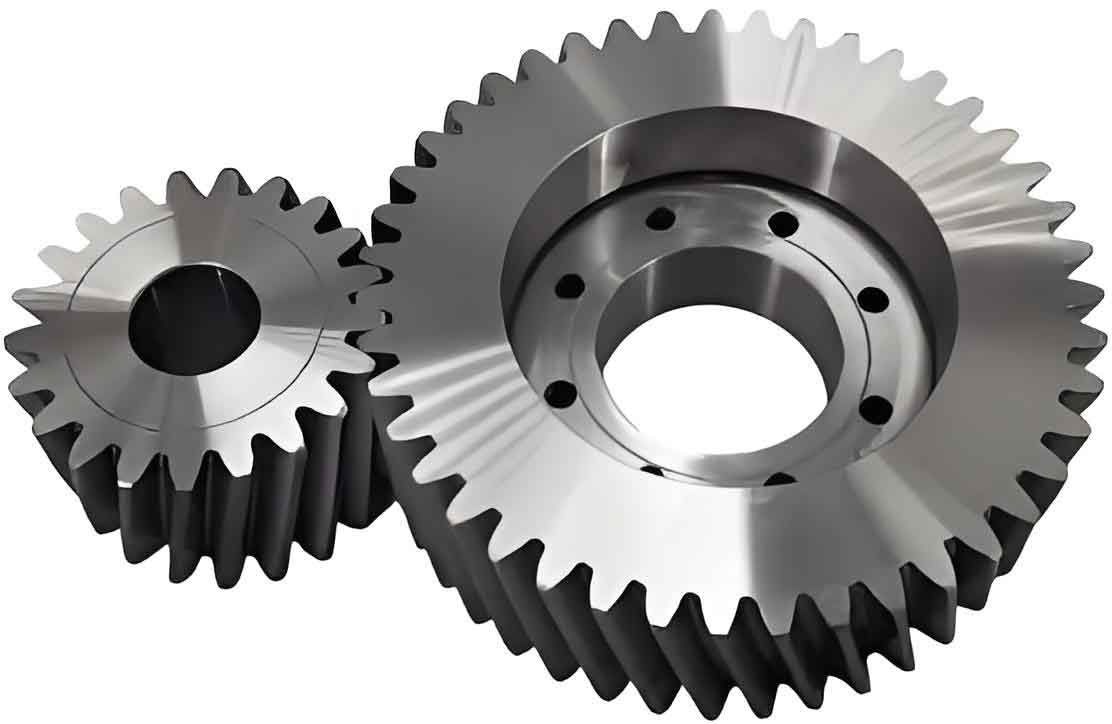
The coaxial dual-output cylindrical gear split-combined-torsion transmission, as studied here, features two power input paths that converge into inner and outer output shafts via split and combined stages. The system employs cylindrical gears for both split-torque and combined-torque stages, ensuring efficient power transmission. Cylindrical gears are chosen for their simplicity, high precision, and ability to handle substantial loads. In this configuration, each input path divides into two branches through split-level cylindrical gears, which then merge at the combined-level cylindrical gears to drive the outputs. This arrangement inherently introduces multiple meshing interfaces, where phase differences between gear pairs can arise due to manufacturing tolerances, assembly errors, or intentional design gaps. These phase differences alter the synchronization of mesh stiffness variations, leading to uneven load distribution among branches. To address this, I establish a static analysis model that simplifies components into spring-connected elements, capturing the essential deformations and forces. The model includes coordinate systems for each gear and shaft, allowing for a detailed examination of displacements and rotations under load. Key parameters such as gear geometry, material properties, and stiffness values are considered to ensure accuracy. Throughout this analysis, the term “cylindrical gears” will be emphasized repeatedly, as these components are central to the transmission’s functionality and the studied phenomena.
To model the static behavior, I consider the system in a fixed state where the output shafts are stationary, and torque is applied to the input shafts. This induces deformations in various elements, including gears, shafts, and supports. The static equilibrium equations are derived based on force and moment balances. For each gear pair, the relationship between torque and mesh force is expressed as:
$$ T_{kip} – (F_{ki1nps} + F_{ki2nps}) r_{bp} = 0 $$
$$ T_{kijs} – F_{kijnps} r_{bs} = 0 $$
$$ T_{kijh} – F_{kijnBh} r_{bh} = 0 $$
$$ T_{kB} – r_{bB} \sum_{k} \sum_{i} \sum_{j} F_{kijnBh} = 0 $$
where \( T \) represents torque, \( F \) denotes mesh force, \( r_b \) is the base circle radius, and indices \( k \), \( i \), \( j \) specify the output path, input branch, and sub-branch, respectively. For instance, \( k = U, D \) corresponds to inner and outer output paths, while \( i = L, R \) indicates left and right input branches. The mesh forces are resolved into components along coordinate axes, leading to force balance equations that account for support stiffnesses \( K_{x} \) and \( K_{y} \):
$$ \frac{T_{ki1s}}{r_{bs}} \cos \alpha_{ki1p} + \frac{T_{ki2s}}{r_{bs}} \cos \alpha_{ki2p} – K_{kipx} x_{kip} = 0 $$
$$ \frac{T_{ki1s}}{r_{bs}} \sin \alpha_{ki1p} + \frac{T_{ki2s}}{r_{bs}} \sin \alpha_{ki2p} – K_{kipy} y_{kip} = 0 $$
$$ \frac{T_{kijs}}{r_{bs}} \cos \alpha_{kijs} + \frac{T_{kijh}}{r_{bh}} \cos \alpha_{kijh} – K_{kijsx} x_{kijs} = 0 $$
$$ \frac{T_{kijs}}{r_{bs}} \sin \alpha_{kijs} + \frac{T_{kijh}}{r_{bh}} \sin \alpha_{kijh} – K_{kijsy} y_{kijs} = 0 $$
Here, \( x \) and \( y \) are displacements along coordinate directions, and \( \alpha \) represents the angle between mesh force and the positive X-axis. Similar equations apply to other gears. The deformation coordination equations are crucial for linking angular displacements due to various sources. The relative angular displacement from mesh deformation is given by:
$$ \varphi^1_{kij} = \frac{T_{kijs}}{r_{bs}^2 K_{kijnps}} $$
$$ \varphi^2_{kij} = \frac{T_{kijh}}{r_{bh}^2 K_{kijnBh}} $$
where \( \varphi^1 \) and \( \varphi^2 \) correspond to split-level and combined-level gear pairs, respectively. The torsional deformation of the quill shaft (connecting gears in a branch) introduces an additional angle:
$$ \varphi^3_{kij} = \frac{T_{kijsh}}{K_{kijsh}} $$
with \( K_{kijsh} \) as the torsional stiffness. Gear backlash contributes to angular displacement as well:
$$ \varphi^4_{kij} = \frac{J_{kijs}}{2r_s} + \frac{J_{kijh}}{2r_h} $$
where \( J \) is circumferential backlash, and \( r_s \), \( r_h \) are pitch radii. Furthermore, relative center displacements of gears due to bending and support deformations lead to angular changes \( \varphi^5_{kij} \) and \( \varphi^6_{kij} \). These displacements are computed from:
$$ \Delta U_{kijps} = (u_{kip} + \Delta E_{kip} \cos \gamma_{kip}) – (u_{kijs} + \Delta E_{kijs} \cos \gamma_{kijs}) $$
$$ \Delta V_{kijps} = (v_{kip} + \Delta E_{kip} \sin \gamma_{kip}) – (v_{kijs} + \Delta E_{kijs} \sin \gamma_{kijs}) $$
$$ \Delta U_{kijBh} = (u_{kijh} + \Delta E_{kijh} \cos \gamma_{kijh}) – (u_{kiB} + \Delta E_{kB} \cos \gamma_{kB}) $$
$$ \Delta V_{kijBh} = (v_{kijh} + \Delta E_{kijh} \sin \gamma_{kijh}) – (v_{kiB} + \Delta E_{kB} \sin \gamma_{kB}) $$
In these expressions, \( u \) and \( v \) are center displacements, \( \Delta E \) denotes comprehensive errors (including manufacturing and assembly), and \( \gamma \) is the error angle relative to the X-axis. The total angular displacement for a branch is then:
$$ \varphi_{kijp} = i_1 (\varphi^1_{kij} + \varphi^2_{kij} + \varphi^3_{kij}) + \varphi^4_{kij} + \varphi^5_{kij} + \varphi^6_{kij} $$
where \( i_1 \) is the gear ratio at the split level. The deformation coordination condition requires that the total angular displacements for left and right branches within an input path be equal:
$$ \varphi_{ki1p} – \varphi_{ki2p} = 0 $$
This set of equations forms the basis for solving static load distribution. The static load-sharing coefficient is defined to quantify unevenness. For each input branch, the load-sharing coefficients for left and right sub-branches are:
$$ \Omega_{ki1} = \frac{2T_{ki1sh}}{T_{ki1sh} + T_{ki2sh}} $$
$$ \Omega_{ki2} = \frac{2T_{ki2sh}}{T_{ki1sh} + T_{ki2sh}} $$
and the overall coefficient for that input part is:
$$ \Omega_{ki} = \max(\Omega_{ki1}, \Omega_{ki2}) $$
Values closer to 1 indicate better load sharing. The meshing phase difference between gear pairs plays a pivotal role in these coefficients. Phase difference arises when gears in two branches enter mesh at different times due to backlash or errors. For cylindrical gears, this affects the synchronization of time-varying mesh stiffness, which is calculated using the potential energy method. Considering Hertzian, bending, shear, and axial compression energies, the mesh stiffness for a gear pair is:
$$ k = \sum_{i=1}^{2} \left[ 1 / \left( \frac{1}{k_{h,i}} + \frac{1}{k_{b1,i}} + \frac{1}{k_{s1,i}} + \frac{1}{k_{f1,i}} + \frac{1}{k_{a1,i}} + \frac{1}{k_{b2,i}} + \frac{1}{k_{s2,i}} + \frac{1}{k_{f2,i}} + \frac{1}{k_{a2,i}} \right) \right] $$
where subscripts \( h \), \( b \), \( s \), \( f \), \( a \) refer to Hertzian, bending, shear, fillet foundation, and axial stiffnesses, respectively, and \( i = 1, 2 \) denotes first and second pairs of teeth in contact. For the cylindrical gears in this study, basic parameters are summarized in Table 1.
| Item | Split-Level Gears | Combined-Level Gears | Other Parameters |
|---|---|---|---|
| Module (mm) | 2.4 | 3.7 | Pressure Angle: 20° |
| Number of Teeth | 36 (driver), 100 (driven) | 31 (driver), 159 (driven) | Elastic Modulus: 2.1×10⁵ MPa |
| Face Width (mm) | 25 | 35 | Poisson’s Ratio: 0.3 |
| Base Circle Radius (mm) | Calculated from geometry | Calculated from geometry | Gear Material: Steel |
The time-varying mesh stiffness for cylindrical gears exhibits periodic fluctuations over a mesh cycle. When phase difference exists between two branches, their stiffness curves shift relative to each other. If \( \gamma_{ba}(t_1) \) represents the phase difference between gear pair a (reference) and gear pair b (related) at time \( t_1 \), it is defined as:
$$ \gamma_{ba}(t_1) = \frac{t_2 – t_1}{T_b} $$
where \( t_2 \) is the meshing start time for pair b, and \( T_b \) is its meshing period. This phase difference can be positive or negative, depending on whether pair b leads or lags. In the context of cylindrical gears, even small phase differences can cause significant mismatches in stiffness, affecting the deformation angles and ultimately load distribution. To analyze this, I solve the static equations numerically for various phase difference scenarios. The focus is on both split-level and combined-level cylindrical gears, across inner and outer output paths. Results indicate that as phase difference increases, the load-sharing coefficient deviates more from unity, indicating worse performance. Moreover, combined-level phase differences have a more pronounced impact than split-level ones. For inner output paths, right input branches are more sensitive to phase differences, while for outer output paths, left input branches show greater sensitivity. This asymmetry stems from the specific layout of cylindrical gears in each path.
To quantify the effect, I compute the fluctuation amount of the load-sharing coefficient, defined as the difference between maximum and minimum values over a meshing cycle. Table 2 summarizes how phase difference magnitude and sign influence this fluctuation for different branches.
| Output Path | Gear Stage | Input Branch | Phase Difference Sign | Fluctuation Amount Trend |
|---|---|---|---|---|
| Inner | Split-Level | Left | Negative | Higher impact than right branch |
| Right | Positive | Higher impact than left branch | ||
| Combined-Level | Left | Negative | Higher fluctuation than positive | |
| Right | Positive | Higher fluctuation than negative | ||
| Outer | Split-Level | Left | Any | Lower impact than right branch |
| Right | Any | Higher impact than left branch | ||
| Combined-Level | Left | Negative | Higher impact than right branch | |
| Right | Positive | Higher impact than left branch |
The underlying mechanism can be understood by examining mesh stiffness curves. When phase difference is zero, stiffness variations are synchronized, leading to minimal load imbalance. However, with non-zero phase difference, stiffness mismatches occur at certain meshing positions, causing unequal deformations and torque redistribution. For cylindrical gears, this is particularly critical due to their linear contact characteristics. The difference in mesh stiffness between two branches at a given time can be expressed as:
$$ \Delta k(t) = k_a(t) – k_b(t + \gamma T) $$
where \( k_a \) and \( k_b \) are stiffness functions, and \( \gamma \) is the phase difference. Larger \( |\Delta k| \) values correlate with higher load-sharing coefficient fluctuations. This relationship is nonlinear and depends on gear geometry and operating conditions. To mitigate adverse effects, design strategies can include minimizing phase differences through precise manufacturing or introducing compensatory adjustments. For instance, in inner output paths, ensuring negative phase differences for right input combined-level cylindrical gears can improve load sharing. Conversely, for outer output paths, positive phase differences for left input combined-level cylindrical gears are beneficial. These insights highlight the importance of phase control in cylindrical gear systems.
Further analysis involves deriving explicit formulas for load distribution under phase difference. From the deformation coordination equation, the torque in each branch can be related to phase difference. Assuming small deformations, a linearized model yields:
$$ T_{ki1sh} = \frac{T_{total}}{2} + \Delta T(\gamma) $$
$$ T_{ki2sh} = \frac{T_{total}}{2} – \Delta T(\gamma) $$
where \( \Delta T(\gamma) \) is a function of phase difference \( \gamma \), stiffness parameters, and errors. For cylindrical gears, \( \Delta T \) can be approximated using series expansions. Incorporating time-varying stiffness, the expression becomes:
$$ \Delta T(\gamma) = \frac{1}{2} \int_{0}^{T_m} \left[ \frac{K_{nps}(\theta) – K_{nps}(\theta + \gamma)}{K_{eq}} \right] d\theta \cdot T_{total} $$
where \( K_{nps} \) is the mesh stiffness of split-level cylindrical gears, \( T_m \) is the meshing period, and \( K_{eq} \) is an equivalent system stiffness. Similar relations apply to combined-level cylindrical gears. These formulas underscore that phase difference directly modulates load distribution via stiffness disparities. In practice, for cylindrical gear transmissions, engineers must account for this during tolerance allocation and assembly alignment.
To validate the model, parametric studies are conducted. Key variables include gear module, number of teeth, support stiffnesses, and torsional stiffness of quill shafts. The results consistently show that cylindrical gears at the combined stage are more susceptible to phase differences due to their higher torque transmission role. This is quantified by sensitivity coefficients, defined as the derivative of load-sharing coefficient with respect to phase difference. For example, for inner output combined-level cylindrical gears, sensitivity can be as high as 0.5 per degree of phase difference, whereas for split-level gears, it is around 0.3. These values emphasize the need for tight phase control in combined-stage cylindrical gears. Additionally, interactions between multiple phase differences across paths are examined. The overall system load-sharing coefficient is a superposition of individual effects, but nonlinear couplings exist. Using matrix formulations, the system equations can be written as:
$$ \mathbf{K} \cdot \mathbf{\delta} = \mathbf{T} $$
where \( \mathbf{K} \) is a stiffness matrix incorporating mesh stiffnesses of all cylindrical gears, \( \mathbf{\delta} \) is a vector of angular displacements, and \( \mathbf{T} \) is a torque vector. Phase differences introduce off-diagonal variations in \( \mathbf{K} \), affecting the solution. Numerical simulations confirm that worst-case scenarios occur when phase differences accumulate constructively, leading to load-sharing coefficients exceeding 1.5 in some cases. This necessitates robust design margins.
In conclusion, the static load-sharing characteristics of coaxial dual-output cylindrical gear split-combined-torsion transmissions are significantly influenced by meshing phase differences between gear pairs. Through detailed static modeling and analysis, I demonstrate that larger phase differences degrade load-sharing performance, with combined-level cylindrical gears having a greater impact than split-level ones. The asymmetry between inner and outer output paths further modulates these effects. For design optimization, minimizing phase differences through precision manufacturing or active compensation is recommended. Specifically, for inner output paths, right input branches require careful phase alignment, while for outer output paths, left input branches are more critical. These findings provide a foundation for enhancing the reliability and efficiency of such transmission systems, where cylindrical gears play a central role. Future work could extend this analysis to dynamic conditions, incorporating inertial effects and nonlinearities, to develop comprehensive design guidelines for high-performance cylindrical gear transmissions in aerospace and marine applications.
The implications of this research extend beyond theoretical modeling. In practical engineering, the insights can inform tolerance specifications for cylindrical gears, ensuring that phase differences are controlled within acceptable limits. For instance, in helicopter main transmissions, where weight and reliability are paramount, optimizing cylindrical gear phases can reduce uneven wear and extend service life. Additionally, the methodology presented here can be adapted to other gear types, but the focus on cylindrical gears highlights their ubiquity and importance in split-torque systems. As technology advances, with trends toward higher speeds and loads, understanding and mitigating phase-related imbalances will become increasingly crucial for cylindrical gear-based transmissions.
To summarize, the static analysis reveals that meshing phase difference is a key factor in load distribution. By leveraging equations and tables, this article provides a quantitative framework for assessing and improving load-sharing in coaxial dual-output cylindrical gear systems. The repeated emphasis on cylindrical gears throughout the discussion underscores their significance in transmission design. Ultimately, achieving optimal load sharing requires a holistic approach that integrates phase control with other design parameters, ensuring that cylindrical gears operate smoothly and efficiently under diverse loading conditions.