
The precise measurement of cylindrical gears is fundamental to ensuring the performance, efficiency, and longevity of power transmission systems across various industries, including automotive, aerospace, and heavy machinery. While specialized gear measuring centers (GMCs) offer high-precision solutions, they represent a significant capital investment. Coordinate Measuring Machines (CMMs), on the other hand, are versatile and widely available in quality control laboratories. However, their standard software lacks dedicated routines for the complex geometries of gears. Our objective was to bridge this gap by developing a specialized measurement method and corresponding software for involute cylindrical spur gears on CMMs, enabling accurate evaluation of critical deviations like profile and pitch errors.
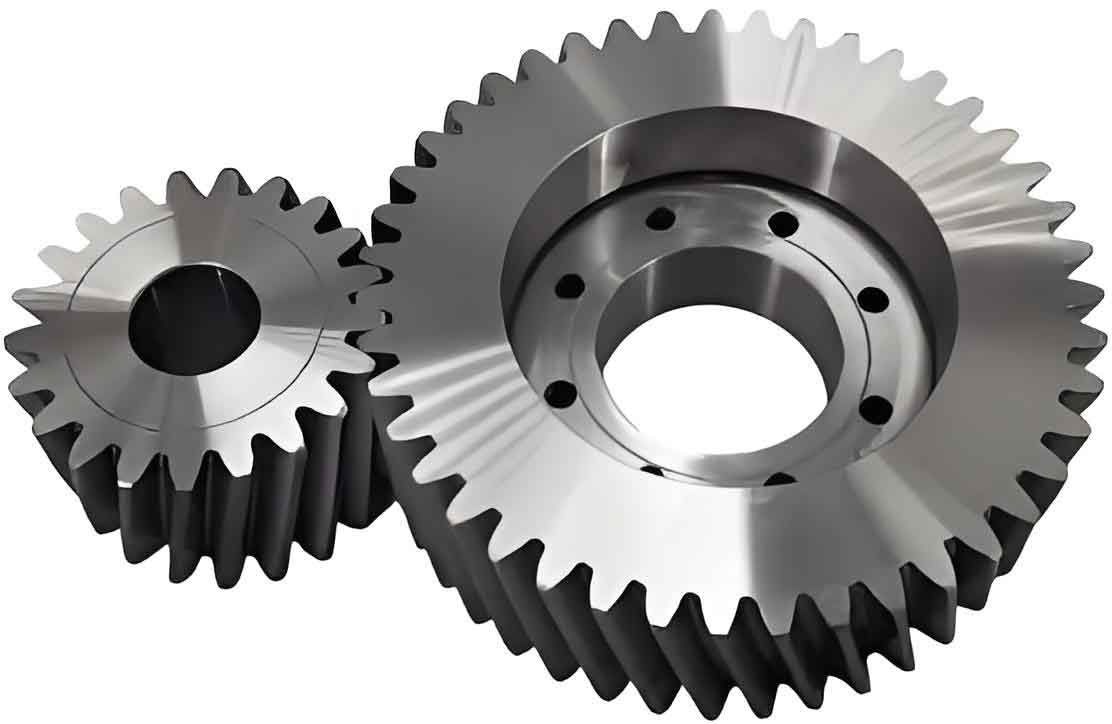
Our approach revolves around a “fixed gear” measurement strategy. Instead of indexing the gear during measurement, the gear remains stationary on the CMM table. The probe travels to predefined theoretical points on the tooth flanks. This requires a robust mathematical model of the gear, precise establishment of a workpiece coordinate system, and intelligent path planning to avoid collisions. We then developed dedicated software to automate the entire process, from generating measurement code for the CMM’s controller (PC-DMIS) to evaluating the measured data according to international standards. This work details our complete methodology and its successful implementation.
Mathematical Foundation for Cylindrical Gears Measurement
The core of any coordinate-based measurement is the knowledge of the nominal geometry. For involute cylindrical gears, this begins with the basic parameters: number of teeth \(z\), normal module \(m_n\), pressure angle \(\alpha_n\), helix angle \(\beta\), face width \(b\), and profile shift coefficient \(x_n\). From these, we derive the essential geometric quantities needed for measurement planning.
The transverse module \(m_t\) and transverse pressure angle \(\alpha_t\) are calculated as:
$$m_t = \frac{m_n}{\cos \beta}, \quad \alpha_t = \arctan\left(\frac{\tan \alpha_n}{\cos \beta}\right)$$
The base circle radius \(r_b\), critical for defining the involute profile, is:
$$r_b = \frac{m_t z}{2} \cos \alpha_t$$
For our measurement planning, we need the theoretical coordinates and surface normal vectors for two types of feature points: those for profile deviation and those for pitch deviation.
Profile Deviation Feature Points
Profile deviation is evaluated on a trace along the tooth flank, typically at the mid-face width position. For the \(i\)-th tooth and the \(j\)-th sample point along its profile, the theoretical coordinate \(\mathbf{T_{\alpha_{ij}}}(x_{T_{\alpha_{ij}}}, y_{T_{\alpha_{ij}}}, z_{T_{\alpha_{ij}}})\) on the involute curve is given by:
$$ x_{T_{\alpha_{ij}}} = r_b \cos(\varepsilon_i – f \varphi_j) – f r_b \varphi_j \sin(\varepsilon_i – f \varphi_j) $$
$$ y_{T_{\alpha_{ij}}} = r_b \sin(\varepsilon_i – f \varphi_j) + f r_b \varphi_j \cos(\varepsilon_i – f \varphi_j) $$
$$ z_{T_{\alpha_{ij}}} = -\frac{b}{2} $$
Here, \(f\) is a sign factor (+1 for left flank, -1 for right flank), \(\varepsilon_i\) is the angular position of the start of the involute for the \(i\)-th tooth, and \(\varphi_j\) is the roll angle corresponding to the \(j\)-th profile point. The corresponding unit normal vector \(\mathbf{n_{T_{\alpha_{ij}}}}(i_{T_{\alpha_{ij}}}, j_{T_{\alpha_{ij}}}, k_{T_{\alpha_{ij}}})\), which dictates the correct probe approach direction, is:
$$ i_{T_{\alpha_{ij}}} = \cos \beta \cos(\varepsilon_i + f(-\varphi_j + \pi/2)) $$
$$ j_{T_{\alpha_{ij}}} = \cos \beta \sin(\varepsilon_i + f(-\varphi_j + \pi/2)) $$
$$ k_{T_{\alpha_{ij}}} = H \sin \beta $$
where \(H\) indicates hand of helix (1 for left-hand, -1 for right-hand, 0 for spur gears).
Pitch Deviation Feature Points
Pitch deviation measurement involves probing points on all teeth at a defined reference circle, commonly the pitch circle. For the \(i\)-th tooth, the coordinate of the pitch point \(\mathbf{T_{p_i}}(x_{T_{p_i}}, y_{T_{p_i}}, z_{T_{p_i}})\) is:
$$ x_{T_{p_i}} = \frac{m_t z}{2} \cos \theta_i $$
$$ y_{T_{p_i}} = \frac{m_t z}{2} \sin \theta_i $$
$$ z_{T_{p_i}} = -\frac{b}{2} $$
The angle \(\theta_i\) for the \(i\)-th tooth is calculated considering the space width:
$$ \theta_i = f \frac{s}{m_t z} – \frac{2\pi(i-1)}{z} + H \frac{b \tan \beta}{m_t z} $$
where \(s\) is the transverse chordal tooth thickness. The unit normal vector \(\mathbf{n_{T_{p_i}}}\) at this point is:
$$ i_{T_{p_i}} = \cos \beta \cos(\theta_i + f(-\alpha_t + \pi/2)) $$
$$ j_{T_{p_i}} = \cos \beta \sin(\theta_i + f(-\alpha_t + \pi/2)) $$
$$ k_{T_{p_i}} = H \sin \beta $$
These equations form the precise digital twin of the cylindrical gear, enabling the CMM to know exactly where and how to probe.
Core CMM Measurement Methodology for Cylindrical Gears
With the mathematical model defined, the practical CMM measurement process involves several critical steps: probe calibration, workpiece coordinate system (WCS) establishment, and safe path planning.
Probe Calibration and Radius Compensation
Probe calibration is essential to determine the effective probe tip radius (\(r_p\)) and to correlate different probe angles. We calibrate by measuring a reference sphere of known radius (\(R_C\)) at multiple points. A least-squares sphere fit to the measured stylus tip centers yields the fitted sphere center and radius (\(R_f\)). The effective probe radius is:
$$r_p = R_f – R_C$$
During gear measurement, when the probe triggers at a ball center coordinate \(\mathbf{S}(x_S, y_S, z_S)\), the actual contact point \(\mathbf{Q}(x_Q, y_Q, z_Q)\) on the cylindrical gear flank is calculated using the theoretical surface normal \(\mathbf{n_Q}\):
$$ x_Q = x_S – i_Q \cdot r_p $$
$$ y_Q = y_S – j_Q \cdot r_p $$
$$ z_Q = z_S – k_Q \cdot r_p $$
This radius compensation, performed in the direction of the nominal surface normal, is crucial for accuracy.
Establishing the Gear Workpiece Coordinate System (WCS)
Accurately aligning the CMM’s coordinate system with the gear’s datums is the most critical step for fixed-gear measurement. We employ a two-stage process: rough alignment and fine iterative alignment.
1. Rough WCS Alignment: This is performed manually or via a simple program.
- Z-axis and Origin: Three points are probed on the gear’s top face to define a plane. Its normal vector defines the +Z axis of the rough WCS (\(Z_{W0}\)). The centroid of three points probed inside the gear bore defines the coordinate origin \(O_{W0}\).
- X-axis Direction: One point (\(C_7\)) is probed on the left flank and another (\(C_8\)) on the right flank of an arbitrary tooth, roughly symmetrical. The line through \(O_{W0}\) and the midpoint \(G\) of \(C_7C_8\) is projected onto the XY plane to define the +X axis direction (\(X_{W0}\)).
This provides a sufficiently good initial alignment for automated fine alignment.
2. Fine Iterative WCS Alignment: The goal is to precisely align the X-axis with the theoretical symmetry plane of a specific tooth. We define an iterative convergence criterion \(\epsilon\) (e.g., 1 µm).
- In the current WCS (\(O_W-X_{Wk}Y_{Wk}Z_{Wk}\)), probe a point \(C_{Lk}\) on the left flank and a point \(C_{Rk}\) on the right flank of the target tooth. The probe approach directions are kept normal to the current X-axis.
- Check the convergence condition: \( |y_{C_{Lk}} + y_{C_{Rk}}| \le \epsilon \). If satisfied, the X-axis is accurately aligned.
- If not satisfied, construct a new X-axis (\(X_{W(k+1)}\)) from \(O_W\) to the midpoint of \(C_{Lk}\) and \(C_{Rk}\), project it, and update the WCS. Repeat from step 1.
This iterative method ensures that the final WCS is precisely aligned with the gear’s geometry, minimizing alignment-induced errors in subsequent measurements of all cylindrical gears.
Probe Path Planning and Motion Control
Safe and efficient probe navigation around the complex shape of cylindrical gears is vital. We plan a “box-frame” style path. For each feature point, the probe moves:
- From a safe clearance position to an approach position near the point.
- Along the surface normal vector to probe the point.
- Back to the approach position.
- To a safe position outside the gear envelope before moving to the next tooth or feature.
For pitch measurement, which involves moving between tight tooth spaces, the path is carefully sequenced: measure the right flank of tooth N, then the left flank of tooth N+1 within the same tooth space, then exit, move around the outside of the gear, and enter the next tooth space. This minimizes risky internal movements. The probe angles (A and B rotations) are selected (typically A0B0 for spur gears measured at mid-face) to ensure the stylus can reach the target points without shaft collision.
Development of the Dedicated Cylindrical Gear Measurement Software
Based on the methodology above, we developed a specialized software application in Python. It acts as a front-end for the CMM operator, integrating gear parameter input, measurement planning, code generation, and data evaluation. The software architecture is modular, focusing on key functionalities.
1. Gear Parameter Management: The user inputs all basic gear parameters. The software calculates all derived geometry (like \(r_b, m_t, \alpha_t\)) and generates the theoretical point clouds for profile and pitch measurements, complete with coordinates and normals.
2. Measurement Program Generation: This is the core interface with the CMM. The software generates a complete, ready-to-run measurement program in the native scripting language of the CMM’s controller (e.g., PC-DMIS). This program includes:
- Code for the fine iterative WCS alignment.
- Sequenced move commands to all theoretical feature points, using the planned safe paths.
- Triggers for data collection at each point.
3. Data Evaluation and Reporting: After measurement execution, the software imports the acquired point data. It performs the probe radius compensation using the stored calibration data and the theoretical normals. It then evaluates the compensated data according to ISO 1328-1 (GB/T 10095.1):
- Profile Deviations: Calculates the profile total deviation \(F_\alpha\), profile form deviation \(f_{f\alpha}\), and profile slope deviation \(f_{H\alpha}\) for each evaluated flank.
- Pitch Deviations: Calculates the single pitch deviation \(f_p\) and the total cumulative pitch deviation \(F_p\) for all teeth.
The software displays graphical plots of the deviations, lists numerical results in tables, and generates a comprehensive inspection report. This seamless integration from planning to reporting makes the CMM an effective tool for inspecting cylindrical gears.
Experimental Validation and Results
To validate our method and software, we conducted measurement trials on a spur cylindrical gear with the following parameters: \(z=24\), \(m_n=4.5\) mm, \(\alpha_n=20^\circ\), \(x_n=-0.5\), \(b=20\) mm. The tests were performed on a high-precision CMM (Hexagon GLOBAL S) and the results were compared against measurements from a dedicated gear measuring center (Klingelnberg P100).
Measurement Procedure on CMM
A 3 mm stylus was calibrated, yielding an effective radius of 3.000 mm with a standard deviation of 0.2 µm. After rough manual alignment, the fine iterative WCS alignment was performed automatically with \(\epsilon = 1 \mu m\). Convergence was achieved in 3 iterations. The dedicated software then generated and executed the measurement program for both pitch and profile deviations.
Pitch deviation was measured on all teeth over 5 consecutive runs. Profile deviation was measured on 4 teeth evenly distributed around the circumference, also over 5 runs. The repeatability was excellent.
Results and Comparison
The key results from our CMM software and the GMC are summarized below. The accuracy grades were determined according to ISO 1328-1 limits.
Pitch Deviation Results: The table below shows the mean values from 5 runs on both flanks.
| Measurement System | Left Flank \(f_p\) (µm) | Left Flank \(F_p\) (µm) | Right Flank \(f_p\) (µm) | Right Flank \(F_p\) (µm) |
|---|---|---|---|---|
| Our CMM Software | 9.1 | 41.6 | 7.9 | 33.9 |
| Gear Measuring Center (P100) | 8.9 | 41.3 | 9.2 | 34.5 |
| Difference (Δ) | +0.2 | +0.3 | -1.3 | -0.6 |
Both systems graded the pitch accuracy of this cylindrical gear as ISO Grade 7. The maximum absolute difference between the two methods was 1.3 µm for single pitch deviation.
Profile Deviation Results: The mean values for the profile total deviation \(F_\alpha\) for the four measured teeth are shown below, comparing the two systems.
| Tooth # | Left Flank \(F_\alpha\) (CMM) [µm] | Left Flank \(F_\alpha\) (P100) [µm] | Δ [µm] | Right Flank \(F_\alpha\) (CMM) [µm] | Right Flank \(F_\alpha\) (P100) [µm] | Δ [µm] |
|---|---|---|---|---|---|---|
| 1 | 20.2 | 19.4 | +0.8 | 19.1 | 18.2 | +0.9 |
| 7 | 15.7 | 14.7 | +1.0 | 15.6 | 14.6 | +1.0 |
| 13 | 23.0 | 22.9 | +0.1 | 16.6 | 15.8 | +0.8 |
| 19 | 15.9 | 15.6 | +0.3 | 26.7 | 25.5 | +1.2 |
The overall profile accuracy was graded as ISO Grade 9. The results from our CMM-based method show excellent agreement with the dedicated GMC. The maximum absolute difference for any profile total deviation value was 1.9 µm, and most differences were well below 1.2 µm. This level of consistency validates the accuracy and reliability of our fixed-gear measurement methodology and the developed software for evaluating cylindrical gears.
Conclusion
We have successfully developed and validated a comprehensive method and dedicated software for measuring cylindrical gears on standard Coordinate Measuring Machines. The work provides a complete solution, encompassing:
- A precise mathematical model for generating theoretical probe points and normals for involute cylindrical gears.
- A robust, iterative algorithm for accurately establishing the gear workpiece coordinate system, which is critical for fixed-gear measurement.
- Intelligent probe path planning to ensure collision-free and efficient measurement cycles.
- A fully functional software package that automates measurement code generation for the CMM and performs standard-compliant evaluation of profile and pitch deviations.
The experimental results demonstrate that the measurement outcomes from our system are in excellent agreement with those from a high-end dedicated gear measuring center. The differences for key deviation parameters were within a few micrometers, confirming the method’s high accuracy. This development effectively enhances the capability of general-purpose CMMs, making them a viable and accurate tool for the inspection of cylindrical gears, especially in environments where dedicated gear metrology equipment is not available. The methodologies for modeling, alignment, and software integration also serve as a valuable reference for the secondary development of CMM platforms for other complex geometric components.