
The pursuit of quieter machinery is a constant endeavor in mechanical engineering. Among various power transmission elements, spur cylindrical gears are ubiquitous due to their simplicity and cost-effectiveness. However, their inherent kinematic characteristics, primarily the time-varying mesh stiffness, often lead to vibration excitation and significant acoustic emissions. While improving manufacturing precision is one path, it is often resource-intensive. This article delves into an alternative, passive approach: the application of viscoelastic damping materials directly onto the gear structure to attenuate noise radiation and transmission from the gear end faces.
Noise and vibration in gear systems originate from dynamic excitations. For spur cylindrical gears operating with a contact ratio in the range $$1 < \epsilon < 2$$, the number of tooth pairs in contact fluctuates. This causes a periodic variation in the mesh stiffness, which is a fundamental source of vibration. The time-varying mesh stiffness $$k_m(t)$$ can be approximated as a periodic function of the mesh frequency $$\omega_m$$:
$$k_m(t) = k_0 + \sum_{n=1}^{N} k_n \cos(n\omega_m t + \phi_n)$$
where $$k_0$$ is the average mesh stiffness, and $$k_n$$ and $$\phi_n$$ are the amplitude and phase of the n-th harmonic, respectively. This fluctuating force excites the structural modes of the gear body, leading to radiated noise. Furthermore, errors in profile, pitch, and assembly, represented as displacement excitations $$e(t)$$, modulate this force, exacerbating the dynamic response. The primary goal is to dissipate the vibrational energy before it radiates as sound. This is where the properties of viscoelastic materials become critical.
The fundamental mechanism of viscoelastic materials is energy dissipation through internal friction. Unlike purely elastic materials where deformation energy is largely stored and returned, viscoelastic polymers exhibit hysteresis. Under cyclic stress, the strain lags behind the stress, creating a hysteresis loop in the stress-strain curve. The area enclosed by this loop represents the energy dissipated per cycle, converted into heat. For a material subjected to sinusoidal stress $$\sigma = \sigma_0 \sin(\omega t)$$ and resulting strain $$\epsilon = \epsilon_0 \sin(\omega t – \delta)$$, the loss factor $$\eta$$, a key damping parameter, is given by:
$$\eta = \tan \delta = \frac{E”}{E’}$$
where $$\delta$$ is the loss angle, $$E’$$ is the storage modulus (elastic component), and $$E”$$ is the loss modulus (viscous component). A high loss factor indicates superior damping performance. When applied to a vibrating surface like a gear end face, the material is subjected to flexural deformation. The shear strain within the viscoelastic layer is key to energy dissipation. For a constrained layer damping treatment, where the viscoelastic material is sandwiched between the base structure and a stiff constraining layer, the damping is highly effective. In our application, a simpler free-layer damping treatment, where the material is applied directly to the gear surface, is investigated. The damping performance increases with the thickness of the layer.
To understand the acoustic attenuation, consider a plane sound wave propagating through a viscoelastic medium in the z-direction. At position z, the amplitude A(z) of a wave with initial amplitude $$A_0$$ and frequency f decays according to:
$$A(z) = A_0 e^{-\beta z}$$
where $$\beta$$ is the attenuation coefficient, closely related to the material’s damping properties. The intensity I, proportional to the square of amplitude, decays as $$I(z) = I_0 e^{-2\beta z}$$. The power dissipated per unit volume can be derived. If we consider a small element of thickness $$\delta z$$ and density $$\rho$$, the net power loss $$\Delta P$$ in this element is the difference between incoming and outgoing acoustic power. For small $$\delta z$$, it can be shown that:
$$\Delta P \approx \beta \rho (f A_0 \delta z e^{-\beta z})^2$$
The loss coefficient $$\kappa$$, representing the fraction of power dissipated in the element, is approximately proportional to the product of the attenuation coefficient and the thickness: $$\kappa \propto 2\beta \delta z$$. This simplified model underscores that for effective noise reduction in cylindrical gears, both the material’s inherent damping (high $$\beta$$) and a sufficient application thickness are crucial parameters.
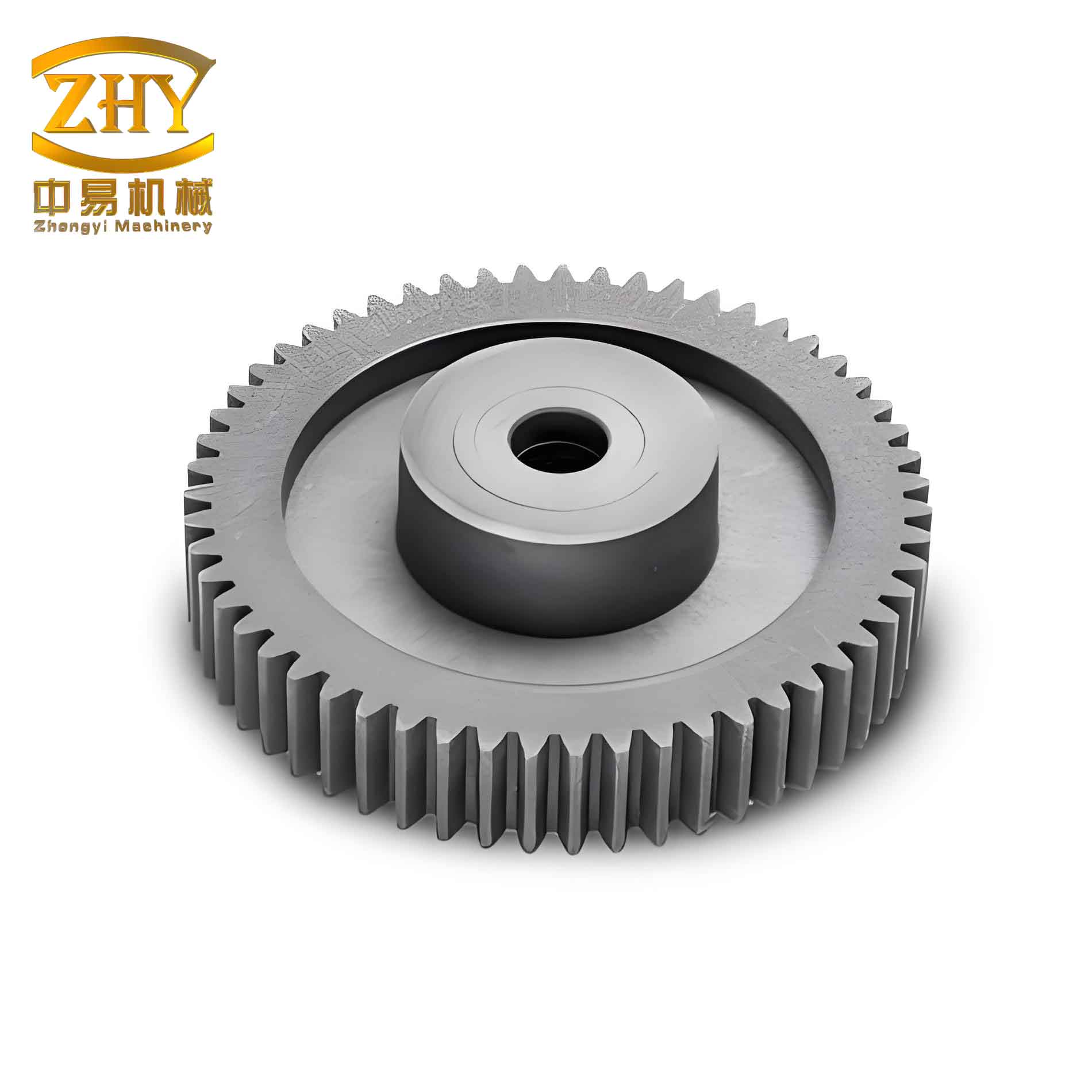
The experimental investigation focused on applying two distinct viscoelastic polymers—Polyurethane (PU) and Acrylic Ester (AE)—onto the end faces of spur cylindrical gears. The test setup comprised a motor-driven gear pair. The key parameters of the test cylindrical gears are summarized in the table below.
| Structural Parameter | Value |
|---|---|
| Number of teeth (Driver) | 30 |
| Number of teeth (Driven) | 20 |
| Module (mm) | 3 |
| Pressure Angle (degrees) | 20 |
| Face Width (mm) | 28 |
| Center Distance (mm) | 75 |
The materials were applied uniformly to both sides of the driver and driven cylindrical gears. Different coating thicknesses were tested to evaluate the thickness-dependent performance. Noise was measured using a calibrated microphone in a semi-anechoic environment. The primary test speed was set at 720 RPM, corresponding to a shaft rotational frequency $$f_r = 12$$ Hz and a gear mesh frequency $$f_m = 360$$ Hz.
The performance of different materials and thicknesses was quantified. The following table compares the average A-weighted sound pressure level (SPL) reduction across a broad frequency band for various test configurations applied to the cylindrical gears.
| Material Type | Average Coating Thickness (mm) | Avg. SPL Reduction [dB(A)] | Key Observation |
|---|---|---|---|
| Polyurethane (PU) | 0.40 | 1.5 – 2.0 | Stable, moderate reduction. |
| Acrylic Ester (AE) | 0.60 | 2.5 – 3.5 | Better than PU at similar thickness. |
| Acrylic Ester (AE) | 0.93 | 4.0 – 5.0 | Significant improvement, especially at mid-high frequencies. |
| Acrylic Ester (AE) | 1.93 | 5.5 – 6.0 | Highest reduction; diminishing returns observed beyond ~1mm. |
| Baseline (No Coating) | 0.00 | 0.0 (Reference) | — |
The results clearly demonstrate the efficacy of the method. Both polymers act as damping layers, converting vibrational energy from the cylindrical gears into heat. The AE coating consistently outperformed the PU coating for comparable thicknesses, likely due to a higher loss factor $$\eta$$ in the relevant frequency and temperature range. More importantly, the data confirms the theoretical premise: noise reduction increases with coating thickness, as suggested by the $$\kappa \propto \delta z$$ relationship. However, the improvement rate diminishes after a certain thickness (around 1 mm for AE), which may be attributed to reduced shear strain in thicker free layers or potential adhesion issues under high centrifugal forces.
A detailed frequency-domain analysis reveals the targeted attenuation of characteristic gear frequencies. The table below shows the sound pressure level at key frequency components for the baseline and the most effective AE coating (1.93 mm) on the cylindrical gears.
| Frequency (Hz) | Frequency Description | SPL – Baseline (dB) | SPL – 1.93mm AE (dB) | Reduction (dB) |
|---|---|---|---|---|
| 72 | 6 x $$f_r$$ (Harmonic) | 58.2 | 52.1 | 6.1 |
| 180 | 0.5 x $$f_m$$ / 15 x $$f_r$$ | 61.8 | 55.0 | 6.8 |
| 360 | Mesh Frequency ($$f_m$$) | 65.5 | 59.2 | 6.3 |
| 720 | 2 x $$f_m$$ | 59.7 | 53.5 | 6.2 |
| 1080 | 3 x $$f_m$$ | 55.3 | 49.8 | 5.5 |
The damping treatment successfully attenuates components related to the mesh frequency and its harmonics, which are primary contributors to gear whine noise in cylindrical gears. Interestingly, lower-order rotational harmonics (e.g., 72 Hz) are also reduced, indicating a broad-band damping effect on the gear’s structural response. This is crucial because it mitigates not only the forced response at the mesh frequency but also the resonant amplification of other excitations.
For design purposes, a semi-empirical model can be proposed to estimate the achievable noise reduction for cylindrical gears based on coating parameters. Assuming the primary effect is an increase in system damping, the reduction in vibration amplitude, and consequently in radiated sound power, can be related to the coating’s properties and geometry. A simplified model for the expected SPL reduction $$\Delta L$$ might take the form:
$$\Delta L \approx 10 \log_{10}\left(\frac{\zeta_0}{\zeta_0 + \Delta\zeta}\right)$$
where $$\zeta_0$$ is the original damping ratio of the gear structure and $$\Delta\zeta$$ is the added damping from the coating. The added damping $$\Delta\zeta$$ is a function of the material’s loss factor $$\eta$$, the coating thickness $$t_c$$, and the gear body’s thickness $$t_g$$. An approximate relation for a free-layer treatment is:
$$\Delta\zeta \propto \eta \left( \frac{t_c}{t_g} \right)^3$$
This cubic relationship highlights the profound influence of coating thickness relative to the gear web thickness. It explains the significant gains observed when increasing the AE thickness from 0.6 mm to 0.93 mm and the subsequent leveling off. Optimizing this ratio is key for practical applications on cylindrical gears.
The choice of material is paramount. An ideal viscoelastic coating for cylindrical gears must possess:
1. A high loss factor over the operational temperature and frequency range (typically 0-100°C and 10-5000 Hz).
2. Strong adhesion to metal substrates to withstand shear stresses induced by gear vibration and centrifugal force.
3. Sufficient hardness and durability to resist abrasion and environmental factors (oil, moisture).
4. Ease of application and curing.
While AE showed better performance in this study, PU may offer advantages in other conditions, such as better low-temperature flexibility or adhesion. The development of tailored polymer blends or segmented copolymers could yield materials with optimized damping spectra specifically for the dynamic excitation profile of cylindrical gears.
Beyond simple coatings, advanced application techniques can be explored. For instance, patterned coatings or constrained layer damping (CLD) patches could provide higher damping efficiency per unit mass. In a CLD configuration, the viscoelastic layer is constrained by a stiff metal foil bonded on top. This forces the polymer into greater shear deformation for a given bending strain, dramatically increasing energy dissipation. The damping capability of a CLD treatment can be modeled more effectively and offers a potential pathway for high-performance noise control in precision cylindrical gears where significant added mass is a concern.
In conclusion, the application of viscoelastic polymer coatings to the end faces of spur cylindrical gears presents a highly effective, economical, and passive method for noise reduction. Experimental evidence confirms that materials like acrylic ester and polyurethane can attenuate both structure-borne and radiated noise by augmenting the system’s damping. The level of attenuation is positively correlated with the coating thickness, following trends predicted by viscoelastic damping theory, though with diminishing returns beyond an optimal point. The treatment successfully targets critical noise components, including the mesh frequency and its harmonics. For engineers, this approach offers a valuable tool for retrofitting existing gear systems or designing quieter new ones without major geometric alterations. Future work should focus on optimizing material formulations for specific operating conditions, investigating long-term durability under load, and exploring advanced application topologies like constrained layer damping to maximize the noise reduction per unit added mass for cylindrical gears.