
In the realm of mechanical transmission systems, cylindrical gears play a pivotal role due to their efficiency in transmitting motion and torque between parallel shafts. Among various innovative gear designs, the variable hyperbolic circular arc tooth line cylindrical gear (VH-CATT cylindrical gear) has garnered significant attention for its superior performance characteristics, including enhanced load-carrying capacity, increased overlap ratio, improved lubrication, higher bending strength, and the absence of axial forces. These attributes make cylindrical gears, particularly those with advanced tooth profiles, essential components in high-performance applications such as automotive transmissions, industrial machinery, and aerospace systems. This article delves into the influence of design parameters on the root bending stress of equally displaced VH-CATT cylindrical gears, leveraging mathematical modeling and finite element analysis to provide insights for optimal gear design. We focus on how displacement coefficients and other key parameters affect the structural integrity of these cylindrical gears, aiming to guide engineers in selecting parameters that maximize strength and durability.
The theoretical foundation for analyzing cylindrical gears with variable hyperbolic circular arc tooth lines begins with deriving the tooth surface equation under displacement conditions. Displacement, or profile shifting, is a common technique in gear design to avoid undercutting, improve strength, and adjust center distances. For equally displaced cylindrical gears, the center distance remains unchanged, making it advantageous for enhancing bending strength without altering system geometry. We establish coordinate systems to model the gear generation process using a dual-blade milling cutter with a displacement correction method. The cutter is offset by a distance \(x_m\) from the standard position relative to the gear blank center, where \(x\) is the displacement coefficient and \(m\) is the module. This adjustment prevents root interference and optimizes tooth thickness.
We define several coordinate systems: the cutter static coordinate system \(O_1-x_1y_1z_1\) with basis vectors \(\mathbf{i}, \mathbf{j}, \mathbf{k}\); the workpiece static coordinate system \(O_2-x_2y_2z_2\) with basis vectors \(\mathbf{i}_2, \mathbf{j}_2, \mathbf{k}_2\); and the workpiece dynamic coordinate system \(O_d-x_dy_dz_d\) with basis vectors \(\mathbf{i}_d, \mathbf{j}_d, \mathbf{k}_d\). The cutter surface equation in the \(O_1-x_1y_1z_1\) system is given by:
$$
\begin{aligned}
x_1 &= -\left(R \mp \frac{\pi}{4}m \pm u \sin \alpha\right) \cos \theta, \\
y_1 &= -\left(R \mp \frac{\pi}{4}m \pm u \sin \alpha\right) \sin \theta, \\
z_1 &= u \cos \alpha,
\end{aligned}
$$
where \(R\) is the cutter head radius, \(m\) is the module, \(\alpha\) is the pressure angle, \(u\) is a parameter along the cutter profile, and \(\theta\) is the rotational angle. The upper signs correspond to the convex side of the tooth, and the lower signs to the concave side for cylindrical gears. The unit normal vector of the cutter surface is:
$$
\mathbf{e}_1 = \cos \theta \cos \alpha \, \mathbf{i} + \sin \theta \cos \alpha \, \mathbf{j} \pm \sin \alpha \, \mathbf{k}.
$$
Based on spatial meshing theory, the engagement condition between the cutter and gear workpiece is \(\phi = \mathbf{n}_1 \cdot \mathbf{v}_2 = 0\), where \(\mathbf{n}_1\) is the normal vector and \(\mathbf{v}_2\) is the relative velocity. This leads to the contact line equation, which, after transformation, yields the tooth surface equation for displaced VH-CATT cylindrical gears in the dynamic coordinate system \(O_d-x_dy_dz_d\):
$$
\begin{aligned}
x_d &= \left[ -\left(R \mp \frac{\pi}{4}m \pm u \sin \alpha\right) \cos \theta + R + R_1 \psi \right] \cos \psi + (u \cos \alpha – R_1 – x_m) \sin \psi, \\
y_d &= \left[ \left(R \mp \frac{\pi}{4}m \pm u \sin \alpha\right) \cos \theta – R – R_1 \psi \right] \sin \psi + (u \cos \alpha – R_1 – x_m) \cos \psi, \\
z_d &= \left(R \mp \frac{\pi}{4}m \pm u \sin \alpha\right) \sin \theta, \\
u &= \frac{\mp \sin \alpha \cos \theta \left(R \mp \frac{\pi}{4}m\right) \pm \sin \alpha (R_1 \psi + R)}{\cos \theta} + x_m \cos \alpha,
\end{aligned}
$$
where \(R_1\) is the pitch radius of the gear, \(\psi\) is the rotation angle of the workpiece, and other parameters are as defined. This equation describes the complete tooth surface, including both convex and concave sides, for cylindrical gears with displacement. Additionally, the transition surface formed by the cutter tip fillet is derived to account for root geometry, which is critical for bending stress analysis. The transition surface equation is:
$$
\begin{aligned}
x_{dr} &= \left\{ -\left[A \mp r(\cos \alpha – \cos \beta)\right] \cos \theta + R + R_1 \psi \right\} \cos \psi + \left[d + r(\sin \beta – \sin \alpha) – R_1 – x_m\right] \sin \psi, \\
y_{dr} &= \left\{ \left[A \mp r(\cos \alpha – \cos \beta)\right] \cos \theta – R – R_1 \psi \right\} \sin \psi + \left[d + r(\sin \beta – \sin \alpha) – R_1 – x_m\right] \cos \psi, \\
z_{dr} &= \left[A \mp r(\cos \alpha – \cos \beta)\right] \sin \theta, \\
\beta &= \arctan \left( \frac{d \cos \theta – r \sin \alpha \cos \theta – x_m \cos \theta}{\pm A \cos \theta \mp (R_1 \psi + R) – r \cos \alpha \cos \theta} \right),
\end{aligned}
$$
where \(A = R \mp \frac{\pi}{4}m \mp d \tan \alpha\), \(d\) is a parameter, \(r\) is the cutter tip fillet radius, and \(\beta\) is an angle parameter. These equations form the basis for generating accurate 3D models of cylindrical gears for subsequent finite element analysis.
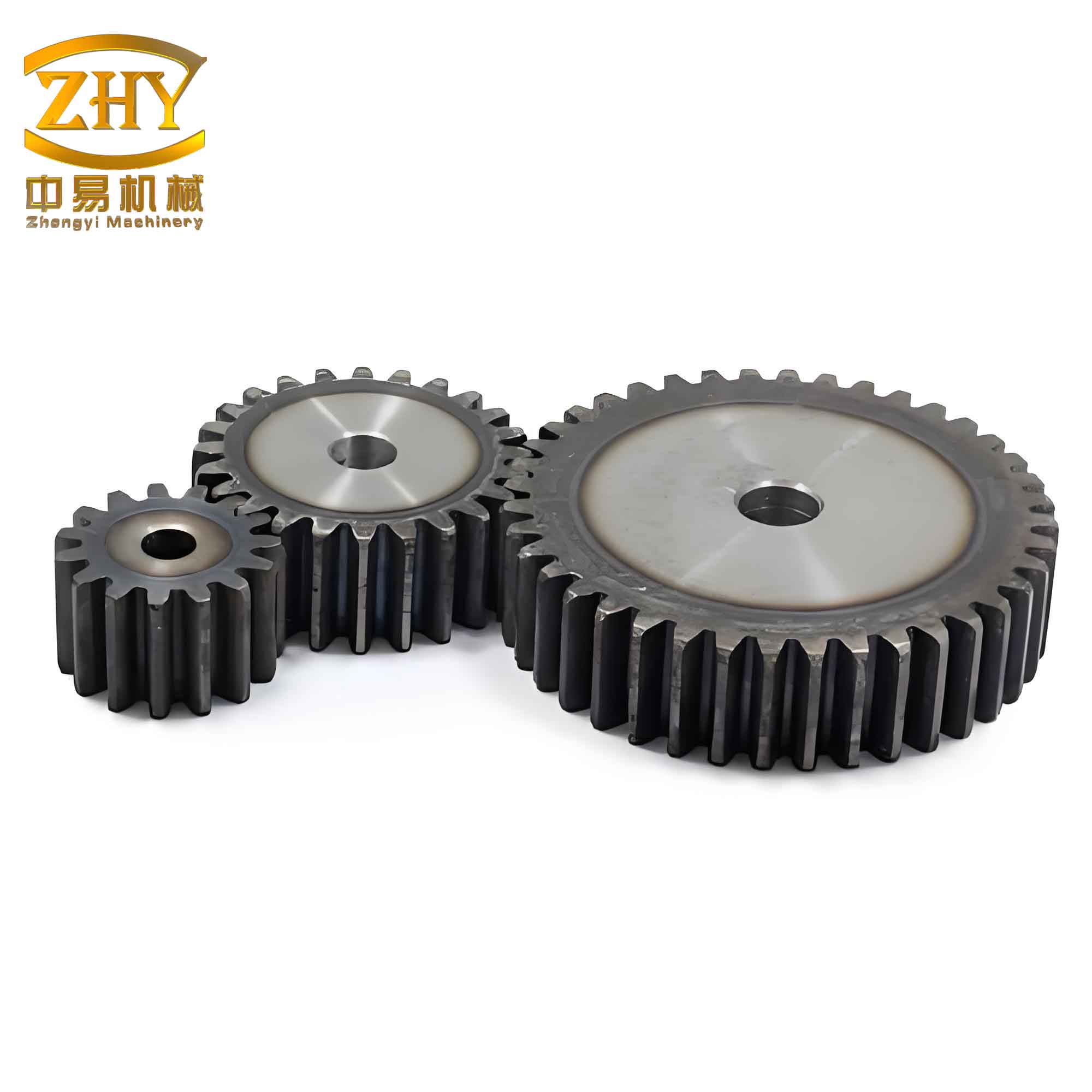
To investigate the bending stress in cylindrical gears, we employ finite element analysis (FEA) using a seven-tooth engagement model to balance computational efficiency and accuracy. The gear pair parameters are summarized in Table 1, which includes key design factors such as module, pressure angle, and cutter dimensions. The model is meshed with hexahedral reduced integration elements (C3D8R) to capture stress concentrations effectively. Material properties are set to an elastic modulus of 210 GPa and a Poisson’s ratio of 0.3, typical for steel alloys used in cylindrical gears. Boundary conditions simulate realistic operating scenarios: the driving gear is allowed to rotate only about its axis, while the driven gear is subjected to a torque load of 100 N·m, with all other degrees of freedom constrained. Contact interactions are defined between meshing tooth surfaces, and the analysis is performed using implicit static steps to ensure convergence and capture the full engagement cycle. This setup allows us to compute root bending stresses under various parameter combinations, providing a comprehensive understanding of how design choices impact the performance of cylindrical gears.
| Parameter | Value | Parameter | Value |
|---|---|---|---|
| Pressure angle \(\alpha\) | 20° | Tip clearance coefficient \(c^*\) | 0.25 |
| Module \(m\) | 3 mm | Tooth width \(B\) | 45 mm |
| Driving gear teeth \(z_1\) | 21 | Cutter head radius \(R\) | 80 mm |
| Driven gear teeth \(z_2\) | 37 | Cutter tip fillet radius \(r\) | 0.2 mm |
| Addendum coefficient \(h_a^*\) | 1 | Displacement coefficient \(x\) | Varied (-0.2 to 0.2) |
The influence of the displacement coefficient on root bending stress is a primary focus for cylindrical gears. We analyze equally displaced gears with displacement coefficients ranging from -0.2 to 0.2, keeping other parameters constant as per Table 1. The FEA results reveal that root bending stress decreases significantly as the displacement coefficient increases for both driving and driven cylindrical gears. Specifically, for the driving gear, stress reduces from 110.03 MPa at \(x = -0.2\) to 90.06 MPa at \(x = 0.2\), a decline of approximately 18.2%. Similarly, for the driven gear, stress drops from 100.48 MPa to 85.64 MPa over the same range, a decrease of about 14.8%. This trend is attributed to the increased tooth root thickness with positive displacement, which enhances the section modulus and reduces stress concentration. The driving gear exhibits a more pronounced reduction, likely due to its smaller number of teeth and higher stress susceptibility. These findings underscore the benefit of positive displacement in improving bending strength for cylindrical gears, aligning with traditional gear design principles where profile shifting mitigates root undercutting and boosts load capacity.
Beyond displacement coefficients, other design parameters profoundly affect the bending stress in cylindrical gears. We systematically vary parameters such as cutter head radius, module, tooth width, and cutter tip fillet radius to quantify their impacts. Each parameter is studied independently while maintaining others at baseline values from Table 1, and results are summarized in Table 2 for clarity. The analysis provides insights into how these factors interact with displacement to influence gear performance.
| Parameter | Range | Trend in Bending Stress | Key Observation |
|---|---|---|---|
| Cutter head radius \(R\) | 60 mm to 100 mm | Decreases with increasing \(R\) | Larger \(R\) enlarges load distribution area, reducing stress. |
| Module \(m\) | 3 mm to 7 mm | Decreases significantly with increasing \(m\) | Stress reduction of ~74% from 3 mm to 5 mm; ~60% from 5 mm to 7 mm. |
| Tooth width \(B\) | 30 mm to 60 mm | Decreases initially, then stabilizes | Stress reduction plateaus when \(B\) exceeds ~45 mm (single cutter radius). |
| Cutter tip fillet radius \(r\) | 0 mm to 0.4 mm | Decreases initially, then stabilizes | Larger \(r\) smoothens root transition but may reduce overlap ratio. |
First, the cutter head radius \(R\) is a critical parameter for cylindrical gears with hyperbolic circular arc tooth lines. We examine values of 60 mm, 80 mm, and 100 mm under varying displacement coefficients. The results indicate that increasing \(R\) reduces root bending stress across all displacement values. For instance, at \(x = 0\), stress decreases by approximately 15% when \(R\) increases from 60 mm to 100 mm. This is because a larger cutter radius expands the contact region between meshing teeth, distributing loads more evenly and lowering peak stresses. The relationship can be expressed empirically as \(\sigma_b \propto R^{-k}\), where \(\sigma_b\) is bending stress and \(k\) is a positive exponent dependent on gear geometry. Thus, for high-strength applications of cylindrical gears, selecting a larger cutter head radius is advantageous, though it may increase manufacturing complexity and cost.
Second, the module \(m\) exhibits a dominant influence on bending stress in cylindrical gears. We analyze modules of 3 mm, 5 mm, and 7 mm, with displacement coefficients from -0.2 to 0.2. As shown in Figure 5 (conceptual), stress drops dramatically with larger modules; for example, at \(x = 0\), increasing \(m\) from 3 mm to 5 mm reduces stress by about 74%, and from 5 mm to 7 mm by another 60%. This is due to the proportional increase in tooth dimensions with module, which enhances the root section modulus according to the beam theory formula for bending stress:
$$
\sigma_b = \frac{M}{S},
$$
where \(M\) is the bending moment and \(S\) is the section modulus. For cylindrical gears, \(S\) scales with \(m^2\) for a given tooth profile, explaining the sharp decline. Moreover, the effect of displacement becomes more pronounced at higher modules; the stress reduction range with \(x\) increases from 18.15% at \(m = 3\) mm to 18.86% at \(m = 7\) mm. This implies that displacement correction is particularly beneficial for large-module cylindrical gears, offering greater flexibility in design optimization.
Third, tooth width \(B\) impacts bending stress in cylindrical gears, but its effect diminishes beyond a threshold. We test widths of 30 mm, 45 mm, and 60 mm at constant cutter radius \(R = 80\) mm. Initially, widening the tooth reduces stress due to increased load-bearing area; for example, stress decreases by about 20% when \(B\) increases from 30 mm to 45 mm at \(x = 0\). However, beyond 45 mm (approximately equal to \(R\)), further widening yields negligible stress reduction—less than 5% from 45 mm to 60 mm. This plateau occurs because the effective contact width in cylindrical gears with arc-shaped tooth lines is limited by the cutter radius; excess width does not contribute significantly to load distribution. Thus, optimizing tooth width relative to cutter radius is essential to avoid material waste while ensuring adequate strength for cylindrical gears.
Fourth, the cutter tip fillet radius \(r\) affects root stress concentration in cylindrical gears. We evaluate \(r = 0\) mm (sharp corner), 0.2 mm, and 0.4 mm. Increasing \(r\) from 0 mm to 0.2 mm reduces bending stress by approximately 25% at \(x = 0\), as a larger fillet radius smoothens the root transition curve, lowering stress concentration factors. The relationship can be approximated by \(\sigma_b \propto r^{-\gamma}\) for small \(r\), where \(\gamma\) is a geometric factor. However, beyond 0.2 mm, stress reduction tapers off; increasing \(r\) to 0.4 mm yields only an additional 5% reduction. This is because excessively large fillet radii can decrease the overlap ratio of cylindrical gears, potentially compromising meshing smoothness and increasing dynamic loads. Therefore, a balanced fillet radius is recommended to maximize bending strength without adverse effects on gear engagement.
The interplay between displacement and other parameters further enriches the design landscape for cylindrical gears. For instance, at a given cutter head radius, positive displacement synergizes with larger modules to achieve minimal stress. We can model the combined effect using a multivariate equation derived from regression analysis of FEA data:
$$
\sigma_b = \sigma_0 \left(1 – k_x x\right) \left(\frac{m_0}{m}\right)^a \left(\frac{R_0}{R}\right)^b \left(1 – e^{-c B}\right) \left(1 – d r\right),
$$
where \(\sigma_0\) is reference stress, \(k_x, a, b, c, d\) are coefficients, and \(m_0, R_0\) are reference values. This empirical formula helps designers quickly estimate bending stress for cylindrical gears under various parameter sets, though precise values require detailed FEA. Additionally, the transition surface geometry, governed by the cutter tip fillet, plays a crucial role in stress distribution; we observe that stress concentrations often occur at the blend between the active tooth flank and root fillet, highlighting the importance of accurate modeling for cylindrical gears.
In practice, the design of cylindrical gears must balance multiple constraints, including size, weight, cost, and performance. Our analysis suggests that for high-load applications, cylindrical gears with positive displacement, larger modules, and optimized cutter radii offer the best bending strength. However, increasing module or cutter head radius may lead to larger gear dimensions, which could be prohibitive in space-constrained systems. Similarly, while wider teeth reduce stress initially, excessive width adds mass and inertia, affecting dynamic response. Therefore, a holistic approach integrating bending stress, contact stress, and dynamic analysis is essential for cylindrical gears. Future work could explore multi-objective optimization algorithms to automate parameter selection for cylindrical gears, considering trade-offs between strength, efficiency, and manufacturability.
In conclusion, this study comprehensively analyzes the influence of design parameters on root bending stress in equally displaced variable hyperbolic circular arc tooth line cylindrical gears. We derive the tooth surface equations incorporating displacement coefficients and establish a finite element model to simulate stress distributions. Key findings include: (1) Root bending stress decreases with increasing displacement coefficient, with the driving gear showing a more significant reduction; (2) Cutter head radius inversely affects stress, as larger radii improve load distribution; (3) Module has a profound impact, with larger modules drastically reducing stress and amplifying the benefits of displacement; (4) Tooth width and cutter tip fillet radius exhibit diminishing returns, with optimal ranges tied to cutter geometry; (5) The effects are consistent across cylindrical gears, underscoring the versatility of displacement correction. These insights provide a foundation for parameter optimization in cylindrical gear design, enabling engineers to enhance bending strength and reliability in transmission systems. As cylindrical gears continue to evolve, advanced manufacturing techniques like additive manufacturing may further unlock potential by enabling complex tooth profiles tailored to specific stress patterns, pushing the boundaries of gear performance.