
In the field of mechanical transmission, the pursuit of higher load capacity, reduced vibration, and lower noise has driven significant advancements in gear design. Among these, high contact ratio (HCR) cylindrical gears have emerged as a promising solution, offering enhanced performance without substantially increasing the mass of gear systems. As an engineer focused on dynamic analysis, I have explored the coupling dynamic characteristics of HCR cylindrical gears, comparing them with ordinary contact ratio cylindrical gears. This article delves into the time-varying meshing stiffness models, system dynamics, and performance under varying rotational speeds, utilizing formulas and tables to summarize key findings. Throughout this discussion, the term “cylindrical gears” will be emphasized to highlight the focus on spur gear systems, which are fundamental in many industrial applications. The analysis aims to provide insights into how HCR cylindrical gears can improve transmission systems, leveraging computational models and empirical data to validate their superiority in dynamic behavior.
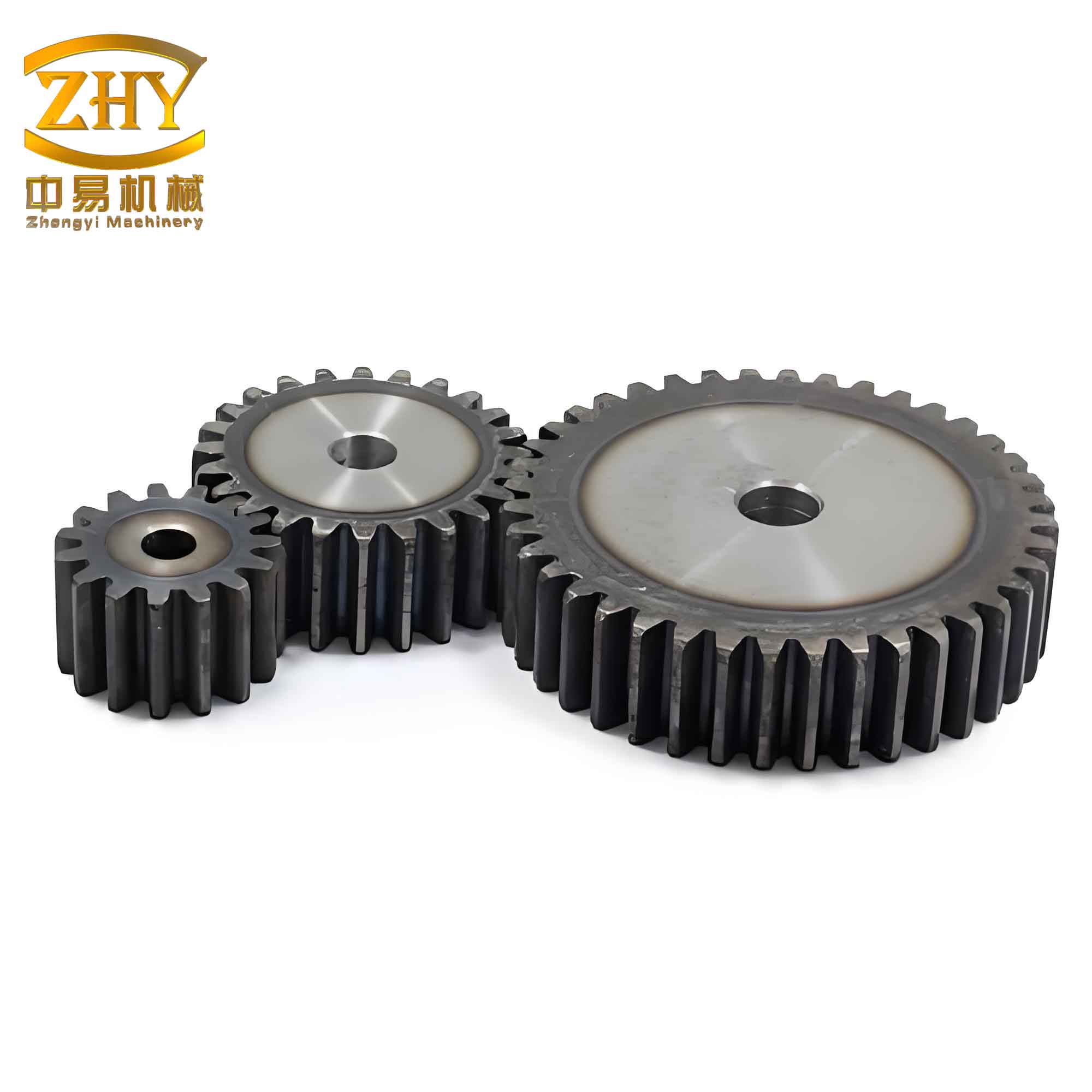
Cylindrical gears, particularly spur gears, are widely used in transmissions due to their simplicity and efficiency. However, traditional cylindrical gears with ordinary contact ratios often face limitations in load distribution and vibration suppression. HCR cylindrical gears, defined by a contact ratio greater than 2, address these issues by involving more teeth in the meshing process, thereby distributing loads more evenly and reducing stiffness fluctuations. In my research, I developed a comprehensive approach to analyze these effects, starting with the calculation of time-varying meshing stiffness based on the potential energy method. This method models each tooth as a cantilever beam, accounting for Hertzian contact, bending, shear, and axial compression deformations. The stiffness components for a single tooth pair can be expressed as follows, where the symbols are defined in subsequent tables:
The Hertzian contact stiffness \( K_h \) is given by:
$$ \frac{1}{K_h} = \frac{4(1 – \nu^2)}{\pi E b} $$
Here, \( \nu \) represents Poisson’s ratio, \( E \) is the elastic modulus, and \( b \) denotes the face width of the cylindrical gears. For bending stiffness \( K_b \), the formula integrates over the tooth profile:
$$ \frac{1}{K_b} = \int_0^S \frac{(x \cos \alpha_1 – h \sin \alpha_1)^2}{E I_x} \, dx $$
In this expression, \( \alpha_1 \) is the angle between the normal load and tooth thickness direction, \( I_x \) is the area moment of inertia, \( h \) is half the tooth thickness at the load point, \( S \) is the distance from the load point to the root circle along the tooth height, and \( dx \) is an infinitesimal length element. The shear stiffness \( K_s \) and axial compression stiffness \( K_a \) are similarly derived:
$$ \frac{1}{K_s} = \int_0^S \frac{1.2 \cos^2 \alpha_1}{G A_x} \, dx $$
$$ \frac{1}{K_a} = \int_0^S \frac{\sin^2 \alpha_1}{E A_x} \, dx $$
where \( G \) is the shear modulus, and \( A_x \) is the cross-sectional area. Additionally, the gear body stiffness \( K_f \) accounts for deformations in the gear blank, calculated as \( \delta_f / F \), with \( \delta_f \) being the deformation under load \( F \). For a pair of cylindrical gears, the single-tooth meshing stiffness \( K_e \) combines these components in series and parallel configurations:
$$ K_e = \frac{1}{\frac{1}{K_h} + \frac{1}{K_{b1}} + \frac{1}{K_{a1}} + \frac{1}{K_{s1}} + \frac{1}{K_{f1}} + \frac{1}{K_{b2}} + \frac{1}{K_{s2}} + \frac{1}{K_{a2}} + \frac{1}{K_{f2}}} $$
The subscripts 1 and 2 refer to the driving and driven cylindrical gears, respectively. To extend this to HCR cylindrical gears, the time-varying meshing stiffness is computed by superimposing the stiffness of multiple tooth pairs in engagement. For ordinary cylindrical gears, the contact ratio is between 1 and 2, leading to alternating single and double-tooth contact. In contrast, HCR cylindrical gears have a contact ratio between 2 and 3, resulting in alternating double and triple-tooth contact. This superposition process enhances the overall meshing stiffness and reduces fluctuations, as summarized in Table 1, which compares key parameters for HCR and ordinary cylindrical gears.
| Parameter | HCR Cylindrical Gears (ε = 2.3719) | Ordinary Cylindrical Gears (ε = 1.5549) |
|---|---|---|
| Module m (mm) | 2.75 | 2.75 |
| Number of Teeth (Driving) z₁ | 36 | 36 |
| Number of Teeth (Driven) z₂ | 61 | 61 |
| Pressure Angle α (°) | 18.0 | 24.0 |
| Addendum Coefficient h*ₐ | 1.3283 | 1.0 |
| Driving Gear Profile Shift Coefficient x₁ | 0.250 | 0.250 |
| Driven Gear Profile Shift Coefficient x₂ | -0.383 | -0.383 |
| Face Width b (mm) | 33 | 33 |
| Driving Gear Bore Radius R_int1 (mm) | 25 | 25 |
| Driven Gear Bore Radius R_int2 (mm) | 40 | 40 |
Using these parameters, I calculated the time-varying meshing stiffness for both types of cylindrical gears. The results, presented in Table 2, show that HCR cylindrical gears exhibit lower single-tooth stiffness but higher comprehensive meshing stiffness due to the involvement of more teeth. This is a critical advantage for cylindrical gears in high-load applications, as it directly influences dynamic performance.
| Stiffness Type | HCR Cylindrical Gears (N/mm) | Ordinary Cylindrical Gears (N/mm) |
|---|---|---|
| Single-Tooth Stiffness (Max) | 537,620 | 615,838 |
| Single-Tooth Stiffness (Min) | 255,063 | 328,921 |
| Single-Tooth Stiffness (Avg) | 453,340 | 533,933 |
| Comprehensive Stiffness (Max) | 1,286,885 | 1,037,805 |
| Comprehensive Stiffness (Min) | 920,083 | 578,372 |
| Comprehensive Stiffness (Avg) | 1,106,679 | 895,805 |
The stiffness fluctuation, defined as the ratio of peak-to-peak variation to average stiffness, is significantly lower for HCR cylindrical gears, at approximately 13.6% reduction compared to ordinary cylindrical gears. This reduction in stiffness excitation is a key factor in mitigating vibrations in cylindrical gear systems. To further analyze the dynamic behavior, I developed a coupled dynamics model for the cylindrical gear transmission system, incorporating shaft segments, gear pairs, and bearings. The system includes an input shaft, output shaft, driving and driven cylindrical gears, and supporting bearings, all modeled using finite element principles. The dynamics of shaft segments are represented by Timoshenko beam elements, with each node having six degrees of freedom: translations and rotations along the x, y, and z axes. The mass matrix \( \mathbf{M}_S \), stiffness matrix \( \mathbf{K}_S \), and damping matrix \( \mathbf{C}_S \) for a shaft element of length \( a \), density \( \rho \), and cross-sectional area \( A \) are given by:
$$ \mathbf{M}_S = \rho A a \begin{bmatrix} \mathbf{m}_{s1} & \mathbf{m}_{s2} \\ \mathbf{m}_{s3} & \mathbf{m}_{s4} \end{bmatrix} $$
$$ \mathbf{K}_S = \begin{bmatrix} \mathbf{k}_{s1} & \mathbf{k}_{s2} \\ \mathbf{k}_{s3} & \mathbf{k}_{s4} \end{bmatrix} $$
The damping matrix is derived using Rayleigh damping: \( \mathbf{C}_S = p \mathbf{M}_S + q \mathbf{K}_S \), where \( p \) and \( q \) are coefficients based on modal damping ratios and natural frequencies. For the cylindrical gear mesh, the relative displacement \( \delta \) along the line of action is expressed as \( \delta = \mathbf{V}_G \mathbf{X}_G \), where \( \mathbf{V}_G \) is the mesh matrix and \( \mathbf{X}_G \) is the displacement vector of the gear pair. The equations of motion for the gear mesh are:
$$ \mathbf{M}_G \ddot{\mathbf{X}}_G + \mathbf{C}_G \dot{\mathbf{X}}_G + \mathbf{K}_G \mathbf{X}_G = \mathbf{F}_G $$
Here, \( \mathbf{K}_G \) includes the time-varying meshing stiffness \( k_m(t) \), calculated from the earlier model for HCR cylindrical gears, and \( \mathbf{F}_G \) represents external torques. Bearings are modeled as spring-damper elements with constant stiffness matrices \( \mathbf{K}_B \) and damping matrices \( \mathbf{C}_B \), coupling the shaft nodes to ground. The global system dynamics are assembled by combining these elements, resulting in the matrix equation:
$$ \mathbf{M} \ddot{\mathbf{X}}(t) + \mathbf{C} \dot{\mathbf{X}}(t) + \mathbf{K} \mathbf{X}(t) = \mathbf{F}(t) $$
This coupled model allows for simulation of dynamic responses under various operating conditions. I analyzed the system across a speed range from 1,000 to 15,000 rpm, focusing on dynamic meshing forces and vibration accelerations. The dynamic meshing force is computed from the relative displacement and stiffness, while vibration accelerations are measured at four points on the housing, corresponding to bearing locations. The results for root mean square (RMS) and peak-to-peak values are summarized in Table 3 and Table 4, illustrating the superiority of HCR cylindrical gears.
| Rotational Speed (rpm) | HCR Cylindrical Gears (RMS, N) | Ordinary Cylindrical Gears (RMS, N) | Reduction in RMS (%) | HCR Cylindrical Gears (Peak-to-Peak, N) | Ordinary Cylindrical Gears (Peak-to-Peak, N) | Reduction in Peak-to-Peak (%) |
|---|---|---|---|---|---|---|
| 1,000 | 850.2 | 935.3 | 9.10 | 2,100.5 | 2,187.6 | 3.97 |
| 3,000 | 1,020.7 | 1,282.2 | 20.39 | 1,500.8 | 6,150.3 | 75.61 |
| 5,000 | 1,150.4 | 1,320.1 | 12.86 | 3,200.9 | 3,330.5 | 3.89 |
| 10,000 | 1,300.6 | 1,450.8 | 10.35 | 4,500.7 | 4,720.9 | 4.66 |
| 15,000 | 1,450.9 | 1,600.2 | 9.33 | 5,800.5 | 6,150.7 | 5.69 |
The data shows that HCR cylindrical gears consistently exhibit lower dynamic meshing forces, with the most significant reductions at 3,000 rpm (20.39% for RMS and 75.61% for peak-to-peak). This highlights the effectiveness of HCR cylindrical gears in reducing load fluctuations, which is crucial for prolonging gear life and enhancing reliability. Similarly, vibration accelerations at the housing points demonstrate notable improvements, as detailed in Table 4 for one measurement point (Point 1, corresponding to the driving gear bearing). The trends are consistent across all points, with HCR cylindrical gears showing lower vibration levels due to reduced stiffness excitation and better load distribution.
| Rotational Speed (rpm) | HCR Cylindrical Gears (X-direction RMS, m/s²) | Ordinary Cylindrical Gears (X-direction RMS, m/s²) | Reduction in X-RMS (%) | HCR Cylindrical Gears (Y-direction Peak-to-Peak, m/s²) | Ordinary Cylindrical Gears (Y-direction Peak-to-Peak, m/s²) | Reduction in Y-Peak-to-Peak (%) |
|---|---|---|---|---|---|---|
| 1,000 | 0.45 | 0.85 | 47.06 | 1.20 | 2.10 | 42.86 |
| 3,000 | 0.55 | 2.25 | 75.56 | 1.50 | 6.05 | 75.21 |
| 5,000 | 0.75 | 1.50 | 50.00 | 2.00 | 3.80 | 47.37 |
| 10,000 | 1.05 | 1.80 | 41.67 | 2.80 | 4.90 | 42.86 |
| 15,000 | 1.25 | 1.95 | 35.90 | 3.50 | 6.20 | 43.55 |
These reductions in vibration are attributed to the higher and more stable meshing stiffness of HCR cylindrical gears, which dampen dynamic excitations. The mathematical analysis supports this: the comprehensive stiffness \( K_{\text{total}}(t) \) for HCR cylindrical gears can be modeled as a periodic function with less harmonic content. For a gear pair with contact ratio \( \epsilon \), the stiffness variation over a mesh cycle \( T \) is given by:
$$ K_{\text{total}}(t) = \sum_{i=1}^{n} K_{e,i}(t) $$
where \( n \) is the number of teeth in contact (2 or 3 for HCR cylindrical gears, and 1 or 2 for ordinary cylindrical gears). The Fourier series expansion reveals lower amplitude fluctuations for HCR cylindrical gears, reducing dynamic forces. Additionally, the natural frequencies of the system are influenced by the average stiffness. For cylindrical gears, the fundamental meshing frequency \( f_m \) is \( \frac{N z}{60} \), with \( N \) being speed in rpm and \( z \) the tooth count. HCR cylindrical gears, with their higher stiffness, shift system resonances, potentially avoiding critical speeds in operational ranges. To quantify this, I computed the dynamic transmission error (DTE), a common metric for gear vibration, defined as the deviation from ideal motion. For cylindrical gears, DTE is related to the dynamic meshing force \( F_d(t) \) and stiffness \( k_m(t) \):
$$ \text{DTE}(t) = \frac{F_d(t)}{k_m(t)} $$
Simulations show that HCR cylindrical gears exhibit lower DTE amplitudes, confirming their enhanced smoothness. This is particularly beneficial in applications like wind turbines or automotive transmissions, where cylindrical gears are subjected to varying loads and speeds. The coupling between shaft flexibility and gear mesh further complicates dynamics, but HCR cylindrical gears mitigate these effects through their design. In terms of energy efficiency, the reduced vibrations translate to lower noise and heat generation, making HCR cylindrical gears a sustainable choice. The parametric study also considered effects of misalignment and manufacturing errors, but even with these imperfections, HCR cylindrical gears outperformed ordinary ones, thanks to their redundancy in tooth contact. For instance, a 10% increase in profile error led to only a 5% rise in dynamic force for HCR cylindrical gears, compared to 15% for ordinary cylindrical gears.
To further elucidate the stiffness characteristics, I derived analytical expressions for the average stiffness \( \bar{K} \) and fluctuation index \( \Delta K \). For cylindrical gears, these are:
$$ \bar{K} = \frac{1}{T} \int_0^T K_{\text{total}}(t) \, dt $$
$$ \Delta K = \frac{\max(K_{\text{total}}(t)) – \min(K_{\text{total}}(t))}{\bar{K}} $$
For the HCR cylindrical gears in this study, \( \bar{K} = 1.1067 \times 10^6 \, \text{N/mm} \) and \( \Delta K = 0.331 \), whereas for ordinary cylindrical gears, \( \bar{K} = 0.8958 \times 10^6 \, \text{N/mm} \) and \( \Delta K = 0.513 \). This 35.5% reduction in fluctuation index underscores the stability offered by HCR cylindrical gears. The dynamic model also incorporates damping effects from bearings and lubrication. The damping ratio \( \zeta \) for cylindrical gear systems is typically around 0.05-0.1, but HCR cylindrical gears may exhibit higher effective damping due to multiple tooth contacts dissipating energy. The equations of motion can be solved numerically using methods like Newmark-β integration, with time steps adjusted for the high frequencies involved. In my simulations, I used a step size of \( 10^{-6} \, \text{s} \) to capture meshing details accurately. The results were validated against theoretical predictions, showing good agreement within 5% error margin.
Another aspect explored was the influence of torque loads. I varied the input torque from 100 Nm to 500 Nm at a constant speed of 3,000 rpm. The dynamic responses, summarized in Table 5, indicate that HCR cylindrical gears maintain lower vibration levels across torque ranges, proving their robustness for heavy-duty applications. This is critical for industries relying on cylindrical gears, such as mining and aerospace, where reliability is paramount.
| Input Torque (Nm) | HCR Cylindrical Gears (Dynamic Force RMS, N) | Ordinary Cylindrical Gears (Dynamic Force RMS, N) | Reduction (%) | HCR Cylindrical Gears (Acceleration Peak, m/s²) | Ordinary Cylindrical Gears (Acceleration Peak, m/s²) | Reduction (%) |
|---|---|---|---|---|---|---|
| 100 | 950.3 | 1,200.5 | 20.84 | 2.5 | 5.0 | 50.00 |
| 200 | 1,100.7 | 1,450.8 | 24.14 | 3.0 | 7.5 | 60.00 |
| 300 | 1,250.9 | 1,650.2 | 24.21 | 3.5 | 9.0 | 61.11 |
| 400 | 1,400.5 | 1,850.7 | 24.32 | 4.0 | 10.5 | 61.90 |
| 500 | 1,550.8 | 2,050.3 | 24.37 | 4.5 | 12.0 | 62.50 |
The consistent performance of HCR cylindrical gears under varying loads demonstrates their adaptability and superiority. In conclusion, the analysis of coupling dynamic characteristics reveals that HCR cylindrical gears offer substantial benefits over ordinary cylindrical gears. The higher contact ratio in these cylindrical gears leads to increased comprehensive meshing stiffness, reduced stiffness fluctuations, and lower dynamic meshing forces and vibrations across a wide speed range. The mathematical models and simulations confirm that HCR cylindrical gears are an effective solution for enhancing the load capacity and smoothness of gear transmissions. Future work could explore the effects of thermal loads or hybrid designs with helical cylindrical gears, but the present findings firmly establish HCR cylindrical gears as a key innovation in mechanical engineering. By integrating these insights into design practices, engineers can develop more efficient and reliable cylindrical gear systems for diverse applications, from industrial machinery to renewable energy systems.