
Skiving, or power skiving, has emerged as a highly efficient and precise gear manufacturing process for cylindrical gears. This process combines the continuous engagement of hobbing with the axial feed motion of shaping. The tool and workpiece, with intersecting axes, rotate at a synchronized high speed while a relative axial feed completes the tooth flank generation. This synergy grants skiving significant advantages in productivity, accuracy, and cost-effectiveness for medium to high-volume production of both external and internal cylindrical gears.
The design of the skiving tool is paramount to realizing the full potential of this technology. Traditional design methods predominantly rely on the conjugate theory based on two-degrees-of-freedom, where the workpiece tooth surface is used to inversely solve for the tool’s cutting edge. While effective, this approach has inherent limitations. The cutting edge solution is explicitly dependent on the workpiece helix angle; a change in the workpiece requires a complete recalculation of the tool form. Furthermore, the inverse-solving process can lead to numerical instability, resulting in divergent or intersecting edge curves. For industrial scenarios where gear data might only be provided as discrete points, obtaining a complete analytical solution for the cutting edge becomes challenging or impossible.
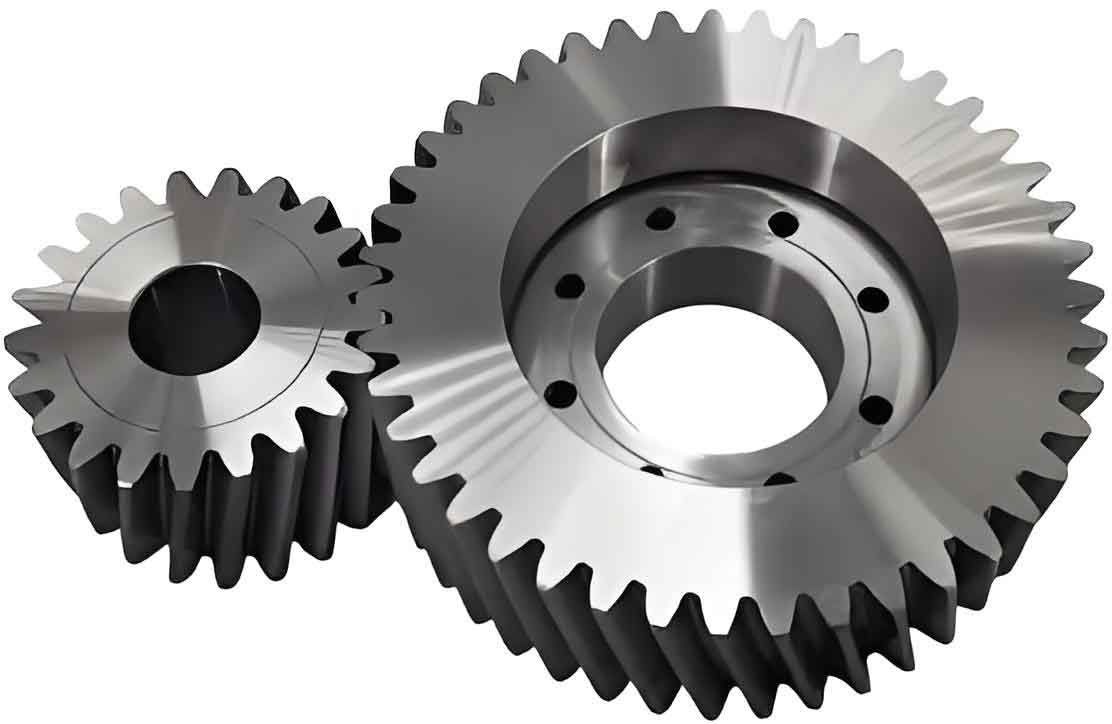
To overcome these constraints and enhance the universality of skiving tools for cylindrical gears, this article introduces a forward design methodology. It is grounded in the fundamental kinematic condition for line-contact meshing between two involute helicoids with crossed axes. The core idea is to deliberately design the tool’s active flank as a specific involute helicoid. This designed surface can serve as a conjugate partner to a family of workpiece involute helicoids with varying helix angles, simply by adjusting the axis crossing angle during machine setup. This approach eliminates theoretical edge form error, simplifies the design process, and inherently provides a universal tool basis.
1. Kinematic Principle of Skiving Process
The skiving process is fundamentally based on spatial meshing theory. As illustrated in the schematic (referencing the general concept), the tool and workpiece axes are positioned at a fixed crossing angle, Σ. During machining, the tool rotates at a high angular velocity ωt and the workpiece rotates at a synchronized angular velocity ωp. This forced conjugate motion generates the primary cutting velocity. Simultaneously, a linear feed motion f, typically along the workpiece axis, is applied to complete the machining of the entire tooth width. The critical requirement is that the cutting edge curve and the instantaneous contact line on the workpiece must always lie on the theoretical tooth flank of the target cylindrical gear.
2. Line-Contact Conjugate Meshing of Crossed-Axis Involute Helicoids
An involute helicoid is the tooth flank form of an involute cylindrical gear. It can be generated by a straight line (the generatrix) that is tangent to a base cylinder and performs a screw motion along it. The geometry is defined by its base radius rb and its base helix angle βb. The surface equation in a coordinate system attached to the gear can be expressed with parameters θ (roll angle) and t (distance along the generatrix):
$$
\begin{align*}
x &= r_b \cos\theta + t \cos\lambda_b \sin\theta \\
y &= r_b \sin\theta – t \cos\lambda_b \cos\theta \\
z &= p \theta – t \sin\lambda_b
\end{align*}
$$
where λb is the base lead angle (λb = 90° – βb) and p is the spiral parameter (p = rb tan λb = rb / tan βb). The unit normal vector n to this surface is:
$$
\mathbf{n} = (-\sin\lambda_b \sin\theta, \ \sin\lambda_b \cos\theta, \ -\cos\lambda_b)
$$
Generally, two involute helicoids in crossed-axis arrangement contact each other at a point at any instant. However, under specific conditions, they can achieve line-contact conjugation. This occurs when their base cylinders are tangent to a common plane, meaning they share the same generatrix direction in space. The conditions for this line-contact meshing between two helicoids (1: tool potential, 2: workpiece) are:
Center Distance a: For external gear machining: $a = r_{b1} + r_{b2}$. For internal gear machining: $a = r_{b1} – r_{b2}$.
Shaft Angle Σ: For external gear machining: $Σ = β_{b1} + β_{b2}$. For internal gear machining: $Σ = |β_{b1} – β_{b2}|$.
Under these conditions, the contact line is the common generatrix. To maintain this conjugate meshing, the angular velocities must satisfy the fundamental meshing equation derived from $\mathbf{n} \cdot \mathbf{v}_{12} = 0$, where $\mathbf{v}_{12}$ is the relative velocity at the contact point. The resulting speed ratio condition is:
$$
\frac{ω_1}{ω_2} = – \frac{r_{b2} \cos β_{b2}}{r_{b1} \cos β_{b1}}
$$
For internal meshing, the negative sign becomes positive. This equation is crucial for setting the spindle speed ratio during skiving of cylindrical gears.
| Meshing Condition | External Gears | Internal Gears |
|---|---|---|
| Axis Distance (a) | $a = r_{b1} + r_{b2}$ | $a = r_{b1} – r_{b2}$ |
| Shaft Angle (Σ) | $Σ = β_{b1} + β_{b2}$ | $Σ = |β_{b1} – β_{b2}|$ |
| Speed Ratio | $ω_1/ω_2 = – \frac{r_{b2} \cos β_{b2}}{r_{b1} \cos β_{b1}}$ | $ω_1/ω_2 = \frac{r_{b2} \cos β_{b2}}{r_{b1} \cos β_{b1}}$ |
3. Universal Skiving Tool Design Method
3.1 Conjugate Flank Design
The proposed method starts by defining the tool’s cutting flank as a specific involute helicoid. This is the “design conjugate surface.” Its parameters—base radius rbt and base helix angle βbt—are chosen based on tool strength, number of teeth, and a desired nominal geometry. The key to universality lies in the meshing conditions above. For a given tool helicoid (fixed rbt, βbt), it can achieve line-contact with various workpiece cylindrical gears (with rbp, βbp) by setting the machine axes according to the conditions:
$$
Σ = |β_{bt} ± β_{bp}| \quad \text{and} \quad a = r_{bp} ± r_{bt}
$$
where the sign depends on external/internal machining. Therefore, one designed tool flank can, in principle, machine workpieces with different helix angles.
Considering a right-hand helical tool, its left and right flanks are two distinct involute helicoids offset by the base tooth thickness. Taking the left flank as an example, and incorporating the base half-thickness angle μb ($μ_b = s_b/(2r_b)$), its surface equation is:
$$
\begin{align*}
x &= r_{bt} \cos(θ – μ_b) + t \cosλ_{bt} \sin(θ – μ_b) \\
y &= r_{bt} \sin(θ – μ_b) – t \cosλ_{bt} \cos(θ – μ_b) \\
z &= p_t θ – t \sinλ_{bt}
\end{align*}
$$
3.2 Cutting Edge Determination
The cutting edge is the intersection curve between the designed conjugate flank (involute helicoid) and the tool’s rake face. For simplicity and manufacturability, a planar rake face is often used. Its equation in the tool coordinate system, with a defined rake angle γ and oriented relative to the base helix, is:
$$
z \cosβ_{bt} + y \sinβ_{bt} = (x – r_{bt}) \tanγ
$$
The cutting edge $\mathbf{r_e}(θ)$ is found by solving the system of the flank equations and the rake face equation simultaneously. This yields a single-parameter curve where t can be expressed as a function of θ:
$$
\mathbf{r_e}(θ) = \begin{cases}
x = r_{bt} \cos(θ – μ_b) + T \cosλ_{bt} \sin(θ – μ_b) \\
y = r_{bt} \sin(θ – μ_b) – T \cosλ_{bt} \cos(θ – μ_b) \\
z = p_t θ – T \sinλ_{bt}
\end{cases}
$$
where:
$$
T(θ) = \frac{p_t θ \cosβ_{bt} + r_{bt}[\sin(θ-μ_b)\sinβ_{bt} – \cos(θ-μ_b)\tanγ] + r_t \tanγ}{\sinλ_{bt}\cosβ_{bt} + \cosλ_{bt}[\cos(θ-μ_b)\sinβ_{bt} + \sin(θ-μ_b)\tanγ]}
$$
This forward intersection provides a stable, unambiguous solution for the cutting edge, applicable to any rake face geometry.
| Design Parameter | Symbol | Equation/Description |
|---|---|---|
| Tool Base Radius | $r_{bt}$ | Selected based on tool diameter and module: $r_{bt} = \frac{m_n z_t \cosα_n}{2\cosβ_{bt}}$ |
| Tool Base Helix Angle | $β_{bt}$ | Chosen design parameter (e.g., 15°-25°). |
| Base Half-Thickness Angle | $μ_b$ | $μ_b = \frac{s_b}{2r_{bt}} = \frac{π m_n \cosα_n + 2 m_n z_t \cosα_n \cdot \text{inv}α_n}{4 r_{bt}}$ |
| Rake Angle | $γ$ | Chosen based on workpiece material (e.g., 10°-20°). |
3.3 Clearance Flank Design
The clearance flank must provide adequate relief angles and ensure that the cutting edge retains its correct conjugate form after regrinding. The design involves generating the clearance surface as an envelope of the cutting edge family obtained after virtual regrinds.
Top Clearance: The tooth top clearance is typically a conical surface. Its axis is aligned with the tool’s base helix direction, and its half-cone angle is the complement of the desired top relief angle αe (i.e., 90° – αe).
Side Clearance: To model side clearance, imagine the tool being reground. Each regrind shifts the rake face inward, effectively changing the parameter μb to μb – Δμ for the “new” cutting edge that lies on a slightly different involute helicoid (same rbt, βbt). The side relief angle αc determines Δμ. The family of all such cutting edges, generated by a screw motion of the tool blank (with a lead corresponding to the relief direction), forms the side clearance surface. Mathematically, if $\mathbf{r_e}^i(θ, Δμ)$ represents the cutting edge after a regrind shift Δμ, and this edge undergoes a screw motion with parameter θc, the clearance surface A is:
$$
\mathbf{A}(θ, θ_c) = \mathbf{M}_{screw}(θ_c) \cdot \mathbf{r_e}^i(θ, Δμ(θ_c))
$$
where $Δμ = \frac{p_c θ_c [\tan(β_{bt}+α_c) – \tanβ_{bt}]}{r_{bt}}$ and pc is the screw parameter for relief generation. This guarantees that every reground edge is still a perfect conjugate curve for the target cylindrical gear tooth form.
4. Calculation of Machining Parameters
To correctly execute the skiving process for a given workpiece, the following machine settings must be calculated based on the tool design and workpiece specifications.
1. Shaft Angle Σ: This is directly determined by the conjugate condition.
$$Σ = |β_{bt} + κ β_{bp}|$$
where κ = +1 for external gears and κ = -1 for internal gears.
2. Center Distance a: The distance between the tool and workpiece axes.
$$a = r_{bp} + κ r_{bt}$$
3. Tool Offset ρ: This is a crucial adjustment to position the tool tip correctly relative to the workpiece root. It ensures proper root machining and avoids interference. The offset is calculated by solving a geometric system where the tool tip ellipse (the tool tip circle projected onto the workpiece transverse plane) is tangent to the workpiece root circle. For internal and external cylindrical gears, the systems are:
Internal Gears:
$$
\begin{cases}
ρ = r_{fp} \cosθ_p – r_{at} \cosΣ \cosθ_t \\
a = r_{fp} \sinθ_p – r_{at} \sinθ_t \\
\cosθ_p \sinθ_t – \sinθ_p \cosΣ \cosθ_t = 0
\end{cases}
$$
External Gears:
$$
\begin{cases}
ρ = r_{fp} \cosθ_p + r_{at} \cosΣ \cosθ_t \\
a = r_{fp} \sinθ_p + r_{at} \sinθ_t \\
\cosθ_p \sinθ_t + \sinθ_p \cosΣ \cosθ_t = 0
\end{cases}
$$
where rfp is workpiece root radius, rat is tool tip radius, and θp, θt are the angular parameters of the tangency point on the workpiece root and tool tip circles, respectively.
4. Motion Speeds: The relationship between spindle speeds and feed rate must satisfy the conjugate condition while compensating for the feed motion that disturbs the pure rolling. The required tool angular velocity ωt is:
$$
ω_t = κ \frac{r_{bp} \cosβ_{bp}}{r_{bt} \cosβ_{bt}} ω_p – \frac{\sinβ_{bp}}{r_{bt} \cosβ_{bt}} f
$$
where f is the axial feed rate (positive along the workpiece axis). ωp is typically set as the primary cutting speed, and ωt is adjusted accordingly.
| Machining Parameter | Symbol | Calculation Formula |
|---|---|---|
| Shaft Angle | $Σ$ | $Σ = |β_{bt} + κ β_{bp}|$ |
| Center Distance | $a$ | $a = r_{bp} + κ r_{bt}$ |
| Tool Offset | $ρ$ | Solve geometric tangency condition (see equations above). |
| Tool Spindle Speed | $ω_t$ | $ω_t = κ \frac{r_{bp} \cosβ_{bp}}{r_{bt} \cosβ_{bt}} ω_p – \frac{\sinβ_{bp}}{r_{bt} \cosβ_{bt}} f$ |
5. Simulation Verification
To validate the universality and feasibility of the proposed design method, a skiving tool was designed and multiple virtual machining operations were performed on cylindrical gears with different parameters using VERICUT simulation software.
The common gear parameters and the specific tool design are summarized below:
| Common Parameters | Value |
|---|---|
| Normal Module, mn (mm) | 4 |
| Normal Pressure Angle, αn (°) | 20 |
| Addendum Coefficient, ha* | 1 |
| Dedendum Coefficient, c* | 0.25 |
| Designed Skiving Tool Parameters | ||
|---|---|---|
| Number of Teeth, zt | 41 | Design ensures universality for various workpiece helix angles. |
| Base Helix Angle, βbt (°) | 18.7472 | |
| Base Radius, rbt (mm) | 81.3719 | |
| Tip Radius, rat (mm) | 93.0 | |
| Root Radius, rft (mm) | 83.0 | |
| Rake Angle, γ (°) | 15 | |
| Top Relief Angle, αe (°) | 9 | |
| Side Relief Angle, αc (°) | 4 | |
Four distinct workpieces were simulated: an internal spur gear, an external spur gear, an internal helical gear, and an external helical gear. The calculated machining parameters for each are listed below:
| Parameter | Workpiece 1 (Int. Spur) | Workpiece 2 (Ext. Spur) | Workpiece 3 (Int. Helical) | Workpiece 4 (Ext. Helical) |
|---|---|---|---|---|
| Teeth, zp | 125 | 125 | 100 | 70 |
| Base Helix βbp (°) | 0 | 0 | -14.0761 | 18.7472 |
| Shaft Angle Σ (°) | 18.7472 | 18.7472 | 32.8233 | 37.4945 |
| Center Dist. a (mm) | 153.551 | 316.295 | 112.384 | 220.300 |
| Tool Offset ρ (mm) | 53.148 | 117.460 | 43.617 | 80.688 |
| Workpiece Speed ωp (rpm) | 246 | 246 | 246 | 246 |
| Tool Speed ωt (rpm) | 750.000 | 750.000 | 600.019 | 420.025 |
The simulation results confirmed the correctness of the tool design and parameter calculations. The automatic comparison function in VERICUT was used to analyze the deviation between the simulated machined tooth flanks and the theoretical models of the cylindrical gears. The analysis showed that the active tooth flanks of all four workpieces were generated with high accuracy, with deviations not exceeding 0.01 mm in the main profile region. A predictable stock allowance of approximately 0.1 mm remained in the root fillet area, which is a standard outcome as the tool tip does not perfectly conjugate with the root trochoid. These results successfully validate that a single tool, designed with the proposed universal method, can accurately machine cylindrical gears with different numbers of teeth, helix angles, and internal/external geometries.
6. Conclusion
This article has presented a novel, forward-design methodology for universal skiving tools dedicated to machining involute cylindrical gears. The method is fundamentally based on establishing the precise conditions for line-contact conjugate meshing between two involute helicoids in a crossed-axis configuration.
The core innovation lies in proactively defining the tool’s active flank as a specific involute helicoid. This design conjugate surface can engage in line-contact with a family of workpiece cylindrical gears having varying helix angles, simply by adjusting the machine setup parameters (shaft angle and center distance) according to the derived kinematic conditions. This approach inherently provides universality, addressing a key limitation of traditional inverse-design methods.
The methodology offers several distinct advantages:
1. Simplicity and Robustness: The cutting edge is obtained through a straightforward intersection of the designed involute flank with the chosen rake face, eliminating the numerical instabilities and potential for multiple/no solutions associated with inverse problem solving.
2. Theoretical Accuracy: The design guarantees zero theoretical form error on the generated involute profile of the workpiece cylindrical gear.
3. Regrinding Stability: The mathematical model for the clearance flank ensures that the cutting edge retains its precise conjugate geometry after repeated regrinds, maintaining tool performance throughout its life.
4. Clarity in Application: Comprehensive formulas are provided for calculating all critical machining parameters—shaft angle, center distance, tool offset, and dynamic speed ratios—enabling direct implementation.
The design and simulation of a single tool that successfully machined four different workpieces (internal/external, spur/helical) confirm the method’s validity, practicality, and universal character. This provides a solid theoretical foundation and a practical tool design path for the advanced manufacturing of high-precision cylindrical gears using the skiving process.