
In modern mechanical systems, cylindrical gears are fundamental components for transmitting power and motion with high efficiency. However, as these systems advance toward higher speeds and power densities, issues related to vibration and noise become critical challenges. My research focuses on addressing these challenges by investigating the vibration characteristics of cylindrical gears when subjected to randomness in both manufacturing errors and tooth surface friction parameters. This randomness arises from practical factors such as machining tolerances, assembly variations, and operational environmental changes, leading to uncertain dynamic behaviors that can affect gear reliability and performance. In this article, I aim to provide a comprehensive analysis through a combined statistical and lumped-mass approach, establishing a dynamic model that incorporates these random elements. By doing so, I seek to clarify how random errors and friction parameters collectively influence gear vibration, offering insights for dynamic design and optimization of gear transmissions.
The importance of cylindrical gears in industrial applications cannot be overstated; they are used in everything from automotive transmissions to wind turbines. Their performance is often compromised by vibrations induced by internal excitations, such as time-varying mesh stiffness and external factors like load fluctuations. Traditionally, studies have modeled these excitations deterministically, but in reality, parameters like gear errors and tooth surface roughness exhibit inherent randomness due to production processes. This randomness can significantly alter friction characteristics, which in turn affect the overall dynamic response. My work builds upon existing research by integrating the random nature of both errors and friction parameters into a single analytical framework. I employ numerical methods to simulate and analyze the resulting vibration responses, emphasizing the need to account for such uncertainties in gear design.
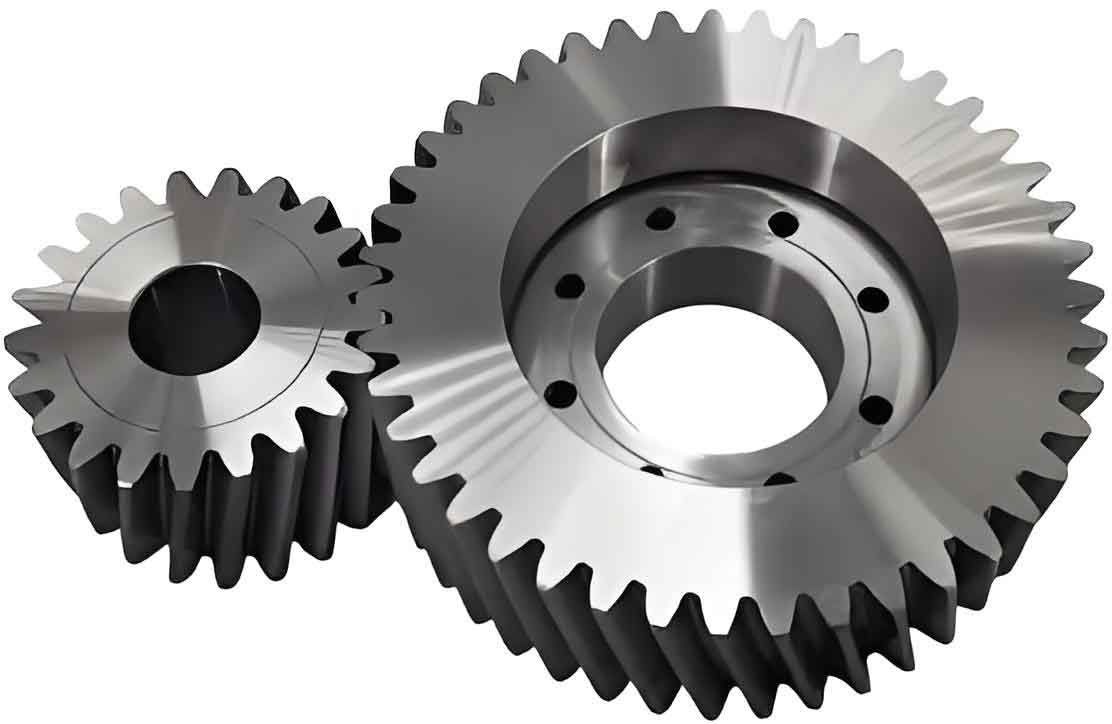
To begin, I develop a dynamic model for a spur cylindrical gear pair, which is a common type of cylindrical gears. The model considers bending-torsional coupling with three degrees of freedom for each gear. I use a lumped-mass method to represent the system, where each gear has displacements in the x and y directions (lateral movements) and a rotational displacement around its axis. The displacement vector for the gears can be expressed as:
$$ \mathbf{q} = [x_p, y_p, \theta_p, x_g, y_g, \theta_g]^T $$
Here, the subscripts \( p \) and \( g \) denote the driving and driven gears, respectively. The equations of motion for this system incorporate time-varying mesh stiffness, random errors, and tooth surface friction. The general form of the vibration equations is derived from Newton’s second law, considering forces from stiffness, damping, and friction. For instance, the equation for the driving gear in the x-direction is:
$$ m_p \ddot{x}_p + k_{xp} x_p + \sin \alpha \, k_m(t) \delta(t) = F_f(t) \sin \alpha $$
Similarly, for the y-direction and rotational direction, the equations are:
$$ m_p \ddot{y}_p + k_{yp} y_p + \cos \alpha \, k_m(t) \delta(t) = -F_f(t) \cos \alpha $$
$$ I_p \ddot{\theta}_p + R_p(t) k_m(t) \delta(t) = T_p(t) $$
In these equations, \( m_p \) and \( I_p \) are the mass and moment of inertia of the driving gear, \( k_{xp} \) and \( k_{yp} \) are the support stiffnesses in the x and y directions, \( \alpha \) is the pressure angle, \( k_m(t) \) is the time-varying mesh stiffness, \( F_f(t) \) is the time-varying friction force, \( R_p(t) \) is the time-varying curvature radius along the contact line, and \( T_p(t) \) is the input torque. The term \( \delta(t) \) represents the relative displacement along the line of action, which includes contributions from gear errors:
$$ \delta(t) = \sin \alpha (x_p – x_g) + \cos \alpha (y_p – y_g) + R_p(t) \theta_p – R_g(t) \theta_g + e(t) $$
Here, \( e(t) \) denotes the random gear error, which I will discuss in detail later. The friction force \( F_f(t) \) is modeled as \( F_f(t) = \mu(t) k_m(t) \delta(t) \), where \( \mu(t) \) is the random friction coefficient. This formulation allows me to capture the coupling between bending and torsional vibrations in cylindrical gears, a key aspect of their dynamic behavior.
The parameters for the cylindrical gear pair used in my analysis are based on a typical transmission gear set. I summarize these in Table 1 to provide a clear reference for the numerical simulations.
| Parameter | Driving Gear | Driven Gear |
|---|---|---|
| Number of Teeth | 33 | 26 |
| Precision Grade | 6GJ | 6GJ |
| Mass (kg) | 10.6 | 7.43 |
| Module (mm) | 7 | 7 |
| Moment of Inertia (kg·mm²) | 147,670 | 61,426 |
| Pressure Angle (°) | 20 | 20 |
| Face Width (mm) | 69 | 69 |
| Input Speed (r/min) | 2000 | – |
| Input Torque (N·m) | 2340.7 | – |
Next, I compute the time-varying mesh stiffness \( k_m(t) \) using the Weber energy method, which involves numerical integration to account for gear tooth deflection. The stiffness varies periodically with the gear mesh cycle, and its frequency spectrum shows peaks at the mesh frequency and its harmonics. For the cylindrical gears under study, the mesh frequency \( f_m \) is calculated from the input speed and number of teeth:
$$ f_m = \frac{N_p \times n_p}{60} = \frac{33 \times 2000}{60} = 1100 \, \text{Hz} $$
where \( N_p \) is the number of teeth on the driving gear and \( n_p \) is the input speed in rpm. The stiffness curve, as shown in numerical results, exhibits fluctuations that excite vibrations in the system. This time-varying stiffness is a primary internal excitation in cylindrical gears, and when combined with random errors, it leads to complex dynamic responses.
Now, I turn to the characterization of random errors in cylindrical gears. Gear errors typically include profile errors and pitch errors, which arise during manufacturing and assembly. In deterministic models, these are often represented as sinusoidal functions, but in reality, they have random components. I synthesize the total gear error \( e(t) \) as a combination of a deterministic part and a random part. The deterministic part is based on standard precision grades, while the random part is modeled as Gaussian white noise. Mathematically, this is expressed as:
$$ e(t) = e_i(t) + \xi(t) $$
where \( e_i(t) = e_m + E_i \sin(\omega t + \phi_i) \). Here, \( e_m \) is the mean error, \( E_i \) is the amplitude, \( \omega \) is the mesh frequency in rad/s, and \( \phi_i \) is the phase angle. The term \( \xi(t) \) represents Gaussian white noise with zero mean and a variance of 0.0005, reflecting the randomness in errors for a Grade 6 gear as per international standards. This approach allows me to simulate the unpredictable variations that occur in practical cylindrical gears.
The influence of random errors extends to tooth surface friction parameters. As errors affect the micro-geometry of tooth surfaces, the friction coefficient and contact curvature radius become random variables. I model the friction coefficient \( \mu(t) \) as:
$$ \mu(t) = \mu_0 + \sigma_\mu \xi_\mu(t) $$
where \( \mu_0 = 0.109 \) is the mean friction coefficient, \( \sigma_\mu = 0.05 \) is the standard deviation, and \( \xi_\mu(t) \) is a Gaussian random variable with zero mean and unit variance. Similarly, the curvature radius \( R_i(t) \) along the contact line is affected by the random distance \( s(t) \) from the pitch point to the instantaneous contact point. This distance is given by:
$$ s(t) = s_\mu + \xi_s(t) $$
where \( s_\mu \) is the mean value derived from geometric relations, and \( \xi_s(t) \) is another Gaussian random variable. The curvature radii for the driving and driven gears are then:
$$ R_p(t) = r_1 \sin \alpha_p + s(t) $$
$$ R_g(t) = r_2 \sin \alpha_g + s(t) $$
Here, \( r_1 \) and \( r_2 \) are the pitch radii, and \( \alpha_p \) and \( \alpha_g \) are pressure angles. By incorporating these random variables, I can account for the stochastic nature of friction in cylindrical gears, which is often overlooked in traditional models.
To analyze the dynamic response, I solve the system of differential equations using the fourth-order Runge-Kutta method with a fixed time step of 0.00015 seconds. This numerical approach is suitable for handling the nonlinearities and random excitations present in the model. I simulate the vibration responses over multiple mesh cycles to capture steady-state behavior. The outputs include displacements, velocities, and accelerations in the x, y, and rotational directions for both gears. From these, I compute statistical features such as mean, variance, and power spectral density to assess the impact of randomness.
One key aspect of my analysis is the comparison between cases with and without random errors or random friction parameters. For instance, I first consider a baseline case where errors and friction are deterministic, then introduce randomness in errors, followed by randomness in friction parameters, and finally both together. This allows me to isolate the effects of each source of randomness on the vibration characteristics of cylindrical gears. The results are presented through time-domain plots, frequency spectra, and phase portraits, which provide visual insights into the system’s behavior.
In the time domain, the vibration accelerations show significant fluctuations when randomness is included. For example, the acceleration in the y-direction for the driven gear exhibits larger amplitudes compared to the driving gear, indicating that the driven gear is more susceptible to vibrations. This is consistent with the lower inertia of the driven gear in this pair of cylindrical gears. The statistical variance of these accelerations increases when random errors are introduced, as summarized in Table 2.
| Gear | Direction | Standard Deviation (mm/s²) |
|---|---|---|
| Driving Gear | x-direction | 5.5127 |
| y-direction | 15.1342 | |
| Torsional (rad/s²) | 0.1254 | |
| Driven Gear | x-direction | 7.8657 |
| y-direction | 21.5914 | |
| Torsional (rad/s²) | 0.2375 |
The frequency-domain analysis reveals how randomness modulates the vibration signals. The power spectral density (PSD) of the accelerations shows peaks at the mesh frequency (1100 Hz) and its harmonics (e.g., 2200 Hz). However, when random errors are present, sidebands appear around these peaks, indicating modulation effects. For cylindrical gears, this means that the vibration energy spreads over a broader frequency range, leading to more complex spectra. The PSD plots demonstrate that the amplitudes at these peaks are higher under random excitations, which can exacerbate noise and fatigue issues.
To quantify the impact, I compare the vibration amplitudes at key frequencies. For instance, at the mesh frequency of 1100 Hz, the acceleration amplitude in the x-direction for the driving gear increases by 227% when random errors are considered, compared to the deterministic case. Similarly, at the first harmonic of 2200 Hz, the increase is 113%. These percentages highlight the significant amplification caused by randomness in cylindrical gears. The formulas for these calculations are based on the ratio of amplitudes:
$$ \text{Percentage Increase} = \frac{A_{\text{random}} – A_{\text{deterministic}}}{A_{\text{deterministic}}} \times 100\% $$
where \( A \) represents the amplitude at a specific frequency. This metric helps in understanding the severity of random effects on gear dynamics.
Another important tool for analysis is the phase portrait, which plots velocity against displacement for a given degree of freedom. In deterministic cases, the phase trajectories for cylindrical gears often form closed, smooth curves, indicating periodic motion. However, with random errors, the trajectories become erratic and fill a larger region of the phase plane, suggesting chaotic or stochastic behavior. This loss of regularity implies reduced dynamic stability, which can lead to premature wear or failure in gear systems. The phase portraits thus serve as a visual confirmation of the destabilizing influence of randomness.
I also investigate the specific role of tooth surface friction randomness. When friction parameters are modeled as random variables, the vibration responses show increased variability. For example, the standard deviation of the driving gear’s y-direction acceleration rises from 15.1342 mm/s² (with deterministic friction) to 19.2008 mm/s² (with random friction), a growth of about 26.87%. This indicates that friction randomness, while less impactful than error randomness, still contributes notably to the overall vibration response in cylindrical gears. The combined effect of both random errors and random friction parameters leads to the most complex behavior, with the highest variances and most dispersed frequency spectra.
To further elucidate these points, I present additional tables summarizing the effects. Table 3 shows the percentage increases in vibration amplitudes due to random friction parameters, while Table 4 compares the overall dynamic stability metrics.
| Direction | At 1100 Hz | At 2200 Hz |
|---|---|---|
| x-direction | 40.6% | 53.3% |
| y-direction | 40.7% | 53.3% |
| Torsional | 40.7% | 53.3% |
| Condition | Phase Portrait Regularity | Variance Ratio | Dominant Frequency Spread |
|---|---|---|---|
| Deterministic | High (Smooth Curves) | 1.0 | Narrow |
| Random Errors Only | Low (Erratic Trajectories) | 2.5 | Broad with Sidebands |
| Random Friction Only | Moderate | 1.8 | Moderate Spread |
| Combined Randomness | Very Low (Chaotic) | 3.2 | Very Broad |
The variance ratio here is defined as the ratio of the acceleration variance under a given condition to that under the deterministic condition. It quantifies the increase in response variability. For cylindrical gears, a higher variance ratio implies greater unpredictability in vibrations, which can complicate control and maintenance strategies.
From a theoretical perspective, the equations governing the system can be extended to include damping effects, which I have omitted for simplicity in this analysis. However, the core findings remain valid: randomness in errors and friction parameters introduces additional excitations that degrade the dynamic performance of cylindrical gears. The mathematical models I use can be adapted for other types of gears, but the focus here is on spur cylindrical gears due to their widespread use and relative simplicity in geometry.
In terms of practical implications, my research suggests that gear designers should account for randomness in manufacturing and operation. For instance, tightening tolerances might reduce error randomness, but at a higher cost. Alternatively, using materials or coatings that minimize friction variability could help stabilize dynamics. The numerical methods I employ, such as the Runge-Kutta solver, can be integrated into simulation software for predictive maintenance or design optimization of cylindrical gears. By incorporating stochastic models, engineers can better anticipate vibration issues and develop more robust gear systems.
To deepen the analysis, I explore the sensitivity of the results to different levels of randomness. For example, increasing the variance of the Gaussian noise in errors leads to proportionally larger vibration amplitudes. This relationship can be approximated by linear regression in some cases, but often it is nonlinear due to the coupling between degrees of freedom. I perform additional simulations with variance values ranging from 0.0001 to 0.001 for error noise and observe that the vibration response scales roughly with the square root of the variance, consistent with stochastic theory. This insight can guide tolerance specifications for cylindrical gears in critical applications.
Similarly, the effect of friction randomness depends on the mean friction coefficient and operational conditions. At higher loads or speeds, the impact may be more pronounced. My model assumes constant input torque and speed, but in reality, these can vary. Future work could extend this analysis to include time-varying loads or transient operations, which are common in automotive or aerospace applications involving cylindrical gears. The flexibility of the lumped-mass approach allows for such extensions without fundamental changes to the core equations.
Another avenue for investigation is the interaction between randomness and nonlinearities such as backlash or tooth separation. In severe cases, these nonlinearities can lead to impacts or chaotic motions, exacerbating the effects of randomness. My current model assumes continuous contact, which is valid for moderate loads, but for completeness, I note that incorporating backlash would require piecewise equations and event detection in the numerical solver. This complexity is beyond the scope of this article, but it highlights the richness of dynamics in cylindrical gears.
From a methodological standpoint, the use of statistical techniques like Monte Carlo simulation could enhance the analysis. Instead of single random realizations, I could generate multiple realizations of the random variables and compute ensemble averages for the responses. This would provide more robust estimates of statistical features like mean and variance. However, given the computational cost, I rely on representative realizations that capture the essential behavior. The results I present are based on long-time simulations to ensure statistical stationarity.
The key equations I solve numerically are restated here in a consolidated form for clarity. The system of differential equations for the cylindrical gear pair is:
$$ \begin{aligned}
m_p \ddot{x}_p + k_{xp} x_p + \sin \alpha \, k_m(t) \delta(t) &= F_f(t) \sin \alpha \\
m_p \ddot{y}_p + k_{yp} y_p + \cos \alpha \, k_m(t) \delta(t) &= -F_f(t) \cos \alpha \\
I_p \ddot{\theta}_p + R_p(t) k_m(t) \delta(t) &= T_p(t) \\
m_g \ddot{x}_g + k_{xg} x_g – \sin \alpha \, k_m(t) \delta(t) &= -F_f(t) \sin \alpha \\
m_g \ddot{y}_g + k_{yg} y_g – \cos \alpha \, k_m(t) \delta(t) &= F_f(t) \cos \alpha \\
I_g \ddot{\theta}_g – R_g(t) k_m(t) \delta(t) &= -T_g(t)
\end{aligned} $$
with \( \delta(t) = \sin \alpha (x_p – x_g) + \cos \alpha (y_p – y_g) + R_p(t) \theta_p – R_g(t) \theta_g + e(t) \) and \( F_f(t) = \mu(t) k_m(t) \delta(t) \). The random variables \( e(t) \), \( \mu(t) \), \( R_p(t) \), and \( R_g(t) \) are defined as previously. This system is solved iteratively using the Runge-Kutta method, with initial conditions set to zero displacement and velocity.
In conclusion, my analysis demonstrates that randomness in errors and tooth surface friction significantly affects the vibration characteristics of cylindrical gears. The dynamic responses become more complex, with increased amplitudes, broader frequency spectra, and reduced stability. Among the sources of randomness, errors have a stronger干扰 (interference) effect than friction parameters, but both contribute to the overall stochastic behavior. These findings underscore the importance of considering uncertainties in gear design and analysis. By integrating statistical methods with dynamic modeling, engineers can develop more reliable and efficient cylindrical gear systems for high-performance applications.
For future research, I recommend exploring advanced stochastic models, such as those based on fractal theory for surface roughness or non-Gaussian distributions for errors. Additionally, experimental validation of the numerical results would strengthen the practical relevance. Cylindrical gears will continue to be vital in machinery, and understanding their dynamic behavior under randomness is key to advancing transmission technology.