
As a mechanical engineer, the design of robust and efficient power transmission systems is a fundamental task. Among these, gear reducers, especially those utilizing involute cylindrical gears, remain pivotal in matching speed and torque between prime movers and working machinery. This article details my first-person perspective on the complete digital design process of a heavy-duty, low-speed three-stage reducer based on involute cylindrical gears. The process encompasses structural layout planning, systematic parametric design of the gear drive system, topological optimization of the housing, and the development of a specialized application to streamline calculations.
Introduction and Design Objectives
The core function of a reducer is to decrease rotational speed and increase torque, and its reliability directly impacts the entire mechanical system’s performance. For heavy-duty applications like cranes, the demand for durability, compactness, and efficiency is paramount. This project aimed to design a three-stage reducer meeting these criteria, employing a fully digital workflow. The primary objectives were: to select an optimal spatial arrangement for the shafts and cylindrical gears, to execute a detailed parametric design covering all components from gears to bearings, to optimize the housing structure for strength and weight using finite element analysis (FEA), and to encapsulate the complex calculation logic for the involute cylindrical gear system into a user-friendly software application.
1. Structural Layout Design for the Three-Stage Reducer
The spatial arrangement of shafts in a multi-stage reducer significantly influences its overall dimensions, bearing arrangements, and lubrication. For a three-stage gear train with four shafts, four fundamental layouts exist relative to the plane containing the input and output shafts of the first stage. These are defined by whether subsequent stages lie in the same plane or in orthogonal planes.
| Layout Type | Description | Spatial Relationship |
|---|---|---|
| Horizontal (In-line) | All shafts are parallel and located in a single horizontal plane. | Co-planar. |
| L-Shaped | Shafts of the second stage are orthogonal to the first stage’s plane, with the third stage returning to a plane parallel to the first. | Second stage orthogonal; others co-planar. |
| Z-Shaped | Both the second and third stages have their axes in planes orthogonal to the preceding stage’s plane. | Staggered orthogonal planes. |
| U-Shaped (Parallel-Shaft Return) | The input and output shafts are parallel but offset; all shafts are in two parallel planes. | Co-planar in two parallel layers. |
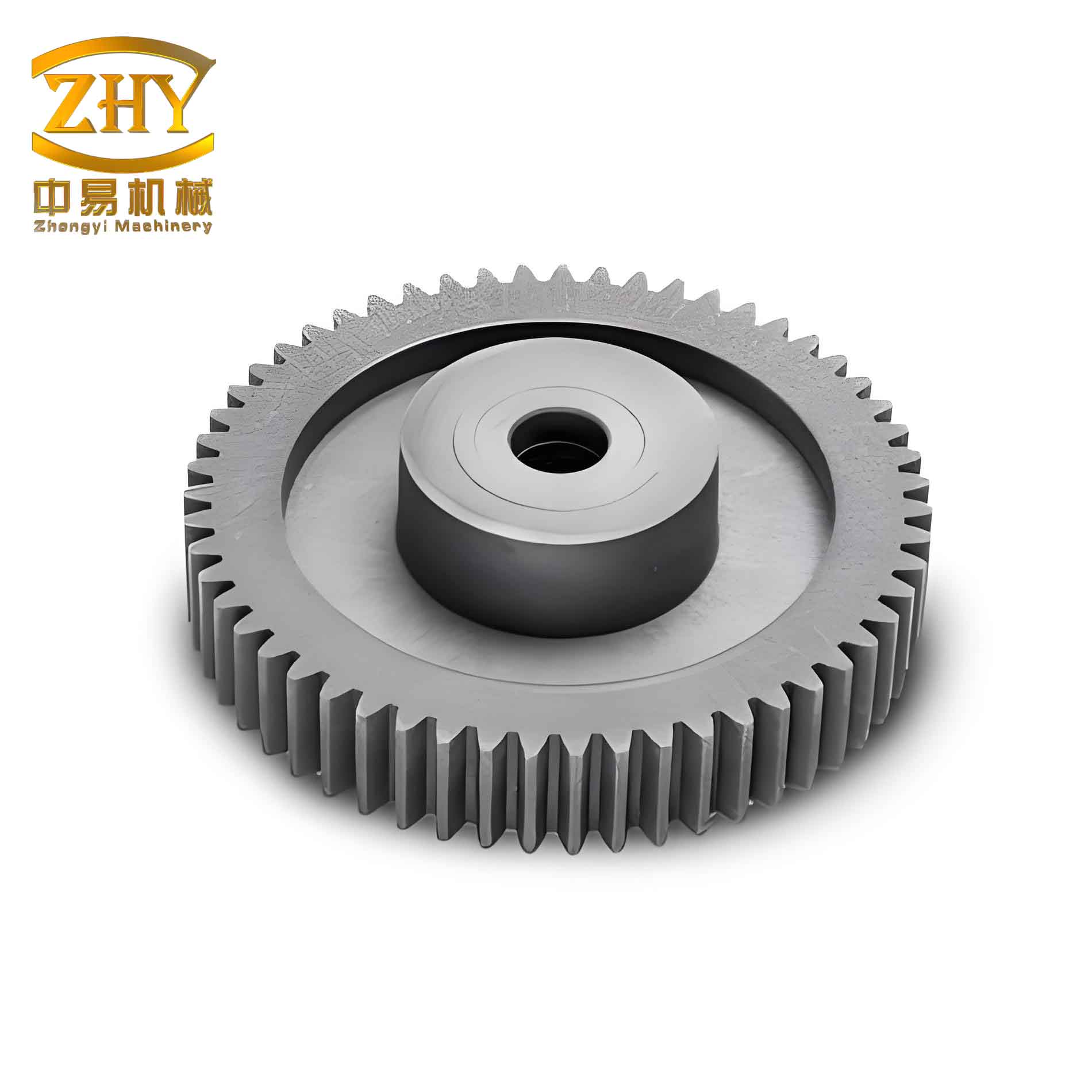
For this heavy-duty crane application, the horizontal in-line layout on two sides was selected. This layout offers good symmetry, facilitates force balancing, and simplifies lubrication system design. Helical involute cylindrical gears were chosen for each stage due to their smoother operation, higher load capacity, and reduced noise compared to spur gears—critical advantages for high-load, low-speed scenarios. The shaft support system employs statically determinate (simply-supported) structures with one-directional axial fixing. Sliding bearings are used for radial support, complemented by tapered roller bearings for handling axial loads. The initial structural concept is illustrated in the following schematic.
2. Parametric Design of the Involute Cylindrical Gear Drive System
The parametric design forms the computational backbone of the reducer. It is a sequential process involving eight key steps, each reliant on established mechanical design principles and formulas specific to involute cylindrical gears.
2.1. Distribution of Total Transmission Ratio
The design initiates with the working conditions: load force \(F\) (N) and load linear velocity \(V\) (m/s). The required effective power \(P_w\) (kW) at the working machine is calculated. After accounting for efficiencies of gears, bearings, and couplings (obtained from standard tables) to find total efficiency \(\eta_{total}\), the required motor power \(P_d\) is determined. A standard motor with a rated power equal to or slightly greater than \(P_d\) is selected.
The total transmission ratio \(i_{total}\) is derived from the motor’s full-load speed \(n_m\) (rpm) and the required output speed \(n_w\) (rpm):
$$ i_{total} = \frac{n_m}{n_w} $$
where \(n_w = \frac{60 \times 1000 \times V}{\pi D}\) and \(D\) is the drum diameter (mm).
To achieve a compact design with near-equal strength across stages, the ratios are distributed using a progression factor \(A\) (e.g., \(A=1.25\)). For a three-stage reducer with ratios \(i_{12}\), \(i_{34}\), and \(i_{56}\):
$$ i_{12} \times i_{34} \times i_{56} = i_{total} $$
$$ i_{34} = A \cdot i_{56} $$
$$ i_{12} = A \cdot i_{34} $$
Solving this system yields the individual stage ratios for the cylindrical gear pairs.
2.2. Kinematic and Dynamic Parameters
With the motor power \(P_d\) and the distributed ratios, the speed, power, and torque for each shaft (I, II, III, IV) are computed sequentially. Let \(\eta_{gear}\) and \(\eta_{bearing}\) represent the efficiency of a single gear mesh and a pair of bearings, respectively.
| Shaft | Power \(P_n\) (kW) | Speed \(n_n\) (rpm) | Torque \(T_n\) (N·mm) |
|---|---|---|---|
| I (Input) | \(P_1 = P_d\) | \(n_1 = n_m\) | \(T_1 = 9.55 \times 10^6 \frac{P_1}{n_1}\) |
| II | \(P_2 = P_1 \cdot \eta_{gear} \cdot \eta_{bearing}\) | \(n_2 = n_1 / i_{12}\) | \(T_2 = 9.55 \times 10^6 \frac{P_2}{n_2}\) |
| III | \(P_3 = P_2 \cdot \eta_{gear} \cdot \eta_{bearing}\) | \(n_3 = n_2 / i_{34}\) | \(T_3 = 9.55 \times 10^6 \frac{P_3}{n_3}\) |
| IV (Output) | \(P_4 = P_3 \cdot \eta_{gear} \cdot \eta_{bearing}\) | \(n_4 = n_3 / i_{56}\) | \(T_4 = 9.55 \times 10^6 \frac{P_4}{n_4}\) |
2.3. Establishment of the Force Model
For each helical involute cylindrical gear pair, the forces acting on the gears are calculated to serve as inputs for shaft and bearing analysis. For a gear with transmitted torque \(T\), normal module \(m_n\), number of teeth \(z\), pressure angle \(\alpha_n\), and helix angle \(\beta\):
- Reference Diameter: \(d = \frac{m_n z}{\cos \beta}\)
- Tangential Force (circumferential): \(F_t = \frac{2T}{d}\)
- Radial Force: \(F_r = \frac{F_t \cdot \tan \alpha_n}{\cos \beta}\)
- Axial Force: \(F_a = F_t \cdot \tan \beta\)
These force components for each gear are then applied to the 3D models of the shafts to determine reaction forces at the bearings, creating a complete static force model.
2.4. Strength Design of the Cylindrical Gear Pairs
Gear design is iterative, balancing size, weight, and strength. For this design, 7-grade accuracy helical gears were specified. Material pairs like 40Cr (case-hardened) for pinions and 20Cr2 (carburized and hardened) for wheels were chosen for their high contact and bending fatigue strength.
Design for Contact Fatigue Strength: The core design equation for the pinion’s reference diameter \(d_1\) based on contact stress is:
$$ d_1 \ge \sqrt[3]{\frac{2 K_H T_1}{\phi_d} \cdot \frac{u \pm 1}{u} \cdot \left( \frac{Z_H Z_E Z_{\epsilon} Z_{\beta}}{[\sigma_H]} \right)^2} $$
Where:
- \(K_H\): Application factor (\(K_A\)), dynamic factor (\(K_V\)), face load distribution factor (\(K_{H\beta}\)), and transverse load distribution factor (\(K_{H\alpha}\)).
- \(\phi_d\): Facewidth factor (\(b/d_1\)).
- \(u\): Gear ratio (\(z_2/z_1\)).
- \(Z_H\): Zone factor accounts for tooth profile curvature at the pitch point.
- \(Z_E\): Elasticity factor accounts for material properties (Young’s modulus, Poisson’s ratio).
- \(Z_{\epsilon}\): Contact ratio factor. For helical gears: $$ Z_{\epsilon} = \sqrt{\frac{4 – \epsilon_{\alpha}}{3}(1 – \epsilon_{\beta}) + \frac{\epsilon_{\beta}}{\epsilon_{\alpha}}} $$ with \(\epsilon_{\alpha}\) as the transverse contact ratio and \(\epsilon_{\beta}\) as the overlap ratio.
- \(Z_{\beta}\): Helix angle factor: \(Z_{\beta} = \sqrt{\cos \beta}\).
- \([\sigma_H]\): Allowable contact stress, derived from material fatigue limits and life factors.
The final contact stress \(\sigma_H\) is checked against the allowable stress:
$$ \sigma_H = \sqrt{ \frac{2 K_H T_1}{\phi_d d_1^3} \cdot \frac{u \pm 1}{u} } \cdot Z_H Z_E Z_{\epsilon} Z_{\beta} \leq [\sigma_H] $$
Design for Bending Fatigue Strength: The normal module \(m_n\) is checked using:
$$ m_n \ge \sqrt[3]{\frac{2 K_F T_1 Y_{\epsilon} Y_{\beta} \cos^2 \beta}{\phi_d z_1^2} \cdot \left( \frac{Y_{Fa} Y_{Sa}}{[\sigma_F]} \right) } $$
Where:
- \(K_F\): Bending strength load factor (similar components to \(K_H\)).
- \(Y_{Fa}\): Form factor (depends on virtual tooth number).
- \(Y_{Sa}\): Stress correction factor.
- \(Y_{\epsilon}\): Bending strength contact ratio factor: \(Y_{\epsilon} = 0.25 + \frac{0.75}{\epsilon_{\alpha v}}\), where \(\epsilon_{\alpha v}\) is the virtual contact ratio.
- \(Y_{\beta}\): Helix angle factor for bending: \(Y_{\beta} = 1 – \epsilon_{\beta} \frac{\beta}{120^\circ}\) (if \(\epsilon_{\beta} > 1\), set \(Y_{\beta} = 1 – 0.25 \epsilon_{\beta} \frac{\beta}{120^\circ}\)).
- \([\sigma_F]\): Allowable bending stress.
The final bending stress \(\sigma_F\) is verified:
$$ \sigma_F = \frac{2 K_F T_1 Y_{\epsilon} Y_{\beta} \cos^2 \beta}{\phi_d m_n^3 z_1^2} \cdot Y_{Fa} Y_{Sa} \leq [\sigma_F] $$
These calculations were performed for all three stages of cylindrical gears to ensure safety under the specified heavy load.
2.5. Shaft Design and Strength Analysis
Shafts were designed based on the calculated torques and the forces from the gear models.
Preliminary Diameter: A minimum diameter \(d_{min}\) is estimated using torsion-based formula with an empirical coefficient \(C\):
$$ d_{min} \ge C \cdot \sqrt[3]{\frac{P}{n}} $$
where \(P\) and \(n\) are the power and speed of that shaft.
Static Strength Check (Combined Stress): Critical sections are checked for combined bending and torsional stress using the von Mises equivalent stress:
$$ \sigma_{ca} = \frac{\sqrt{M^2 + (\alpha T)^2}}{W} \le [\sigma_{-1}] $$
where \(M\) is the resultant bending moment, \(T\) is the torque, \(W\) is the section modulus, \(\alpha\) is a conversion factor for the torsional stress cycle, and \([\sigma_{-1}]\) is the allowable bending stress for fully reversed loading.
Fatigue Strength Check (Safety Factor): A more refined analysis evaluates the fatigue safety factor at stress concentration features (keyways, fillets). The overall safety factor \(S_{ca}\) is:
$$ S_{ca} = \frac{S_{\sigma} S_{\tau}}{\sqrt{S_{\sigma}^2 + S_{\tau}^2}} \ge [S] $$
where \([S]\) is the required design safety factor (1.5-2.5 depending on certainty), and \(S_{\sigma}\) and \(S_{\tau}\) are the safety factors for bending and shear, respectively:
$$ S_{\sigma} = \frac{\sigma_{-1}}{K_{\sigma} \sigma_a + \psi_{\sigma} \sigma_m}, \quad S_{\tau} = \frac{\tau_{-1}}{K_{\tau} \tau_a + \psi_{\tau} \tau_m} $$
Here, \(K_{\sigma}, K_{\tau}\) are fatigue notch factors, \(\sigma_a, \tau_a\) are stress amplitudes, \(\sigma_m, \tau_m\) are mean stresses, and \(\psi_{\sigma}, \psi_{\tau}\) are material sensitivity factors.
2.6. Bearing Life Calculation and Selection
Based on the radial and axial reaction forces from the shaft analysis, appropriate tapered roller and sliding bearings were selected. The life \(L_{10}\) (in millions of revolutions) for the rolling-element bearings was calculated using the standard life equation:
$$ L_{10} = \left( \frac{C}{P} \right)^p $$
where \(C\) is the dynamic load rating, \(P\) is the equivalent dynamic load (calculated from actual loads and bearing factors \(X, Y\)), and \(p=10/3\) for roller bearings. This calculated life was checked against the required service life \(L_{h,req}\) in hours:
$$ L_{h} = \frac{10^6}{60 n} L_{10} \ge L_{h,req} $$
2.7. Lubrication and Sealing
Given the low-speed, high-load condition, the cylindrical gears and bearings were designed for splash lubrication. The oil level is set to ensure proper immersion of the gears. Rolling bearings are shielded with grease and feature oil-retaining discs to prevent wash-out. Sealing is achieved with J-type skeleton rubber seals at all shaft exits, preventing oil leakage and contaminant ingress. Gaskets are used at all housing joints.
3. Topological Optimization of the Reducer Housing
The housing must be rigid enough to maintain precise gear alignment under load, yet material-efficient. Topological optimization via FEA was employed to achieve this balance. The process started with a conservative initial CAD model of the split housing.
3.1. FEA Model Setup
The housing material was defined as cast steel (Young’s Modulus \(E = 210,000\) MPa, Poisson’s ratio \(\nu = 0.3\), density \(\rho = 7.85 \times 10^{-9}\) tonne/mm³). A tetrahedral mesh was generated. Constraints fixed all degrees of freedom on the mounting base foot surfaces. Loads representing the gear forces from all three stages were applied at the centers of the eight bearing bore locations. The magnitude and direction of these radial (\(F_r\)) and axial (\(F_a\)) forces for one side of the housing are summarized below.
| Shaft / Bore Location | First Stage Forces | Second Stage Forces | Third Stage Forces | |||
|---|---|---|---|---|---|---|
| \(F_{a1}\) (N) | \(F_{r1}\) (N) | \(F_{a2}\) (N) | \(F_{r2}\) (N) | \(F_{a3}\) (N) | \(F_{r3}\) (N) | |
| Input Shaft (I) | 6,000 (-Y) | 5,000 (-Z) | – | – | – | – |
| Intermediate Shaft (II) | – | – | 26,000 (+Y) | 62,000 (-Z) | – | – |
| Intermediate Shaft (III) | – | – | – | – | 50,000 (+Y) | 120,000 (-Z) |
| Output Shaft (IV) | 4,000 (-Y) | 8,000 (-Z) | 35,000 (+Y) | 77,000 (-Z) | 75,000 (+Y) | 170,000 (-Z) |
3.2. Optimization and Results
Using the Optistruct solver, a topology optimization was run with the objective of minimizing strain energy (maximizing stiffness) under a volume fraction constraint of 50%. Manufacturing constraints like symmetry and minimum member size were applied. The resulting material density plot clearly showed the primary load paths from the bearing bores to the fixed base.
3.3. Design Interpretation and Validation
The optimization output was interpreted into a new ribbed design. Internal ribs were added along the high-stress paths, particularly around and between bearing bosses, while non-critical wall thicknesses were reduced. A static structural analysis of this optimized design confirmed its performance. The maximum displacement was 0.34 mm at the output shaft bore, and the maximum von Mises stress was 265 MPa at constrained corners (which were subsequently filleted), both well within acceptable limits for the material. This process yielded a housing that was significantly lighter while maintaining requisite stiffness and strength.
4. Development of a Digital Design Application (APP)
To encapsulate the complex parametric design workflow for involute cylindrical gear systems, a specialized desktop application was developed. This APP guides the user through a logical sequence, automating calculations and look-ups to improve accuracy and efficiency.
Module Structure: The APP is divided into six sequential modules:
- Motor Selection Module: Inputs: \(F\), \(V\), \(D\). Calculates \(P_w\), \(P_d\), \(i_{total}\), and aids in selecting a standard motor, finally computing shaft speeds, torques, and powers.
- Cylindrical Gear Design Module: Inputs gear life, materials, and initial guesses. Iteratively calculates contact and bending parameters, performs strength checks, and finalizes \(m_n\), \(z\), \(\beta\), and facewidth for each stage.
- Shaft Design Module: Uses forces from Module 2. Calculates reactions, plots bending moment diagrams, determines minimum diameters, and performs static and fatigue safety checks.
- Coupling Selection Module: Inputs shaft power and speed. Calculates required torque \(T_c = K_A \cdot T_{shaft}\) and helps select a standard coupling based on \(T_c\) and bore diameter.
- Bearing Calculation Module: Inputs radial and axial loads from shaft analysis. Calculates equivalent dynamic load \(P\) and predicts bearing life \(L_{10h}\).
- Summary & Report Generation: Compiles all key parameters, component selections, and safety factors into a summary table or report.
The interface for each module features input fields, dropdown menus for standard parts (like bearings), action buttons to run calculations, and clear output areas displaying results, warnings, and next-step suggestions. This digital tool effectively translates the theoretical design procedure for cylindrical gear reducers into a practical, error-resistant engineering aid.
5. Conclusion
This project demonstrated a holistic digital design approach for a heavy-duty three-stage involute cylindrical gear reducer. The process began with selecting an appropriate horizontal layout for the cylindrical gears and shafts, followed by a rigorous parametric design sequence covering every mechanical element from power calculation to sealing. The integration of FEA-based topological optimization was crucial for developing a lightweight yet rigid housing structure. Finally, the development and use of a dedicated software application validated the feasibility of digitizing and streamlining the complex, formula-driven design process for involute cylindrical gear transmission systems. This methodology ensures a reliable, optimized design while significantly reducing manual calculation time and potential errors, representing a modern approach to traditional mechanical design challenges.