
In modern manufacturing, cylindrical gears are critical components widely used in power transmission and motion systems across industries such as aerospace, automotive, and home appliances. The demand for high-precision, durable, and cost-effective cylindrical gears has driven the adoption of cold precision forging, a process that offers superior material utilization, enhanced mechanical properties, and excellent surface finish. However, the complex geometry of cylindrical gears, particularly the challenges in filling tooth corners and the high forming loads that reduce模具 life, remain significant hurdles. In this study, I explore advanced cold precision forging techniques for cylindrical gears through numerical analysis, aiming to optimize both the process design and key parameters to improve efficiency and quality.
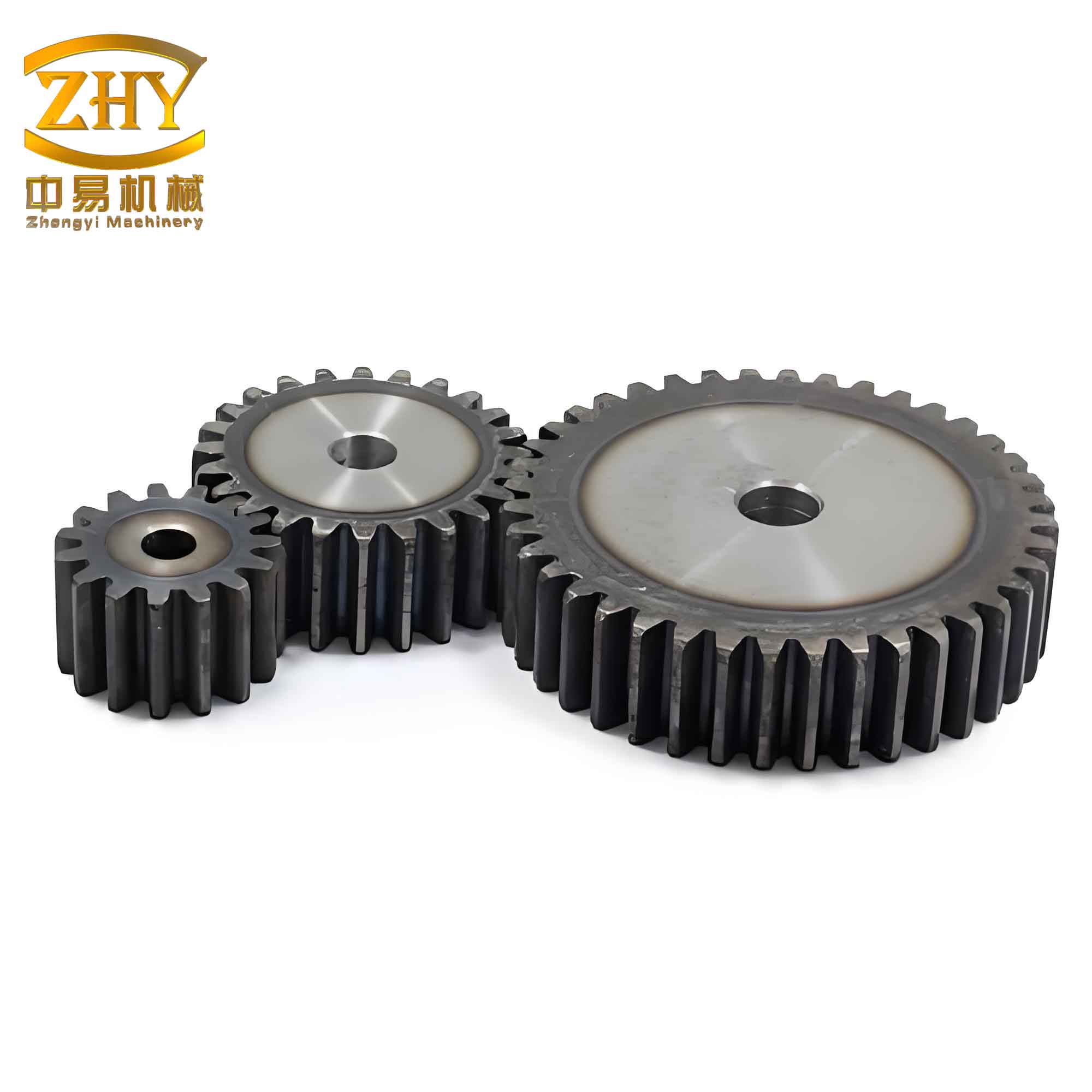
The cold precision forging of cylindrical gears involves shaping metal at room temperature under high pressure, which minimizes material waste and eliminates the need for extensive machining. Compared to traditional hot forging, which often requires subsequent加工 to achieve precision, cold forging produces near-net-shape components with intact metal flow lines. This not only enhances strength but also reduces production costs. Despite these advantages, the process is constrained by high forming forces that can lead to模具 wear and potential defects in critical areas like tooth tips. To address this, I investigate three distinct process schemes: a conventional closed-die forging (Scheme A), a modified approach with a flash hole (Scheme B), and another with diversion grooves (Scheme C). These modifications are designed to alleviate forming loads and improve material flow, thereby enhancing the quality of cylindrical gears.
My analysis employs Deform-3D, a finite element software widely used for simulating metal forming processes. By modeling a quarter of the cylindrical gear due to symmetry, I efficiently compute the forming behavior under various conditions. The basic parameters for the simulation include a billet size of Ø50 mm × 38.5 mm, material Steel AISI-4120, and ambient temperature of 20°C. The initial friction coefficient is set to 0.1, and the upper die speed is 1 mm/s, with a mesh count of 100,000 elements to ensure accuracy. Through this numerical approach, I aim to evaluate the effectiveness of Schemes B and C in reducing forming loads and stress concentrations, compared to the baseline Scheme A. The results provide insights into optimizing cylindrical gear production for industrial applications.
Process Schemes for Cylindrical Gears
To overcome the limitations of standard cold forging for cylindrical gears, I propose two innovative modifications. Scheme A represents the typical closed-die forging process without any additional features, serving as a reference. In Scheme B, I introduce a flash hole with a diameter of 6 mm at the center of the upper die. This small aperture allows excess material to escape, effectively reducing the forming pressure. Scheme C incorporates diversion grooves at the tooth tips of the cylindrical gear, each with a depth of 0.5 mm, to facilitate material flow into the challenging corner areas. Both schemes are designed with practical constraints in mind, ensuring minimal impact on the final part geometry while targeting specific issues. The table below summarizes the key characteristics of these schemes for cylindrical gears.
| Scheme | Description | Key Feature | Purpose |
|---|---|---|---|
| A | Conventional closed-die forging | No modifications | Baseline for comparison |
| B | Flash hole implementation | 6 mm diameter hole in upper die | Reduce forming load |
| C | Diversion groove addition | 0.5 mm deep grooves at tooth tips | Improve corner filling and stress distribution |
These schemes are evaluated based on forming load, stress-strain fields, and material flow patterns. For cylindrical gears, the tooth geometry—with a module of 2.0, 30 teeth, 20 mm face width, and pressure angle of 20°—presents significant filling difficulties. The cold forging process must ensure complete formation without defects, which is why Schemes B and C are crucial. By allowing controlled material escape or directed flow, they mitigate the high stresses that typically occur in standard forging of cylindrical gears. This not only prolongs模具 life but also enhances the dimensional accuracy of the final product.
Finite Element Modeling and Analysis
Using Deform-3D, I establish a finite element model to simulate the cold precision forging of cylindrical gears. Due to the rotational symmetry of cylindrical gears, a quarter-model is adopted to reduce computational time while maintaining accuracy. The billet is meshed with approximately 100,000 tetrahedral elements, and the dies are treated as rigid bodies. The material properties are defined by the stress-strain relationship for Steel AISI-4120, which follows the power law hardening model: $$ \sigma = K \epsilon^n $$ where $\sigma$ is the true stress, $\epsilon$ is the true strain, $K$ is the strength coefficient, and $n$ is the strain-hardening exponent. For this steel, typical values are $K = 600$ MPa and $n = 0.2$, though these may vary based on specific conditions. The friction at the die-workpiece interface is modeled using the shear friction law: $$ \tau = m \cdot \sigma_y / \sqrt{3} $$ where $\tau$ is the frictional stress, $m$ is the friction coefficient, and $\sigma_y$ is the yield stress. This formulation accounts for the sliding resistance during forming of cylindrical gears.
The simulation parameters are summarized in the table below, providing a comprehensive overview of the initial conditions for analyzing cylindrical gears.
| Parameter | Value | Unit |
|---|---|---|
| Billet dimensions | Ø50 × 38.5 | mm |
| Material | Steel AISI-4120 | – |
| Temperature | 20 | °C |
| Friction coefficient (initial) | 0.1 | – |
| Upper die speed (initial) | 1 | mm/s |
| Mesh elements | 100,000 | – |
| Symmetry condition | Quarter-model | – |
The forming process is simulated in steps, with the upper die moving downward to compress the billet into the gear shape. I monitor key outputs such as forming load, stress distribution, and strain fields. For cylindrical gears, the forming load is a critical metric, as it directly impacts模具 durability and energy consumption. The stress and strain analyses reveal the uniformity of deformation, which correlates with the quality of the forged cylindrical gears. High stresses in localized areas can lead to defects or residual stresses, affecting the performance of cylindrical gears in service.
Results and Discussion on Forming Loads
The numerical results indicate significant differences in forming loads among the three schemes for cylindrical gears. Scheme A, the conventional process, exhibits the highest maximum forming load of approximately 1,500 kN. In contrast, Scheme B with the flash hole reduces this load to 1,393 kN, and Scheme C with diversion grooves achieves 1,397 kN. Both modified schemes lower the load by over 100 kN, demonstrating their effectiveness in alleviating pressure during cold forging of cylindrical gears. This reduction is achieved despite the small dimensions of the modifications—a 6 mm flash hole and 0.5 mm deep grooves—highlighting their practical viability for cylindrical gear production.
The forming load curves over time are plotted for each scheme, showing that the load increases gradually as the tooth cavities fill. For cylindrical gears, the initial stage involves upsetting the billet, with minimal load, followed by a sharp rise during tooth formation. The table below compares the peak loads and reductions for cylindrical gears across the schemes.
| Scheme | Maximum Forming Load (kN) | Reduction Compared to Scheme A (kN) | Percentage Reduction |
|---|---|---|---|
| A | 1500 | 0 | 0% |
| B | 1393 | 107 | 7.1% |
| C | 1397 | 103 | 6.9% |
These load reductions are crucial for extending模具 life in manufacturing cylindrical gears. High forming loads can cause模具 fatigue, leading to cracks and premature failure. By implementing Schemes B or C, the stress on the模具 is diminished, potentially lowering maintenance costs and improving production efficiency for cylindrical gears. Additionally, the reduced loads correlate with lower energy consumption, making the process more sustainable. For cylindrical gears used in high-performance applications, such as automotive transmissions, these benefits translate to enhanced reliability and cost savings.
Stress and Strain Analysis for Cylindrical Gears
The stress and strain distributions during cold forging provide deeper insights into the quality of cylindrical gears. In Scheme A, the maximum effective stress reaches about 5.5 GPa, concentrated at the tooth roots and tips. This high stress indicates potential for defect formation or residual stresses in the forged cylindrical gears. Schemes B and C, however, show lower maximum stresses of approximately 3 GPa, with more uniform distribution across the gear teeth. The strain fields also reveal that the tooth tips experience the highest deformation, consistent with the challenges in filling sharp corners of cylindrical gears. The improved stress uniformity in Schemes B and C suggests better mechanical properties and reduced risk of failure in service.
To quantify this, I calculate the stress homogeneity index $H$ defined as: $$ H = 1 – \frac{\sigma_{\text{max}} – \sigma_{\text{min}}}{\sigma_{\text{avg}}} $$ where $\sigma_{\text{max}}$, $\sigma_{\text{min}}$, and $\sigma_{\text{avg}}$ are the maximum, minimum, and average stresses in the gear teeth. For cylindrical gears, a higher $H$ value indicates more uniform stress distribution. The results are tabulated below for the three schemes.
| Scheme | Maximum Stress (GPa) | Minimum Stress (GPa) | Average Stress (GPa) | Homogeneity Index $H$ |
|---|---|---|---|---|
| A | 5.5 | 0.2 | 2.1 | 0.62 |
| B | 3.0 | 0.5 | 1.8 | 0.72 |
| C | 3.0 | 0.6 | 1.9 | 0.74 |
The higher homogeneity indices for Schemes B and C confirm that these modifications enhance the structural integrity of cylindrical gears. This is particularly important for cylindrical gears subjected to cyclic loading, as uniform stresses reduce stress concentrations that can initiate cracks. Moreover, the strain analysis shows that the effective strain in the tooth tips is reduced in Schemes B and C, from around 2.5 in Scheme A to 1.8, indicating less severe deformation and better filling. For cylindrical gears, this translates to improved dimensional accuracy and surface finish, reducing the need for post-forging machining.
Material Flow and Filling Behavior
The material flow patterns during forging are critical for achieving complete filling in cylindrical gears. In Scheme A, the metal flows radially outward from the billet center, but encounters resistance at the tooth cavities, leading to incomplete filling at the tips. Schemes B and C alter this flow: the flash hole in Scheme B allows excess material to escape, reducing pressure and enabling more controlled flow into the teeth, while the diversion grooves in Scheme C direct material specifically toward the tooth tips, ensuring full filling. This behavior is visualized through velocity vectors in the simulation, showing that for cylindrical gears, the modified schemes promote smoother and more efficient material movement.
To analyze the filling efficiency, I define a filling ratio $F$ as: $$ F = \frac{V_{\text{filled}}}{V_{\text{cavity}}} \times 100\% $$ where $V_{\text{filled}}$ is the volume of material in the tooth cavity and $V_{\text{cavity}}$ is the total cavity volume. For cylindrical gears, a filling ratio close to 100% indicates optimal forming. The results for the tooth tip regions are summarized below.
| Scheme | Filling Ratio at Tooth Tips (%) | Improvement Over Scheme A (%) |
|---|---|---|
| A | 85 | 0 |
| B | 92 | 7 |
| C | 95 | 10 |
Scheme C shows the best filling performance for cylindrical gears, owing to the diversion grooves that channel material directly into the critical areas. This is essential for cylindrical gears used in precision applications, where even minor voids can compromise strength and noise characteristics. The improved flow also reduces the forming load, as less energy is wasted on overcoming friction and geometric constraints. For cylindrical gears produced in high volumes, such enhancements can lead to significant quality improvements and lower rejection rates.
Optimization of Process Parameters
Beyond the process schemes, key parameters like friction coefficient and upper die speed significantly influence the cold forging of cylindrical gears. I conduct a parametric study by varying the friction coefficient from 0.1 to 0.3 and the upper die speed from 1 to 10 mm/s, using Scheme C as the base due to its superior performance. The forming loads under these conditions are computed to identify optimal settings for cylindrical gears. The table below presents the maximum forming loads for the nine parameter combinations.
| Friction Coefficient | Upper Die Speed (mm/s) | Maximum Forming Load (kN) |
|---|---|---|
| 0.1 | 1 | 1489 |
| 5 | 1652 | |
| 10 | 1688 | |
| 0.2 | 1 | 1654 |
| 5 | 1773 | |
| 10 | 1862 | |
| 0.3 | 1 | 1718 |
| 5 | 1873 | |
| 10 | 2070 |
The results show that forming loads for cylindrical gears increase with both friction coefficient and die speed. The minimum load of 1,489 kN occurs at a friction coefficient of 0.1 and speed of 1 mm/s, while the maximum load of 2,070 kN is at 0.3 and 10 mm/s—a difference of 581 kN, representing a 28% reduction at the lower end. This highlights the sensitivity of cylindrical gear forging to these parameters. To model this relationship, I derive an empirical formula based on regression analysis: $$ P = P_0 + \alpha m + \beta v $$ where $P$ is the forming load, $P_0$ is a base load, $m$ is the friction coefficient, $v$ is the die speed, and $\alpha$ and $\beta$ are coefficients. For cylindrical gears under these conditions, $P_0 = 1400$ kN, $\alpha = 200$ kN per unit friction, and $\beta = 20$ kN per mm/s. This formula aids in predicting loads for various settings in cylindrical gear production.
Practically, a friction coefficient of 0.2 and die speed of 1 mm/s are recommended for cylindrical gears, balancing load reduction (1,654 kN) with reasonable production time. Lower friction can be achieved through advanced lubricants, while slower speeds ensure controlled deformation, minimizing defects in cylindrical gears. This optimization not only enhances模具 life but also improves the consistency of cylindrical gears, crucial for mass manufacturing.
Theoretical Implications for Cylindrical Gear Forging
The findings from this study have broader theoretical implications for cold precision forging of cylindrical gears. The reduction in forming load through Schemes B and C aligns with plasticity theory, where stress relief features lower the mean pressure required for deformation. For cylindrical gears, the forming pressure $p$ can be estimated using the slab method: $$ p = \sigma_y \left(1 + \frac{\mu D}{4h}\right) $$ where $\sigma_y$ is the yield stress, $\mu$ is the friction coefficient, $D$ is the workpiece diameter, and $h$ is the height. Introducing a flash hole or diversion grooves effectively reduces the apparent $D$ or $h$, thereby decreasing $p$. This explains the load reductions observed in cylindrical gears.
Moreover, the improved stress uniformity relates to the principle of hydrostatic pressure in metal forming. By providing escape paths or flow guides, Schemes B and C increase the hydrostatic component of stress, which enhances ductility and filling in cylindrical gears. The strain rate sensitivity also plays a role; at lower die speeds, the material has more time to flow, reducing strain hardening effects. This is quantified by the strain rate $\dot{\epsilon}$, given by: $$ \dot{\epsilon} = \frac{v}{h} $$ where $v$ is the die speed and $h$ is the instantaneous height. For cylindrical gears, lower $\dot{\epsilon}$ values at slower speeds contribute to lower flow stresses, consistent with the parametric results.
These theoretical insights can guide further research on cylindrical gears, such as exploring other geometries or materials. For instance, applying similar modifications to helical gears or bevel gears could yield comparable benefits. Additionally, the numerical models developed here can be refined with advanced constitutive equations to capture temperature effects or anisotropic behavior in cylindrical gears.
Industrial Applications and Future Directions
The optimized cold forging process for cylindrical gears has direct applications in industries requiring high-performance gears, such as automotive, aerospace, and robotics. By adopting Schemes B or C, manufacturers can produce cylindrical gears with lower energy consumption, extended模具 life, and improved quality. For example, in electric vehicle transmissions, precision-forged cylindrical gears offer enhanced efficiency and durability, contributing to longer battery life and reduced maintenance. The parametric guidelines also enable tailored production lines for cylindrical gears, adjusting speeds and lubrication based on specific design requirements.
Future work could focus on several areas. First, experimental validation of the numerical results for cylindrical gears is essential to confirm the load reductions and filling improvements. This could involve physical trials with instrumented dies to measure loads and inspect gear teeth. Second, economic analysis can assess the cost-benefit ratio of implementing flash holes or diversion grooves in cylindrical gear production, considering模具 modification costs and savings from reduced wear. Third, exploring hybrid processes, such as warm forging or combined forging-machining, may further optimize cylindrical gears for complex applications. Finally, advancing the finite element models to include multi-scale simulations could predict microstructural evolution in cylindrical gears, linking process parameters to mechanical properties like fatigue strength.
In conclusion, this study demonstrates the value of numerical analysis in optimizing cold precision forging for cylindrical gears. Through innovative process schemes and parameter adjustments, significant improvements in forming loads, stress distribution, and filling behavior are achieved for cylindrical gears. The insights provided here serve as a foundation for enhancing the manufacturing of cylindrical gears, driving innovation in gear technology across multiple sectors.