
The pursuit of higher power density, reduced noise, and increased longevity in power transmission systems is a constant driver for innovation in gear design. Among various gear types, cylindrical gears remain foundational. Traditional involute cylindrical gears, while highly standardized and manufacturable, have inherent limitations in contact stress distribution and bending strength. This has led to significant research into alternative tooth geometries. One promising direction involves the use of circular arc profiles, as seen in Novikov/Wildhaber gears, which offer superior contact strength due to their convex-to-concave contact pattern. Separately, the concept of cylindrical gears with circular arc tooth traces (CATT gears) has been explored for their potential to eliminate axial thrust and introduce beneficial “crowning” effects. This paper presents a comprehensive study on a novel synthesis of these two concepts: a cylindrical gear that integrates a multi-segment circular arc tooth profile with a circular arc tooth line. We develop a precise mathematical model based on face-milling generation principles, construct detailed three-dimensional solid models, and conduct a finite element analysis to evaluate and compare the load-carrying capacity of double-arc and quadruple-arc profile variants.
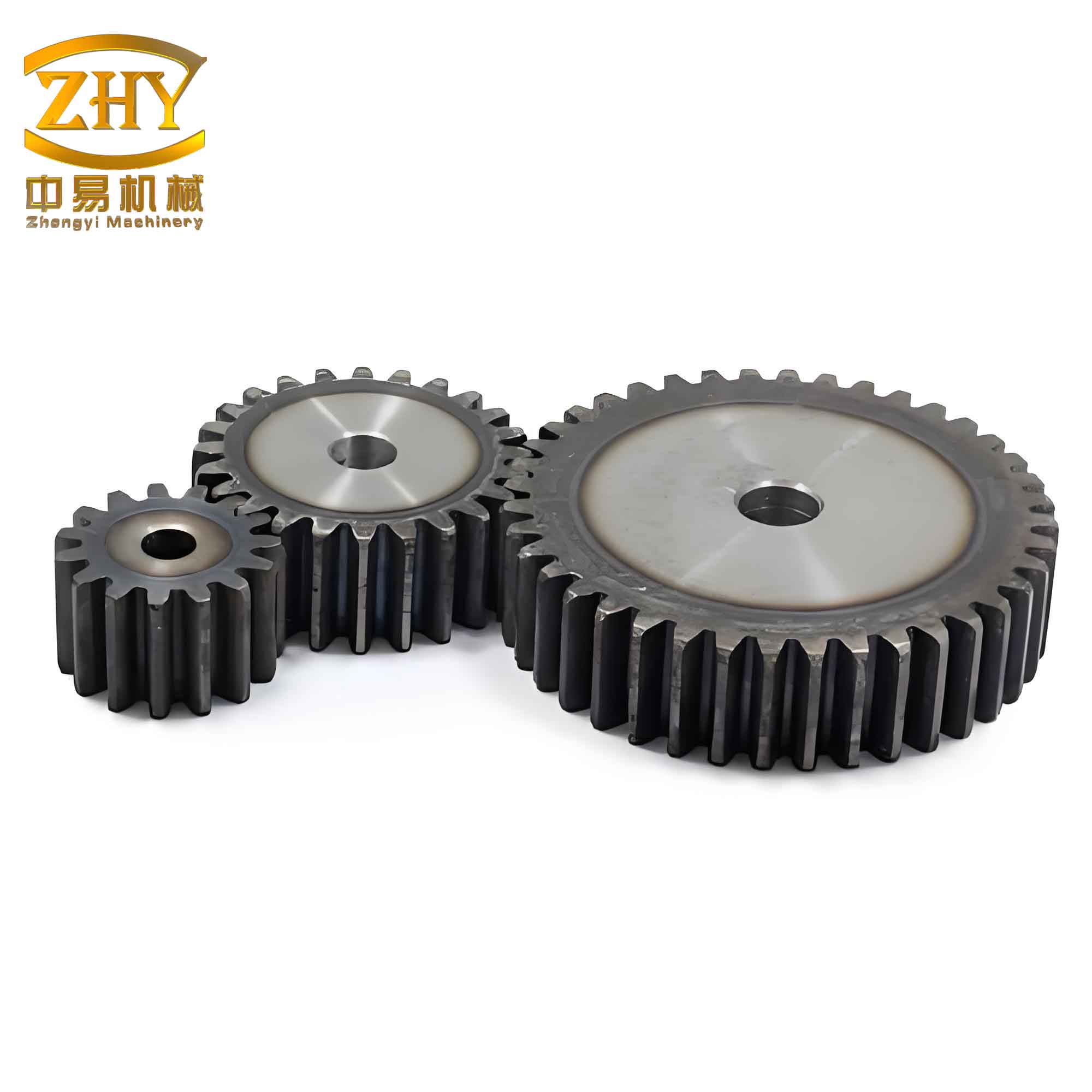
The fundamental geometry of the proposed gear is characterized by two key features: the tooth profile in the transverse section is composed of one or more circular arcs, and the tooth trace (the line along the tooth width) is also a circular arc, symmetric about the mid-plane of the gear face width. This configuration aims to combine the multi-point contact and favorable Hertzian contact conditions of arc-profile cylindrical gears with the axial force cancellation and improved load distribution of CATT cylindrical gears. Unlike herringbone gears, which require a recess for tool withdrawal, this design can be generated in a continuous machining process, leading to a more compact and potentially stronger structure. The theoretical meshing process involves contact points that travel along the convex-concave interfaces, moving towards the gear’s mid-plane during engagement, which promotes smoother load transfer and reduced stress concentrations.
Mathematical Modeling of the Tooth Surface
To accurately define and manufacture this complex gear geometry, a rigorous mathematical model is essential. We adopt the generation principle analogous to that used for spiral bevel gears on a face-milling machine. This approach is practical and efficient. The coordinate systems established for this derivation are crucial and are defined as follows:
- Coordinate System σn = [On; Xn, Yn, Zn]: Fixed to the cutting blade (cutter tooth). The basic circular arc profile is defined here.
- Coordinate System σt = [Ot; Xt, Yt, Zt]: Fixed to the rotating cutter head (blade group).
- Coordinate System σ0 = [O0; X0, Y0, Z0]: Fixed to the imaginary generating crown gear (or planning gear).
- Coordinate System σ2 = [O2; X2, Y2, Z2]: Fixed to the workpiece (the gear being generated).
The cutter head rotates with an angular velocity ω0, and the gear blank rotates with an angular velocity ω2. Their relationship is governed by the generating roll ratio, linked to the cutter radius Rr and the gear’s pitch radius r.
The foundation of the model is the definition of the basic cutter profile. For a generic circular arc segment “i” on the cutter blade, its equation in σn is:
$$ \mathbf{r}_{n}^{(i)} = \begin{bmatrix} x_{n}^{(i)} \\ y_{n}^{(i)} \\ z_{n}^{(i)} \\ 1 \end{bmatrix} = \begin{bmatrix} \rho_i \sin \alpha_i + E_i \\ \rho_i \cos \alpha_i + F_i \\ 0 \\ 1 \end{bmatrix}, \quad \alpha_i \in [\alpha_i^{‘}, \alpha_i^{”}] $$
where (Ei, Fi) are the coordinates of the arc’s center, ρi is its radius, and αi is the angular parameter.
Through a series of coordinate transformations, we obtain the family of surfaces represented by the cutter blade in the gear blank coordinate system σ2. The final tooth surface is the envelope of this family, satisfying the equation of meshing. The transformation sequence and the resulting equations are detailed below.
1. Cutter Surface in Cutter Head System (σt):
The blade arc is rotated about the cutter head axis. The transformation matrix Mtn incorporates the rotation angle θ and the cutter head radius Rr.
$$ \mathbf{r}_{t}^{(i)} = \mathbf{M}_{tn} \cdot \mathbf{r}_{n}^{(i)} = \begin{bmatrix} 1 & 0 & 0 & 0 \\ 0 & \cos\theta & -\sin\theta & R_r \cos\theta \\ 0 & \sin\theta & \cos\theta & R_r \sin\theta \\ 0 & 0 & 0 & 1 \end{bmatrix} \begin{bmatrix} \rho_i \sin \alpha_i + E_i \\ \rho_i \cos \alpha_i + F_i \\ 0 \\ 1 \end{bmatrix} = \begin{bmatrix} \rho_i \sin \alpha_i + E_i \\ (\rho_i \cos \alpha_i + F_i + R_r)\cos\theta \\ (\rho_i \cos \alpha_i + F_i + R_r)\sin\theta \\ 1 \end{bmatrix} $$
2. Family of Surfaces in Generating Gear System (σ0):
The cutter head is given a radial setting and a tilt angle (machine root angle) δ. This angle changes during generation to create the curved tooth trace. The transformation matrix M0t includes this angle δ and a radial offset u.
$$ \mathbf{r}_{0}^{(i)} = \mathbf{M}_{0t} \cdot \mathbf{r}_{t}^{(i)} = \begin{bmatrix} 1 & 0 & 0 & 0 \\ 0 & \cos\delta & -\sin\delta & -u \sin\delta \\ 0 & \sin\delta & \cos\delta & u \cos\delta \\ 0 & 0 & 0 & 1 \end{bmatrix} \begin{bmatrix} \rho_i \sin \alpha_i + E_i \\ (\rho_i \cos \alpha_i + F_i + R_r)\cos\theta \\ (\rho_i \cos \alpha_i + F_i + R_r)\sin\theta \\ 1 \end{bmatrix} $$
This results in the generating gear surface family:
$$ \mathbf{r}_{0}^{(i)} = \begin{bmatrix} \rho_i \sin \alpha_i + E_i \\ (\rho_i \cos \alpha_i + F_i + R_r)\cos(\delta + \theta) – u \sin\delta \\ (\rho_i \cos \alpha_i + F_i + R_r)\sin(\delta + \theta) + u \cos\delta \\ 1 \end{bmatrix} $$
3. Equation of Meshing:
The tooth surface is the envelope of the family of surfaces generated by the cutter. The necessary condition is that the relative velocity between the generating gear and the workpiece is orthogonal to the common surface normal at the contact point. This is expressed as:
$$ \mathbf{n}_{0}^{(i)} \cdot \mathbf{V}_{0}^{(02)} = 0 $$
where $\mathbf{n}_{0}^{(i)}$ is the normal vector to the generating surface and $\mathbf{V}_{0}^{(02)}$ is the relative velocity vector in σ0. Deriving this condition leads to the implicit meshing function Φ(αi, θ, δ, u) = 0. For our specific gear geometry and machine kinematics, this equation takes the form:
$$
(\rho_i \cos \alpha_i + F_i + R_r) \cos(\delta + \theta) \frac{R_r}{r} \sin \alpha_i – (\rho_i \sin \alpha_i + E_i) \frac{R_r}{r} \cos \alpha_i \cos(\delta + \theta) – u \left[ \sin\delta \frac{R_r}{r} \sin \alpha_i + \cos\delta \cos \alpha_i \cos(\delta + \theta) + \sin\delta \cos \alpha_i \sin(\delta + \theta) \right] = 0
$$
Here, r is the pitch radius of the generated cylindrical gear. The relationship between the angular change Δδ and the workpiece rotation φ is Δδ/φ = r/Rr.
4. Tooth Surface of the Workpiece (σ2):
The final tooth surface on the gear is obtained by transforming the generating gear surface, which satisfies the meshing equation, back to the workpiece system σ2. This involves a rotation by the workpiece roll angle φ and a translation.
$$ \mathbf{r}_{2}^{(i)} = \mathbf{M}_{20} \cdot \mathbf{r}_{0}^{(i)} = \begin{bmatrix} \cos\phi & \sin\phi & 0 & 0 \\ -\sin\phi & \cos\phi & 0 & 0 \\ 0 & 0 & 1 & 0 \\ 0 & 0 & 0 & 1 \end{bmatrix} \begin{bmatrix} 1 & 0 & 0 & -r \\ 0 & 1 & 0 & 0 \\ 0 & 0 & 1 & 0 \\ 0 & 0 & 0 & 1 \end{bmatrix} \begin{bmatrix} x_{0}^{(i)} \\ y_{0}^{(i)} \\ z_{0}^{(i)} \\ 1 \end{bmatrix} $$
The explicit parametric equations for a point on the i-th arc segment of the gear tooth surface are:
$$ \begin{cases}
x_{2}^{(i)} = \cos\phi \cdot x_{0}^{(i)} + \sin\phi \cdot y_{0}^{(i)} – r \cos\phi \\
y_{2}^{(i)} = -\sin\phi \cdot x_{0}^{(i)} + \cos\phi \cdot y_{0}^{(i)} + r \sin\phi \\
z_{2}^{(i)} = z_{0}^{(i)}
\end{cases} $$
where $(x_{0}^{(i)}, y_{0}^{(i)}, z_{0}^{(i)})$ are given by $\mathbf{r}_{0}^{(i)}$ and the parameters (αi, θ, δ, u) are not independent but are linked by the meshing equation Φ(αi, θ, δ, u) = 0.
Three-Dimensional Solid Model Generation
With the mathematical model established, the next step is to create a three-dimensional solid model suitable for visualization, simulation, and eventual manufacturing. The process is computational and relies on generating a dense point cloud that accurately represents the complex, doubly-curved tooth flank. The following table outlines the key parameters used for modeling two distinct gear designs: a Double-Arc Profile Gear and a Quadruple-Arc Profile Gear.
| Parameter | Symbol | Double-Arc Gear | Quadruple-Arc Gear |
|---|---|---|---|
| Number of Teeth (Pinion/Gear) | z1 / z2 | 20 / 30 | 20 / 30 |
| Module | mn | 8 mm | 8 mm |
| Face Width | B | 120 mm | 120 mm |
| Cutter Head Radius | Rr | 6 inches (~152.4 mm) | 6 inches (~152.4 mm) |
| Profile Arc Segments (per flank) | – | 2 (Convex & Concave) | 4 (Two Convex, Two Concave) |
| Primary Design Goal | – | Baseline for multi-point contact | Increased number of potential contact points |
The modeling workflow proceeds as follows:
- Discrete Point Calculation: A numerical algorithm is implemented in computational software (e.g., MATLAB). For each tooth flank (drive side and coast side), and for each circular arc segment constituting the profile, the system of equations comprising the surface coordinates $\mathbf{r}_{2}^{(i)}$ and the meshing equation Φ = 0 is solved. Parameters αi and θ (or u) are varied systematically over their defined ranges to generate a dense, ordered grid of points (x2, y2, z2) in the workpiece coordinate system.
- Curve and Surface Construction: The calculated point cloud is exported to a professional CAD system (e.g., Pro/ENGINEER, SolidWorks, CATIA). Within the CAD environment, spline curves are fitted through rows of points corresponding to constant profile parameters or constant tooth-trace parameters. These networks of curves are then used to generate high-quality, trimmed NURBS surfaces for each distinct segment of the tooth flank.
- Solid Model Assembly: The individual surfaces for the convex and concave sides of a single tooth are knitted together into a closed, watertight volume, forming a solid tooth. This solid tooth is then patterned circumferentially around the gear axis using the specified number of teeth (z=20 or z=30). Finally, the gear body (web, hub, bore) is added to complete the fully detailed 3D solid model of the cylindrical gear. The model of the quadruple-arc profile gear reveals a more complex undulating profile in the transverse section compared to the simpler two-arc form.
Finite Element Analysis and Load Capacity Assessment
To quantitatively evaluate the performance benefits of the multi-arc design, a static finite element contact analysis is performed. The objective is to compare the contact stress distribution and magnitude between the Double-Arc and Quadruple-Arc cylindrical gears under identical loading conditions. The analysis focuses on a single-tooth pair engagement at a position where the theoretical maximum number of contact points is active.
1. Model Preparation and Meshing:
The 3D solid models of a mating pinion and gear pair are imported into a commercial FEA software package (e.g., ABAQUS, ANSYS). The material properties are assigned as homogeneous, linear-elastic steel: Young’s Modulus E = 2.06e5 MPa and Poisson’s Ratio ν = 0.3. A critical step is the creation of a fit-for-purpose finite element mesh. A pure hexahedral mesh is often difficult to generate for such complex geometries; therefore, a primarily tetrahedral mesh is used with extreme refinement in the contact zones. The contact regions on both the convex and concave flanks are identified and seeded with a very fine mesh size, while non-critical areas like the gear web and hub are given a coarser mesh to reduce the total number of elements and computational cost. A representative mesh is shown below, highlighting the refined contact zones.
2. Boundary Conditions and Loading:
Realistic boundary conditions are applied to simulate a static torque transmission scenario:
- Gear (driven): The inner bore surface of the larger gear is fixed in all degrees of freedom (fully constrained).
- Pinion (driver): The inner bore surface of the pinion is constrained in all translational degrees of freedom. It is only allowed to rotate about its axis. A concentrated torque of T = 1000 Nm is applied to a reference point coupled to the pinion’s bore.
A surface-to-surface contact definition is established between the pinion and gear tooth flanks. A “hard” normal contact behavior (penalty method) is typically used to enforce impenetrability, and a Coulomb friction model with a low coefficient (e.g., μ=0.05-0.1) is applied to account for tangential forces.
3. Results and Comparative Analysis:
The FEA solver calculates the stress field throughout the gear bodies. The primary result of interest is the contact pressure distribution on the tooth flanks. For the double-arc profile cylindrical gears, the analysis clearly shows four distinct, high-stress contact patches: two on the convex flanks and two on the concave flanks. Conversely, for the quadruple-arc profile cylindrical gears, eight distinct contact patches are visible, corresponding to the four convex-to-concave interactions provided by its more complex profile.
| Gear Design | Theoretical Max Contact Points per Flank Pair | Observed Contact Points (FEA) | Maximum Contact Stress (σHmax) | Comparative Stress Ratio |
|---|---|---|---|---|
| Double-Arc Profile | 4 | 4 | 422 MPa | 1.00 (Baseline) |
| Quadruple-Arc Profile | 8 | 8 | 337 MPa | ~0.80 |
The key finding is the significant reduction in peak contact stress. The maximum von Mises or contact pressure (σHmax) for the quadruple-arc gear is approximately 337 MPa, which is about 80% of the 422 MPa observed for the double-arc gear. This 20% reduction is directly attributable to the increased number of contact points, which effectively distributes the transmitted load over a larger total contact area. The relationship between contact stress, load, and curvature is governed by the Hertzian contact theory. For line contact, the maximum contact pressure σH is proportional to the square root of the load per unit length. By doubling the number of load-sharing contact lines, the load per line is roughly halved, leading to a reduction in contact pressure by a factor of approximately √2 ≈ 0.707. The observed reduction to 0.80 of the baseline value aligns well with this theoretical trend, considering factors like edge effects, slight load misdistribution, and finite element discretization. This result strongly supports the hypothesis that increasing the segmentation of the circular arc profile in these novel cylindrical gears is a viable and effective strategy for enhancing their load-carrying capacity.
Discussion and Potential Applications
The successful modeling and analysis presented herein validate the core concept of integrating multi-segment circular arc profiles with a circular arc tooth line in cylindrical gears. The quadruple-arc design demonstrates a clear mechanical advantage in static contact stress. Beyond this fundamental finding, several important aspects warrant discussion:
Meshing Dynamics and Load Sharing: The analysis presented is static. In a dynamic meshing cycle, the number of contact points and the load share among them will vary as the teeth engage and disengage. A transient dynamic analysis would be necessary to fully understand the vibration and noise characteristics, which are critical for high-speed applications. The curved tooth trace may introduce timing variations in the engagement of different profile segments, potentially smoothing out torque fluctuations.
Manufacturing Considerations: The proposed face-milling generation method leverages existing spiral bevel gear technology, which is a significant practical advantage. However, the setup and tooling require precise control. The cutter head must be designed with blades ground to the exact multi-arc profile. The machine kinematics (the relationship between δ, φ, and u) must be precisely programmed, potentially requiring specialized CNC functions or post-processors for standard face-milling gear generators. The table below contrasts key manufacturing aspects.
| Aspect | Challenge/Opportunity | Potential Solution |
|---|---|---|
| Tooling | Design and grinding of cutter blades with complex multi-arc profiles. | Use of precision CNC tool grinding machines and CMM verification. |
| Machine Setup | Non-standard kinematic relationship for generating cylindrical gears. | Development of custom post-processors for commercial face-mill gear generators (e.g., Gleason, Klingelnberg). |
| Inspection | No standard metrology exists for these complex tooth surfaces. | Utilization of 3D coordinate measuring machines (CMMs) with specialized software to compare point clouds against the theoretical model. |
| Prototyping | High cost for small batches. | Additive manufacturing (3D printing) in metals for functional prototype testing. |
Bending Strength: While contact strength is improved, the bending stress at the tooth root is another critical failure mode. The root geometry of these gears is dictated by the trochoid generated by the cutter tip. A separate bending stress analysis using FEM or analytical methods is required to ensure the design has sufficient bending strength. The stress concentration factors may differ from those of standard involute cylindrical gears.
Potential Applications: These high-capacity, compact cylindrical gears are well-suited for applications where space and weight are at a premium, and high reliability is required. Potential sectors include:
- Heavy Machinery & Mining: High-torque, low-speed reducers in conveyors, crushers, and hoists.
- Marine Propulsion: Compact reduction gears in ship drives.
- Aviation: High-power-density gearboxes in helicopter main transmissions and auxiliary power units (APUs), where weight savings are paramount.
- Energy: Gearboxes in wind turbines and tidal power systems, where high reliability and maintenance intervals are crucial.
Future Research Directions: This work opens several avenues for further investigation:
- Dynamic Analysis: Conducting full multi-body dynamic simulations to evaluate vibration, noise, and dynamic load factors under realistic operating conditions.
- Optimization: Using the mathematical model within a formal optimization loop to find the ideal combination of arc radii, centers, and tooth trace radius that minimizes contact and bending stress simultaneously for a given load case.
- Experimental Validation: Manufacturing physical prototypes (initially via additive manufacturing for cost-effectiveness) and conducting bench tests to measure contact patterns, transmission error, efficiency, and ultimate strength, comparing results directly with the FEA predictions.
- Lubrication Analysis: Studying the elastohydrodynamic lubrication (EHL) film formation in the multiple convex-concave contacts, which likely differs significantly from the line contact in involute gears.
Conclusion
This study has successfully established a complete framework for the design and analysis of a novel class of high-performance cylindrical gears. By synthesizing the principles of multi-point circular arc contact and axial-force-canceling curved tooth traces, we have developed a gear with a theoretically superior load distribution mechanism. The core contribution is the derivation of a precise mathematical model for the tooth surface based on practical face-milling generation principles. This model enabled the creation of accurate 3D solid models for both double-arc and quadruple-arc profile variants. The subsequent finite element contact analysis provided quantitative evidence of the performance gain: the quadruple-arc profile gear exhibited a peak contact stress approximately 20% lower than its double-arc counterpart under identical loading, confirming the benefit of increasing the number of load-sharing contact points.
The research demonstrates that the strategic complexity added to the tooth profile geometry of these cylindrical gears can yield significant mechanical advantages. While manufacturing and inspection challenges exist, they are addressable with modern CNC and metrology technologies. The results provide a strong theoretical foundation and compelling justification for further development, optimization, and eventual practical application of these advanced cylindrical gears in demanding power transmission systems where enhanced durability, compactness, and efficiency are critical design goals.