
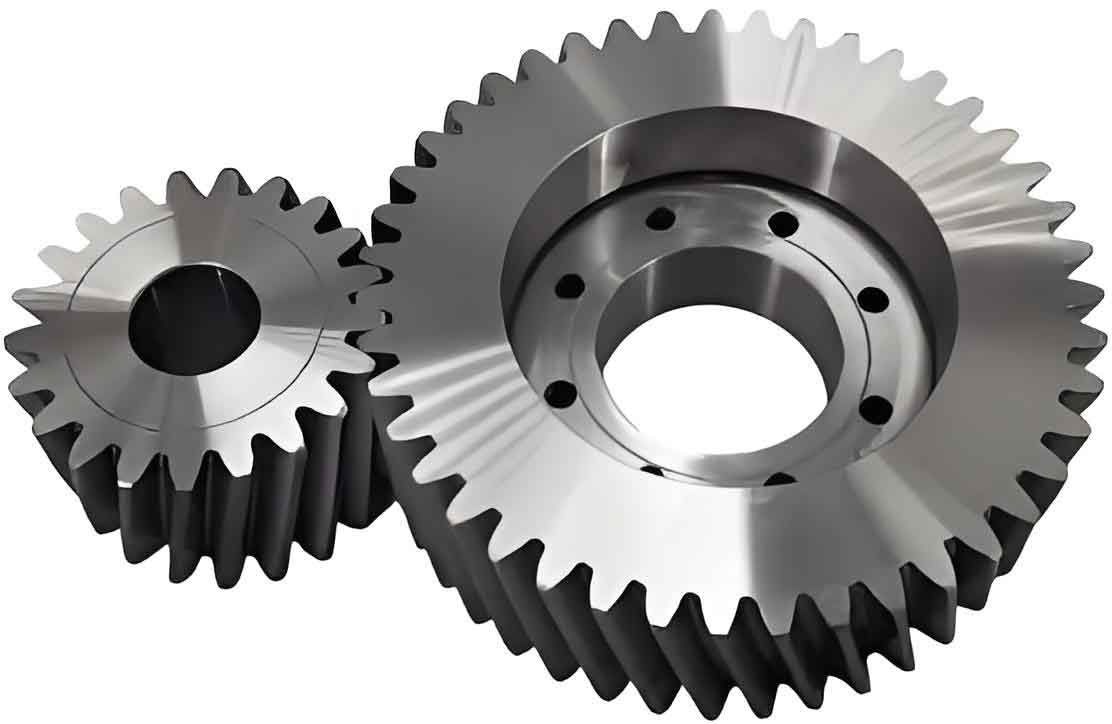
In power transmission systems, cylindrical gears are fundamental components, and their dynamic behavior directly influences the overall stability and reliability of machinery. Manufacturing imperfections, such as cumulative pitch errors, are pervasive in real-world cylindrical gears and significantly alter the tooth contact conditions. These alterations not only affect the vibration and noise characteristics but also accelerate the progression of surface damage modes like pitting, scuffing, and notably, wear. While existing research has extensively investigated the influence of manufacturing errors or surface damage on gear meshing and dynamic response, a significant gap remains in quantitatively analyzing how pitch errors affect the uniformity of wear distribution across different teeth of cylindrical gears. Traditional wear models often assume uniform load sharing, leading to identical wear on each tooth—an idealization that does not hold in practical cylindrical gear systems with inherent errors. This study aims to bridge this gap by developing a coupled dynamic wear prediction model specifically for cylindrical gears that incorporates the effects of cumulative pitch error. This model will be used to analyze the impact of such errors on meshing characteristics, vibration response, and, crucially, the non-uniform wear distribution among the teeth of cylindrical gears.
1. Dynamic Wear Prediction Model for Cylindrical Gears with Pitch Errors
The proposed model integrates three key components: a quasi-static Loaded Tooth Contact Analysis (LTCA) model accounting for pitch errors, a geared rotor dynamic model, and a dynamic wear model based on Archard’s theory. This integrated approach enables the simulation of the interaction between time-varying mesh properties, system vibration, and progressive wear in cylindrical gears.
1.1 Load Distribution Model Considering Cumulative Pitch Error
Cumulative pitch error is a common manufacturing deviation in cylindrical gears where the actual tooth spacing deviates from the theoretical value. As shown schematically, if $P_t$ is the theoretical pitch, $f_{pt}$ is the single pitch error, and $F_{pk}$ represents the cumulative pitch error for the k-th tooth. A positive $f_{pt}$ indicates a thicker actual tooth, while a negative value indicates a thinner tooth. This error disrupts the ideal simultaneous contact of multiple tooth pairs in cylindrical gears.
The LTCA method is employed to obtain the load distribution. This method efficiently separates the global tooth body deflection from the local contact deformation. Global compliance is calculated using a finite element model constructed for the cylindrical gear teeth, while local contact deformation is computed using an analytical formula for Hertzian contact. The pitch error must be converted to a normal direction deviation on the tooth flank of the cylindrical gear:
$$E_{pt} = f_{pt} \cos \alpha_t \cos \beta_b$$
where $\alpha_t$ is the transverse pressure angle and $\beta_b$ is the base circle helix angle of the cylindrical gear.
The system compliance matrix $\boldsymbol{\lambda_b}$ combines the global flexibilities of the pinion and gear from the FE model. The local contact compliance matrix $\boldsymbol{\lambda_c}$ is a diagonal matrix where each element $\lambda_{ci}$ for contact point $i$ is given by:
$$\lambda_{ci} = \frac{1.275}{E^{0.9} L^{0.8} F_i^{0.1}}$$
where $E$ is the elastic modulus, $L$ is the face width of the cylindrical gear, and $F_i$ is the contact force at point $i$. The nonlinear LTCA governing equation is:
$$\begin{bmatrix}
-(\boldsymbol{\lambda_c} + \boldsymbol{\lambda_b}) & \mathbf{I}_{n \times 1} \\
\mathbf{I}_{1 \times n} & 0
\end{bmatrix}
\begin{bmatrix}
\mathbf{F_n} \\
\delta_s
\end{bmatrix}
=
\begin{bmatrix}
\boldsymbol{\varepsilon} \\
F_s
\end{bmatrix}$$
Here, $\mathbf{F_n}$ is the normal contact force vector (load distribution), $\delta_s$ is the static transmission error (STE), $F_s = T / r_{b1}$ is the static mesh force (with $T$ as input torque and $r_{b1}$ as the pinion base radius), and $\boldsymbol{\varepsilon}$ is the profile deviation vector encompassing tooth separation, intentional modifications, and the converted pitch errors. Solving this equation yields the load distribution $\mathbf{F_n}$ and STE $\delta_s$ for the cylindrical gear pair. The mesh stiffness $k_m$ and unloaded transmission error (UTE) $e$ are then derived as:
$$k_m = \frac{F_s}{\delta_s – e}$$
1.2 Geared Rotor Dynamic Model for Cylindrical Gears
The dynamic model represents a cylindrical gear pair supported by flexible shafts and bearings. The gear mesh is modeled as a spring-damper element acting along the line of action. The generalized coordinate vector for the mesh element $\mathbf{x_m}$ includes translational and rotational degrees of freedom for both the pinion and gear. The displacement is projected onto the line of action using a projection vector $\mathbf{V_m}$. The time-varying mesh stiffness $k_m(t)$ obtained from LTCA forms the element stiffness matrix:
$$\mathbf{K_m}(t) = k_m(t) \mathbf{V_m^T} \mathbf{V_m}$$
Shafts are modeled using Timoshenko beam elements, and bearings are represented by linear springs. Assembling these elements leads to the system’s equation of motion:
$$\mathbf{M} \ddot{\mathbf{X}} + (\mathbf{C} + \mathbf{G}) \dot{\mathbf{X}} + \mathbf{K} \mathbf{X} = \mathbf{F}$$
where $\mathbf{M}$, $\mathbf{C}$, $\mathbf{G}$, and $\mathbf{K}$ are the mass, damping, gyroscopic, and stiffness matrices, respectively, for the cylindrical gear rotor system. $\mathbf{F}$ is the external force vector. The dynamic mesh force $F_d$ is:
$$F_d = k_m(t) (\delta – e) = k_m(t) (\mathbf{V_m} \mathbf{x_m} – e)$$
where $\delta$ is the dynamic transmission error (DTE). Due to pitch errors in cylindrical gears, the vibration response period is not simply the mesh period $T_m$ but the “hunting tooth period” $T_{ht}$, which is the time for two specific teeth on the pinion and gear to meet again:
$$T_{ht} = \frac{1}{f_{ht}} = \text{lcm}(z_1, z_2) \cdot T_m = \frac{z_1 z_2}{N_{ap}} \cdot T_m$$
where $z_1$, $z_2$ are tooth numbers, $\text{lcm}$ is the least common multiple, $N_{ap}$ is the greatest common divisor (assembly phase number), and $f_{ht}$ is the hunting tooth frequency. This leads to additional characteristic frequencies in the response of cylindrical gears, such as the hunting tooth frequency and the assembly phase frequency:
$$f_{ht} = f_m \frac{N_{ap}}{z_1 z_2}, \quad f_{ap} = \frac{f_m}{N_{ap}}$$
where $f_m$ is the mesh frequency.
1.3 Dynamic Wear Model Based on Archard’s Theory
Wear on the tooth flanks of cylindrical gears is modeled using Archard’s wear equation. The wear depth $\Delta h$ per meshing cycle at a contact point is calculated as:
$$\Delta h_p = 2 k_w \bar{\sigma}_H a_H |1 – v_g/v_p|$$
$$\Delta h_g = 2 k_w \bar{\sigma}_H a_H |1 – v_p/v_g|$$
The subscripts $p$ and $g$ denote pinion and gear of the cylindrical gear pair, $v$ is the sliding velocity, $a_H$ is the Hertzian contact half-width, and $\bar{\sigma}_H$ is the average Hertzian contact pressure. The wear coefficient $k_w$ depends on the lubrication regime, determined by the film thickness ratio $\lambda$:
$$
k_w =
\begin{cases}
k_{w0}, & \lambda < 0.5 \quad \text{(Boundary Lubrication)} \\
2k_{w0}(4 – \lambda)/7, & 0.5 \leq \lambda \leq 4 \quad \text{(Mixed Lubrication)} \\
0, & \lambda > 4 \quad \text{(Full EHL)}
\end{cases}
$$
where $k_{w0}$ is the boundary lubrication wear coefficient. To couple dynamics and wear efficiently, an iterative scheme is used where the tooth profile (and consequently, LTCA and dynamic response) is updated only after the cumulative wear depth exceeds a predefined threshold (e.g., 2 μm), rather than every cycle. This divides the lifetime of the cylindrical gear into stages with constant mesh properties within each stage.
2. Analysis of Meshing and Vibration Characteristics
The analysis employs parameters typical for industrial cylindrical gears. Key parameters for the cylindrical gear pair and supporting structure are listed below.
| Parameter | Pinion/Gear | Parameter | Pinion/Gear |
|---|---|---|---|
| Number of Teeth | 28 / 56 | Face Width (mm) | 40 |
| Module (mm) | 4 | Pressure Angle (°) | 20 |
| Helix Angle (°) | 0 (Spur) | Input Torque (N·m) | 500 |
| Young’s Modulus (GPa) | 210 | Pinion Speed (rpm) | 2865 |
| Bearing Stiffness Direction | Stiffness Value (N/m or N·m/rad) |
|---|---|
| $k_{xx}$, $k_{yy}$ | $1.7 \times 10^8$ |
| $k_{zz}$ | $7.6 \times 10^7$ |
| $k_{\theta_x \theta_x}$, $k_{\theta_y \theta_y}$ | $1.0 \times 10^6$ |
The cumulative pitch error profile is based on measured data from real cylindrical gears. The time-varying mesh stiffness under different conditions reveals significant effects. For a perfect cylindrical gear pair, mesh stiffness is periodic with the mesh period $T_m$. Introducing pitch errors causes the mesh stiffness to vary from one mesh cycle to another, showing an overall fluctuation over the much longer hunting tooth period $T_{ht}$. Crucially, pitch errors primarily affect the stiffness in the double-tooth contact regions of cylindrical gears, while the single-tooth contact stiffness remains largely unchanged. After significant wear (e.g., $400 \times 10^6$ cycles), the stiffness transition between single and double contact becomes smoother, and the double-contact region shortens, effectively reducing the contact ratio of the cylindrical gear pair.
The dynamic response spectrum after substantial wear shows rich frequency content when pitch error is considered. A traditional model neglecting pitch error would only show the mesh frequency $f_m$ and its harmonics for worn cylindrical gears. The proposed model predicts additional components: low-frequency components at the hunting tooth frequency $f_{ht}$ and assembly phase frequency $f_{ap}$, and sidebands around $f_m$ and its harmonics modulated by shaft rotational frequencies. For the specific tooth numbers (28, 56), $f_{ht}$ coincides with the gear rotational frequency and $f_{ap}$ with the pinion rotational frequency.
The dynamic factor $K_d$, defined as the ratio of maximum dynamic mesh force to static force, evolves with wear. Initially, mild wear acts as a “running-in” process for cylindrical gears, smoothing minor interferences and slightly improving load sharing, which may reduce $K_d$. However, as wear progresses, increasing backlash and profile deviation degrade the meshing condition, leading to a sharp rise in vibration. The proposed model predicts a dynamic factor approximately 10% higher than a traditional model that ignores pitch error effects in cylindrical gears, highlighting the importance of including this manufacturing imperfection.
3. Analysis of Non-Uniform Wear Distribution in Cylindrical Gears
A key advantage of the proposed model is its ability to predict non-uniform wear across different teeth of the cylindrical gear, a phenomenon caused by uneven load distribution due to pitch errors. The wear pattern on the pinion after long-term operation shows that wear depth is zero at the pitch point (zero sliding) and higher near the root and tip. More importantly, significant variation in wear depth exists from one tooth to another on the same cylindrical gear. The pinion typically experiences more severe wear than the gear because it undergoes more meshing cycles per hunting tooth period.
To quantify this, a Wear Non-uniformity Coefficient $c_{wear}$ is defined as the standard deviation of wear depth at the tooth root across all teeth divided by its mean value:
$$c_{wear} = \frac{\text{std}(\mathbf{h_{root}})}{\bar{h}_{root}}$$
The evolution of $c_{wear}$ with running time correlates with the dynamic factor trend. Early mild wear can reduce $c_{wear}$ by improving load sharing. However, severe, progressive wear exacerbates non-uniformity, which in turn worsens dynamic loading, creating a coupled degradation feedback loop in cylindrical gears.
The relationship between gear tooth number design and wear uniformity is investigated by analyzing different cylindrical gear pairs. The Hunting Tooth Coefficient $c_{ht}$ is defined as:
$$c_{ht} = \frac{N_{ap}}{\max(z_1, z_2)}$$
Analysis shows that as $c_{ht}$ increases, the wear non-uniformity coefficient $c_{wear}$ also increases. The most uniform wear occurs when the tooth numbers are coprime ($N_{ap}=1$, $c_{ht}$ is minimal), known as a “hunting tooth” design. In this design, each pinion tooth mates with every gear tooth over the hunting tooth period, promoting wear equalization. Compared to a non-hunting design (e.g., 28/56 teeth), a hunting tooth design (e.g., 27/56 teeth) can reduce the wear non-uniformity coefficient by approximately 30% for cylindrical gears. Conversely, if $N_{ap}$ equals the larger tooth number (e.g., 28/28), severe localized wear on specific tooth pairs is inevitable.
| Gear Pair | Tooth Count ($z_1, z_2$) | $N_{ap}$ | $c_{ht}$ | Relative Wear Uniformity |
|---|---|---|---|---|
| A | 27, 56 | 1 | 0.018 | Best (Hunting Tooth Design) |
| B | 26, 56 | 2 | 0.036 | Good |
| C | 24, 56 | 8 | 0.143 | Moderate |
| D | 28, 56 | 28 | 0.5 | Poor (Reference Case) |
| E | 28, 28 | 28 | 1.0 | Worst |
The effectiveness of the hunting tooth design in reducing vibration (dynamic factor) is consistent across different levels of pitch error magnitude in cylindrical gears. However, when the manufacturing precision is high (small pitch errors), the vibration benefit of the hunting tooth design becomes less pronounced, offering flexibility in gear design when other constraints exist.
4. Conclusion
This study developed a comprehensive dynamic wear prediction model for cylindrical gears that incorporates the influence of cumulative pitch errors. The model couples a quasi-static load distribution analysis (LTCA), a geared rotor dynamic model, and Archard’s wear theory through an efficient iterative scheme. The key findings are as follows:
- Meshing and Vibration Characteristics: Cumulative pitch errors in cylindrical gears introduce significant low-frequency components (shaft frequency, hunting tooth frequency $f_{ht}$, assembly phase frequency $f_{ap}$) and sidebands around the mesh frequency in the vibration spectrum. These features are absent in models that ignore pitch errors. Pitch errors primarily affect the mesh stiffness in the double-tooth contact region.
- Wear Evolution and Dynamics Coupling: Mild initial wear can have a beneficial running-in effect on cylindrical gears, slightly improving load sharing and reducing vibration. However, progressive wear increases backlash and transmission error, leading to a sharp increase in dynamic loading. Models ignoring pitch errors underestimate the dynamic factor by approximately 10% for worn cylindrical gears.
- Non-Uniform Wear Distribution: The proposed model quantitatively predicts non-uniform wear across the teeth of a cylindrical gear, a direct consequence of uneven load distribution caused by pitch errors. The wear non-uniformity coefficient $c_{wear}$ evolves with operating time, initially decreasing due to running-in but eventually increasing as severe wear worsens contact conditions.
- Influence of Tooth Number Design: The tooth number combination of cylindrical gears has a profound impact on wear uniformity. A hunting tooth design (coprime tooth numbers) maximizes the period for load equalization, reducing the wear non-uniformity coefficient by about 30% compared to a non-hunting design. This design also generally yields lower vibration levels. The benefit is most significant for cylindrical gears with larger pitch errors.
This research provides a theoretical foundation and a practical model for understanding the wear mechanism in non-ideal cylindrical gears and offers guidance for parameter design, such as selecting tooth numbers to promote uniform wear and enhance longevity.