
In the field of mechanical transmission systems, particularly in aviation and marine applications, the demand for compact, lightweight, and high-load-capacity designs has led to the widespread adoption of coaxial double-output cylindrical gear split-combined-torsion transmissions. These systems, which utilize cylindrical gears for power distribution and combination, offer significant advantages in terms of structural efficiency and reliability. However, despite the inherent symmetry in their configuration, issues related to uneven load sharing among the branches persist, potentially affecting performance and durability. In this study, I focus on the static load sharing characteristics of such systems, with a particular emphasis on the impact of meshing phase differences between gear pairs. By developing a detailed static analysis model that accounts for torsional deformations, support deflections, and gear meshing deformations, I aim to elucidate how phase differences in cylindrical gears influence load distribution. This investigation not only enhances our understanding of these complex systems but also provides insights for optimizing design parameters to achieve better load balancing.
The coaxial double-output cylindrical gear transmission system typically involves multiple stages, including split-torsion and combined-torsion levels, where cylindrical gears play a crucial role in transmitting torque from inputs to outputs. The system’s architecture, as described in prior research, features two input paths that diverge through bevel gears and converge via cylindrical gears to drive inner and outer output shafts. For this analysis, I concentrate solely on the cylindrical gear stages, excluding the initial bevel gear interactions. The core challenge lies in the static load sharing among the branches, which is influenced by factors such as manufacturing errors, assembly misalignments, and, as I explore here, meshing phase differences. These phase differences arise due to variations in the timing of gear engagement, often exacerbated by intentional or unintentional clearance settings in the gear pairs. Understanding their effects is essential for improving the reliability and efficiency of cylindrical gear-based transmissions.
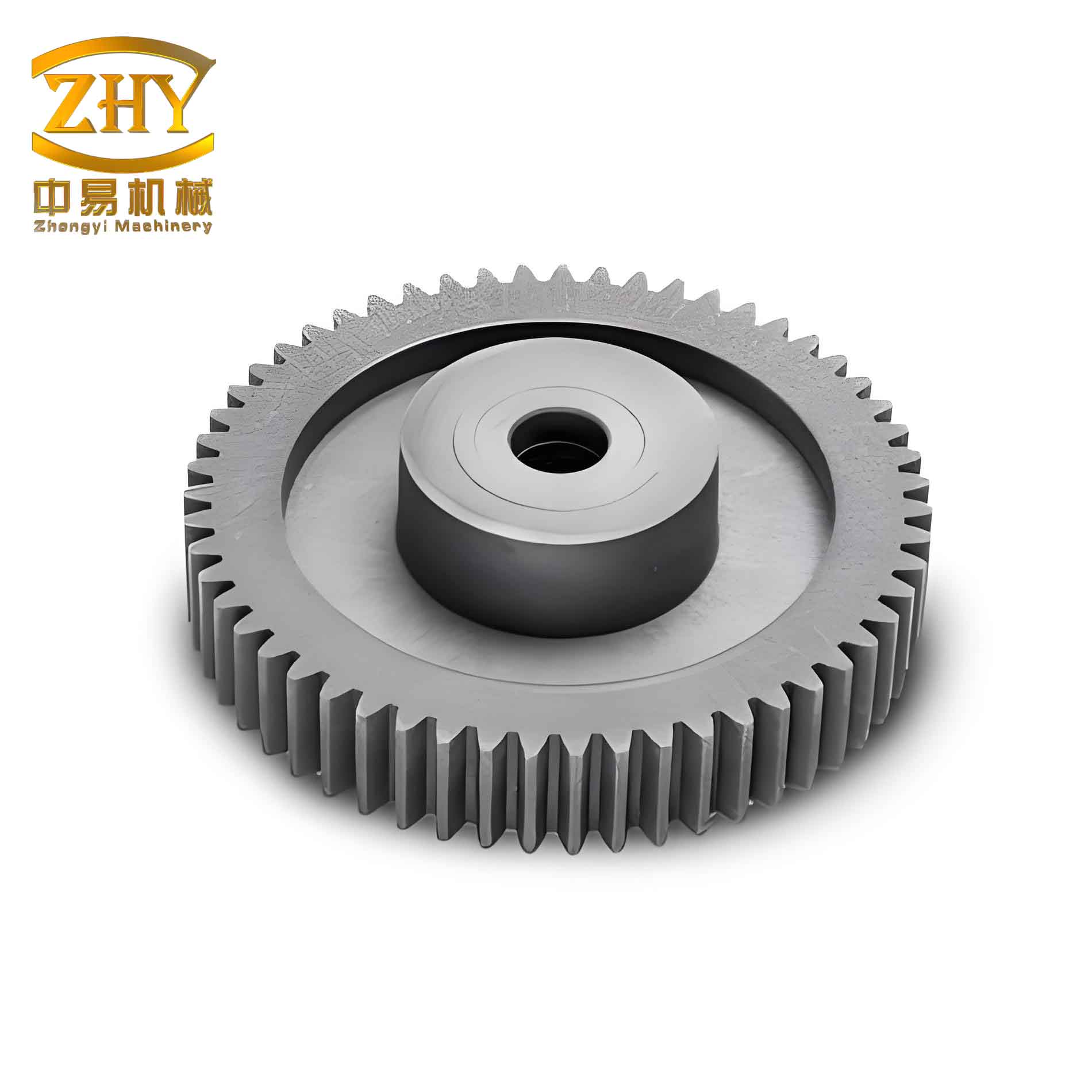
To analyze the static behavior, I begin by establishing a simplified mechanical model that represents the system as a network of interconnected springs, accounting for the stiffness of gear meshes, shafts, and supports. This approach allows for a comprehensive evaluation of deformations and forces under static loading conditions. The model incorporates coordinate systems for each gear pair, distinguishing between the inner and outer output paths, as well as left and right input branches. For instance, let the inner output path be denoted by index \(k = U\) and the outer output path by \(k = D\), with \(i = L, R\) representing left and right input branches, and \(j = 1, 2\) indicating the dual-shaft systems within each branch. The key parameters include meshing stiffnesses \(K_{kijnps}\) and \(K_{kijnBh}\) for the split-torsion and combined-torsion cylindrical gears, respectively, which are time-varying due to the cyclic nature of gear engagement. The geometry of these cylindrical gears, such as base circle radii \(r_{bp}\), \(r_{bs}\), \(r_{bh}\), and \(r_{bB}\), is critical in determining torque transmission and deformation characteristics.
The static equilibrium equations are derived based on force and moment balance across the system. For each cylindrical gear pair, the torques and meshing forces are interrelated through fundamental gear mechanics. The general equilibrium conditions can be expressed as follows for the entire system:
$$
\begin{aligned}
&T_{kif} – T_{kip} = 0 \\
&T_{ki1s} + T_{ki2s} – i_1 T_{kip} = 0 \\
&T_{kijs} – T_{kijh} = 0 \\
&T_{kB} – i_2 \sum_{i} \sum_{j} \sum_{k} T_{kijh} = 0
\end{aligned}
$$
Here, \(T_{kif}\), \(T_{kip}\), \(T_{kijs}\), \(T_{kijh}\), and \(T_{kB}\) represent the torques on various cylindrical gears, while \(i_1\) and \(i_2\) are the transmission ratios for the split-torsion and combined-torsion stages, respectively. The meshing forces \(F_{kijnps}\) and \(F_{kijnBh}\) relate to these torques via the base circle radii, as shown in:
$$
\begin{aligned}
&T_{kip} – (F_{ki1nps} + F_{ki2nps}) r_{bp} = 0 \\
&T_{kijs} – F_{kijnps} r_{bs} = 0 \\
&T_{kijh} – F_{kijnBh} r_{bh} = 0 \\
&T_{kB} – r_{bB} \sum_{i} \sum_{j} \sum_{k} F_{kijnBh} = 0
\end{aligned}
$$
Additionally, the force balance equations account for displacements in the X and Y directions due to bending and support deformations. For each cylindrical gear, the equilibrium in these directions is given by:
$$
\begin{aligned}
&\frac{T_{ki1s}}{r_{bs}} \cos \alpha_{ki1p} + \frac{T_{ki2s}}{r_{bs}} \cos \alpha_{ki2p} – K_{kipx} x_{kip} = 0 \\
&\frac{T_{ki1s}}{r_{bs}} \sin \alpha_{ki1p} + \frac{T_{ki2s}}{r_{bs}} \sin \alpha_{ki2p} – K_{kipy} y_{kip} = 0 \\
&\frac{T_{kijs}}{r_{bs}} \cos \alpha_{kijs} + \frac{T_{kijh}}{r_{bh}} \cos \alpha_{kijh} – K_{kijsx} x_{kijs} = 0 \\
&\frac{T_{kijs}}{r_{bs}} \sin \alpha_{kijs} + \frac{T_{kijh}}{r_{bh}} \sin \alpha_{kijh} – K_{kijsy} y_{kijs} = 0 \\
&\frac{T_{kijs}}{r_{bs}} \cos \alpha_{kijs} + \frac{T_{kijh}}{r_{bh}} \cos \alpha_{kijh} – K_{kijhx} x_{kijh} = 0 \\
&\frac{T_{kijs}}{r_{bs}} \sin \alpha_{kijs} + \frac{T_{kijh}}{r_{bh}} \sin \alpha_{kijh} – K_{kijhy} y_{kijh} = 0 \\
&\sum_{k} \sum_{j} \sum_{i} \frac{T_{kijh}}{r_{bh}} \cos \alpha_{kijB} – K_{kBx} x_{kB} = 0 \\
&\sum_{k} \sum_{j} \sum_{i} \frac{T_{kijh}}{r_{bh}} \sin \alpha_{kijB} – K_{kBy} y_{kB} = 0
\end{aligned}
$$
In these equations, \(x\) and \(y\) denote displacements, \(K\) represents support stiffnesses, and \(\alpha\) angles define the orientation of meshing forces relative to the coordinate axes. These equations form the basis for understanding how external loads and internal deformations interact in cylindrical gear systems.
The deformation compatibility equations are equally important, as they link the angular deflections from various sources. The relative angular displacements due to gear meshing deformations are calculated as:
$$
\begin{aligned}
&\varphi^1_{kij} = \frac{T_{kijs}}{r_{bs}^2 K_{kijnps}} \\
&\varphi^2_{kij} = \frac{T_{kijh}}{r_{bh}^2 K_{kijnBh}}
\end{aligned}
$$
Here, \(\varphi^1_{kij}\) and \(\varphi^2_{kij}\) represent the angular deflections from the split-torsion and combined-torsion cylindrical gear pairs, respectively. The torsional deformation of the dual shafts contributes an additional angle:
$$
\varphi^3_{kij} = \frac{T_{kijsh}}{K_{kijsh}}
$$
where \(T_{kijsh}\) is the torque on the dual shaft and \(K_{kijsh}\) is its torsional stiffness. Furthermore, gear backlash introduces a phase-related angular displacement:
$$
\varphi^4_{kij} = \frac{J_{kijs}}{2r_s} + \frac{J_{kijh}}{2r_h}
$$
with \(J_{kijs}\) and \(J_{kijh}\) being the circumferential backlashes for the cylindrical gears, and \(r_s\) and \(r_h\) their pitch radii. The displacements of gear centers due to bending and support effects lead to additional angles \(\varphi^5_{kij}\) and \(\varphi^6_{kij}\), which are derived from the relative movements in the X and Y directions. These displacements are expressed as:
$$
\begin{aligned}
&\Delta U_{kijps} = (u_{kip} + \Delta E_{kip} \cos \gamma_{kip}) – (u_{kijs} + \Delta E_{kijs} \cos \gamma_{kijs}) \\
&\Delta V_{kijps} = (v_{kip} + \Delta E_{kip} \sin \gamma_{kip}) – (v_{kijs} + \Delta E_{kijs} \sin \gamma_{kijs}) \\
&\Delta U_{kijBh} = (u_{kijh} + \Delta E_{kijh} \cos \gamma_{kijh}) – (u_{kiB} + \Delta E_{kB} \cos \gamma_{kB}) \\
&\Delta V_{kijBh} = (v_{kijh} + \Delta E_{kijh} \sin \gamma_{kijh}) – (v_{kiB} + \Delta E_{kB} \sin \gamma_{kB})
\end{aligned}
$$
where \(u\) and \(v\) are displacements, \(\Delta E\) denotes comprehensive errors, and \(\gamma\) angles indicate error orientations. By combining these angular contributions, the total relative angular displacement for each branch is:
$$
\varphi_{kijp} = i_1 (\varphi^1_{kij} + \varphi^2_{kij} + \varphi^3_{kij}) + \varphi^4_{kij} + \varphi^5_{kij} + \varphi^6_{kij}
$$
The compatibility condition requires that the angular displacements between left and right branches be equal, leading to:
$$
\varphi_{ki1p} – \varphi_{ki2p} = 0
$$
This set of equations allows for the static analysis of the system, but the inclusion of meshing phase differences adds complexity. Meshing phase difference refers to the timing offset between the engagement of two gear pairs, such as in split-torsion or combined-torsion cylindrical gears. It arises due to factors like manufacturing tolerances or intentional clearances, and it affects the instantaneous meshing stiffness of the cylindrical gears. To quantify this, I define the phase difference \(\gamma_{ba}(t_1)\) between a reference gear pair \(a\) and a related pair \(b\) as:
$$
\gamma_{ba}(t_1) = \frac{t_2 – t_1}{T_b}
$$
where \(t_1\) and \(t_2\) are the engagement start times, and \(T_b\) is the meshing period of pair \(b\). This phase difference causes the meshing stiffness of the cylindrical gears to vary asynchronously, impacting load distribution.
The time-varying meshing stiffness of cylindrical gears is a critical parameter in this analysis. I compute it using the potential energy method, which models gear teeth as variable-section cantilever beams. The total meshing stiffness \(k\) for a cylindrical gear pair is given by:
$$
k = \sum_{i=1}^{2} \left[ 1 / \left( \frac{1}{k_{h,i}} + \frac{1}{k_{b1,i}} + \frac{1}{k_{s1,i}} + \frac{1}{k_{f1,i}} + \frac{1}{k_{a1,i}} + \frac{1}{k_{b2,i}} + \frac{1}{k_{s2,i}} + \frac{1}{k_{f2,i}} + \frac{1}{k_{a2,i}} \right) \right]
$$
Here, \(k_{h,i}\) is the Hertzian contact stiffness, \(k_{b1,i}\) and \(k_{b2,i}\) are bending stiffnesses, \(k_{s1,i}\) and \(k_{s2,i}\) are shear stiffnesses, \(k_{f1,i}\) and \(k_{f2,i}\) are gear body stiffnesses, and \(k_{a1,i}\) and \(k_{a2,i}\) are axial compression stiffnesses for the driving and driven cylindrical gears, respectively. The basic parameters for the cylindrical gears in this study are summarized in the table below, which highlights key dimensions and material properties essential for stiffness calculations.
| Parameter | Split-Torsion Stage | Combined-Torsion Stage | General Properties |
|---|---|---|---|
| Module (mm) | 2.4 | 3.7 | – |
| Number of Teeth | 36 (driving), 100 (driven) | 31 (driving), 159 (driven) | – |
| Face Width (mm) | 25 | 35 | – |
| Pressure Angle (°) | 20 | 20 | 20 |
| Elastic Modulus (MPa) | 2.1×10⁵ | 2.1×10⁵ | 2.1×10⁵ |
| Poisson’s Ratio | 0.3 | 0.3 | 0.3 |
These parameters influence the meshing stiffness curves, which vary cyclically over the engagement period. When a phase difference exists between two branches of cylindrical gears, their stiffness curves become out of sync, leading to disparities in load sharing. For example, if the phase difference is zero, the stiffness variations are synchronized, minimizing load imbalances. However, as the phase difference increases, the stiffness values at given moments diverge, causing significant fluctuations in the torque carried by each branch. This effect is particularly pronounced in cylindrical gears due to their linear contact characteristics and high sensitivity to timing errors.
To evaluate the impact of meshing phase differences on static load sharing, I define load sharing coefficients for each branch. For a given input section with left and right branches, the coefficients \(\Omega_{ki1}\) and \(\Omega_{ki2}\) are:
$$
\begin{aligned}
&\Omega_{ki1} = \frac{2T_{ki1sh}}{T_{ki1sh} + T_{ki2sh}} \\
&\Omega_{ki2} = \frac{2T_{ki2sh}}{T_{ki1sh} + T_{ki2sh}}
\end{aligned}
$$
The overall static load sharing coefficient \(\Omega_{ki}\) for each part is then the maximum of these values:
$$
\Omega_{ki} = \max(\Omega_{ki1}, \Omega_{ki2})
$$
Using this framework, I analyze how phase differences in both the split-torsion and combined-torsion cylindrical gear pairs affect \(\Omega_{ki}\). The phase difference is considered positive when one branch leads another, and negative when it lags. The results are presented through a series of analytical simulations, focusing on the inner and outer output paths separately.
For the inner output path, the influence of phase differences on load sharing coefficients reveals distinct patterns. As shown in the analysis, any non-zero phase difference in the cylindrical gears causes abrupt changes in the load sharing coefficient at specific meshing instants. When the phase difference is zero, the coefficient exhibits minor fluctuations due to inherent errors, but it remains relatively stable. However, as the phase difference increases in magnitude, the load sharing performance deteriorates, with larger coefficients indicating poorer balance. Notably, the combined-torsion stage phase difference has a more significant impact than the split-torsion stage, highlighting the critical role of cylindrical gears in the final torque combination process. Specifically, for the inner output path, the right input branch’s phase difference affects the load sharing coefficient more than the left input branch, suggesting asymmetry in the system’s response.
The outer output path shows similar trends, but with some variations. Here, the left input branch’s phase difference tends to have a greater influence on the load sharing coefficient compared to the right input branch. This difference underscores the importance of considering the specific configuration of cylindrical gears in each path. To quantify these effects, I calculate the fluctuation amount of the load sharing coefficient, defined as the difference between its maximum and minimum values over a meshing cycle. The relationship between phase difference and fluctuation amount is summarized in the table below, which compares the inner and outer output paths for both split-torsion and combined-torsion cylindrical gears.
| Path and Stage | Phase Difference Sign | Fluctuation Amount Trend | Key Observation |
|---|---|---|---|
| Inner Output, Split-Torsion | Negative | Higher for left input branch | Left branch phase difference dominates |
| Inner Output, Split-Torsion | Positive | Higher for right input branch | Right branch phase difference dominates |
| Inner Output, Combined-Torsion | Negative | Higher for right input branch | Right branch impact is greater |
| Inner Output, Combined-Torsion | Positive | Higher for right input branch | Right branch impact is greater |
| Outer Output, Split-Torsion | Negative | Higher for right input branch | Right branch phase difference dominates |
| Outer Output, Split-Torsion | Positive | Higher for right input branch | Right branch phase difference dominates |
| Outer Output, Combined-Torsion | Negative | Higher for left input branch | Left branch impact is greater |
| Outer Output, Combined-Torsion | Positive | Higher for right input branch | Right branch impact is greater |
This table illustrates that the combined-torsion stage consistently exhibits larger fluctuation amounts than the split-torsion stage, emphasizing its sensitivity to phase differences in cylindrical gears. Moreover, for the inner output path, the right input branch’s combined-torsion phase difference has the most substantial effect, while for the outer output path, the left input branch’s combined-torsion phase difference shows greater influence when negative. These findings suggest that optimizing phase alignment in cylindrical gears, particularly in the combined-torsion stages, can significantly enhance load sharing.
The underlying mechanism for these effects lies in the asynchronous variation of meshing stiffness due to phase differences. When cylindrical gears in two branches engage with a timing offset, their stiffness curves are displaced relative to each other. At certain points in the meshing cycle, this leads to large differences in stiffness values, as described by:
$$
\Delta K = K_{a}(t) – K_{b}(t + \gamma T)
$$
where \(K_{a}\) and \(K_{b}\) are the meshing stiffnesses of the two cylindrical gear pairs, and \(\gamma\) is the phase difference. This stiffness disparity causes unequal angular deformations \(\varphi^1_{kij}\) and \(\varphi^2_{kij}\), which in turn affect the torque distribution via the compatibility equations. For instance, if one branch has higher stiffness at a given moment, it will carry more load, increasing the load sharing coefficient. The abrupt changes observed in the coefficients correspond to instances where the stiffness difference peaks, often near the engagement or disengagement points of the cylindrical gears.
To further illustrate, consider a simplified example where the meshing stiffness of cylindrical gears is approximated by a sinusoidal function:
$$
K(t) = K_0 + K_1 \sin(\omega t)
$$
For two branches with a phase difference \(\gamma\), the stiffness functions are \(K_a(t) = K_0 + K_1 \sin(\omega t)\) and \(K_b(t) = K_0 + K_1 \sin(\omega t + \phi)\), where \(\phi = 2\pi \gamma\). The difference is:
$$
\Delta K = K_1 [\sin(\omega t) – \sin(\omega t + \phi)] = -2K_1 \sin\left(\frac{\phi}{2}\right) \cos\left(\omega t + \frac{\phi}{2}\right)
$$
This shows that the amplitude of the stiffness difference scales with \(\sin(\phi/2)\), which increases with \(\phi\) up to \(\pi\). Therefore, larger phase differences lead to greater stiffness imbalances, exacerbating load sharing issues in cylindrical gear systems. This mathematical insight reinforces the empirical results, highlighting the need for precise phase control in the design of coaxial double-output transmissions.
In practice, phase differences in cylindrical gears can stem from various sources, such as manufacturing errors in tooth spacing, assembly misalignments, or wear over time. To mitigate their negative effects, strategies like controlled backlash settings, tolerance adjustments, or active compensation mechanisms may be employed. For example, by intentionally introducing a negative phase difference in the right input branch’s combined-torsion stage for the inner output path, or a positive phase difference in the left input branch’s combined-torsion stage for the outer output path, the overall load sharing performance can be improved. This approach leverages the asymmetric influences identified in the analysis to balance the system.
Additionally, the static model developed here can be extended to dynamic analyses, where inertial effects and time-varying loads further complicate load sharing. However, the static findings provide a foundational understanding for addressing dynamic challenges. Future work could incorporate factors like damping, nonlinearities from gear contact, or thermal effects, all of which are relevant for real-world applications of cylindrical gear transmissions.
In conclusion, this study demonstrates that meshing phase differences in cylindrical gears have a profound impact on the static load sharing characteristics of coaxial double-output split-combined-torsion transmissions. Through detailed modeling and analysis, I show that larger phase differences degrade load sharing performance, with the combined-torsion stage being more sensitive than the split-torsion stage. The influence varies between input branches and output paths, underscoring the complexity of these systems. By optimizing phase alignments and minimizing timing errors in cylindrical gears, designers can achieve better load distribution, enhancing the reliability and efficiency of such transmissions. These insights contribute to the broader field of gear mechanics, offering practical guidelines for improving the performance of cylindrical gear-based power transmission systems in demanding applications.
The role of cylindrical gears in this context cannot be overstated; their geometric and material properties directly affect meshing stiffness and phase relationships. As seen in the parameter table, factors like module, tooth count, and face width are crucial for determining stiffness characteristics. Moreover, the use of potential energy methods for stiffness calculation provides a robust framework for evaluating these effects. By repeatedly emphasizing cylindrical gears throughout this analysis, I aim to highlight their centrality in the transmission’s behavior and the importance of careful design and manufacturing to control phase differences.
Ultimately, the findings from this static analysis serve as a stepping stone for more comprehensive studies, including dynamic simulations and experimental validations. By continuing to explore the interplay between phase differences, stiffness variations, and load sharing in cylindrical gears, we can advance the development of more efficient and reliable transmission systems for aerospace, marine, and other high-performance industries.