
In the field of aerospace engineering, the demand for high-performance transmission components is paramount. Among these, cylindrical gears serve as fundamental elements in power transmission systems, where reliability, durability, and efficiency are critical. Traditional manufacturing methods for cylindrical gears, such as machining and cutting, have been widely adopted due to their precision and established processes. However, these techniques often lead to material waste, disrupted fiber orientations, and reduced mechanical properties, which can compromise the longevity and performance of gears in demanding applications like aerospace. To address these limitations, advanced plastic forming technologies, particularly hot orbital forging, have emerged as a promising alternative. This process involves localized deformation through an oscillating die motion, resulting in significant force reduction, improved grain structure, and enhanced material utilization. In this study, I investigate the hot orbital forging process for aerospace cylindrical gears, focusing on metal deformation behavior, tooth filling characteristics, and process optimization through finite element simulation and experimental validation. The goal is to provide insights into the forming mechanisms and to establish a foundation for the industrial application of this technology in producing high-quality cylindrical gears.
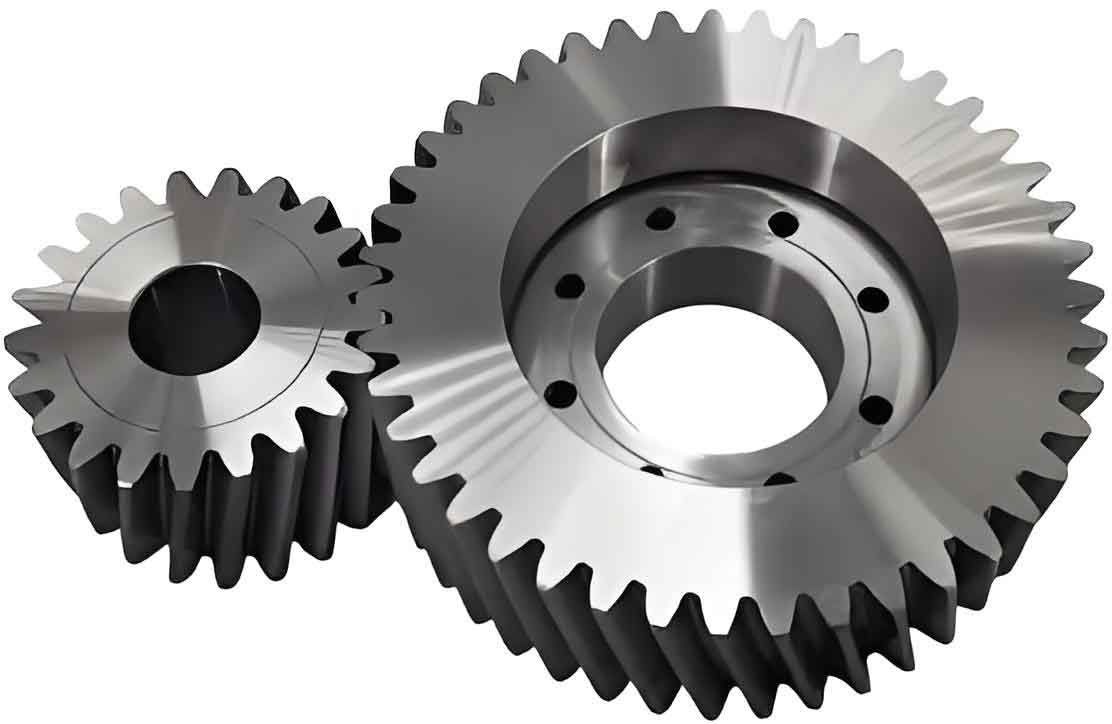
The hot orbital forging process for cylindrical gears leverages a combination of axial feed and oscillatory motion to achieve plastic deformation. During operation, the orbital die, set at a tilt angle, rotates around the machine spindle while simultaneously rotating on its own axis. This complex motion, coupled with the upward feed of the gear cavity die, facilitates gradual and controlled deformation of the billet. The localized contact between the die and billet reduces the required forming force compared to conventional forging, typically to about 10–20% of that needed in traditional presses. This not only minimizes energy consumption but also reduces tool wear and noise, making it an environmentally friendly manufacturing option. Moreover, the incremental nature of deformation promotes fine-grained microstructure and continuous fiber flow along the tooth profile, which enhances the gear’s fatigue resistance and load-bearing capacity. For aerospace cylindrical gears, which must withstand extreme operational conditions, these attributes are crucial. In this analysis, I employ a three-dimensional rigid-plastic finite element model to simulate the hot orbital forging process, examining key aspects such as metal flow velocity, stress-strain distribution, temperature evolution, and forming loads. The findings aim to elucidate the deformation laws and optimize process parameters for producing precision cylindrical gears.
To accurately model the hot orbital forging of cylindrical gears, a detailed finite element framework is established. The geometric parameters of the target aerospace cylindrical gear are summarized in Table 1. These parameters define the tooth profile, dimensions, and overall geometry essential for designing the forming dies and billet. Based on the gear specifications, a three-dimensional CAD model is created, incorporating features such as the tooth module, pressure angle, and addendum modifications. The billet is designed as a cylindrical shape with a diameter slightly smaller than the gear’s hub diameter to ensure proper material flow and minimize defects. Volume constancy is maintained to calculate the billet dimensions, ensuring that the final forged gear meets the required specifications without excess material.
| Parameter | Value |
|---|---|
| Number of Teeth | 16 |
| Module (mm) | 4.5 |
| Pressure Angle (°) | 20 |
| Addendum Coefficient | 1 |
| Clearance Coefficient | 0.25 |
| Addendum Modification Coefficient | 0.1917 |
| Tooth Width (mm) | 11 |
The orbital die and gear cavity die are designed based on the principle of hot orbital forging. The orbital die is tilted at an angle γ, typically set at 2°, to enable the oscillatory motion. The gear cavity die, which contains the negative impression of the cylindrical gear, moves upward at a constant feed rate. The interaction between these dies and the billet drives the plastic deformation. In the finite element model, the dies are treated as rigid bodies, while the billet is defined as a plastic body with material properties corresponding to 20CrMnTi steel, a common alloy for aerospace gears due to its high strength and toughness. The simulation parameters, including feed rate, rotational speed, and thermal conditions, are listed in Table 2. These parameters are critical for replicating the actual hot forging process and analyzing the deformation mechanics. The billet mesh is refined in the tooth region to capture detailed metal flow and stress concentrations, with approximately 100,000 elements and a refinement ratio of 0.01. Friction at the die-billet interfaces is modeled using a shear friction model with a coefficient of 0.25, accounting for the high-temperature conditions.
| Parameter | Value |
|---|---|
| Feed Rate of Teeth Cavity (mm/s) | 11.5 |
| Rotational Speed of Orbital Die (r/s) | 4 |
| Orbital Angle (°) | 2 |
| Feed Time (s) | 2 |
| Finishing Time (s) | 0.5 |
| Blank Temperature (°C) | 1000 |
| Die Temperature (°C) | 300 |
| Interfacial Thermal Conductivity (N·s⁻¹·mm⁻¹·°C⁻¹) | 11 |
The deformation behavior during hot orbital forging of cylindrical gears is characterized by distinct stages. Initially, the billet contacts the orbital die at a localized area, leading to the formation of hubs at both ends. As deformation progresses, the billet undergoes upsetting, with height reduction and diameter increase, resulting in a mushroom-like shape. The tooth filling occurs gradually from the upper to lower sections, with material flowing first into the tooth root and then toward the tooth tip. This sequential filling is driven by the oscillatory motion, which creates active and passive deformation zones. The active deformation zone, directly under the orbital die, experiences higher metal flow velocities and plastic strain, while the passive zone undergoes slower deformation. The velocity field distribution reveals that metal flow in the active zone is primarily radial during early stages, shifting to axial flow as the tooth cavity fills. This flow pattern ensures complete filling of the gear teeth and minimizes defects such as underfill or folding. The effective strain and stress distributions are non-uniform, with maximum values concentrated at the tooth root due to high contact pressure and complex geometry. The effective strain \(\bar{\epsilon}\) is calculated using the formula:
$$\bar{\epsilon} = \sqrt{\frac{2}{3} \epsilon_{ij} \epsilon_{ij}}$$
where \(\epsilon_{ij}\) represents the strain tensor components. Similarly, the effective stress \(\bar{\sigma}\) is given by:
$$\bar{\sigma} = \sqrt{\frac{3}{2} s_{ij} s_{ij}}$$
where \(s_{ij}\) is the deviatoric stress tensor. In the context of cylindrical gears, these measures highlight the intensity of deformation in critical regions, which influences the gear’s mechanical properties. Temperature evolution during forging shows that the tooth tip retains higher temperatures than the tooth root, due to less heat conduction to the dies and greater plastic work conversion. The temperature distribution can be described by the heat transfer equation:
$$\rho c_p \frac{\partial T}{\partial t} = k \nabla^2 T + \dot{q}$$
where \(\rho\) is density, \(c_p\) is specific heat, \(k\) is thermal conductivity, \(T\) is temperature, \(t\) is time, and \(\dot{q}\) is the heat generation rate from plastic deformation. This thermal gradient affects material flow and residual stresses, which are crucial for the performance of aerospace cylindrical gears.
The forming loads during hot orbital forging of cylindrical gears exhibit specific trends. The axial load increases progressively with plastic deformation, reaching a peak of approximately 2500 kN at the end of the feed stage. This load is necessary to overcome the resistance of material flow into the gear cavity. In contrast, the radial load oscillates periodically due to the orbital motion, with magnitudes significantly lower than the axial load. The relationship between forming force and process parameters can be expressed by empirical formulas, such as:
$$F_a = k \sigma_y A \left(1 + \mu \frac{d}{h}\right)$$
where \(F_a\) is the axial force, \(k\) is a correction factor, \(\sigma_y\) is the yield stress, \(A\) is the contact area, \(\mu\) is the friction coefficient, \(d\) is the billet diameter, and \(h\) is the billet height. This formula underscores the influence of geometry and friction on load requirements. For cylindrical gears, optimizing these parameters can reduce forming loads and improve tool life. The periodic radial load \(F_r\) is linked to the orbital angle and rotational speed, as shown by:
$$F_r = F_a \tan(\gamma) \sin(\omega t)$$
where \(\gamma\) is the orbital angle, \(\omega\) is the angular velocity, and \(t\) is time. This oscillatory component contributes to the incremental deformation and enhances material consolidation in the gear teeth.
To validate the finite element simulation, experimental trials of hot orbital forging for cylindrical gears were conducted. A T630 hot orbital forging machine was used, with dies and billets manufactured according to the design specifications. The billet material was 20CrMnTi steel, heated to 1000°C before forging. The process parameters matched those in the simulation, including a feed rate of 11.5 mm/s and an orbital angle of 2°. The forged cylindrical gears exhibited complete tooth filling with minimal flash, confirming the accuracy of the simulation. Comparative analysis between experimental and simulated results showed good agreement in terms of gear shape, deformation patterns, and load characteristics. This validation reinforces the reliability of the finite element model as a tool for analyzing and optimizing the hot orbital forging process for aerospace cylindrical gears. Future work could explore the effects of varying parameters like orbital angle, feed rate, and billet temperature on gear quality, as well as investigate post-forging heat treatments to enhance mechanical properties.
In summary, the hot orbital forging process offers a viable method for manufacturing high-performance aerospace cylindrical gears. Through detailed finite element analysis, I have elucidated the deformation mechanics, including metal flow, stress-strain distribution, temperature evolution, and forming loads. The process enables gradual tooth filling with reduced forming forces, leading to improved material utilization and gear integrity. The experimental validation supports the simulation findings, demonstrating the practical feasibility of this technology. For industries requiring precision cylindrical gears, such as aerospace, adopting hot orbital forging can lead to significant benefits in terms of cost, performance, and sustainability. Further research should focus on scaling the process for larger gears and integrating it with digital twin technologies for real-time monitoring and control.