
Cylindrical gear transmission is the most prevalent transmission mechanism in the mechanical field, serving as a critical component in various machines and equipment. It is a cornerstone of modern industrialization, playing a pivotal role in aerospace, automotive, manufacturing, and mining industries. Common cylindrical gears primarily feature tooth traces such as straight, helical, herringbone, and curved lines. In recent years, with the maturation of research on curved-tooth-trace cylindrical gears, scholars have focused on the concept of arc-tooth-trace gears. Compared to traditional linear gears, arc gears exhibit significant improvements in load-bearing capacity and transmission performance. However, achieving efficient machining remains a significant challenge. This paper introduces a novel ideal model for a planar spiral-toothed cylindrical gear, develops a corresponding high-efficiency machining method and dedicated processing device. This new type of cylindrical gear is shown to possess excellent anti-bias load characteristics and can be manufactured rapidly, substantially enhancing production efficiency.
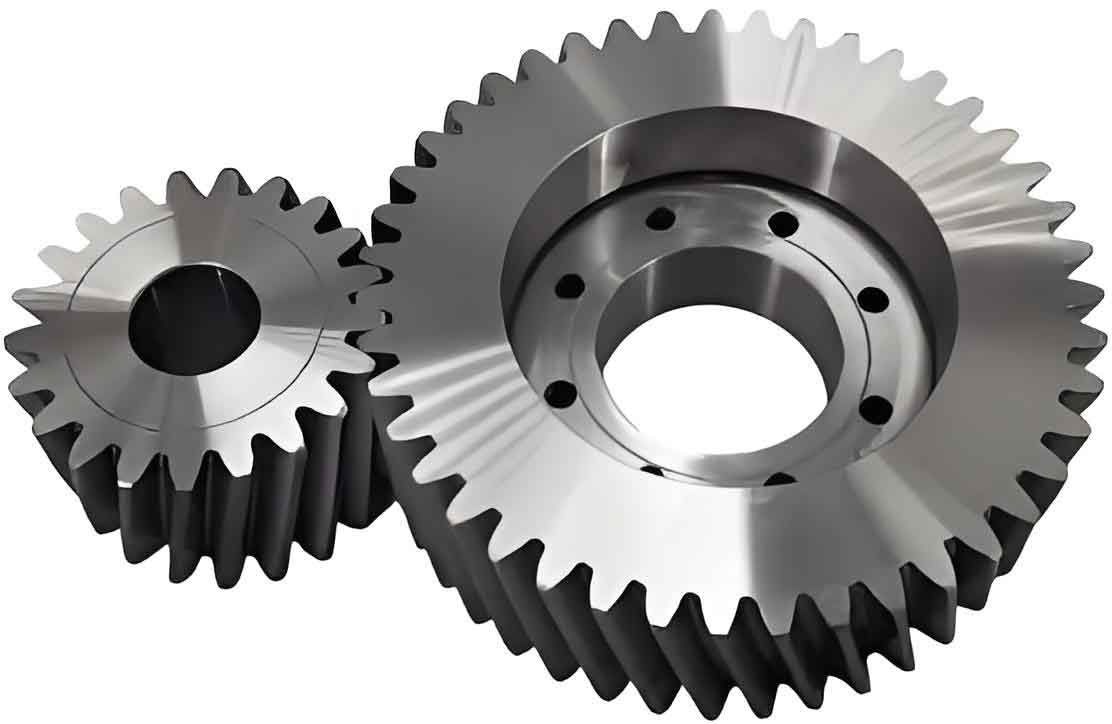
Geometric Model and Mathematical Foundation of Planar Spiral-Toothed Cylindrical Gears
The proposed planar spiral-toothed cylindrical gear is characterized by its unique tooth trace geometry. The key parameters defining this gear are the module (m), number of teeth (Z), pressure angle (α), face width (B), and the curvature radius of the spiral tooth trace at the mid-face width (RT). The tooth trace on the developed pitch cylinder is a planar spiral. Critically, the curvature radius of the concave tooth flank is slightly larger than that of the convex tooth flank, expressed as:
$$R_{ob} = R_T + \frac{\pi m}{4}, \quad R_{ib} = R_T – \frac{\pi m}{4}$$
This differential creates a slightly crowned tooth form, which is fundamental to its superior contact characteristics. The mathematical model is derived using differential geometry and spatial coordinate transformation. The static tooth surface equation for the convex flank is derived from the tool revolution surface and the generating motion. In the coordinate system SD(OD-XDYDZD) attached to the cutter, the tool surface equation is:
$$
\begin{aligned}
x_D &= \left( R_T \sin u \mp \frac{\pi m}{4} \right) \cos \theta \\
y_D &= \left( R_T \sin u \mp \frac{\pi m}{4} \right) \sin \theta \\
z_D &= R_T \cos u
\end{aligned}
$$
where ‘∓’ corresponds to the convex and concave flanks, respectively, u is the tool surface parameter, and θ is the rotation angle parameter. Through a series of coordinate transformations involving the cutting depth and generating rotation (φ), the final tooth surface equation in the gear coordinate system S1(O1-X1Y1Z1) is obtained. The contact condition during generation is given by the equation Φ = n · v(12) = 0, where n is the unit normal vector of the tool surface and v(12) is the relative velocity between the gear blank and the tool. Solving this yields the parameter ‘u’ as a function of θ and φ, leading to the complete mathematical description of the tooth flank.
To facilitate design and analysis, a parametric modeling system was developed using Visual Basic 6.0 and the SolidWorks API. This system automates the generation of accurate 3D models of planar spiral-toothed cylindrical gears based on input parameters like module, tooth count, face width, and tool radius. The modeling process involves creating the gear blank, sketching the involute profile on the mid-plane, replicating and positioning this profile on multiple parallel planes along the face width according to the spiral tooth trace equation, and finally performing a loft-cut operation to form the tooth space. This system fills a technological gap for modeling complex curved-tooth cylindrical gears and provides a reliable foundation for subsequent finite element analysis and transmission performance studies.
Comparative Analysis of Anti-Bias Load Characteristics in Cylindrical Gears
Bias load in gear pairs, leading to uneven stress distribution, is primarily caused by manufacturing errors, assembly misalignments (parallelism errors of axes), and deflections under load. This phenomenon severely impacts transmission stability, noise, vibration, and fatigue life. Traditional spur and helical cylindrical gears are particularly susceptible.
When assembly errors exist, such as a slight angular misalignment of the axes, spur and helical gears experience edge-loading, where contact is concentrated at one end of the tooth face. The planar spiral-toothed gear, due to its crowned tooth form resulting from the differential curvature radii of its flanks, exhibits a self-compensating ability. The contact pattern naturally localizes in the central 80-90% region of the tooth face, inherently mitigating the effects of minor misalignments and reducing sensitivity to assembly errors.
A comprehensive finite element analysis (FEA) was conducted using ANSYS Workbench to quantify this advantage. Models of spur, helical, and planar spiral-toothed cylindrical gear pairs were created with identical basic parameters (material: alloy steel, E=200 GPa, ν=0.3). Analyses were performed under two conditions: ideal meshing and meshing with imposed parallel misalignment errors (0.1° in both horizontal and vertical directions). The contact stress was evaluated for different modules (m=3,4,5,6) and different tooth count combinations (20:40, 30:60, 40:80).
The results under ideal conditions already showed a benefit for the planar spiral design. More importantly, under misaligned conditions, the planar spiral-toothed gear consistently demonstrated significantly lower maximum contact stress compared to both spur and helical gears. The following table summarizes the maximum contact stress for a 20:40 tooth pair with a module of m=4 under 0.1° misalignment.
| Gear Type | Max Contact Stress (Horizontal Error) | Max Contact Stress (Vertical Error) |
|---|---|---|
| Spur Cylindrical Gear | 148.14 MPa | 168.57 MPa |
| Helical Cylindrical Gear | 294.58 MPa | 339.90 MPa |
| Planar Spiral Cylindrical Gear | 118.43 MPa | 112.88 MPa |
The trend analysis revealed that for all three types of cylindrical gears, maximum contact stress decreases with increasing module and tooth count. However, the planar spiral-toothed gear consistently maintained a stress level approximately 20-30% lower than spur gears and 40-60% lower than helical gears under misalignment, conclusively verifying its superior anti-bias load capability. This characteristic directly translates to higher permissible load, better tolerance to installation errors, and improved longevity for these cylindrical gears.
Principle of the Full-Tooth-Width High-Speed Continuous Generation Milling Method
The core innovation enabling the practical application of planar spiral-toothed cylindrical gears is a novel machining technique termed “Full-Tooth-Width High-Speed Continuous Generation Milling.” This method overcomes the inefficiencies of traditional single-point or interrupted cutting processes used for curved-tooth gears.
The fundamental principle is derived from the meshing relationship between the gear and a planar spiral rack. By simulating this rack as a series of cutters arranged on a large-diameter rotating disc, a continuous generation process is achieved. Multiple cutting tool holders are mounted on the face of the disc. Their mounting points follow a planar spiral trajectory on the disc, with the spiral’s pitch (P) equal to the gear’s circular pitch:
$$P = \pi m$$
The radial position (rdk) and axial position (xdk) of the k-th tool holder are given by:
$$
\begin{aligned}
x_{dk} &= R_T \cos\left(\frac{2\pi K}{n}\right) \mp \frac{mK}{n} \\
r_{dk} &= R_T \sin\left(\frac{2\pi K}{n}\right)
\end{aligned}
$$
where K=0,1,…,n-1, and n is the number of tools. The tool with the smallest mounting radius (RT) is the primary finishing cutter, while others are set at progressively lower heights to act as pre-cutters, reducing the load on the finishing cutter.
The machining process involves two main, continuous phases:
1. Tooth Slot Depth-Cutting Phase: The cutter disc rotates at a high angular velocity ωD. The gear blank rotates at a synchronized angular velocity ωC, with the ratio precisely controlled as:
$$\frac{\omega_C}{\omega_D} = \frac{1}{Z}$$
This means the disc rotates once while the blank rotates one tooth pitch. Simultaneously, the blank is fed along its axis (Y-direction) at a constant rate. This combined motion causes the tools to cut the tooth slots, with each tool progressively engaging the blank as the disc rotates, resulting in a continuous, full-tooth-width cutting action. The tooth trace formed on the blank is the planar spiral given by:
$$r(\theta) = R_T \theta \pm \frac{m\theta}{2\pi}$$
2. Involute Profile Generation Phase: After the slot is cut to full depth, the generating motion is added. The axial feed stops. An additional rotational component (±ωs) is superimposed on the blank’s rotation, and a corresponding linear motion (±vxc) is added along the radial direction (X-direction), satisfying vxc = r ωs, where r is the pitch radius. This classic generating motion, combined with the continued rotation of the disc and blank, shapes the tooth flanks into the precise involute profile. The “+” and “-” signs correspond to generating the convex and concave flanks, respectively.
The feasibility of this method was verified using Vericut simulation software. A virtual machine tool with X, Z linear axes, a workpiece rotary B-axis, and a cutter disc rotary C-axis was modeled. The simulation successfully generated a complete planar spiral-toothed gear model, confirming the correctness of the toolpath and the absence of collisions. The generated tooth profile was verified to be a standard involute.
Development of the Dedicated Processing Device and Experimental Validation
As the proposed machining method requires precise four-axis synchronous control (two linear and two rotary axes) with a specific velocity ratio, no commercially available machine tool is suitable. Consequently, a dedicated processing device was developed based on retrofitting a数控 lathe.
The key components of the device include:
- Machine Bed & Linear Axes: Houses the X-axis (for radial generating motion) and Z-axis (for axial depth-of-cut feed) using high-precision ball screws driven by servo motors (e.g., Yaskawa SGMJV series) for accurate positioning.
- Large Diameter Cutter Disc & Tooling System: A large steel disc mounted on the main spindle, which is driven by a high-torque servo motor (e.g., 5.5 kW) via a belt drive. It features precisely machined slots for mounting multiple tool holders. Radial adjustment bolts allow precise setting of the tool positions to the planar spiral pattern. Carbide inserts (e.g., W12Cr4V3Mo3Co5Si) are used for cutting.
- CNC Rotary Table: A high-precision servo-driven rotary table (e.g., with 5 arc-second accuracy) mounted on the Z-axis carriage holds the gear blank. It provides the precise rotational motion (B-axis) synchronized with the cutter disc (C-axis).
- Control System: A custom CNC system based on a Guangzhou数控 platform was developed. It provides a human-machine interface and, crucially, the software logic to maintain the strict rotational ratio (ωC/ωD = 1/Z) during cutting and to coordinate the four-axis interpolation for the generating phase.
A successful trial cut was performed on an aluminum alloy blank with parameters: m=5, Z=63, B=50mm, RT=230mm. The cutter disc speed was 200 rpm, resulting in a high cutting speed of approximately 289 m/min at the primary tool tip, ensuring good surface finish. The machining time was approximately 35 minutes, compared to an estimated 160 minutes for hobbing a comparable spur gear, demonstrating a 4-5x improvement in efficiency.
The physical gear sample exhibited a smooth tooth surface with a clearly visible planar spiral trace. The crowned tooth form was apparent, and profile inspection confirmed the involute geometry. This practical validation proves that the planar spiral-toothed cylindrical gear is not merely a theoretical concept but a manufacturable component with significant potential advantages over traditional cylindrical gears.
Conclusion and Future Outlook
This paper has systematically presented a comprehensive study on planar spiral-toothed cylindrical gears, covering their theoretical foundation, distinctive advantages, and a groundbreaking manufacturing solution.
Theoretical Contribution: A precise geometric model of the planar spiral-toothed cylindrical gear was established, with derived tooth surface equations, contact line equations, and overlap ratio calculations. The key geometric feature—the differential curvature between concave and convex flanks leading to a crowned tooth form—was mathematically defined.
Performance Advantage: Through detailed FEA, the planar spiral-toothed gear demonstrated exceptional anti-bias load characteristics. Under assembly misalignment, it exhibited significantly lower and more uniformly distributed contact stress compared to standard spur and helical cylindrical gears. This translates directly into higher load capacity, reduced noise and vibration, and greater tolerance for real-world installation errors.
Manufacturing Innovation: The proposed “Full-Tooth-Width High-Speed Continuous Generation Milling” method and the subsequently developed dedicated processing device solve the historical challenge of inefficient machining for curved-tooth cylindrical gears. This method enables rapid, continuous, and precise production of these high-performance gears.
The planar spiral-toothed cylindrical gear represents a promising evolution in gear technology. It effectively combines favorable attributes: the axial force cancellation similar to herringbone gears (due to approximate symmetry), high overlap ratio for smoothness, and superior resistance to bias loads. Its efficient manufacturability makes it a viable candidate for replacing traditional cylindrical gears in demanding applications such as high-power transmissions, wind turbine gearboxes, aerospace systems, and precision machinery, where reliability, compactness, and performance are critical. Future work will focus on dynamic characteristic analysis, experimental testing under load in a gearbox setup, optimization of the machining process, and further refinement of the processing device for industrial-grade production.