
The pursuit of enhanced performance in power transmission systems has consistently driven innovation in gear design. Among critical gear types, spiral bevel gears are indispensable for transmitting power between intersecting axes, prized for their smooth operation, high load capacity, and compact design. A fundamental parameter governing their dynamic behavior, noise generation, and load distribution is the contact ratio. This article delves into the paradigm of high contact ratio design for spiral bevel gears, presenting a novel methodology for achieving a contact path oriented along the face width. This approach is systematically compared against the conventional high contact ratio design featuring an inner diagonal contact path. The core of this analysis lies in pre-setting key meshing performance indices—namely, the design contact ratio, transmission error amplitude, and symmetry—and subsequently deriving the necessary manufacturing parameters through the iterative optimization of local synthesis parameters. Comprehensive evaluation using Tooth Contact Analysis (TCA) and Loaded Tooth Contact Analysis (LTCA) reveals significant advantages of the face-width-oriented design in terms of tooth strength, loaded transmission error, and reduced sensitivity to assembly errors.
The contact ratio, defined as the average number of tooth pairs in contact during the meshing cycle, is a cornerstone of gear performance. For cylindrical gears, a higher contact ratio generally leads to reduced load per tooth, lower transmission error fluctuations, and diminished noise and vibration. Translating this principle to spiral bevel gears, however, introduces greater complexity due to their varying geometry along the face width. Traditional designs often resulted in contact paths nearly perpendicular to the root cone, yielding low contact ratios and suboptimal performance. The evolution towards “inner diagonal” designs, where the contact path angle relative to the root cone is reduced, marked a significant improvement. This article expands upon this concept by exploring an alternative strategy: orienting the contact path predominantly along the length of the tooth (face width). This investigation provides a direct comparison of two high-contact-ratio philosophies, quantifying their impact on crucial performance metrics.
The foundation for controlled gear design is the local synthesis method. This technique allows for the pre-determination of meshing characteristics at a chosen reference point on the tooth surface. The key parameters govern the contact conditions and, by extension, the overall performance of the gear pair. The primary local synthesis parameters are illustrated in the following conceptual framework and include the direction angle of the contact path, the location of the design reference point, and the first derivative of the inverse ratio of transmission.
The mathematical model for gear meshing is built upon the coordinate transformation between the pinion and gear. Defining coordinate systems: $S_1$ (pinion), $S_2$ (gear), and $S_h$ (fixed housing), the fundamental TCA equations ensuring contact at a point are given by:
$$
\begin{cases}
\mathbf{r}_h^{(1)}(\theta_p, \phi_p, \varphi_1) = \mathbf{r}_h^{(2)}(\theta_g, \phi_g, \varphi_2) \\
\mathbf{n}_h^{(1)}(\theta_p, \phi_p, \varphi_1) = \mathbf{n}_h^{(2)}(\theta_g, \phi_g, \varphi_2)
\end{cases}
$$
Here, $\mathbf{r}_h^{(1)}, \mathbf{r}_h^{(2)}$ are the position vectors of the pinion and gear tooth surfaces in $S_h$, $\mathbf{n}_h^{(1)}, \mathbf{n}_h^{(2)}$ are their corresponding unit normal vectors, $(\theta_p, \phi_p)$ and $(\theta_g, \phi_g)$ are the surface parameters, and $(\varphi_1, \varphi_2)$ are the rotational angles of the pinion and gear, respectively.
The process for designing machining parameters that yield pre-specified meshing performance is methodical. The target performance metrics are the design contact ratio $\epsilon_{target}$, the amplitude of transmission error at the transfer point $\delta \phi_{2}^{(tr)}$, and the symmetry of the transmission error curve, often desired to be parabolic. An iterative loop adjusts the local synthesis parameters—primarily the contact path direction angle $\eta_2$ to achieve $\epsilon_{target}$ and the height of the reference point $\Delta y$ to achieve symmetry—until the TCA-calculated performance matches the pre-set values. The contact ratio is calculated from the TCA results as the ratio of the angular duration of meshing ($|\varphi_{1}^{end} – \varphi_{1}^{start}|$) to the angular pitch of the pinion.
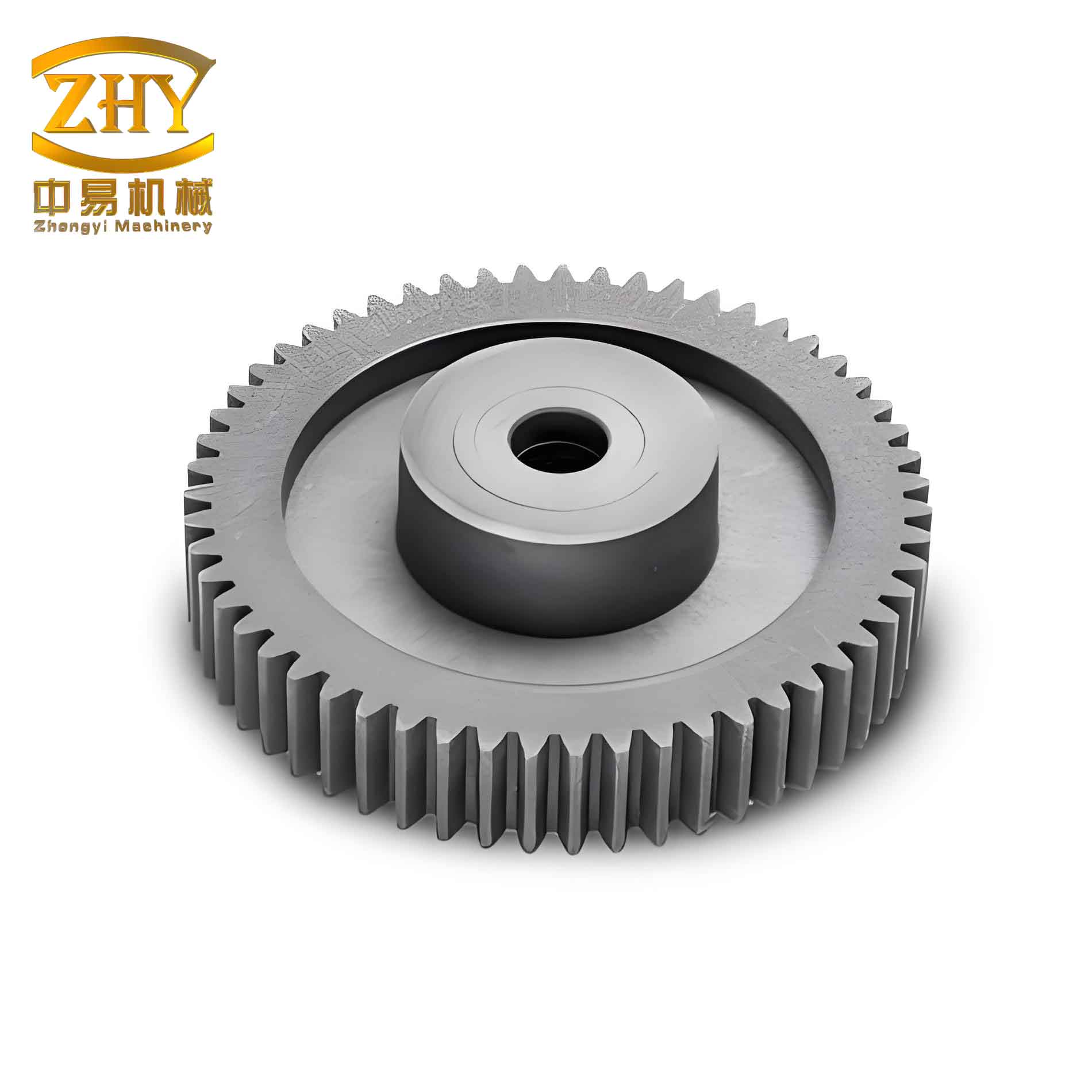
The concept of high contact ratio is realized through specific orientations of the contact path on the tooth flank. We classify and analyze two principal design configurations for achieving a high contact ratio in spiral bevel gears, contrasting them with the behavior observed in high-contact-ratio cylindrical gears.
| Contact Path Type | Description & Trajectory | Design Contact Ratio Trend | Key Characteristics & Applications |
|---|---|---|---|
| Inner Diagonal Path | Path runs from the toe (or heel) near the tip to the opposite end near the root. Forms a distinct diagonal across the tooth face. | Increases as the path angle relative to the root cone decreases. Can achieve high values. | Established method. Higher sliding velocities, potentially increasing risk of scoring. Can be sensitive to misalignment, leading to edge contact. |
| Face-Width Oriented Path | Path runs predominantly along the face width, from heel to toe, staying near the center of the tooth height. | Primarily determined by face width and spiral angle. Can be very high, especially with larger spiral angles. | Novel approach. Resembles contact in helical cylindrical gears. Aims for better load distribution, lower sliding, and reduced misalignment sensitivity. |
The effectiveness of these two high-contact-ratio design strategies is demonstrated through a numerical case study. A spiral bevel gear pair is designed using both the inner diagonal and the face-width-oriented approach, targeting identical pre-set meshing performance.
| Parameter | Pinion | Gear (Wheel) |
|---|---|---|
| Number of Teeth | 23 | 65 |
| Module (mm) | 3.9 | 3.9 |
| Normal Pressure Angle (°) | 25 | 25 |
| Mean Spiral Angle (°) | 35 | 35 (Left Hand) |
| Shaft Angle (°) | 90.0 | |
| Face Width (mm) | 37.0 | |
| Machine Setting | Gear (Convex Side) | Pinion – Inner Diagonal Design | Pinion – Face-Width Design |
|---|---|---|---|
| Cutter Radius (mm) | 94.2350 | 93.4224 | 92.0286 |
| Cutter Blade Angle (°) | 22.5 | 22.5 | 22.5 |
| Radial Setting (mm) | 114.7853 | 105.7476 | 87.8726 |
| Machine Root Angle (°) | 68.2229 | 18.3281 | 18.3281 |
| Gear Ratio | 1.0599 | 2.7875 | 2.6799 |
The TCA results for both designs successfully achieved the pre-set targets: a design contact ratio $\epsilon_r \approx 2.5$, a parabolic transmission error with an amplitude at the transfer point of $\delta\phi_2^{(tr)} = 20$ arcseconds, and perfect symmetry ($\varsigma = |T_{in}-T_0| / |T_0-T_{out}| \approx 1$). The visual distinction is clear: the inner diagonal design shows a contact pattern slanting across the tooth, while the face-width design shows a pattern extending nearly the full length of the tooth, centered in height.
A critical performance differentiator is the sensitivity of the contact pattern to assembly errors. Standardized error values were introduced: axial misalignments of the pinion and gear ($\Delta A_1, \Delta A_2$), an offset error ($\Delta E$), and a shaft angle error ($\Delta \Sigma$). The LTCA was performed under a nominal load torque of 1000 Nm applied to the gear. The analysis quantified three key performance indicators: tooth bending stress (maximum tensile stress at the root), surface contact stress (Hertzian pressure), and the amplitude of the loaded transmission error (LTE).
| Performance Metric | Inner Diagonal Design | Face-Width Oriented Design | Percentage Improvement |
|---|---|---|---|
| Pinion Bending Stress (Max. Tensile, MPa) | 110.24 | 95.24 | +13.67% (Reduction) |
| Gear Bending Stress (Max. Tensile, MPa) | 127.70 | 114.86 | +10.05% (Reduction) |
| Contact Stress (Max. Hertzian, MPa) | 1033.39 | 973.74 | +5.77% (Reduction) |
| Loaded TE Amplitude (arcseconds) | 13.53 | 9.29 | +31.32% (Reduction) |
The sensitivity analysis revealed a fundamental behavioral difference. For the inner diagonal design, misalignments typically cause the contact pattern to shift towards the toe or heel, with a high risk of edge contact, particularly at the thin toe end. The face-width oriented design showed a different reaction: axial misalignments primarily cause a slight shift along the tooth height, while offset errors ($\Delta E$) cause a nearly one-to-one shift along the face width. This makes the face-width design generally less prone to detrimental edge contact from typical assembly errors, though it demands more precise control of the center distance.
The results lead to several definitive conclusions regarding high contact ratio design strategies for spiral bevel gears. The methodology of pre-setting meshing performance and optimizing local synthesis parameters is validated as a powerful tool for achieving targeted designs, be it inner diagonal or face-width oriented.
- Performance Superiority of Face-Width Design: The proposed contact path along the face width delivers comprehensive performance gains. It significantly improves tooth strength, reducing root bending stress by over 10% for both members and surface contact stress by nearly 6%. Furthermore, it drastically smooths operation under load, reducing the loaded transmission error amplitude by over 31%. This translates directly to higher power density, longer life, and lower noise.
- Robustness to Misalignment: The face-width oriented design alters the sensitivity profile to assembly errors. While it requires good control of the center distance, it effectively mitigates the risk of critical edge contact caused by axial misalignments, a common weakness in diagonal contact designs. This robustness is a major advantage for applications where precise alignment cannot be guaranteed.
- Design Principle Contrast: The inner diagonal design increases contact ratio by lengthening the path across the tooth face. In contrast, the face-width design maximizes the utilization of the available face width, creating a contact pattern reminiscent of that in high-performance helical cylindrical gears. This fundamental difference in approach underlies the observed benefits in load distribution and stress reduction.
This comparative analysis provides gear designers with a clear rationale for selecting a high-contact-ratio strategy. For applications demanding the utmost in strength, smoothness, and operational robustness, orienting the contact path along the face width emerges as a superior design paradigm, pushing the performance boundaries of spiral bevel gears closer to the ideals often associated with advanced cylindrical gears.