
In modern mechanical engineering, the design and manufacturing of gears, particularly spur and pinion gears, play a critical role in power transmission systems. As an engineer specializing in CAD automation, I have often faced challenges in creating repetitive gear models efficiently. Traditional manual modeling in software like Pro/Engineer (PROE) is time-consuming, especially when dealing with variations in gear parameters. To address this, I embarked on a project to develop a parameterized system for spur and pinion gears using Visual Basic (VB) and Automation Gateway (AGW) for PROE re-development. This approach not only streamlines the design process but also enables the creation of a personalized standard parts library, which is essential for optimizing structural parameters and supporting serialized production. In this article, I will detail my methodology, from the foundational concepts of involute spur gears to the implementation of a custom interface that drives PROE to generate gear models dynamically. Throughout, I will emphasize the application to spur and pinion gears, as they are fundamental components in many mechanical assemblies.
The involute spur gear is a common type of gear characterized by straight teeth parallel to the axis of rotation. Its tooth profile is based on an involute curve, which ensures smooth meshing and constant velocity ratio. For spur and pinion gears, key design parameters must be defined to control the geometry accurately. In my work, I identified a set of basic variables that govern the gear model, as summarized in the table below. These parameters are essential for any spur and pinion gear design and serve as inputs for the parameterized system.
| Parameter Name | Design Variable |
|---|---|
| Number of Teeth | z |
| Module | m |
| Pressure Angle | alpha |
| Addendum Coefficient | hax |
| Dedendum Coefficient | cx |
| Face Width | b |
| Profile Shift Coefficient | x |
From these basic variables, derived parameters are calculated to fully define the gear geometry. For instance, the addendum height \( h_a \), dedendum height \( h_f \), and various diameters are computed using standard gear equations. These derived variables are crucial for generating the 3D model in PROE. The table below lists the key derived parameters for spur and pinion gears, which are automatically updated based on the input design variables.
| Parameter Name | Derived Variable |
|---|---|
| Addendum Height | \( h_a = (hax + x) \cdot m \) |
| Dedendum Height | \( h_f = (hax + cx – x) \cdot m \) |
| Pitch Diameter | \( d = m \cdot z \) |
| Base Circle Diameter | \( d_b = d \cdot \cos(\alpha) \) |
| Tip Diameter | \( d_a = d + 2 \cdot h_a \) |
| Root Diameter | \( d_f = d – 2 \cdot h_f \) |
The tooth profile of an involute spur gear is defined by the involute curve, which can be expressed mathematically. In my parameterized model, I used the following parametric equations to describe the involute curve in a Cartesian coordinate system, which is essential for creating the gear tooth geometry in PROE. These equations are embedded in the PROE model to generate the tooth profile accurately.
$$ x = r \cdot \cos(\theta) + r \cdot \sin(\theta) \cdot \theta \cdot \frac{\pi}{180} $$
$$ y = r \cdot \sin(\theta) – r \cdot \cos(\theta) \cdot \theta \cdot \frac{\pi}{180} $$
$$ z = 0 $$
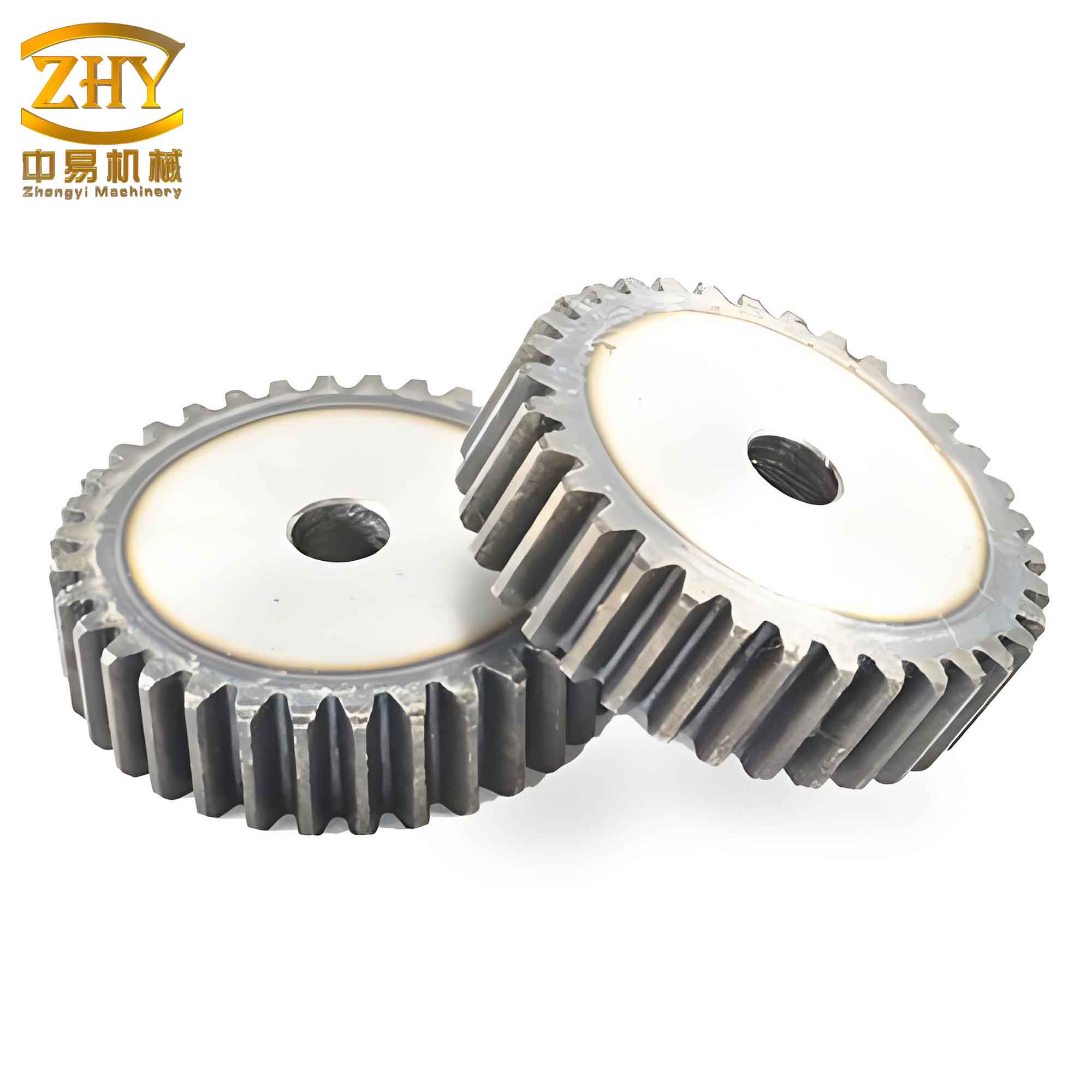
Here, \( r \) represents the base circle radius, calculated as \( r = \frac{d_b}{2} \), and \( \theta \) is the angle variable, typically defined as \( \theta = t \cdot 45 \) where \( t \) is a parameter ranging from 0 to 1. This formulation ensures that the involute curve is correctly generated for any spur and pinion gear configuration. To visualize a typical spur and pinion gear set, I include an image below that illustrates their meshing arrangement, which is common in applications like automotive transmissions and industrial machinery.
In PROE, I started by creating a base 3D model of an involute spur gear. This model serves as a template that can be modified through parameters. The modeling process involves sketching the gear profile using the involute equations, extruding the teeth, and adding features like hubs and keyways. It is critical to establish correct feature dependencies and constraints to avoid regeneration failures. For example, I added relational expressions to control the fillet radius at the tooth root, which is necessary for stress reduction and manufacturability. The fillet radius \( sd_0 \) is defined by the following conditional relation:
$$ sd_0 = 0.38 \cdot m \quad \text{if } hax \geq 1 $$
$$ sd_0 = 0.38 \cdot m \quad \text{if } hax < 1 $$
This ensures that the gear model remains valid across different design scenarios. Once the base model is prepared, I proceed to the re-development phase using VB and AGW. AGW acts as a bridge between VB and PROE, allowing me to control PROE programmatically. Unlike the native PROE toolkit, which requires C programming, AGW simplifies the process by providing a VB-compatible interface. This makes it accessible for engineers like me who are more comfortable with VB. The integration enables automated retrieval and modification of PROE models, which is ideal for generating spur and pinion gears with varying parameters.
To implement the re-development, I designed a user-friendly interface in VB that allows users to input gear parameters and generate the corresponding 3D model. The interface includes text boxes for each design variable, such as the number of teeth and module, and a button to trigger the model generation. The VB form is structured with labels and input fields, and it includes a picture control to display a schematic of spur and pinion gears for reference. The core functionality is driven by AGW functions, which interact with PROE’s API. Below, I outline the key steps in the code development process.
First, I declare an AGW object in the VB project to establish communication with PROE. This is done by adding a reference to the AGW library in the VB environment. Then, I write code to handle the button click event, which retrieves the PROE base model, sets the design parameters based on user input, and regenerates the model. The AGW functions used include ModelRetrieve to load the PROE file, SessionSetCurrentModel to activate it, ParamSetValue to assign new values to parameters, and ModelRegenerate to update the geometry. For example, to set the number of teeth for a spur and pinion gear, I use a line like:
rg1 = gateway1.ParamSetValue("Z", Text1.Text)
Where gateway1 is the AGW object, “Z” is the parameter name in PROE, and Text1.Text is the value from the VB interface. This process is repeated for all parameters, ensuring that the spur and pinion gear model is customized according to user specifications. The table below summarizes the AGW functions and their purposes in the context of spur and pinion gear re-development.
| AGW Function | Description | Application in Spur and Pinion Gears |
|---|---|---|
| ModelRetrieve | Loads a PROE model into memory without displaying it. | Used to open the base gear template (e.g., gear.prt). |
| SessionSetCurrentModel | Activates and displays the model in the PROE window. | Brings the spur gear model to the forefront for modification. |
| ParamSetValue | Assigns a new value to a PROE parameter. | Updates variables like module and pressure angle for custom spur and pinion gears. |
| ModelRegenerate | Regenerates the model to reflect parameter changes. | Generates the final 3D gear model after all inputs are set. |
The advantage of this method is its simplicity and efficiency. With VB, I can quickly develop a robust interface, and AGW handles the complex interactions with PROE. This combination reduces development time compared to using Pro/Toolkit with C. Moreover, it allows for rapid prototyping of spur and pinion gears, which is beneficial in design iterations. For instance, if I need to test different tooth counts for a pinion gear in a transmission system, I can simply input new values in the VB form and generate the model within seconds. This accelerates the overall design cycle and supports optimization efforts.
To ensure the re-development system is practical, I tested it with various gear configurations. For example, I created a spur gear with 20 teeth, a module of 2 mm, and a pressure angle of 20 degrees, and a matching pinion gear with 10 teeth. The generated models were accurate and ready for further analysis, such as finite element analysis or manufacturing preparation. The parameterized approach also facilitates the creation of gear pairs, where the spur and pinion gears must mesh correctly. By linking the parameters of both gears in the VB interface, I can ensure proper alignment and avoid interference issues.
In terms of mathematical validation, the gear geometry must adhere to standard equations to ensure functionality. For spur and pinion gears, the center distance \( a \) between two meshing gears is given by:
$$ a = \frac{m \cdot (z_1 + z_2)}{2} $$
Where \( z_1 \) and \( z_2 \) are the tooth counts of the spur gear and pinion gear, respectively. This formula is critical for assembling gear pairs, and it can be incorporated into the VB code to provide feedback to the user. Additionally, the contact ratio \( \epsilon \), which affects the smoothness of motion, can be calculated using the following equation based on the gear parameters:
$$ \epsilon = \frac{\sqrt{d_{a1}^2 – d_{b1}^2} + \sqrt{d_{a2}^2 – d_{b2}^2} – a \cdot \sin(\alpha)}{\pi \cdot m \cdot \cos(\alpha)} $$
Here, \( d_{a1} \) and \( d_{a2} \) are the tip diameters, and \( d_{b1} \) and \( d_{b2} \) are the base circle diameters of the spur and pinion gears. By embedding such calculations in the re-development system, I can enhance its utility for engineering design. The table below shows a sample calculation for a spur and pinion gear pair to illustrate the use of these formulas.
| Parameter | Spur Gear (z=20) | Pinion Gear (z=10) |
|---|---|---|
| Module (m) | 2 mm | 2 mm |
| Pressure Angle (α) | 20° | 20° |
| Pitch Diameter (d) | 40 mm | 20 mm |
| Tip Diameter (d_a) | 44 mm | 24 mm |
| Base Circle Diameter (d_b) | 37.59 mm | 18.79 mm |
| Center Distance (a) | 30 mm (calculated using formula) | |
| Contact Ratio (ε) | 1.67 (calculated using formula) | |
The re-development system also supports advanced features, such as handling profile shift for spur and pinion gears. Profile shift, controlled by the coefficient \( x \), is used to avoid undercutting in pinion gears with low tooth counts or to adjust the center distance. In my VB interface, I include an input for \( x \), and the PROE model updates accordingly using the derived parameter for addendum height. This flexibility is crucial for designing customized spur and pinion gears for specific applications, such as in robotics or aerospace, where space constraints and load requirements vary.
From a programming perspective, the VB code is structured to be modular and extensible. I can easily add new parameters or validation rules without overhauling the entire system. For example, I implemented error checking to ensure that the module value is positive and the tooth count is an integer. This improves the user experience and prevents invalid inputs that could cause PROE regeneration errors. The code snippet below shows a simplified version of the button click event handler in VB, focusing on the core operations for spur and pinion gear generation.
Private Sub Command1_Click()
    Dim gateway1 As New GwayAX
    ' Retrieve the base PROE model for spur and pinion gears
    gateway1.ModelRetrieve("C:\GearModels\base_gear.prt")
    gateway1.SessionSetCurrentModel("C:\GearModels\base_gear.prt")

    ' Set parameters based on user input for spur and pinion gears
    gateway1.ParamSetValue "Z", Text1.Text ' Number of teeth
    gateway1.ParamSetValue "M", Text2.Text ' Module
    gateway1.ParamSetValue "ALPHA", Text3.Text ' Pressure angle
    gateway1.ParamSetValue "B", Text4.Text ' Face width
    gateway1.ParamSetValue "HAX", Text5.Text ' Addendum coefficient
    gateway1.ParamSetValue "CX", Text6.Text ' Dedendum coefficient
    gateway1.ParamSetValue "X", Text7.Text ' Profile shift coefficient

    ' Regenerate the model to create the custom spur and pinion gear
    gateway1.ModelRegenerate
End Sub
This code demonstrates the simplicity of the AGW integration. Once the VB application is compiled into an executable, it can be distributed to other engineers, allowing them to generate spur and pinion gears without deep knowledge of PROE modeling. This promotes standardization and reduces training time. In my experience, the system has been particularly useful for creating families of spur and pinion gears for series production, where multiple sizes are needed but the basic design remains consistent.
However, there are some limitations to consider. AGW may introduce a slight performance overhead compared to native Pro/Toolkit development, as it acts as an intermediary layer. But for most applications involving spur and pinion gears, the impact is negligible, and the trade-off in development ease is worthwhile. Additionally, AGW’s function library continues to expand, providing more capabilities for future enhancements. For instance, I plan to extend the system to include helical gears or bevel gears, building on the foundation established for spur and pinion gears.
In conclusion, the re-development of PROE models for spur and pinion gears using VB and AGW offers a practical solution for parameterized design automation. By leveraging VB’s user-friendly environment and AGW’s seamless PROE integration, I have created a system that accelerates gear modeling, reduces errors, and supports customization. The method is generalizable to other mechanical components, making it a valuable tool for engineering departments. As industries move toward digitalization and mass customization, such re-development approaches will become increasingly important. For spur and pinion gears, which are ubiquitous in machinery, this system ensures that designers can quickly iterate and optimize designs, ultimately leading to better products and faster time-to-market.
Looking ahead, I envision integrating this system with other software tools, such as finite element analysis packages or manufacturing planning systems, to create a comprehensive digital thread for spur and pinion gear production. The parameterized models can serve as a single source of truth, driving simulations, tolerance analysis, and CNC programming. This holistic approach aligns with Industry 4.0 principles and enhances the competitiveness of manufacturing enterprises. Through continuous improvement and community feedback, the re-development framework for spur and pinion gears will evolve to meet emerging challenges in mechanical design and automation.