
Gears are fundamental power transmission elements, and their design and manufacturing quality directly impact the performance and reliability of mechanical systems. Precise calculation and analysis of the stresses experienced by meshing gears are therefore crucial for their optimization, leading to improved transmission performance, reduced vibration and noise, and enhanced meshing characteristics. Traditional analytical methods based on classical mechanics, such as the Hertzian contact theory and Lewis bending formula, often involve significant simplifications and can be time-consuming for complex analyses. This study explores the application of Finite Element Analysis (FEA) using ABAQUS software to perform a detailed quasi-static stress analysis on an involute spur and pinion gear pair. A simplified five-tooth model is established, and the influence of critical parameters like friction coefficient and model boundary conditions on contact and bending stresses is systematically investigated, providing a valuable reference for the optimal design of spur and pinion gear systems.
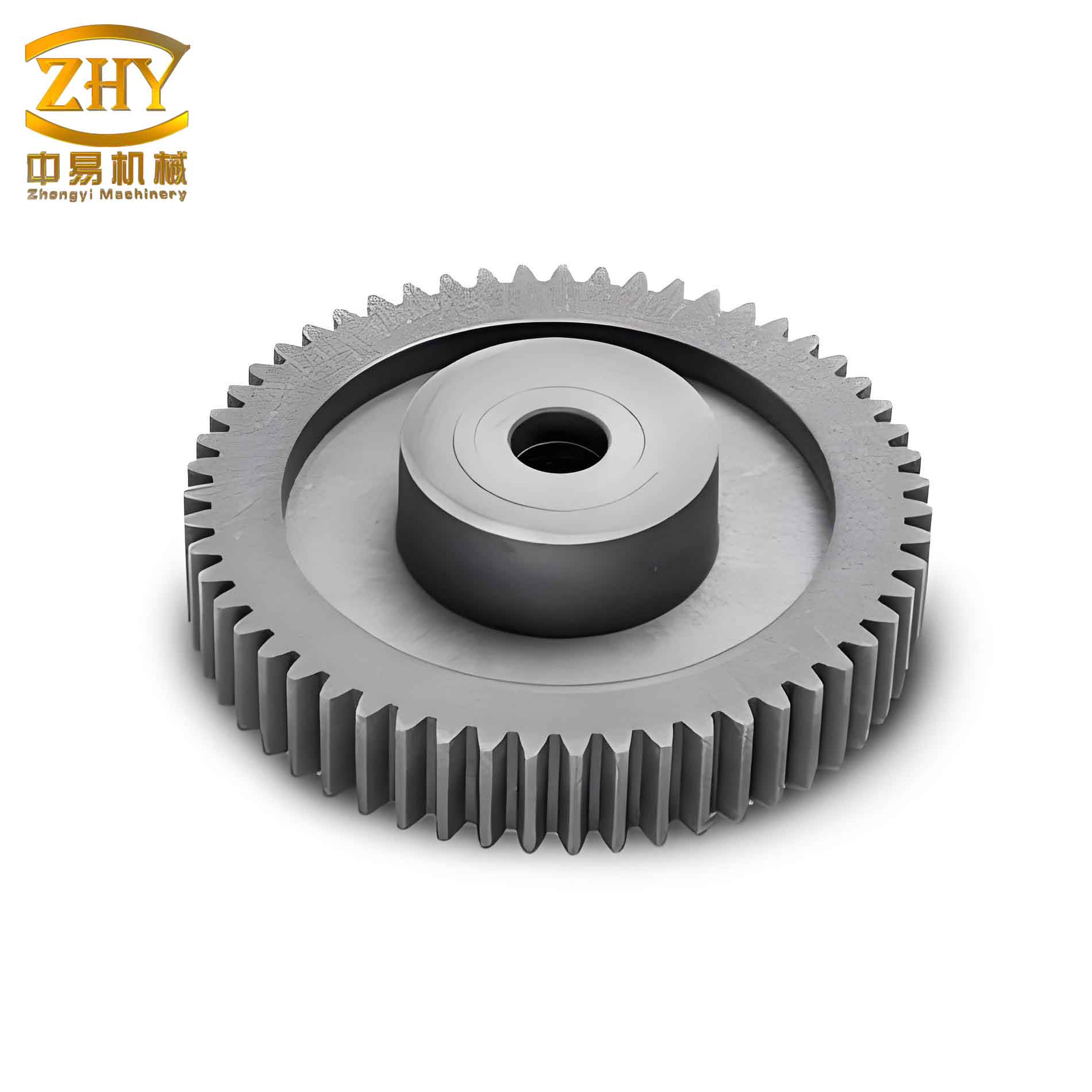
Geometric Model Establishment and Simplification
Parameter Definition
The geometric model for this analysis is based on standard involute profile parameters for a spur and pinion gear set operating in external meshing conditions. The primary dimensions and operating parameters are summarized in the table below. The pinion is the driving gear, and a constant driving torque is applied to simulate the load condition.
| Parameter | Symbol | Value | Unit |
|---|---|---|---|
| Module | $m$ | 2 | mm |
| Number of Teeth (Pinion) | $z_1$ | 25 | – |
| Number of Teeth (Gear) | $z_2$ | 83 | – |
| Face Width | $b$ | 17 | mm |
| Pressure Angle | $\alpha$ | 20 | ° |
| Driving Torque (on Pinion) | $T_1$ | 95000 | N·mm |
| Young’s Modulus | $E$ | 206000 | MPa |
| Poisson’s Ratio | $\nu$ | 0.3 | – |
Model Simplification Strategy
Performing a full-gear FEA model is computationally expensive. Research indicates that the stress field in a loaded gear tooth is localized. The circumferential influence extends approximately over three teeth, and the radial influence extends roughly 2 to 3 times the module ($m$) from the root circle. To achieve an optimal balance between computational efficiency and result accuracy, a simplified five-tooth segment model is adopted. The geometry is created by extending the tooth root circle radially inward by a distance $\delta_0 = 2.5m$ (i.e., 5 mm) to define the inner boundary of the model, which is then fully constrained. This simplification effectively captures the stress concentration in the loaded region of the spur and pinion while significantly reducing model size.
Theoretical Foundation: Classical Hertzian Contact Stress
The maximum contact stress between two elastic bodies with curved surfaces can be estimated using the Hertzian contact theory. For gear teeth, the standard formula used in mechanical design handbooks incorporates several correction factors to account for gear geometry and meshing conditions. The contact stress $\sigma_H$ at the pitch point is given by:
$$ \sigma_H = Z_H \cdot Z_E \cdot Z_\varepsilon \cdot \sqrt{ \frac{K F_t}{b d_1} \cdot \frac{\mu + 1}{\mu} } $$
Where:
$Z_H$ is the zone coefficient (accounts for tooth geometry at the pitch point),
$Z_E$ is the elastic coefficient (accounts for material properties),
$Z_\varepsilon$ is the contact ratio factor,
$K$ is the application factor (accounts for dynamic loads),
$F_t$ is the nominal tangential load at the reference circle,
$b$ is the face width,
$d_1$ is the reference diameter of the pinion,
$\mu$ is the gear ratio ($z_2 / z_1$).
The tangential force $F_t$ is derived from the applied torque: $F_t = \frac{2 T_1}{d_1}$. Using the parameters from the model and standard design charts, the following values are obtained for the calculation related to our specific spur and pinion set:
| Parameter | Symbol | Value |
|---|---|---|
| Application Factor | $K$ | 1.2 |
| Zone Coefficient | $Z_H$ | 2.5 |
| Elastic Coefficient | $Z_E$ | 189.8 $\sqrt{\text{MPa}}$ |
| Contact Ratio Factor | $Z_\varepsilon$ | 0.872 |
| Pinion Reference Diameter | $d_1$ | 50.0 mm |
| Gear Ratio | $\mu$ | 3.32 |
| Tangential Force | $F_t$ | 3800 N |
Substituting these values into the Hertzian formula yields a theoretical maximum contact stress of $\sigma_H \approx 1029$ MPa. This value serves as a benchmark for validating the subsequent finite element analysis of the spur and pinion contact.
Finite Element Model Setup and Quasi-Static Analysis
The simplified five-tooth model of both the pinion and gear is meshed with high-quality, second-order tetrahedral (C3D10) elements, with a refined mesh in the contact region around the tooth flanks and root fillets to accurately capture stress gradients. The material is defined as linear elastic with properties listed earlier. A surface-to-surface contact interaction is defined between the gear teeth flanks. The analysis is a quasi-static step where a rotational displacement (or torque) is applied to the pinion’s reference point, coupled to its inner bore, while the gear’s inner bore is fixed in all degrees of freedom except for rotation about its axis, simulating a resistive load. Multiple analyses are run to investigate parameter influences.
Contact Stress Results
The FEA results for the base configuration (with a nominal friction coefficient) show the contact stress distribution during meshing. The maximum contact stress from the simulation is approximately 1209 MPa, which is higher than the classical Hertzian prediction of 1029 MPa. This discrepancy is expected and insightful. The classical formula calculates stress at the pitch point, while the FEA identifies the maximum stress occurring slightly below the pitch point, near the region where the contact line approaches the root fillet transition on the driving spur and pinion. This location often experiences higher stress due to the combined effect of contact and bending deformation, a nuance captured by the comprehensive FEA model but not by the simplified analytical formula.
Parametric Study on Stress Influences
Influence of Friction Coefficient
In real spur and pinion gear operation, friction between the meshing tooth flanks is unavoidable and influences the stress state, particularly as the line contact deforms into an elliptical contact area. To quantify this effect, a series of analyses were performed with different friction coefficients ($\mu_f$) applied at the contact interface: 0 (frictionless), 0.05, 0.07, 0.10, and 0.15.
The results indicate that the presence of friction increases the calculated maximum contact stress. The increase is most pronounced when moving from a frictionless model to one with a small amount of friction. As the friction coefficient rises further, the maximum contact stress continues to increase but at a gradually diminishing rate. This trend can be attributed to the shear traction component introduced by friction, which modifies the subsurface stress field. The table below summarizes the FEA-calculated maximum contact stress for the different friction conditions in the analyzed spur and pinion model.
| Friction Coefficient ($\mu_f$) | Maximum Contact Stress $\sigma_{H, max}$ (MPa) |
|---|---|
| 0.00 | 1040 |
| 0.05 | 1048 |
| 0.07 | 1050 |
| 0.10 | 1050 |
| 0.15 | 1055 |
Influence of Radial Model Extension ($\delta_0$)
The distance $\delta_0$ by which the tooth root circle is extended radially inward to create the fixed boundary of the FEA model is a critical simplification parameter. An insufficient extension can artificially constrain the material, leading to an overestimation of root stresses (stiffening effect). To determine a suitable value for accurate bending stress calculation, the pinion model was analyzed with different extension distances: $\delta_0 = 1m, 1.5m, 2m, 2.5m,$ and $3m$, where $m=2$ mm is the module.
The primary output monitored was the maximum bending stress at the tooth root fillet. The results show a clear convergence trend. As $\delta_0$ increases, the calculated maximum root bending stress also increases but the rate of increase slows down significantly. This indicates that for small $\delta_0$, the fixed boundary is too close to the high-stress region, preventing necessary deformation and yielding non-conservative (lower) stress values. The stress values stabilize as $\delta_0$ reaches approximately $2.5m$, suggesting the boundary condition’s influence has diminished. The results for the spur and pinion pinion root stress are consolidated below.
| Root Extension Distance ($\delta_0$) | Maximum Root Bending Stress $\sigma_{F, max}$ (MPa) |
|---|---|
| $1m$ (2 mm) | 353 |
| $1.5m$ (3 mm) | 402 |
| $2m$ (4 mm) | 430 |
| $2.5m$ (5 mm) | 458 |
| $3m$ (6 mm) | 462 |
The bending stress $\sigma_F$ at the root can be related to the tangential load $F_t$ and geometry by the Lewis formula, modified with factors for stress concentration and load distribution:
$$ \sigma_F = \frac{K F_t}{b m} Y_F Y_S Y_\beta $$
Where $Y_F$ is the form factor, $Y_S$ is the stress concentration factor, and $Y_\beta$ is the helix angle factor (1 for spur and pinion gears). The FEA provides a more direct and accurate calculation of this stress, including the precise location of the maximum, which is vital for fatigue life prediction of the spur and pinion gear set.
Conclusion
This finite element-based investigation into the static stress state of an involute spur and pinion gear pair provides detailed insights that complement and extend classical analytical methods. The use of ABAQUS software allows for a comprehensive analysis that captures the true location and magnitude of peak stresses, which often differ from simplified theoretical predictions. Key findings from this study include:
- The maximum contact stress in the meshing spur and pinion occurs near the region where the contact path approaches the root fillet, not precisely at the theoretical pitch point, with FEA values being sensibly higher than standard Hertzian calculations.
- The coefficient of friction at the tooth flank interface has a measurable, though non-linear, effect on the calculated maximum contact stress. Accounting for friction is necessary for a realistic analysis, though its impact on the peak value in this quasi-static case is moderate for typical friction ranges.
- The radial extension distance $\delta_0$ used to define the model’s fixed boundary has a significant impact on the calculated tooth root bending stress. Results converge and become stable when $\delta_0 \geq 2.5m$, validating common modeling guidelines that recommend this distance for accurate stress recovery in gear tooth FEA. This is a critical consideration for the fatigue design of any spur and pinion transmission.
In summary, finite element analysis serves as a powerful tool for the detailed stress evaluation and optimization of spur and pinion gear designs. It enables engineers to study the influence of various parameters—such as precise geometry modifications, material properties, and loading conditions—with a level of detail unattainable through pure analytical means, ultimately contributing to the development of more efficient, durable, and quiet gear transmission systems.