
As a foundational element in power transmission systems across countless industries, the spur gear represents a critical component whose manufacturing efficiency and final performance have far-reaching implications. Traditional methods of gear production, primarily based on subtractive machining, are increasingly recognized for their significant drawbacks: substantial material waste, limited production rates, compromised part strength due to cut fibers, and consequently, higher overall costs. In this context, the advent of cold forging for spur gears presents a transformative alternative. This near-net-shape manufacturing process promises substantial improvements, including a material utilization increase of over 30%, a strength enhancement of more than 20%, and a productivity boost of approximately 40%. For high-volume applications, especially those involving precision spur and pinion gear pairs in automotive transmissions, robotics, or aerospace actuators, these advantages are not merely incremental but revolutionary.
Despite its clear potential, the widespread industrial adoption of cold forging for cylindrical spur gears has been hindered by persistent technical challenges. The primary obstacles are the exceptionally high forming loads required and the difficulty in achieving complete, defect-free filling of the gear tooth corners, particularly at the dedendum. These challenges escalate costs due to accelerated die wear and limit the size and module of gears that can be feasibly produced. Consequently, a detailed investigation into the factors governing the forming load is not just an academic exercise but a necessary step toward unlocking the industrial potential of this technology for manufacturing robust spur and pinion sets.
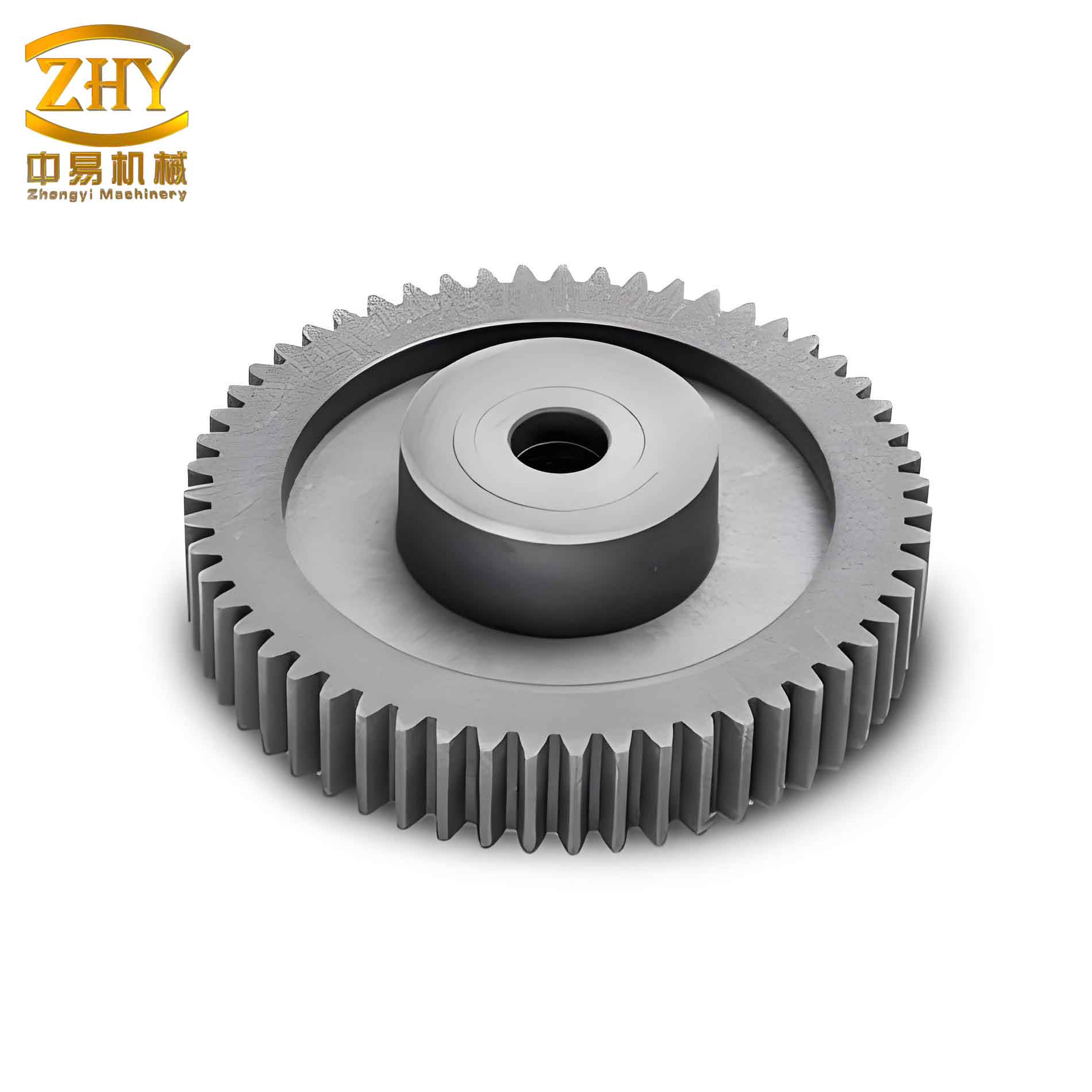
To address these core issues, the principle of radial divided-flow has emerged as a highly effective strategy. This technique fundamentally alters the metal flow pattern during forging. By intentionally creating an alternative flow path—typically a central hole or cavity—the process diverts a portion of the material radially inward. This分流 action relieves the intense pressure that builds up in the final stages of tooth cavity filling, thereby preventing the characteristic steep rise in load and significantly reducing the peak forging force. A complementary approach to implement this principle is the floating-die process. In this setup, the die containing the gear tooth cavity is allowed to move axially under controlled pressure. This relative motion between the punch and the die assists in metal flow, further promoting cavity filling and reducing the load on the primary punch. The combination of radial divided-flow and a floating-die mechanism offers a powerful solution for the cold forging of challenging geometries like spur and pinion gears.
This analysis employs advanced three-dimensional rigid-plastic finite element method (FEM) simulation as the primary investigative tool. By systematically varying key process parameters—namely, the friction factor, die corner radius, diameter of the divided-flow hole, and forming speed—we can isolate and quantify their individual and combined effects on the final forming load. The goal is to establish clear, actionable guidelines for process optimization, paving the way for the industrialization of cold-forged spur and pinion gears.
Finite Element Modeling and Simulation Setup
To ensure computational efficiency while maintaining accuracy, the model leverages the inherent symmetry of the spur gear. A 90-degree sector (one-fourth) of the full workpiece and die assembly is used for simulation. The gear specifications are typical for power transmission applications: number of teeth $Z = 20$, module $m = 3 \text{ mm}$, pressure angle $\alpha = 20^\circ$, and profile shift coefficient $x = 0.0$. The selected workpiece material is AISI 1010 steel in a cold-worked condition, modeled as a rigid-plastic, isotropic body deforming under room temperature (20°C) conditions. Its flow stress behavior is often represented by a power-law model:
$$\bar{\sigma} = K \cdot (\bar{\varepsilon} + \varepsilon_0)^n$$
where $\bar{\sigma}$ is the effective stress, $K$ is the strength coefficient, $\bar{\varepsilon}$ is the effective strain, $\varepsilon_0$ is a pre-strain constant, and $n$ is the work-hardening exponent. The dies (punch and floating die) are defined as analytically rigid surfaces to reduce computational cost.
The initial billet is designed with an outer diameter close to the gear’s root circle diameter to ensure proper positioning and efficient filling. For a standard gear with $m=3$ and $Z=20$, the root diameter $d_f \approx 52.5 \text{ mm}$. A billet diameter of $52 \text{ mm}$ is chosen. The billet features a pre-machined central hole, which serves as the radial divided-flow channel. Its initial diameter is a critical variable in this study. The billet height $H_0$ is calculated from volume constancy, considering the final forged gear volume and the volume of the central hole. The general formula is:
$$V_{\text{billet}} = \frac{\pi}{4} (D_o^2 – D_{ih}^2) \cdot H_0 = V_{\text{gear\_solid}} + V_{\text{final\_hole}}}$$
where $D_o$ is the billet outer diameter, $D_{ih}$ is the initial hole diameter, and $V_{\text{gear\_solid}}$ is the volume of a solid gear of the same dimensions. For a starting hole diameter of 16 mm, the calculated height is approximately 37.5 mm.
The interface friction between the deforming billet and the dies is modeled using the shear friction model, defined by a friction factor $m_f$ (ranging from 0 to 1):
$$\tau_f = m_f \cdot \frac{\bar{\sigma}}{\sqrt{3}}$$
where $\tau_f$ is the frictional shear stress. A baseline value of $m_f = 0.12$ is used. The punch and the floating die are assigned downward velocities (e.g., 10 mm/s each). The tetrahedral element type is selected for meshing the billet due to its ability to handle complex shape changes. Automatic remeshing is employed to maintain mesh quality throughout the large deformation process.
Analysis of Process Parameter Effects on Forming Load
The forming load, typically measured as the total force on the main punch or the average pressure over the punch face, is the primary response variable. The simulation matrix explores four key parameters, as summarized below:
| Process Parameter | Symbol | Simulated Values / Levels |
|---|---|---|
| Friction Factor | $m_f$ | 0.1, 0.3, 0.5, 0.7 |
| Die Tooth Root Radius | $r_f$ | 0.0 mm, 0.5 mm, 1.0 mm, 1.5 mm |
| Initial Divided-Flow Hole Diameter | $D_{ih}$ | 0 mm (solid), 5 mm, 10 mm, 15 mm |
| Forming Speed | $v$ | 10 mm/s, 100 mm/s, 200 mm/s, 300 mm/s |
1. Influence of Friction Factor ($m_f$)
Friction is a dominant dissipative force in metal forming. The simulation results vividly demonstrate its profound impact on the load-stroke curve for cold forging a spur and pinion gear. As the friction factor increases from a well-lubricated condition ($m_f=0.1$) to a high-friction state ($m_f=0.7$), the required forming pressure rises substantially at any given stroke. The divergence is most pronounced in the stroke range of 60% to 95% of the total fill. This can be explained by the contact mechanics of the process. In the early stage, as the billet upsets and begins to fill the dedendum, contact with the die sidewalls is limited, minimizing frictional effects. Once material flows past the root fillet and above the pitch line, the increasing conformity between the deformed metal and the intricate tooth cavity geometry drastically expands the contact area. The frictional shear stress $\tau_f$, proportional to $m_f$, thus acts over a much larger surface, resulting in a significant increase in the total forming force. The relationship between peak pressure $P_{max}$ and friction factor can be approximated by:
$$P_{max} \approx \bar{\sigma} \cdot \left(1 + \frac{2 \mu L}{h}\right) \quad \text{(for sliding friction)} \quad \text{or} \quad P_{max} \approx \bar{\sigma} \cdot \left(1 + \frac{m_f A_c}{\sqrt{3} A_p}\right)$$
where $L$ is the contact length, $h$ is the workpiece height, $A_c$ is the total contact area, and $A_p$ is the punch area. This underscores the critical importance of superior lubrication in reducing the forging load for spur and pinion gears.
2. Influence of Die Tooth Root Radius ($r_f$)
The radius at the base of the die tooth cavity ($r_f$) guides the initial flow of metal from the billet into the tooth space. Intuitively, a sharp corner ($r_f=0$) creates a severe restriction, while a larger radius facilitates smoother metal entry. The simulation results confirm this, showing a moderate but consistent decrease in forming load as $r_f$ increases from 0 to 1.5 mm. The effect is most noticeable during the intermediate filling stage. However, a crucial observation is that in the final stages of filling (the last 5-10% of stroke), the load curves for different radii tend to converge. This indicates that once the main tooth profile is formed, the resistance to filling the final sharp corners at the tooth tip is largely governed by localized deformation and hydrostatic pressure, becoming less sensitive to the initial root radius. Therefore, while a generous root radius is beneficial for load reduction and die life, its utility is bounded, and it cannot solely solve the problem of final corner fill in spur and pinion gear forging.
| Root Radius, $r_f$ (mm) | Relative Peak Load (%) | Primary Effect Stage |
|---|---|---|
| 0.0 | 100% (Baseline) | Intermediate Filling |
| 0.5 | ~97% | Intermediate Filling |
| 1.0 | ~94% | Intermediate Filling |
| 1.5 | ~92% | Intermediate Filling |
3. Influence of Divided-Flow Hole Diameter ($D_{ih}$)
This parameter is the cornerstone of the radial divided-flow strategy and exhibits the most dramatic influence on load reduction for spur and pinion gear forging. The results show a steep decline in peak forming pressure as the initial hole diameter increases. Crucially, for hole diameters at or above a certain threshold (around 10 mm in this study), the load-stroke curve loses the sharp vertical ascent typically seen at the end of solid forging. Instead, the load increases more gradually and reaches a lower plateau. This is the definitive signature of successful分流. The central hole provides a “pressure relief valve,” allowing material to flow inward. This inward flow compensates for the volume constraint as the outer tooth cavities near completion, preventing the development of excessive hydrostatic stress. The effectiveness can be related to the area ratio of the分流 channel to the punch area. A simplified criterion for effective load mitigation might be:
$$\frac{A_{hole}}{A_{punch}} = \frac{D_{ih}^2}{D_o^2} \geq C$$
where $C$ is an empirical constant dependent on gear geometry. The data clearly advocates for incorporating a sufficiently large分流 hole as the most effective single measure for lowering the forming load in the cold forging of spur and pinion gears.
| Hole Dia., $D_{ih}$ (mm) | Peak Load Reduction | End-of-Stroke Load Behavior | Metal Flow Pattern |
|---|---|---|---|
| 0 (Solid) | 0% (Baseline) | Sharp, exponential rise | Purely outward, high constraint |
| 5 | Moderate (~15-25%) | Steep rise, but lower peak | Predominantly outward, some分流 |
| 10 | Significant (~40-50%) | Gradual rise, plateau | Balanced outward and radial inward flow |
| 15 | Major (~55-65%) | Very gradual increase | Strong radial inward分流 dominant |
4. Influence of Forming Speed ($v$)
Within the practical range of cold forging speeds simulated (10 to 300 mm/s), the effect on the quasi-static forming load is negligible. The load-stroke curves for different speeds are virtually superimposable. This is because the strain-rate sensitivity of the material (AISI 1010 steel) at room temperature is relatively low for the rates achieved in this range. The flow stress $\bar{\sigma}$ in a rate-sensitive material is often modeled as:
$$\bar{\sigma} = \bar{\sigma}(\bar{\varepsilon}, \dot{\bar{\varepsilon}}) = K’ \cdot (\bar{\varepsilon})^n \cdot (\dot{\bar{\varepsilon}})^m$$
where $\dot{\bar{\varepsilon}}$ is the effective strain rate and $m$ is the strain-rate sensitivity exponent. For typical low-carbon steels at room temperature, $m$ is very small (close to 0.01-0.02), explaining the minimal speed effect observed. Therefore, for the cold forging process design of spur and pinion gears, speed can be selected based on productivity and equipment capability without a significant penalty or benefit regarding forming load.
Synthesis and Conclusion: A Pathway for Industrial Application
The numerical investigation into the cold forging of a spur gear using radial divided-flow and a floating-die process yields clear hierarchies of influence among the studied parameters. These findings provide a strategic blueprint for process optimization aimed at industrial implementation, particularly for mass-producing high-strength spur and pinion gear sets.
The most potent levers for reducing the formidable forming loads are, unequivocally, minimizing friction and implementing a sufficiently large radial divided-flow channel. Advanced lubrication systems and surface treatments to achieve a consistently low friction factor ($m_f < 0.1$) are paramount. Concurrently, designing the preform with a central hole whose diameter is a significant fraction (e.g., >20%) of the billet diameter is the most effective engineering solution to circumvent the high-pressure plateau and enable the forging of larger or higher-module spur and pinion gears.
The die tooth root radius plays a secondary but valuable role. A well-sized radius ($r_f \approx 0.5m$ to $1.0m$, where $m$ is the module) promotes smoother metal entry, reduces stress concentration in the die, and contributes to a modest load reduction during the intermediate filling phase. Its design is more crucial for die durability and ensuring consistent fill than for drastic load minimization.
Finally, within the conventional range of mechanical or hydraulic press speeds, the forming speed has a negligible impact on the peak load for typical steel spur and pinion gears. This parameter offers flexibility for production scheduling without compromising process mechanics.
In conclusion, the synergistic application of a low-friction environment, a strategic radial divided-flow design, a optimized die profile, and a floating-die action presents a viable and robust technical solution to the historical challenges of spur gear cold forging. By systematically applying these principles, the manufacturing industry can transition this high-performance process from the laboratory to the factory floor, enabling the economical production of superior spur and pinion gears with enhanced mechanical properties and material efficiency.