
The quest for efficient and precise mechanical power transmission has been a cornerstone of engineering for centuries. Among the various solutions, the spur and pinion gear pair stands as a fundamental and ubiquitous component. Its seemingly simple geometry belies a complex interplay of mathematical principles and manufacturing constraints. Traditional design methods, often iterative and manual, can be time-consuming and prone to error, especially when creating families of gears with varying specifications. In my professional journey, I have found that embracing parametric design methodologies within modern CAD environments transforms this process. It shifts the focus from drafting individual models to defining intelligent, rule-driven systems. This article delves into my comprehensive approach to the fully parametric three-dimensional modeling of standard involute spur and pinion gears, a method that encapsulates not just geometry but engineering intent, enabling rapid design iteration, simulation, and analysis.
The core philosophy behind parametric modeling is the separation of the geometric definition from the specific dimensional values. Instead of drawing a circle with a fixed 50mm diameter, one creates a “circle” feature whose diameter is controlled by a variable, say `D`. This variable `D` can then be linked to other variables through mathematical relationships. For a spur and pinion set, the key parameters—module, number of teeth, pressure angle, and face width—become the primary drivers. Changing a single driver, like the number of teeth on the pinion, automatically triggers a cascade of recalculations through the model’s “relations” or “equations,” updating the pitch diameter, root diameter, tooth profile, and pattern count. This is not merely a convenience; it is a paradigm that ensures consistency, enforces geometric constraints, and allows for the exploration of design alternatives in seconds. The model becomes a dynamic embodiment of the gear’s design theory.
At the heart of any involute spur and pinion design lies a precise set of geometric parameters and constraints. For a standard full-depth tooth system (with an addendum coefficient of 1 and a dedendum coefficient of 1.25), the following variables and formulas form the essential blueprint. These are the rules that our parametric model will encode.
| Parameter | Symbol | Defining Formula |
|---|---|---|
| Module | \( m \) | Primary design variable (scale factor). |
| Number of Teeth | \( z \) | Primary design variable (spur gear `z1`, pinion `z2`). |
| Pressure Angle | \( \alpha \) | Typically \( 20^\circ \) or \( 14.5^\circ \). |
| Face Width | \( B \) | Primary design variable (based on strength requirements). |
| Pitch Diameter | \( d_p \) | \( d_p = m \cdot z \) |
| Base Diameter | \( d_b \) | \( d_b = d_p \cdot \cos(\alpha) \) |
| Addendum Diameter (Outside Diameter) | \( d_a \) | \( d_a = m \cdot z + 2m = m(z + 2) \) |
| Dedendum Diameter (Root Diameter) | \( d_f \) | \( d_f = m \cdot z – 2.5m = m(z – 2.5) \) |
| Circular Pitch | \( p \) | \( p = \pi \cdot m \) |
| Tooth Thickness (on pitch circle) | \( s \) | \( s = p / 2 = \pi \cdot m / 2 \) |
The soul of the spur and pinion tooth form is the involute curve. This profile is essential for providing constant velocity ratio and smooth meshing. Generating this curve accurately within the CAD software is the most critical step. The involute can be defined by a parametric equation based on the base circle radius \( r_b = d_b / 2 \). Let \( \theta \) be the roll angle (in radians) from the start of the involute. The coordinates of a point on the involute are given by:
$$ x = r_b (\cos(\theta) + \theta \sin(\theta)) $$
$$ y = r_b (\sin(\theta) – \theta \cos(\theta)) $$
$$ z = 0 $$
For implementation in CAD systems like Pro/ENGINEER (Creo Parametric), the equation is often written using a parameter `t` that ranges from 0 to 1, and the roll angle is expressed as a function of `t` (e.g., \( \theta = t \cdot \theta_{max} \)). The exact syntax becomes part of the model’s feature definition, ensuring the tooth shape is mathematically perfect and updates seamlessly with changes to `m`, `z`, and `\alpha`. The creation of this precise involute curve is what separates a merely illustrative model from a true engineering model suitable for analysis and manufacturing.
Initialization and Parameter Declaration
The process begins by establishing the driving parameters. I create a set of user-defined parameters: `MODULE` (m), `NUM_TEETH` (z), `PRESSURE_ANGLE` (α), and `FACE_WIDTH` (B). These are given initial default values, for example, m=2 mm, z=25, α=20°, B=15 mm. These parameters are purely alphanumeric and represent the high-level design inputs for our spur and pinion components. The next step is to use these to calculate the dependent geometric values via relations. I write equations directly in the CAD relation editor that define the pitch, base, addendum, and dedendum diameters as shown in the table above. This network of equations ensures that all derived geometry is always consistent with the primary inputs.
The Genesis of a Spur and Pinion
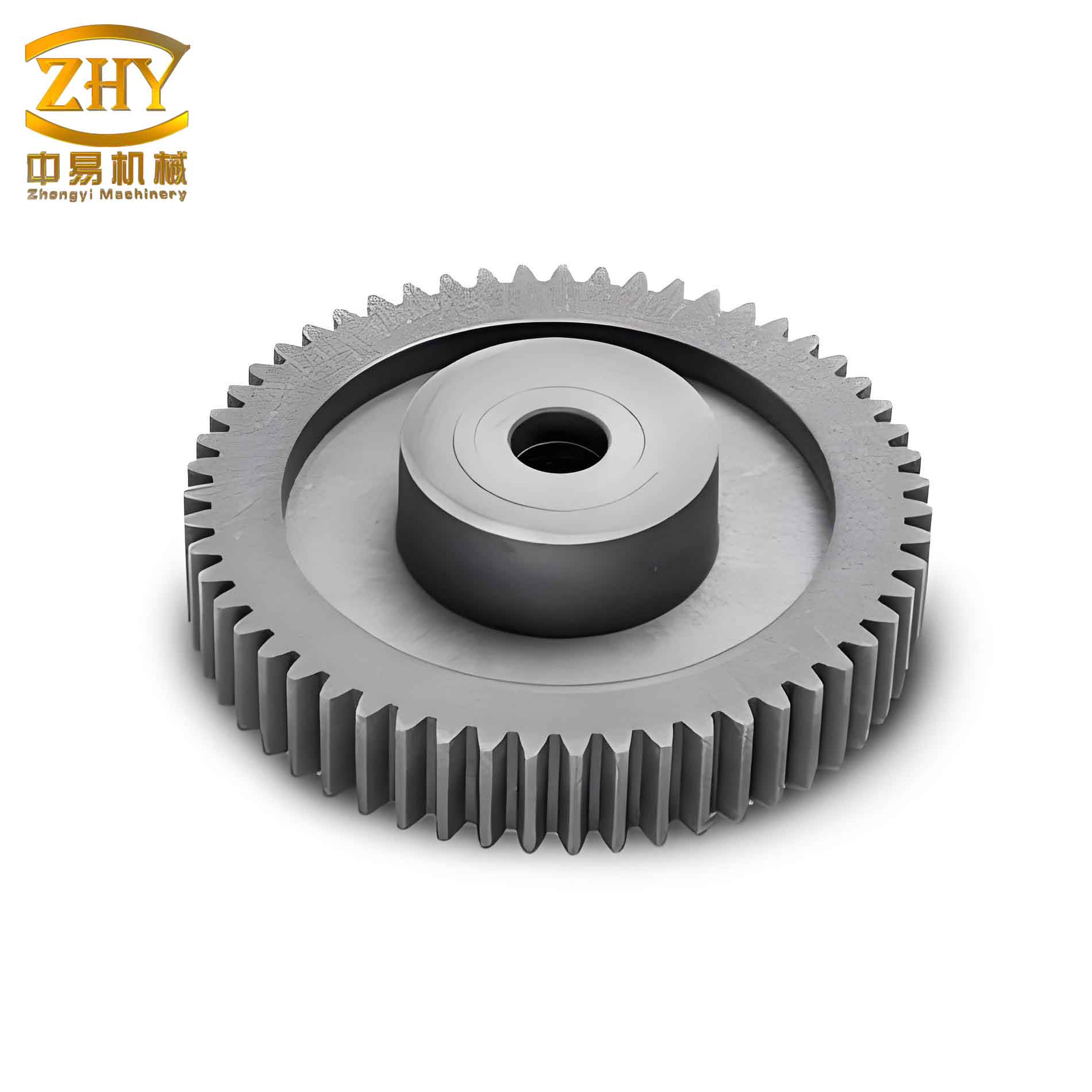
I start the solid geometry by creating the gear blank. This is typically a cylindrical extrusion. Its diameter is controlled by the addendum diameter parameter `d_a`, and its depth is controlled by the `FACE_WIDTH` parameter. Crucially, I also sketch the four key circles—addendum, pitch, base, and dedendum—as construction geometry on the defining plane. Their diameters are not manually dimensioned but are driven by the previously established relations (e.g., `sd0 = m*(z-2.5)` for the root circle). This sketch serves as the foundational canvas for the tooth profile.
Conjuring the Involute
The magic happens when I insert a datum curve defined by an equation. Selecting the coordinate system and choosing the Cartesian type, I input the involute equations, adapting them to the software’s syntax. For instance, using `t` as the independent variable from 0 to 1:
/* Parameter definition for the involute */
r = d_b / 2
theta = t * 90 /* Unrolling over 90 degrees is often sufficient */
x = r * cos(theta) + r * sin(theta) * theta * (pi/180)
y = r * sin(theta) – r * cos(theta) * theta * (pi/180)
z = 0
The system generates the precise involute curve originating from the base circle. I then create a datum point at the intersection of this involute curve and the pitch circle. This point is critical as it defines the location where the tooth thickness is measured.
Carving the First Tooth
Using the involute curve and the key circles as boundaries, I construct the profile for a single tooth space. This involves:
- Mirroring the initial involute curve about a centerline. This centerline is positioned at an angular offset from the involute’s start. The offset angle is defined by the circular tooth thickness: \( \text{angle} = (s / d_p) \times (180/\pi) \) degrees, which simplifies to \( 360 / (4 \cdot z) \) degrees for a standard tooth (since \( s = \pi m / 2 \) and \( d_p = m z \)).
- Trimming the two mirrored involute segments with the addendum and dedendum circles to form a closed loop for one tooth.
- Extruding this closed profile as a solid protrusion, with its depth linked to the `FACE_WIDTH` parameter.
This first solid tooth is a standalone feature, parametrically tied to all the primary inputs. The angular position of this tooth is also defined by a relation, such as `d7 = 360/(4*z)`, ensuring it is always correctly placed relative to the pitch circle.
Pattern Intelligence: From One Tooth to a Full Spur and Pinion
Manually creating each tooth is unthinkable. The power of parametric design shines with the pattern feature. First, I take the single tooth and create a copied instance of it, rotated around the gear axis by exactly one circular pitch, which is \( 360/z \) degrees. This second tooth’s rotation angle is defined by the relation `d15 = 360/z`. With this patterned reference established, I apply a radial axis pattern feature to the original tooth. In the pattern definition, I specify the number of instances as `NUM_TEETH` (or `NUM_TEETH – 1` if patterning the second instance) and set the angular increment to be governed by the relation `memb_i = 360/z`. The software then instantly generates the complete set of teeth around the gear blank. Any change to `z` automatically updates the count and spacing of all teeth. The design of a meshing spur and pinion pair then simply involves creating two separate part files (or bodies within an assembly) driven by different `NUM_TEETH` parameters (e.g., z1=40 for the spur, z2=12 for the pinion) while sharing the same `MODULE` and `PRESSURE_ANGLE` to ensure proper meshing.
Completing the Model: Hubs, Webs, and Keyways
A functional spur and pinion gear requires more than just teeth. Parametric design extends seamlessly to these features. I add a central bore, whose diameter is a new parameter `BORE_DIA`. Web thickness, rim thickness, lightening holes, and keyway dimensions (defined by standards like ANSI B17.1) can all be added as sketches and extrusions/cuts, with their dimensions controlled by relations linked to the primary module or pitch diameter. For example, a common rule is `WEB_THICKNESS = 0.3 * m * z` or `HUB_DIAMETER = 1.5 * BORE_DIA`. Chamfers and fillets at the ends of the teeth (for safety and to reduce stress concentrations) are also added, with their sizes potentially related to the module. The entire model is therefore a cohesive, rule-based entity.
Application and Advantages in Spur and Pinion Development
The creation of a fully parametric spur and pinion model is not an end in itself; it is the beginning of a highly efficient digital workflow. The advantages are profound:
- Rapid Design Variants: Creating a new gear for a different load or speed ratio requires only modifying the `MODULE`, `NUM_TEETH`, or `FACE_WIDTH` in the parameter table and regenerating the model. A family of related spur and pinion gears for a product line can be managed from a single master file.
- Foundation for Analysis: The accurate geometric model is essential for Finite Element Analysis (FEA) to calculate bending stress, contact stress, and root fatigue life. Parametric models allow for quick “what-if” studies by adjusting face width or root fillet size to meet stress targets.
- Ensuring Meshing Compatibility: In an assembly context, the parametric definitions guarantee that a spur and pinion pair with the same module and pressure angle will mesh correctly at the correct center distance \( a = m(z_1 + z_2)/2 \), regardless of individual tooth counts.
- Direct Path to Manufacturing: The solid model can be used to generate toolpaths for CNC machining, wire EDM, or 3D printing. Parametric changes automatically update the manufacturing geometry.
- Dynamic Simulation: For mechanism analysis, the precise tooth geometry allows for accurate kinematic and dynamic simulations of the spur and pinion transmission, revealing vibrations, forces, and efficiency under motion.
The following table contrasts the traditional design workflow with the parametric approach, highlighting the transformative impact on spur and pinion design tasks.
| Design Aspect | Traditional / Direct Modeling | Parametric / Rule-Based Modeling |
|---|---|---|
| Design Change | Requires manual editing of numerous sketches and features. Error-prone and slow. | Change a few driving parameters (m, z); model updates automatically via relations. |
| Family of Parts | Each variant (different tooth count) is a separate, disconnected model file. | All variants are derived from a single master model, ensuring consistency. |
| Geometric Integrity | Relationships (e.g., base circle derived from pitch circle) may break after edits. | Relations are explicit and maintained, enforcing design theory constraints. |
| Analysis & Optimization | Setting up studies for different sizes is cumbersome and manual. | Enables seamless design-of-experiments (DOE) and automated optimization loops. |
| Integration with Calculations | Design calculations (e.g., from AGMA standards) are done externally; input manually. | Calculations (for face width based on stress, etc.) can be embedded as relations. |
Conclusion
The parametric design of spur and pinion gears represents a powerful synthesis of classical mechanical engineering theory and modern digital design tools. By meticulously encoding the mathematical relationships of the involute curve and gear geometry into a feature-based, constraint-driven CAD model, we create more than just a static representation. We create an adaptive, intelligent design organism. This master model, governed by a handful of key parameters, becomes a reusable asset that dramatically accelerates the design cycle, enforces accuracy, and serves as the single source of truth for subsequent analysis, simulation, and manufacturing. For any engineer working with power transmission systems, mastering this parametric approach for spur and pinion components is not just a skill—it is a fundamental methodology that enhances creativity, reliability, and efficiency in bringing robust mechanical designs to life.