
In modern mechanical transmission systems, spur and pinion gears are fundamental components due to their simplicity and efficiency in power transfer. Traditional manufacturing methods for spur and pinion gears, such as machining, often suffer from low material utilization, high production costs, and reduced strength because the fiber structure in the tooth profile is cut, compromising load-bearing capacity. To address these issues, cold forging has emerged as a superior alternative, offering high dimensional accuracy, excellent surface finish, and enhanced strength without the need for heating. This process not only improves material efficiency but also optimizes metal flow lines, leading to superior mechanical properties. In this study, I investigate the cold forging process for cylindrical spur and pinion gears using finite element numerical simulation, focusing on a coupled axial分流 and floating die technique to overcome challenges like difficult tooth cavity filling and high forming loads.
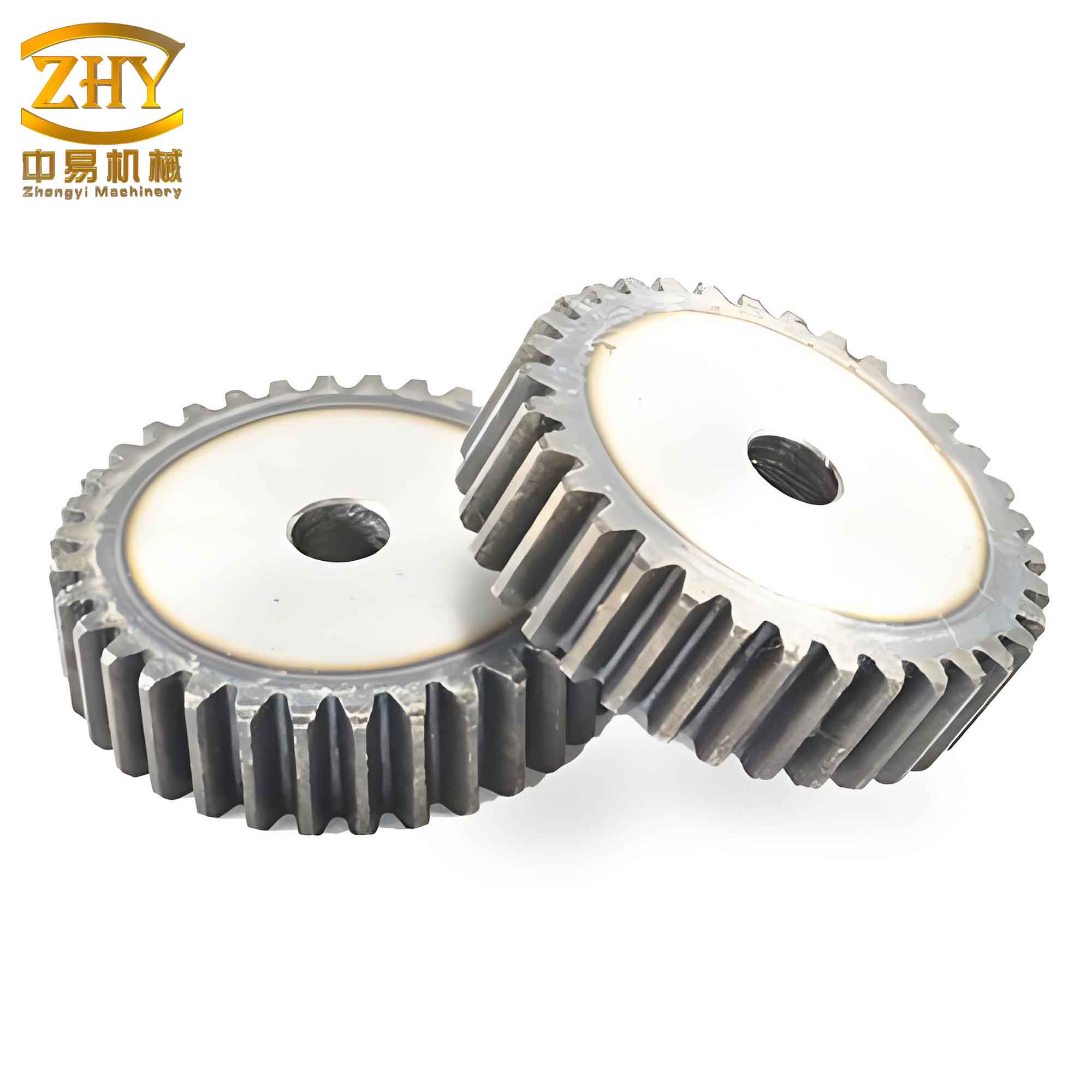
The application of cold forging for spur and pinion gears is particularly advantageous because it allows for near-net-shape production, minimizing post-processing and energy consumption. Compared to hot forming, cold forging provides better control over dimensional tolerances and surface quality, which is critical for gear performance. The key to successful cold forging of spur and pinion gears lies in understanding the metal flow behavior during deformation, which can be effectively analyzed through numerical simulations. In this work, I employ DEFORM-3D software to model the process, aiming to optimize the forming parameters and die design for high-quality spur and pinion gear production.
1. Finite Element Model Development
To simulate the cold forging of spur and pinion gears, I first established a detailed finite element model based on specific gear parameters. The gear under consideration is a cylindrical spur gear with the following specifications, which are typical for spur and pinion gears used in automotive and industrial applications:
| Parameter | Symbol | Value |
|---|---|---|
| Module | m | 2 mm |
| Number of Teeth | Z | 18 |
| Face Width | h | 10 mm |
| Pressure Angle | α | 20° |
| Profile Shift Coefficient | x | 0.0 |
These parameters define the geometry of the spur and pinion gear, influencing the forming process. The die assembly consists of an upper die, a floating die, and a lower die, with a central分流 hole diameter of 10 mm in both upper and lower dies to facilitate material flow and reduce forming loads. The billet is a cylindrical rod, and its dimensions were determined using the volume constancy principle, which is fundamental in plastic deformation. According to this principle, the initial volume equals the final volume, accounting for necessary machining allowances. The equation is expressed as:
$$ V_{initial} = V_{final} + V_{allowance} $$
where \( V_{initial} = \pi \left( \frac{D_b}{2} \right)^2 H_b \) for the billet, and \( V_{final} \) is the volume of the forged spur and pinion gear. After calculations, the billet was designed as a cylinder with diameter \( D_b = 30 \) mm and height \( H_b = 15 \) mm.
To reduce computational cost while maintaining accuracy, I leveraged the geometric symmetry of the spur and pinion gear. Only one-quarter of the deformation body was modeled, as shown in the geometric representation. The model was then imported into DEFORM-3D for simulation. In the setup, the dies were treated as rigid bodies, while the billet was defined as a plastic material using AISI-4140 (cold) properties. The friction between the dies and billet was modeled as shear friction with a coefficient of 0.12. The billet was meshed with tetrahedral elements to capture complex deformations, and the upper die and floating die were assigned a velocity of 1 mm/s to simulate the forging process.
2. Numerical Simulation Analysis for Spur and Pinion Gears
The simulation provided insights into key parameters such as equivalent strain, equivalent stress, velocity fields, and forming load-displacement curves, which are crucial for assessing the quality of cold-forged spur and pinion gears. The results are summarized below, highlighting the metal flow patterns and forming mechanics.
2.1 Equivalent Strain Distribution
The equivalent strain field reveals the extent of deformation in different regions of the spur and pinion gear during forging. As observed in the simulation, the tooth profile areas exhibited higher strain compared to the central shaft section. Specifically, the tooth cavities and die corners experienced significant strain, indicating intense material deformation. This is desirable for spur and pinion gears because high strain in the tooth regions ensures proper filling and enhances mechanical properties through work hardening. The strain distribution can be quantified using the equivalent strain formula:
$$ \bar{\epsilon} = \sqrt{\frac{2}{3} \epsilon_{ij} \epsilon_{ij}} $$
where \( \epsilon_{ij} \) are the components of the strain tensor. At the final forging stage, the entire tooth profile showed substantial strain, confirming effective forming of the spur and pinion gear teeth.
2.2 Equivalent Stress Distribution
The equivalent stress field indicates the internal stresses within the material. In the central hole area, stresses were relatively low, while the tooth regions displayed high stress levels. High stress is beneficial for healing internal defects and improving the strength of spur and pinion gears. The equivalent stress is calculated as:
$$ \bar{\sigma} = \sqrt{\frac{3}{2} s_{ij} s_{ij}} $$
where \( s_{ij} \) are the deviatoric stress components. The results suggest that the forging process induces favorable triaxial compressive stresses in the tooth cavities, promoting density and integrity in spur and pinion gears.
2.3 Velocity Field Analysis
The velocity field illustrates the material flow directions and rates. During the initial stages, material flowed preferentially into the tooth cavities due to lower resistance compared to the central分流 hole. This was enhanced by the floating die action, which aided in filling the lower tooth sections. As the upper die moved downward, the upper part of the billet exhibited higher flow velocities. In the final stage, with the tooth cavities nearly filled, material shifted toward the central hole under two-dimensional compressive stress, leading to increased flow velocities in that region. This behavior is critical for avoiding defects and ensuring uniform filling in spur and pinion gear forging.
2.4 Forming Load-Displacement Curve
The load-displacement curve, derived from the simulation, shows the variation in forming force throughout the process. Initially, the load increased linearly as the upper die contacted the billet, followed by a slow rise during upsetting. As the tooth cavities began to fill, the load increased steadily, with a sharp escalation in the final stage due to the small free surfaces and high triaxial stresses in the die corners. This curve is essential for predicting equipment requirements and optimizing the forging of spur and pinion gears. The relationship can be expressed as:
$$ P = f(\delta) $$
where \( P \) is the forming load and \( \delta \) is the displacement. The steep rise at the end underscores the need for precise control in cold forging spur and pinion gears.
To summarize the simulation findings, the table below presents key observations at different incremental steps for spur and pinion gear forming:
| Increment Step | Equivalent Strain | Equivalent Stress (MPa) | Velocity Trend | Forming Load (kN) |
|---|---|---|---|---|
| 60 | High in tooth cavities | Moderate | Fast flow into teeth | ~150 |
| 75 | Increasing overall | High in teeth | Balanced flow | ~300 |
| 89 (Final) | Maximum in teeth | Peak in corners | Flow to central hole | >500 |
3. Discussion on Cold Forging Optimization for Spur and Pinion Gears
The simulation results demonstrate that the axial分流 and floating die coupling工艺 effectively addresses common issues in spur and pinion gear forging, such as incomplete filling and excessive loads. By allowing material to flow both into the tooth cavities and through the central hole, the process reduces resistance and distributes strain evenly. This is particularly important for spur and pinion gears, which require precise tooth profiles for smooth meshing and load transmission. The use of a floating die helps in applying axial force to enhance lower tooth filling, a key advantage for complex spur and pinion gear geometries.
Moreover, the cold forging process for spur and pinion gears offers significant material savings. Compared to machining, where up to 40-50% material may be wasted, cold forging can achieve material utilization rates above 90%. This efficiency is calculated as:
$$ \eta_m = \frac{V_{gear}}{V_{billet}} \times 100\% $$
where \( \eta_m \) is the material utilization percentage. For the spur and pinion gear in this study, \( \eta_m \) is approximately 95%, highlighting the economic benefits.
The strength improvement in cold-forged spur and pinion gears stems from the uninterrupted fiber lines along the tooth contours. This can be quantified using the Hall-Petch relationship for grain refinement:
$$ \sigma_y = \sigma_0 + k d^{-1/2} $$
where \( \sigma_y \) is the yield strength, \( \sigma_0 \) is a material constant, \( k \) is the strengthening coefficient, and \( d \) is the grain size. Cold forging reduces grain size, thereby enhancing the load-bearing capacity of spur and pinion gears.
However, challenges remain, such as die wear and high initial investment. To mitigate these, process parameters like friction coefficient and die speed must be optimized. For instance, reducing friction to 0.1 could lower forming loads by 10-15%, based on empirical formulas for spur and pinion gear forging:
$$ P \propto \mu \sigma_y A $$
where \( \mu \) is the friction coefficient, \( \sigma_y \) is the flow stress, and \( A \) is the contact area. Future work could involve multi-objective optimization for spur and pinion gear production.
4. Conclusion
In this study, I successfully simulated the cold forging process for cylindrical spur and pinion gears using finite element analysis with DEFORM-3D. The axial分流 and floating die coupling工艺 proved effective in forming well-defined tooth profiles with high dimensional accuracy and strength. Through analysis of equivalent strain, stress, velocity fields, and load-displacement curves, I gained insights into the metal flow behavior and forming mechanics. The results indicate that material initially flows into the tooth cavities, with strain and stress peaking in the final stage, while the central分流 hole aids in load reduction. This research provides a theoretical foundation for implementing cold forging in the mass production of spur and pinion gears, offering advantages in material utilization, energy efficiency, and product quality. Further experimental validation and parameter optimization are recommended to advance the industrial application of this technique for spur and pinion gears.
The cold forging of spur and pinion gears represents a transformative approach in gear manufacturing, aligning with sustainable production goals. By leveraging numerical simulations, engineers can refine processes to produce high-performance spur and pinion gears for diverse applications, from automotive transmissions to industrial machinery. As technology evolves, the integration of AI and real-time monitoring could further enhance the precision and efficiency of forging spur and pinion gears, paving the way for next-generation manufacturing systems.