
In mechanical transmission systems, gear drives, particularly spur and pinion gears, are among the most widespread and critical components. The performance of these gears is heavily dependent on various design parameters, with backlash—the clearance between mating teeth—playing a pivotal role. Backlash is essential for storing lubricant, forming effective oil films, and compensating for manufacturing inaccuracies, assembly errors, thermal expansions, and elastic deformations under load. However, improper backlash can lead to increased noise, vibration, uneven load distribution, and reduced transmission accuracy. Therefore, designing an appropriate backlash is crucial for ensuring smooth operation, longevity, and efficiency of spur and pinion gear systems. This article delves into the factors influencing backlash in spur gears, offering a comprehensive analysis from a first-person perspective, supported by formulas, tables, and practical insights.
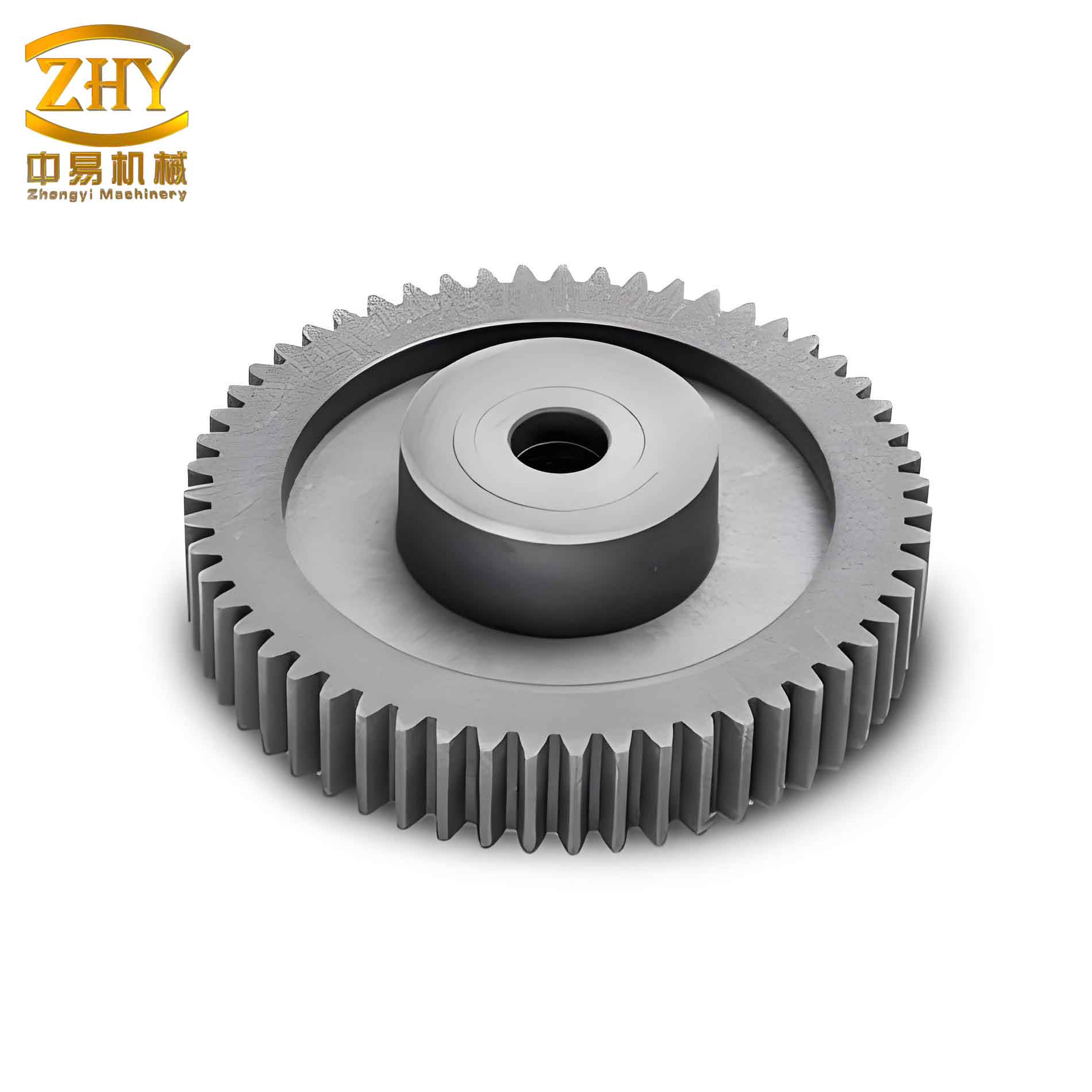
The design of backlash in spur and pinion gears is not a one-size-fits-all approach; it requires careful consideration of operational conditions, precision requirements, and application specifics. Over the years, I have observed that backlash influences not only the mechanical functionality but also the acoustic and dynamic behavior of gear trains. For instance, in high-speed applications, excessive backlash can cause impact loads and chatter, while insufficient backlash may lead to jamming or overheating due to inadequate lubrication. Thus, understanding the multifaceted nature of backlash is key to optimizing gear design. This analysis aims to explore the primary factors affecting backlash, evaluate design methodologies, and provide guidance on calculating and controlling backlash for various precision grades in spur and pinion gears.
Backlash design typically revolves around three main methods: empirical, computational, and tabular approaches. The empirical method relies on referencing proven gear designs or prototypes, adjusting based on similarities in load, environment, assembly, and lubrication. This approach demands substantial experience and a rich database of successful cases, making it somewhat subjective but valuable for custom applications. The computational method involves theoretical formulas to derive backlash values, offering a scientific basis but often simplifying real-world complexities, such as nonlinear deformations or random errors. For example, a common formula for minimum normal backlash, \( j_{bn,\min} \), integrates tooth thickness deviations, center distance errors, and manufacturing inaccuracies:
$$ j_{bn,\min} = |E_{sns1} + E_{sns2}| \cos \alpha_n – f_a \sin \alpha_n – J_n $$
where \( E_{sns1} \) and \( E_{sns2} \) are the tooth thickness upper deviations of the pinion and gear, \( \alpha_n \) is the normal pressure angle, \( f_a \) is the center distance deviation, and \( J_n \) represents the combined influence of pitch deviations and helix errors. While useful for analysis, this formula may lack specificity for unique operating conditions. The tabular method, a variant of the empirical approach, consults standards or reference tables—such as GB/Z18620.2-2008—that recommend backlash values based on factors like pitch line velocity, temperature, load, and lubrication. These tabulated values are empirically validated and widely adopted in industry, often serving as a starting point for design. In my practice, I prioritize the tabular method for its practicality, but I supplement it with computational checks to account for specific influences, especially in precision spur and pinion gear systems.
To systematically address backlash, it is essential to identify all factors that can alter the center distance or tooth thickness of spur and pinion gears. These factors range from environmental conditions to manufacturing tolerances, each contributing uniquely to the overall clearance. Based on my analysis, I have compiled a table summarizing the primary influences, their mechanisms, and calculation methods. This table serves as a foundation for deeper exploration.
| No. | Influencing Factor | Mechanism of Influence | Calculation Method |
|---|---|---|---|
| 1 | Temperature of Gear Transmission | Differential thermal expansion between gearbox and gears alters center distance, increasing or decreasing backlash. Significant temperature differences have a pronounced effect. | $$ j_{bn,\min2} = a (\Delta t_1 \alpha_1 – \Delta t_2 \alpha_2) \times 2 \sin \alpha_n $$ where \( a \) is center distance, \( \Delta t_1, \Delta t_2 \) are temperature differences from standard for housing and gears, \( \alpha_1, \alpha_2 \) are linear expansion coefficients. |
| 2 | Center Distance of Gear Transmission | Variations in center distance move mating teeth closer or apart, directly affecting backlash. This is a systematic error tied to manufacturing and assembly. | Contribution to backlash: \( -f_a \sin \alpha_n \), where \( f_a \) is the center distance deviation. The tolerance for \( f_a \) is based on gear precision grade. |
| 3 | Axis Parallelism Error | Misalignment of axes, arising from coaxiality, radial runout, and bearing errors, introduces random variations in tooth engagement and backlash. | Incorporated into \( J_n \): $$ J_n = \sqrt{ (f_{pt1} \cos \alpha_n)^2 + (f_{pt2} \cos \alpha_n)^2 + 2.104 F_\beta^2 } $$ where \( f_{pt1}, f_{pt2} \) are pitch deviations, \( F_\beta \) is helix error. |
| 4 | Gear Manufacturing Errors | Pitch deviations, profile errors, helix errors, and radial runout randomly affect tooth thickness and spacing, altering backlash unpredictably. | Probabilistic summation via \( J_n \), as above. These errors are governed by gear accuracy standards. |
| 5 | Fit Clearances (Shaft-Hole, Shaft-Bearing) | Clearances in fits can shift gear positions, modifying center distance randomly. Generally small but notable in low-precision spur and pinion gears. | Often neglected; if significant, treated similarly to center distance deviation using \( f_a \). |
| 6 | Elastic Deformation from Loads | Under load, shafts, bearings, and gears deform elastically, changing center distance systematically. Direction is fixed in fixed-axis systems. | Usually minor and omitted in standard calculations; for heavy loads, finite element analysis may be needed. |
From this table, it is evident that backlash in spur and pinion gears is a composite outcome of multiple variables. In my experience, the most dominant factors are center distance deviation (\( f_a \)) and manufacturing errors (\( J_n \)), as they directly stem from production and assembly processes. Temperature effects are critical in applications with large thermal gradients, such as aerospace or automotive transmissions, while fit clearances and elastic deformations are often secondary but should not be ignored in high-precision contexts. To quantify the relative impact of \( f_a \) and \( J_n \), I have analyzed their contributions relative to the minimum backlash \( j_{bn,\min1} \) recommended by standards, across different gear accuracy grades and module sizes. The results are presented in the following tables, which highlight trends useful for design decisions.
First, consider the influence of center distance deviation \( f_a \). The term \( 2f_a \tan \alpha_n \) represents its effect on backlash, and comparing it to \( j_{bn,\min1} \) reveals its significance percentage-wise. Below is a table for various gear modules (\( m_n = 2, 4, 8 \text{ mm} \)), center distances (\( a = 50, 100, 200, 400, 800 \text{ mm} \)), and accuracy grades (1–2 to 9–10, grouped for clarity). These values are derived from tolerance tables and standard backlash recommendations, assuming a normal pressure angle \( \alpha_n = 20^\circ \).
| Gear Accuracy Grade | Module \( m_n \) (mm) | Center Distance \( a \) (mm) | \( 2f_a \tan \alpha_n / j_{bn,\min1} \) (%) |
|---|---|---|---|
| 1–2 | 2 | 50 | 2.5 |
| 4 | 100 | 3.0 | |
| 8 | 200 | 3.4 | |
| 3–4 | 2 | 100 | 6.7 |
| 4 | 200 | 7.3 | |
| 8 | 400 | 6.2 | |
| 5–6 | 2 | 200 | 11.3 |
| 4 | 400 | 10.0 | |
| 8 | 800 | 7.4 | |
| 7–8 | 2 | 400 | 15.0 |
| 4 | 800 | 11.5 | |
| 8 | 800 | 9.6 | |
| 9–10 | 2 | 800 | 24.0 |
| 4 | 800 | 18.0 | |
| 8 | 800 | 12.0 |
This table illustrates several key patterns for spur and pinion gears. Firstly, at higher accuracy grades (e.g., 1–2), the impact of \( f_a \) is minimal, often below 5%, indicating that center distance tolerances are tight enough to neglect in backlash calculations for precision systems. Secondly, as accuracy decreases (e.g., grades 9–10), the influence grows substantially, reaching up to 24% for small modules at large center distances. This underscores the importance of controlling center distance in low-precision spur and pinion gears to avoid excessive backlash variation. Thirdly, for a given accuracy grade and center distance, larger modules tend to reduce the percentage influence, because \( j_{bn,\min1} \) typically increases with module size, diluting the effect of \( f_a \). Lastly, across different center distances, the influence generally stabilizes for similar module-accuracy combinations, affirming that \( f_a \)’s role is more sensitive to tolerance class than to absolute size in spur and pinion gear pairs.
Next, examine the manufacturing error term \( J_n \), which aggregates pitch deviations and helix errors. Its ratio to \( j_{bn,\min1} \) is presented in the following table, covering accuracy grades 2, 4, 6, 8, 10 (as per common classification) and similar parameter ranges. The values are computed using standard tolerance limits for \( f_{pt} \) and \( F_\beta \) from gear accuracy norms.
| Gear Accuracy Grade | Module \( m_n \) (mm) | Center Distance \( a \) (mm) | \( J_n / j_{bn,\min1} \) (%) |
|---|---|---|---|
| 2 | 2 | 50 | 5.5 |
| 4 | 100 | 4.6 | |
| 8 | 200 | 4.0 | |
| 4 | 2 | 100 | 9.4 |
| 4 | 200 | 8.0 | |
| 8 | 400 | 5.7 | |
| 6 | 2 | 200 | 18.7 |
| 4 | 400 | 16.0 | |
| 8 | 800 | 11.7 | |
| 8 | 2 | 400 | 37.5 |
| 4 | 800 | 31.7 | |
| 8 | 800 | 22.7 | |
| 10 | 2 | 800 | 75.0 |
| 4 | 800 | 63.0 | |
| 8 | 800 | 45.5 |
The trends for \( J_n \) are even more pronounced. For high-accuracy spur and pinion gears (grade 2), \( J_n \) contributes only 4–6%, suggesting that manufacturing errors are well-controlled and their effect on backlash is minor. However, as precision drops to grade 10, \( J_n \) can account for 45–75% of the recommended minimum backlash, making it the dominant factor in low-quality gear systems. This aligns with my observation that manufacturing imperfections are often the primary source of backlash variability in mass-produced spur and pinion gears. Additionally, \( J_n \)’s influence decreases with larger modules and larger center distances, because \( j_{bn,\min1} \) scales up, while manufacturing tolerances may not increase proportionally. Comparing the two tables, \( J_n \) consistently has a greater impact than \( f_a \) across all grades—for instance, at grade 6, \( J_n \) reaches ~18% while \( f_a \) is around 11%. This highlights that investing in gear manufacturing accuracy is more effective for backlash control than tightening center distance tolerances alone, especially for critical spur and pinion gear applications.
Beyond these quantitative analyses, the determination of tooth thickness deviations \( E_{sns1} \) and \( E_{sns2} \) for the pinion and gear is crucial for achieving the desired backlash. I typically consider three methods: the equal-value method, proportional distribution, and the zero-deviation method for the pinion. The equal-value method sets \( E_{sns1} = E_{sns2} \), simplifying calculations but ignoring differences in gear sizes and load cycles. In spur and pinion gear pairs, the pinion (smaller gear) experiences more frequent stress cycles, so to enhance its lifespan, I often reduce its tooth thickness deviation (make it less negative) to retain more material. The proportional method allocates deviations based on tooth numbers: \( E_{sns1} : E_{sns2} = Z_1 : Z_2 \), which accounts for size but may not optimize strength. For high transmission ratios, I prefer the zero-deviation method, where \( E_{sns1} = 0 \) and \( E_{sns2} \) is negative, ensuring the pinion has maximum tooth thickness for durability while the gear accommodates backlash. This approach is particularly beneficial in high-speed spur and pinion gear drives, where pinion failure is common due to higher cyclical loading.
To integrate these factors into a practical design workflow, I recommend a step-by-step process. First, select the gear accuracy grade based on application requirements—not just pitch line velocity but also noise, vibration, and load conditions. For low-noise spur and pinion gear systems, such as those in robotics or precision machinery, a higher grade (e.g., 5–6 or better) is advisable even if speed is low, to minimize backlash and ensure smooth engagement. Second, determine the minimum backlash \( j_{bn,\min1} \) from standards like GB/Z18620.2-2008, considering lubrication needs. Third, calculate compensatory backlash \( j_{bn,\min2} \) for temperature effects using the formula provided earlier, if operational temperatures differ significantly from standard conditions (e.g., in automotive or aerospace spur and pinion gearboxes). Fourth, estimate contributions from \( f_a \) and \( J_n \) using the tables above; for high-accuracy gears (grades 1–6), these can often be neglected to simplify, leading to the backlash formula:
$$ j_{bn,\min} = |E_{sns1} + E_{sns2}| \cos \alpha_n $$
This simplification is valid because \( f_a \sin \alpha_n \) and \( J_n \) are relatively small. However, for grades 7–10, include them for accuracy. Fifth, assign tooth thickness deviations using one of the three methods, favoring the zero-deviation method for pinion strength in high-ratio spur and pinion gear trains. Finally, verify designs via prototyping or simulation, as real-world factors like run-in wear or lubrication film thickness can further modify backlash over time.
In conclusion, backlash in spur and pinion gears is a multifaceted parameter influenced by temperature, center distance, axis alignment, manufacturing errors, fit clearances, and elastic deformations. Through this analysis, I have shown that center distance deviation \( f_a \) and manufacturing error composite \( J_n \) are the most significant controllable factors, with \( J_n \) dominating especially in lower-precision gears. For high-accuracy spur and pinion gear systems (grades 1–6), their effects are minimal, allowing simplified backlash calculations focused on tooth thickness deviations. In contrast, low-accuracy gears require comprehensive inclusion of all factors to avoid excessive clearance or binding. Moreover, to ensure longevity and performance, designers should consider asymmetric tooth thickness allocations, such as the zero-deviation method for the pinion, to balance load capacity and backlash. Ultimately, achieving optimal backlash demands a holistic approach that blends standard recommendations, computational analysis, and practical experience, tailored to the specific demands of each spur and pinion gear application. By mastering these influences, engineers can enhance gear transmission efficiency, reduce noise, and extend service life across diverse mechanical systems.
As gear technology evolves, with trends toward miniaturization, higher speeds, and smart manufacturing, backlash control in spur and pinion gears will remain a critical research area. Future work could explore real-time backlash compensation via adaptive controls or advanced materials with tailored thermal properties. For now, the principles outlined here provide a robust foundation for designing and analyzing spur and pinion gear backlash in most industrial contexts.