
The analysis and mitigation of vibration in power transmission systems constitute a critical challenge in mechanical engineering. Among these systems, the spur and pinion gear pair stands as a fundamental component, renowned for its efficiency and compact design. However, its operation is inherently dynamic and nonlinear, primarily due to the parametric excitation induced by time-varying mesh stiffness. This article presents a comprehensive investigation into the parametric vibration properties of a spur and pinion gear meshing and coupling system. We develop a refined nonlinear dynamic model, perform a detailed stability analysis using perturbation methods, and explore the system’s response characteristics through numerical simulation, aiming to elucidate the complex interplay between design parameters and dynamic stability.
The dynamic behavior of a spur and pinion gear system is governed by internal and external excitations. The primary internal excitation stems from the fluctuation in mesh stiffness. As gear teeth engage and disengage, the number of tooth pairs in contact cyclically changes, causing the effective stiffness along the line of action to vary periodically with the meshing frequency. This can be idealized as a rectangular wave pattern. Furthermore, manufacturing inaccuracies and assembly errors introduce a displacement excitation known as static transmission error, which acts as a forced vibration input at the meshing frequency. Externally, load characteristics can also introduce nonlinearities; a quintessential example is the wind turbine gearbox, where the input torque is proportional to the square of the input shaft speed. A holistic model of a spur and pinion gear system must integrate these factors—time-varying stiffness, transmission error, nonlinear external loads, and the compliance of supporting structures like shafts, bearings, and housings—to accurately predict its dynamic response and stability boundaries.
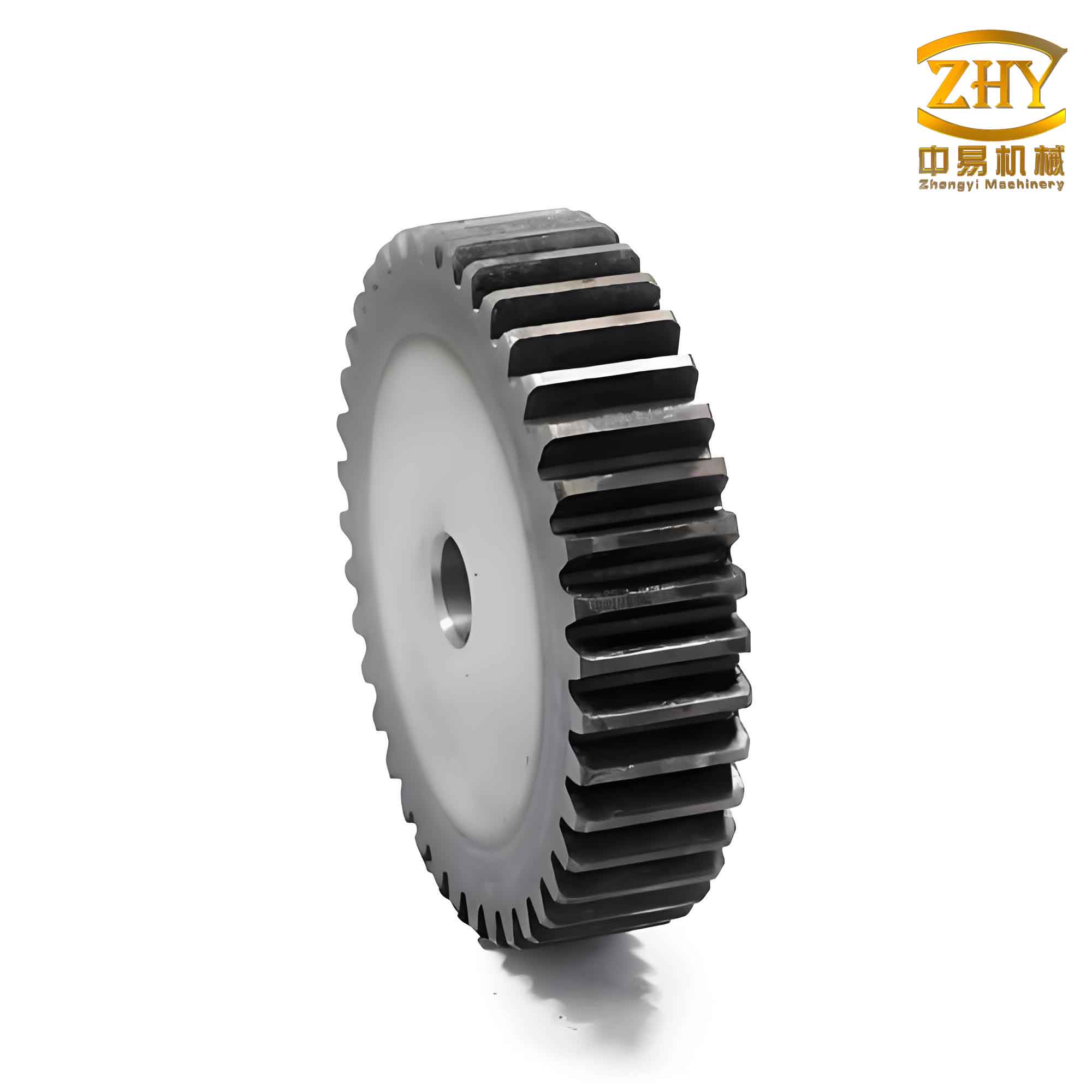
The physical model for a spur and pinion gear pair considers four degrees of freedom: the rotational displacements of the pinion (driver) and gear (driven), denoted by $\theta_p$ and $\theta_g$, and their transverse translations perpendicular to the line of centers, denoted by $y_p$ and $y_g$. The system includes the masses $m_p$, $m_g$, moments of inertia $I_p$, $I_g$, base circle radii $R_p$, $R_g$, and the supporting stiffness and damping coefficients $k_{py}, k_{gy}, c_{py}, c_{gy}$ for the transverse motions. The meshing action is modeled by a spring-damper element along the line of action, with time-varying stiffness $k_m(t)$ and constant damping $c_m$. The static transmission error is $e(t)$. The governing equations of motion derived from Newton’s second law are:
$$
\begin{aligned}
m_p \ddot{y}_p + c_{py} \dot{y}_p + k_{py} y_p &= -F_k – F_c \\
I_p \ddot{\theta}_p &= -F_k R_p – F_c R_p – T_p(t) \\
m_g \ddot{y}_g + c_{gy} \dot{y}_g + k_{gy} y_g &= F_k + F_c \\
I_g \ddot{\theta}_g &= -F_k R_g – F_c R_g – T_g(t)
\end{aligned}
$$
Here, $F_k$ and $F_c$ represent the elastic and viscous meshing forces, respectively:
$$
\begin{aligned}
F_k &= k_m(t) (y_p + R_p \theta_p – y_g – R_g \theta_g – e(t)) \\
F_c &= c_m (\dot{y}_p + R_p \dot{\theta}_p – \dot{y}_g – R_g \dot{\theta}_g – \dot{e}(t))
\end{aligned}
$$
The time-varying mesh stiffness $k_m(t)$ is periodic with the meshing period $T$ (angular frequency $\Omega = 2\pi/T$). It is approximated as a rectangular wave fluctuating between maximum ($k_{max}$) and minimum ($k_{min}$) values. This can be expanded into a Fourier cosine series:
$$
k_m(t) = k_0 + \sum_{n=1}^{\infty} A_n \cos(n \Omega t)
$$
where $k_0 = (k_{max} + k_{min})/2$ is the average stiffness. For analysis, often the first few harmonics are retained. The transmission error is typically modeled as a sinusoidal excitation: $e(t) = e_r \sin(\Omega t + \phi)$. The nonlinear input torque, relevant for applications like wind turbines, takes the form $T_p \propto \dot{\theta}_p^2$.
To facilitate analysis, the equations are non-dimensionalized. Introducing a characteristic frequency $\omega_1$ (e.g., the first natural frequency of the uncoupled system) and a characteristic displacement $e_r$, we define non-dimensional time $\tau = \omega_1 t$ and displacements $\eta_i = y_i / e_r$. The resulting matrix equation is:
$$
\mathbf{M}\ddot{\boldsymbol{\eta}} + \mathbf{C}\dot{\boldsymbol{\eta}} + (\mathbf{K} + \Delta\mathbf{K}(\tau))\boldsymbol{\eta} = \mathbf{F}(\tau)
$$
where $\mathbf{M}$ is the mass matrix, $\mathbf{C}$ is the damping matrix, $\mathbf{K}$ is the constant stiffness matrix from $k_0$, $\Delta\mathbf{K}(\tau)$ is the periodically varying stiffness matrix from the Fourier series terms, and $\mathbf{F}(\tau)$ contains excitations from transmission error and nonlinear torques.
The core of the parametric instability analysis lies in the homogeneous form of this equation, which describes the system’s inherent stability. Negforcing damping, nonlinear terms, and external forcing for the stability study, we have:
$$
\mathbf{M}\ddot{\boldsymbol{\eta}} + (\mathbf{K} + \Delta\mathbf{K}(\tau))\boldsymbol{\eta} = \mathbf{0}
$$
This is a set of linear differential equations with periodic coefficients, known as Hill’s equations. To analyze it, we first decouple the constant part. Solving the eigenvalue problem $(\mathbf{K} – \omega_i^2 \mathbf{M})\boldsymbol{\zeta}_i = \mathbf{0}$ yields the system’s natural frequencies $\omega_i$ and mode shapes $\boldsymbol{\zeta}_i$ ($i=1,2,3,4$ for our 4-DOF model). These mode shapes are normalized to obtain the orthonormal modal matrix $\boldsymbol{\Phi} = [\tilde{\boldsymbol{\zeta}}_1, \tilde{\boldsymbol{\zeta}}_2, \tilde{\boldsymbol{\zeta}}_3, \tilde{\boldsymbol{\zeta}}_4]$. Applying the transformation $\boldsymbol{\eta} = \boldsymbol{\Phi} \mathbf{x}$, where $\mathbf{x} = [x_1, x_2, x_3, x_4]^T$ are the modal coordinates, and pre-multiplying by $\boldsymbol{\Phi}^T$, we obtain the modal equations:
$$
\ddot{\mathbf{x}} + \boldsymbol{\Lambda} \mathbf{x} + \boldsymbol{\Phi}^T\Delta\mathbf{K}(\tau)\boldsymbol{\Phi} \mathbf{x} = \mathbf{0}
$$
where $\boldsymbol{\Lambda} = \text{diag}(\omega_1^2, \omega_2^2, \omega_3^2, \omega_4^2)$. Retaining the first harmonic ($n=1$) of the time-varying stiffness for illustration, the equation becomes:
$$
\ddot{x}_i + \omega_i^2 x_i + \epsilon \sum_{r=1}^{4} H_{ir} \cos(\Omega \tau) x_r = 0, \quad i=1,\ldots,4
$$
Here, $\epsilon H_{ir}$ are the elements of the parametric excitation matrix in modal coordinates, and $\epsilon$ is a small bookkeeping parameter signifying weak modulation.
We employ the method of multiple scales to seek approximate solutions and determine the conditions for parametric resonance. We introduce two time scales: $T_0 = \tau$ (fast) and $T_1 = \epsilon \tau$ (slow). The solution is assumed as $x_i(\tau) = x_{i0}(T_0, T_1) + \epsilon x_{i1}(T_0, T_1) + \cdots$. Substituting into the modal equations and separating orders of $\epsilon$ yields a sequence of equations. The solvability conditions for the first-order equations lead to the elimination of secular terms, which grow unbounded in time. Instability, or parametric resonance, occurs when these terms cannot be eliminated.
Parametric resonance is particularly strong when the excitation frequency $\Omega$ approaches certain combinations of the natural frequencies. For a system with multiple degrees of freedom like our spur and pinion gear model, combination resonances are possible. The critical resonance conditions are of the “sum” and “difference” types:
Sum-type (Combination) Resonance: $\quad \Omega \approx \omega_i + \omega_j$
Difference-type (Combination) Resonance: $\quad \Omega \approx |\omega_i – \omega_j|$
Principal Parametric Resonance: $\quad \Omega \approx 2\omega_i / l$, where $l=1,2,\ldots$
For the sum-type resonance condition $\Omega = \omega_i + \omega_j + \epsilon \sigma$, where $\sigma$ is a detuning parameter, the analysis yields a set of equations for the complex amplitudes $A_i$ and $A_j$ in the form:
$$
\begin{aligned}
2j\omega_i \frac{dA_i}{dT_1} + \bar{H}_{ij} A_j e^{j\sigma T_1} &= 0 \\
2j\omega_j \frac{dA_j}{dT_1} + \bar{H}_{ji} A_i e^{j\sigma T_1} &= 0
\end{aligned}
$$
where $\bar{H}_{ij}$ are constants derived from the modal projection of the stiffness variation. Seeking solutions proportional to $e^{\lambda T_1}$ leads to a characteristic equation. The condition for unbounded growth (instability) is that $\lambda$ has a positive real part. This occurs when:
$$
|\sigma| < \frac{\sqrt{\bar{H}_{ij}\bar{H}_{ji}}}{2\sqrt{\omega_i \omega_j}}
$$
This inequality defines an instability region in the parameter plane of excitation frequency $\Omega$ (via $\sigma$) and modulation amplitude. The system exhibits unbounded response within this “instability tongue”. Conversely, for the difference-type resonance $\Omega = |\omega_i – \omega_j| + \epsilon \sigma$, a similar analysis shows that the instability condition is $|\sigma| < \frac{\sqrt{-\bar{H}_{ij}\bar{H}_{ji}}}{2\sqrt{\omega_i \omega_j}}$. Since $\bar{H}_{ij}\bar{H}_{ji}$ is often positive for gear systems, the difference-type resonance is usually stable. The stability boundaries for principal parametric resonance ($\Omega \approx 2\omega_i$) and subharmonic resonance ($\Omega \approx \omega_i$) can be derived analogously.
The specific stability boundaries depend on the system parameters. For a typical spur and pinion gear system, the natural frequencies and the coupling coefficients $\bar{H}_{ij}$ can be calculated. The table below shows an example set of calculated parameters.
| Natural Frequency $\omega_i$ (Hz) | $\bar{H}_{i1}$ | $\bar{H}_{i2}$ | $\bar{H}_{i3}$ | $\bar{H}_{i4}$ |
|---|---|---|---|---|
| $\omega_1 = 0.1533$ | 0.0140 | 0.6676 | 0.4785 | -0.8665 |
| $\omega_2 = 1.1871$ | 0.0111 | 1.0675 | 1.1462 | 0.0200 |
| $\omega_3 = 1.2892$ | 0.0068 | 0.9719 | 1.2653 | 1.4223 |
| $\omega_4 = 2.4651$ | -0.0033 | 0.0045 | 0.3888 | 3.6047 |
From this data, we observe that products like $\bar{H}_{12}\bar{H}_{21}$ and $\bar{H}_{34}\bar{H}_{43}$ are positive, indicating that sum-type resonances (e.g., $\Omega \approx \omega_1+\omega_2$, $\Omega \approx \omega_3+\omega_4$) are potential instability regions. The instability boundaries in the ($\Omega$, $\epsilon$) plane form characteristic V-shaped regions emanating from the critical frequency ratios.
To verify the analytical predictions and explore the nonlinear steady-state response, we perform numerical simulations on the full nonlinear system (including damping, transmission error forcing, and quadratic torque nonlinearity) using a Runge-Kutta method. We examine responses for meshing frequencies $\Omega$ chosen from stable and unstable regions identified by the perturbation analysis.
When $\Omega$ is in a stable region (e.g., away from combination frequencies like $\omega_i+\omega_j$), the system’s steady-state response is a bounded, quasi-periodic motion. The time history exhibits a beating pattern, the phase portrait shows a torus-like structure, and the power spectrum reveals discrete frequency components including the meshing frequency $\Omega$, the system’s natural frequencies $\omega_i$, and combination tones like $\Omega \pm \omega_i$. This is a non-parametric forced response dominated by the transmission error excitation, but modulated by the system’s internal dynamics.
In contrast, when the meshing frequency $\Omega$ is tuned into an analytically predicted unstable region (e.g., near $\omega_2+\omega_3$), the response demonstrates parametric instability. Even in the presence of damping, the amplitude of vibration grows exponentially from a small initial condition, leading to an unbounded response in the linearized model. In a real nonlinear system with factors like backlash, this growth would saturate into large-amplitude limit cycle oscillations or chaotic motion, potentially leading to severe noise, accelerated wear, or tooth impact. The figure below summarizes this critical distinction in system behavior based on the operational frequency.
| Condition | Meshing Frequency $\Omega$ Relation | Dynamic Response Type | Key Features |
|---|---|---|---|
| Non-Parametric Region | $\Omega$ not near $2\omega_i$, $\omega_i \pm \omega_j$ | Bounded, Quasi-Periodic | Forced vibration. Spectrum contains $\Omega$, $\omega_i$, $\Omega \pm \omega_i$. Beating phenomenon. |
| Parametric Instability Region | $\Omega \approx \omega_i + \omega_j$ (Sum-type) | Unbounded Growth / Large-Amplitude Limit Cycle | Exponential amplitude growth from small disturbances. Critical condition for design avoidance. |
| Stable Parametric Region | $\Omega \approx |\omega_i – \omega_j|$ (Difference-type) | Bounded, Periodic/Quasi-Periodic | Stable periodic solution exists despite parametric excitation. |
The implications for the design and operation of spur and pinion gear drives are significant. The primary practical guideline is to avoid operating the gear mesh at speeds where the meshing frequency $\Omega$ coincides with or is close to the sum of any two natural frequencies of the coupled rotor-bearing-gear housing system. This requires a thorough modal analysis during the design phase. Strategies to widen stable operating regions include increasing system damping (e.g., via specialized gear coatings or housing dampers) and minimizing the amplitude of stiffness variation $\epsilon$ (e.g., through profile modifications like tip relief to smooth the transition between single and double tooth contact). Furthermore, the presence of nonlinearities like backlash, while often a source of complication, can sometimes limit the unbounded growth predicted by linear instability analysis, leading to complex but bounded nonlinear phenomena that must also be assessed.
In conclusion, the dynamics of a spur and pinion gear system are fundamentally parametric due to the time-varying mesh stiffness. A multi-degree-of-freedom model capturing the coupling between rotational and translational motions is essential for accurate stability assessment. The method of multiple scales provides a powerful analytical tool to delineate the instability boundaries, revealing that sum-type combination resonances ($\Omega \approx \omega_i + \omega_j$) are particularly hazardous. Numerical simulations confirm that operation within these instability tongues leads to drastically amplified vibrations. Therefore, a key objective in the design of reliable spur and pinion gear transmissions is to carefully tune the system’s natural frequencies and operational speeds to ensure the meshing frequency remains within the stable zones, thereby suppressing parametric resonance and ensuring smooth, durable operation. Future work may extend this analysis to include more detailed nonlinearities such as tooth contact loss, friction, and the effects of distributed flexibility across the gear body, providing an even more comprehensive understanding of spur and pinion gear dynamics.