
In my exploration of mechanical design and simulation, I have focused on the development of precise three-dimensional models for spur and pinion gears, which are fundamental components in power transmission systems. The ability to create accurate digital representations of these gears is crucial for engineering applications such as finite element analysis, virtual assembly, and computer-aided manufacturing. This article details my approach to parametric modeling of spur and pinion gears using Pro/E (now Creo) and the dynamic simulation of their generation process via MATLAB. By leveraging parameter-driven design, I aim to provide a flexible methodology that can adapt to various gear specifications, enhancing efficiency in design and production cycles. The integration of these tools not only streamlines the modeling process but also offers insights into the manufacturing dynamics, ultimately contributing to advancements in CAD/CAPP/CAM integration.
Spur and pinion gears are widely used in machinery due to their simplicity and efficiency in transmitting motion between parallel shafts. My work emphasizes the parametric modeling of these gears, where key dimensions are defined as variables, allowing for rapid modifications and customization. This approach is particularly valuable in industries where gear designs must be tailored to specific load conditions or space constraints. In the following sections, I will elaborate on the theoretical foundations, the step-by-step modeling process in Pro/E, and the simulation of gear generation using MATLAB. Throughout this discussion, I will repeatedly reference spur and pinion gears to underscore their significance in mechanical systems.
| Parameter | Symbol | Value or Expression |
|---|---|---|
| Number of Teeth | z | 30 |
| Module | m | 2.5 mm |
| Face Width | B | 20 mm |
| Pressure Angle | α | 20° |
| Addendum Coefficient | hax | 1 |
| Dedendum Coefficient | cx | 0.25 |
| Addendum Height | ha | $$ha = (hax + x) \cdot m$$ |
| Dedendum Height | hf | $$hf = (hax + cx – x) \cdot m$$ |
| Whole Depth | ht | $$ht = ha + hf$$ |
| Pitch Diameter | d | $$d = m \cdot z$$ |
| Tip Diameter | da | $$da = d + 2 \cdot ha$$ |
| Base Diameter | db | $$db = d \cdot \cos(\alpha)$$ |
| Root Diameter | df | $$df = d – 2 \cdot hf$$ |
The parametric design of spur and pinion gears begins with defining these fundamental parameters. In my workflow, I utilize Pro/E’s parameter and relation tools to establish mathematical relationships between variables. For instance, the pitch diameter is derived from the module and number of teeth, while the base diameter depends on the pressure angle. This parametric framework ensures that any change in input variables automatically updates all dependent dimensions, facilitating rapid prototyping and design iteration. Such capabilities are essential when designing custom spur and pinion gears for specific applications, as they reduce manual recalculation errors and save time.
To create the gear profile, I start by constructing the base circles, pitch circles, tip circles, and root circles. These circles serve as the foundation for generating the involute curve, which defines the tooth flank. In Pro/E, I sketch these circles on the FRONT plane and assign dimensions through relations. For example, the diameter of the pitch circle is set to d, as defined in the parameter table. This step ensures that the geometry is driven by the parametric equations, maintaining consistency throughout the model. The involute curve is then generated using a parametric equation based on the base circle radius. The equation is expressed as follows:
$$ \begin{aligned} \text{ang} &= 90 \cdot t \\ r &= \frac{db}{2} \\ s &= \frac{\pi \cdot r \cdot t}{2} \\ x_c &= r \cdot \cos(\text{ang}) \\ y_c &= r \cdot \sin(\text{ang}) \\ x &= x_c + s \cdot \sin(\text{ang}) \\ y &= y_c – s \cdot \cos(\text{ang}) \\ z &= 0 \end{aligned} $$
Here, t is a parameter ranging from 0 to 1, and the equations describe the locus of a point on a straight line rolling without slipping on the base circle. This involute curve is critical for accurate tooth geometry, as it ensures proper meshing in spur and pinion gear pairs. After creating the curve, I mirror it across a plane rotated by an angle derived from the number of teeth to form a symmetric tooth profile. The rotation angle is given by:
$$ \theta = \frac{360}{4 \cdot z} $$
This step highlights the parametric nature of the modeling process, where geometric features are dynamically linked to input variables. Once the tooth profile is defined, I extrude it along the face width B to create a single tooth. The extrusion depth is controlled by the parameter B, ensuring that changes in gear width are automatically reflected. Subsequently, I replicate the tooth around the gear axis using pattern features, with the number of instances equal to z. This completes the full set of teeth for the spur and pinion gear model. The entire process is summarized in the table below, outlining key steps and their parametric dependencies.
| Modeling Step | Pro/E Feature | Parametric Relation |
|---|---|---|
| Parameter Input | Tools > Parameters | Define z, m, B, α, hax, cx |
| Basic Circles | Sketch on FRONT plane | Diameters linked to d, da, db, df |
| Involute Curve | Insert > Model Datum > Curve > From Equation | Equation based on db and t |
| Tooth Profile | Sketch using projected curves | Profile derived from involute and circles |
| Tooth Extrusion | Extrude tool | Depth set to B |
| Gear Completion | Pattern feature | Number of patterns = z |
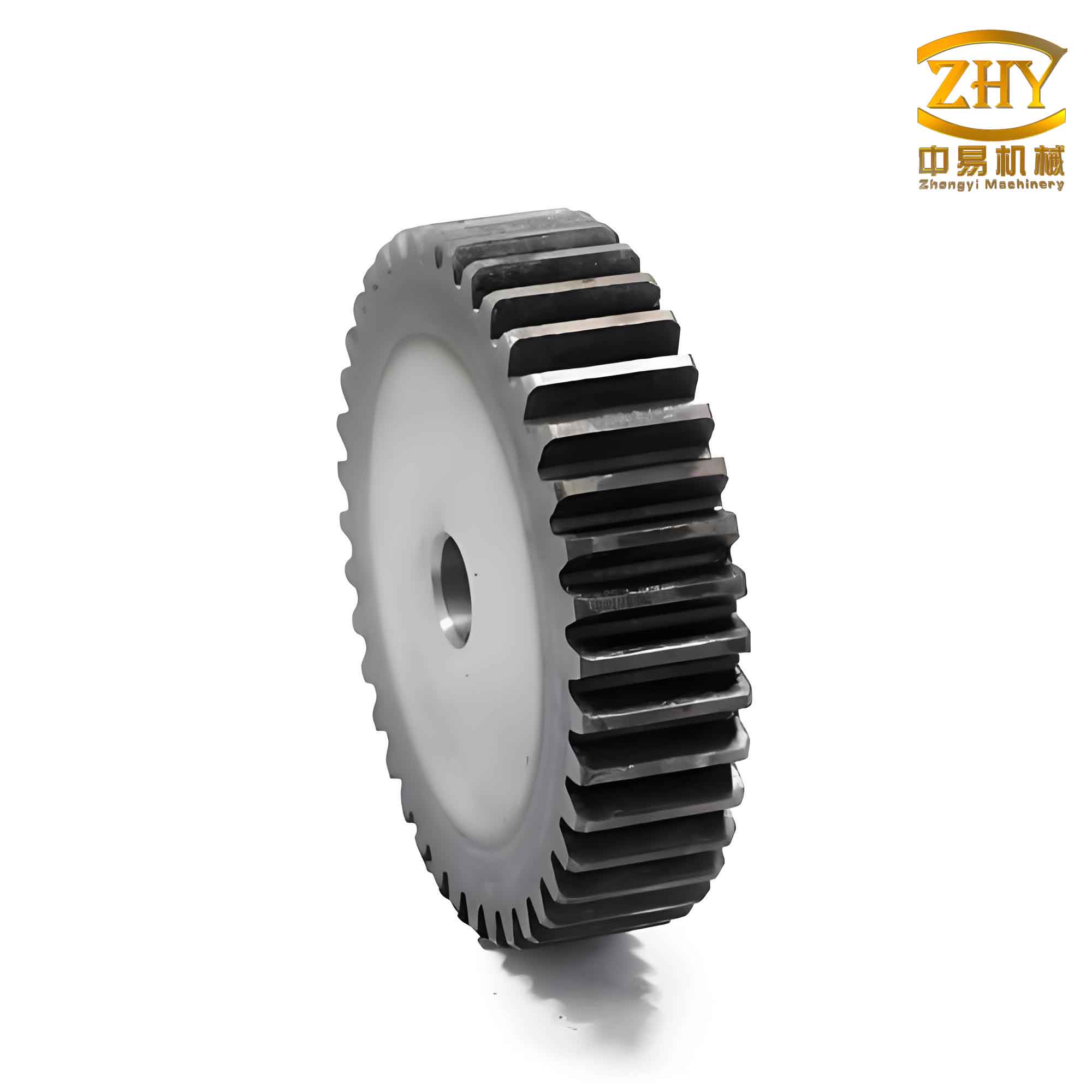
The resulting three-dimensional model of a spur and pinion gear is a precise digital twin that can be used for further analysis. For visualization purposes, I include an image that illustrates the gear geometry, which is essential for understanding the tooth form and overall structure. This image serves as a reference for the parametric modeling outcomes, showing the intricate details of the gear teeth generated through the described process.
Beyond modeling, I have simulated the generation process of spur and pinion gears using MATLAB. Generation machining, such as hobbing or shaping, involves the relative motion between a cutting tool (e.g., a rack or another gear) and the gear blank. This process is based on the principle of enveloping, where the tool’s profile sweeps out the desired gear tooth shape. In my simulation, I treat the tool as a rack and the gear blank as a rotating disk, mimicking the kinematics of gear hobbing. The dynamic simulation allows me to observe how the tooth profile evolves over time, providing insights into manufacturing accuracy and potential issues like undercutting. The mathematical basis for this simulation involves coordinate transformations and envelope theory, which can be expressed through the following equations:
$$ \begin{aligned} x’ &= x \cdot \cos(\phi) – y \cdot \sin(\phi) + r \cdot \phi \\ y’ &= x \cdot \sin(\phi) + y \cdot \cos(\phi) + r \end{aligned} $$
Here, (x, y) are coordinates of the tool profile, φ is the rotation angle of the gear blank, and r is the pitch radius. This equation describes the relative motion between the tool and blank, generating the envelope that forms the gear teeth. By iterating over φ, I can animate the process, showing the gradual formation of each tooth on the spur and pinion gear. This simulation not only validates the parametric model but also aids in optimizing machining parameters for real-world production. The table below compares generation machining with form cutting, highlighting the advantages of the former for spur and pinion gears.
| Aspect | Generation Machining | Form Cutting |
|---|---|---|
| Principle | Tool and blank simulate meshing | Tool shape matches tooth space |
| Accuracy | High (ideal involute profile) | Lower (dependent on tool accuracy) |
| Common Methods | Hobbing, shaping, shaving | Milling, broaching |
| Application | Precision spur and pinion gears | Low-volume or rough gears |
In my simulation, I implemented these equations in MATLAB to create a dynamic visualization. The program plots the tool position at incremental steps, overlaying the generated tooth profiles to show the complete formation. This approach clearly demonstrates how the involute shape emerges from the rolling motion, reinforcing the theoretical foundations of gear design. Such simulations are invaluable for educating engineers on manufacturing processes and for troubleshooting in industrial settings. Moreover, by adjusting parameters like module or pressure angle, I can simulate the generation of different spur and pinion gear configurations, showcasing the versatility of parametric design.
The integration of Pro/E and MATLAB in my workflow underscores the synergy between CAD and simulation tools. The parametric model from Pro/E provides the geometric data needed for the simulation, while MATLAB handles the kinematic analysis. This combination enables a comprehensive study of spur and pinion gears from design to production. For instance, I can export the gear profile coordinates from Pro/E and import them into MATLAB to verify the generation process. Additionally, the simulation can be extended to study effects like tooth root stresses or noise generation, further enhancing the design optimization. The equations governing these analyses often involve gear mesh stiffness and dynamic loads, which can be expressed as:
$$ K_m = \frac{E \cdot B}{1 – \nu^2} \cdot \int_{0}^{L} \frac{dx}{h(x)^3} $$
Where Km is the mesh stiffness, E is Young’s modulus, ν is Poisson’s ratio, B is face width, L is the contact length, and h(x) is the tooth thickness variation along the profile. Such advanced analyses benefit from the accurate models created through parametric design, highlighting the practical value of my approach.
In conclusion, my work on parametric modeling and generation simulation of spur and pinion gears demonstrates the power of modern engineering software. By using Pro/E for parameter-driven design, I can quickly create accurate 3D models that adapt to changing requirements. The MATLAB simulation then provides a dynamic view of the manufacturing process, enhancing understanding and enabling optimization. These methodologies not only reduce design time but also improve product quality, making them essential for industries relying on precision gear systems. The repeated focus on spur and pinion gears throughout this article emphasizes their ubiquity and importance in mechanical transmissions. Future directions may include incorporating these models into virtual reality environments for immersive training or linking them to IoT platforms for real-time monitoring in smart factories. Overall, the fusion of parametric modeling and dynamic simulation represents a significant step forward in the digital transformation of gear design and manufacturing.
To further elaborate, the parametric approach allows for seamless scalability. For example, if I need to design a spur and pinion gear pair for a high-torque application, I can simply adjust the module or face width in the parameter table, and the entire model updates accordingly. This flexibility is crucial in custom gear production, where each set of spur and pinion gears may have unique specifications. Moreover, the simulation of generation machining helps identify potential issues such as interference or excessive wear early in the design phase, reducing costly prototypes. In educational contexts, these tools can be used to teach students about gear geometry and manufacturing principles, fostering a deeper appreciation for mechanical engineering fundamentals.
Throughout this article, I have emphasized the iterative nature of design and simulation. By continuously refining the parametric relationships and simulation algorithms, I can achieve higher accuracy and efficiency. The use of tables and formulas, as shown, consolidates key information, making it accessible for practitioners. As technology evolves, methods like direct modeling in Creo or cloud-based simulations may further enhance the workflow for spur and pinion gear development. Nonetheless, the core principles of parametric design and generation simulation will remain foundational, driving innovation in gear technology for years to come.