
The transmission of motion and power through geared systems is foundational to modern machinery. Among these, the spur and pinion gear pair, characterized by its simplicity and efficiency, remains ubiquitous. However, the dynamic behavior of these systems is far from simple, governed by intrinsic nonlinearities that critically influence performance, reliability, and longevity. This article delves into the nonlinear dynamic characteristics of spur and pinion gear pairs, focusing on the interplay between time-varying mesh stiffness, backlash, and internal parametric excitations. We will construct a detailed dynamic model, perform extensive numerical simulations, and analyze the resulting complex behaviors, including periodic, multi-periodic, and chaotic motions, as well as their corresponding gear impact states.
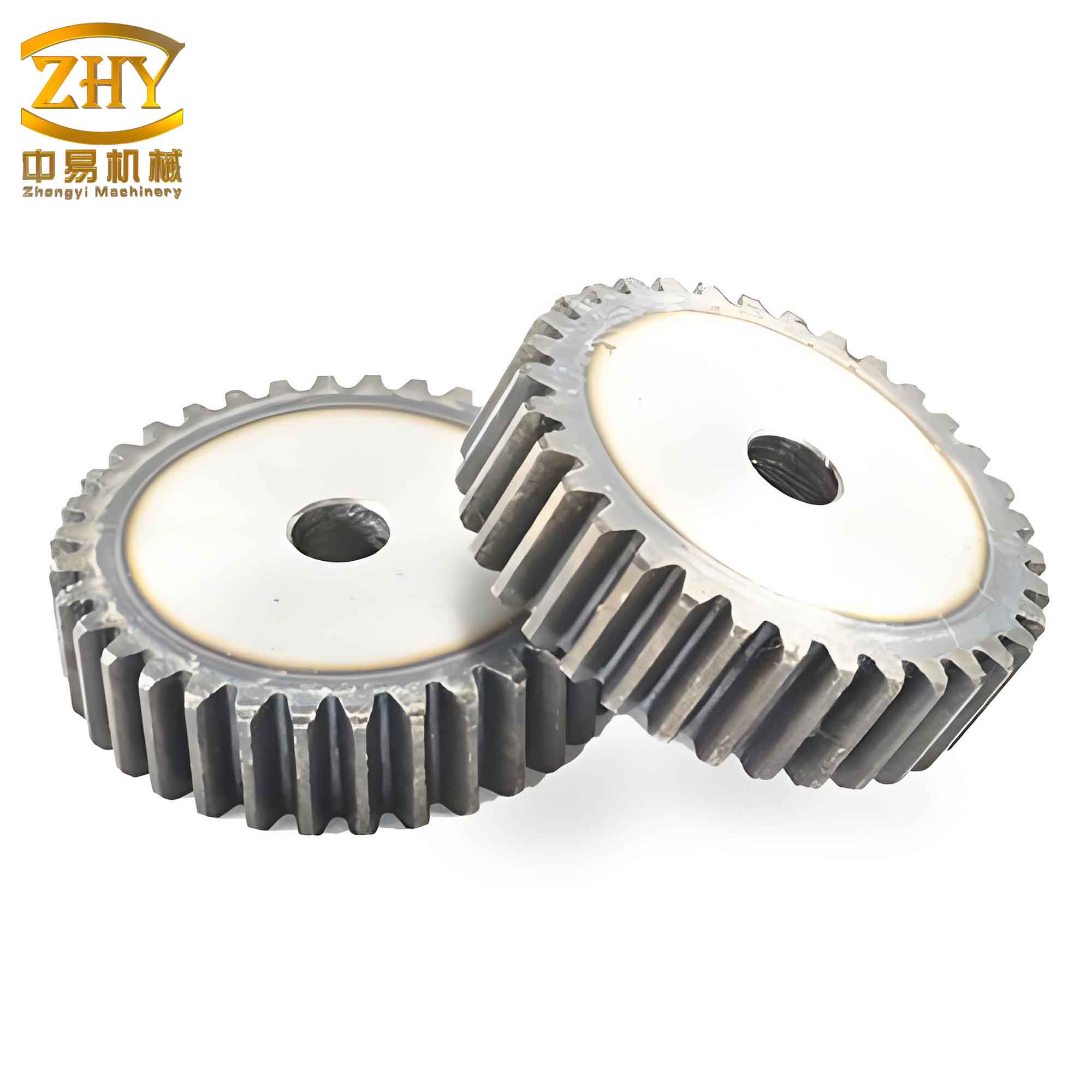
1. Dynamic Modeling of a Spur and Pinion Gear Pair
The dynamic analysis begins with an accurate mechanical model. We consider a single-stage spur and pinion gear transmission. Key assumptions are made to focus on the torsional vibrations induced by mesh compliance: the supporting shafts and bearings are assumed to be sufficiently rigid, and any clearances other than the gear tooth backlash are neglected. The purely torsional dynamic model is illustrated schematically below.
The system parameters are defined as follows for the driving (pinion) and driven (gear) gears: masses \( m_1, m_2 \); moments of inertia \( I_1, I_2 \); base circle radii \( r_{b1}, r_{b2} \); applied torques \( T_1, T_2 \); and angular displacements \( \theta_1, \theta_2 \). The gear mesh is characterized by a time-varying stiffness \( k_h(t) \), a linear damping coefficient \( c_h \), a total static backlash \( 2b_h \), and a static transmission error excitation \( e(t) \).
The dynamic transmission error along the line of action, denoted \( x(t) \), is the primary coordinate of interest. It represents the relative displacement of the gear teeth from their nominal kinematic position, accounting for deflections and errors:
$$ x(t) = r_{b1}\theta_1 – r_{b2}\theta_2 – e(t). $$
The static transmission error \( e(t) \), a primary source of internal excitation, is modeled as a sinusoidal function of the mesh frequency:
$$ e(t) = e_a \sin(\omega_e t + \psi), $$
where \( e_a \) is the amplitude, \( \omega_e = \omega / Z \) is the mesh frequency (\( \omega \) being the pinion speed and \( Z \) the pinion tooth number), and \( \psi \) is the initial phase, often set to zero for analysis.
The presence of backlash \( b_h \) introduces a piecewise-linear nonlinearity. Defining the dynamic mesh displacement function \( f(x(t)) \), which relates the dynamic transmission error to the actual elastic force, yields:
$$ f(x(t)) = \begin{cases}
x(t) – b_h, & x(t) > b_h \\
0, & -b_h \le x(t) \le b_h \\
x(t) + b_h, & x(t) < -b_h
\end{cases}. $$
Applying Lagrange’s equations to the two-degree-of-freedom torsional system results in the following equations of motion:
$$ \begin{aligned}
I_1 \ddot{\theta}_1 + r_{b1} c_h \dot{f}(x(t)) + r_{b1} k_h(t) f(x(t)) &= T_1(t), \\
I_2 \ddot{\theta}_2 – r_{b2} c_h \dot{f}(x(t)) – r_{b2} k_h(t) f(x(t)) &= -T_2(t).
\end{aligned} $$
The applied torques consist of a mean component and a fluctuating component: \( T_i(t) = T_{im} + T_{ia}(t) \). To isolate the effects of internal nonlinearities and parametric excitation from external load fluctuations, we set the fluctuating torque components \( T_{ia}(t) \) to zero, retaining only the mean load \( T_m \), where \( T_{1m}/r_{b1} = T_{2m}/r_{b2} = F_m \).
These two equations can be combined into a single equation governing the dynamic transmission error \( x(t) \). Defining an equivalent mass \( m_e = 1 / (r_{b1}^2/I_1 + r_{b2}^2/I_2) \) simplifies the system to:
$$ m_e \ddot{x} + c_h \dot{x} + k_h(t) f(x) = F_m – m_e \ddot{e}(t). $$
To generalize the analysis, we non-dimensionalize the equation using the backlash \( b_h \) as the characteristic length and the natural frequency associated with the average mesh stiffness \( k_m \), i.e., \( \omega_n = \sqrt{k_m / m_e} \). Defining non-dimensional time \( \tau = \omega_n t \) and non-dimensional displacement \( X = x / b_h \), we obtain:
$$ \ddot{X} + 2\zeta \dot{X} + \kappa(\tau) F(X) = \bar{F}_m + \bar{F}_a \Omega^2 \sin(\Omega \tau + \phi). $$
The corresponding non-dimensional parameters and functions are:
- Non-dimensional displacement: \( X = x/b_h \)
- Non-dimensional time: \( \tau = \omega_n t \)
- Non-dimensional mesh frequency: \( \Omega = \omega_e / \omega_n \)
- Non-dimensional backlash function: \( F(X) = f(x)/b_h = \begin{cases} X-1, & X>1 \\ 0, & -1 \le X \le 1 \\ X+1, & X<-1 \end{cases} \)
- Non-dimensional time-varying stiffness: \( \kappa(\tau) = k_h(t)/k_m \)
- Non-dimensional mean load: \( \bar{F}_m = F_m / (b_h k_m) \)
- Non-dimensional error amplitude: \( \bar{F}_a = e_a / b_h \)
- Damping ratio: \( \zeta = c_h / (2 m_e \omega_n) \)
This non-dimensional form, Equation (6), is the fundamental equation for our nonlinear dynamic analysis of the spur and pinion gear pair. The nonlinearity is encapsulated in the piecewise-linear function \( F(X) \), while the parametric excitation arises from \( \kappa(\tau) \).
2. Modeling Time-Varying Mesh Stiffness in Spur and Pinion Gears
The time-varying mesh stiffness \( k_h(t) \) is a critical internal excitation mechanism in spur and pinion gear dynamics. It originates from the periodic change in the number of tooth pairs in contact as the gears rotate, governed by the contact ratio \( \epsilon \). Accurate representation of this stiffness is essential. Rather than approximating it with a simple sinusoidal function, a more precise model accounts for the discrete jumps in stiffness at the boundaries of single and double-tooth contact zones.
The mesh stiffness can be numerically calculated by considering the elastic deformations of the gear teeth, including bending, shear, foundation deflection, and contact deformation. For a given gear pair with specific geometry (number of teeth \( Z_1, Z_2 \), pressure angle, module), the stiffness variation over one mesh cycle resembles a rectangular wave. The average stiffness over the cycle is \( k_m \). During double-tooth contact, the stiffness is higher, \( k_m + k_a \), and during single-tooth contact, it is lower, \( k_m – k_b \).
Let \( T \) be the mesh period. The stiffness variation can be modeled as a piecewise-constant function:
$$ k_h(t) = \begin{cases}
k_m + k_a, & 0 \le t < (\epsilon – 1)T \\
k_m – k_b, & (\epsilon – 1)T \le t < T
\end{cases}. $$
In non-dimensional form, with \( \kappa(\tau) = k_h(t)/k_m \) and noting the non-dimensional mesh period is 1, this becomes:
$$ \kappa(\tau) = \begin{cases}
1 + a, & 0 \le \tau < \epsilon – 1 \\
1 – b, & \epsilon – 1 \le \tau < 1
\end{cases}, $$
where \( a = k_a/k_m \) and \( b = k_b/k_m \). The parameters \( a \) and \( b \) depend on the gear geometry and contact ratio. For a typical spur and pinion gear pair with a contact ratio of \( \epsilon = 1.68 \), representative values might be \( a \approx 0.116 \) and \( b \approx 0.414 \). This rectangular wave model more accurately captures the harmonic content of the stiffness excitation compared to a single-term harmonic approximation.
For numerical simulation, we define the state variables as \( x_1 = X \) and \( x_2 = \dot{X} \). Substituting the expressions for \( F(X) \) and \( \kappa(\tau) \) into the governing equation yields the first-order state-space equations:
$$ \begin{cases}
\dot{x}_1 = x_2, \\
\dot{x}_2 = \bar{F}_m + \bar{F}_a \Omega^2 \sin(\Omega \tau + \phi) – \kappa(\tau) F(x_1) – 2\zeta x_2.
\end{cases} $$
This system is a non-autonomous, piecewise-smooth, nonlinear dynamical system. Its response depends on the key parameters: non-dimensional mesh frequency \( \Omega \), damping ratio \( \zeta \), mean load \( \bar{F}_m \), error amplitude \( \bar{F}_a \), and the stiffness parameters \( a, b, \epsilon \).
| Parameter | Symbol | Nominal Value | Description |
|---|---|---|---|
| Mean Load | \( \bar{F}_m \) | 0.1 | Non-dimensional mean force on the mesh |
| Error Amplitude | \( \bar{F}_a \) | 0.2 | Non-dimensional amplitude of transmission error |
| Contact Ratio | \( \epsilon \) | 1.68 | Average number of tooth pairs in contact |
| Stiffness Parameter | \( a \) | 0.116 | Relative increase in stiffness during double contact |
| Stiffness Parameter | \( b \) | 0.414 | Relative decrease in stiffness during single contact |
| Error Phase | \( \phi \) | 0 | Phase angle of the transmission error excitation |
3. Numerical Simulation Methodology
The state equations for the spur and pinion gear system are solved numerically due to their strong nonlinearity and piecewise nature. A variable-step 4th-5th order Runge-Kutta integration method (such as MATLAB’s ode45) is employed for its accuracy and efficiency in handling stiff and non-smooth problems. Transients are eliminated by discarding a sufficiently long initial time history, and the steady-state response is analyzed.
To investigate the long-term dynamic behavior, we utilize tools from nonlinear dynamics:
- Phase Portraits: Plots of velocity \( x_2 \) versus displacement \( x_1 \) reveal the trajectory of the system in the state space.
- Poincaré Maps: A powerful technique for reducing continuous flow to a discrete map. For a system with periodic forcing of period \( T_h = 2\pi/\Omega \), the Poincaré section is defined by sampling the state \( (x_1, x_2) \) at integer multiples of the forcing period: \( \Sigma = \{ (x_1, x_2, \theta) | \theta = \text{mod}(\tau, T_h) = 0 \} \). A fixed point indicates period-1 motion, n discrete points indicate period-n motion, and a complex, fractal set of points suggests chaotic motion.
- FFT Spectra: The Fast Fourier Transform of the time-domain response \( x_1(\tau) \) shows the frequency content. Periodic motion yields discrete peaks at the fundamental frequency and its harmonics. Quasi-periodic motion shows incommensurate frequency peaks, while chaotic motion exhibits a broadband, continuous spectrum.
- Bifurcation Diagrams: These are essential for understanding how the system’s qualitative behavior changes with a control parameter (e.g., \( \Omega \) or \( \zeta \)). The diagram is constructed by plotting a Poincaré section variable (typically \( x_1 \)) against the varying parameter. Sudden changes in the pattern of points indicate bifurcations.
We will analyze the system’s response under two primary parametric variations: 1) changing the non-dimensional mesh frequency \( \Omega \) (internal excitation frequency), and 2) changing the damping ratio \( \zeta \). The nominal system parameters are as listed in Table 1, with initial conditions typically set to zero unless specified otherwise for impact state analysis.
4. Dynamic Response Analysis: Bifurcations and Chaos
4.1 Variation with Mesh Frequency (\( \Omega \))
Setting the damping ratio \( \zeta = 0.02 \), we vary the non-dimensional mesh frequency \( \Omega \) in the range [0.7, 1.7]. The resulting bifurcation diagram, plotting the Poincaré points of \( x_1 \) against \( \Omega \), reveals a rich tapestry of dynamic behaviors for the spur and pinion gear system.
| Frequency Range (\( \Omega \)) | Dynamic Regime | Key Characteristics |
|---|---|---|
| 0.700 – 0.799 | Stable Period-1 Motion | Single closed orbit in phase portrait. Single point in Poincaré map. Discrete spectrum at \( n\Omega \). |
| 0.799 | Period-Doubling Bifurcation | Birth of period-2 orbit from period-1. |
| 0.799 – 0.865 | Period-2 Motion | Two closed loops in phase portrait. Two distinct points in Poincaré map. |
| 0.865 | Period-Doubling Bifurcation | Birth of period-4 orbit from period-2. |
| 0.865 – 1.028 | Period-4 Motion | Four distinct points in Poincaré map. Spectrum shows peaks at \( n\Omega/4 \). |
| 1.028 | Reverse Period-Doubling | Collapse of period-4 orbit back to period-2. |
| 1.028 – 1.191 | Period-2 Motion | Re-emergence of stable period-2 behavior. |
| 1.191 – 1.459 | Complex & Chaotic Motion | Intermittent windows of period-3, period-6, and chaotic motion. Fractal Poincaré maps. Broadband spectrum. |
| 1.459 – 1.555 | Period-2 Motion | Re-stabilization to period-2 motion after chaotic region. |
| 1.555 – 1.700 | Period-1 Motion | Final return to simple period-1 motion at higher frequencies. |
The analysis shows a classic route to chaos via a period-doubling cascade. As \( \Omega \) increases from 0.7, the system undergoes period-doubling bifurcations at \( \Omega \approx 0.799 \) (1→2) and \( \Omega \approx 0.865 \) (2→4). Before completing the cascade to chaos, a reverse bifurcation occurs at \( \Omega \approx 1.028 \), returning the system to period-2 motion. Subsequently, a wide parameter window \( \Omega \in [1.191, 1.459] \) exhibits highly complex dynamics. Within this window, one can find stable period-3 motions (e.g., at \( \Omega = 1.300 \)), period-6 motions (e.g., at \( \Omega = 1.442 \)), and bands of apparent chaotic motion (e.g., at \( \Omega = 1.219 \)). The chaotic motion is characterized by a bounded, non-repeating trajectory in the phase plane, a Poincaré map with a fractal structure of infinitely many points, and a continuous, broadband FFT spectrum. This rich behavior underscores the sensitivity of spur and pinion gear dynamics to operating speed.
4.2 Variation with Damping Ratio (\( \zeta \))
The damping ratio \( \zeta \) is a critical design parameter that profoundly affects the dynamic response. Holding the mesh frequency constant at a low value (\( \Omega = 0.7 \)) where the system exhibits period-1 motion under nominal damping, we vary \( \zeta \) from 0 to 0.025. The bifurcation diagram reveals a distinct and sensitive transition.
| Damping Range (\( \zeta \)) | Dynamic Regime | Key Characteristics |
|---|---|---|
| 0.000 – 0.00275 | Chaotic Motion | Erratic, bounded motion. Complex Poincaré point set. Broad spectrum. |
| 0.00275 | Crisis / Boundary Bifurcation | Sudden transition from chaotic attractor to periodic window. |
| 0.00275 – 0.0165 | Period-3 Motion | Three intertwined loops in phase portrait. Three discrete Poincaré points. Spectrum at \( n\Omega/3 \). |
| 0.0165 | Saddle-Node or Neimark-Sacker Bifurcation | Transition from period-3 to period-1 motion. |
| 0.0165 – 0.0250 | Period-1 Motion | Simple, stable periodic response. |
This analysis highlights a critical feature: even at a low mesh frequency, insufficient damping can lead to chaotic vibrations in a spur and pinion gear pair. As damping is increased from zero, the system undergoes a sudden transition (a boundary crisis) from chaos to a stable period-3 orbit at \( \zeta \approx 0.00275 \). This period-3 motion persists over a range of damping before finally giving way to the expected stable period-1 motion at \( \zeta \approx 0.0165 \). This demonstrates that achieving a stable, quiet operation in spur and pinion gear systems requires careful consideration and often sufficient damping to suppress these complex nonlinear instabilities, which can be excited even under nominally benign operating conditions.
5. Analysis of Gear Mesh Impact States
Beyond the classification of periodic or chaotic motion, the physical condition of the gear mesh is paramount for durability and noise. The piecewise-linear backlash function defines three distinct operational regimes or impact states for the spur and pinion gear teeth:
- No-Impact (I): The teeth remain in continuous contact. The dynamic transmission error never reaches the backlash limits: \( -1 < X(\tau) < 1 \) for all \( \tau \).
- Single-Sided Impact (II): The teeth separate and re-impact, but only on one side (either the drive side or the coast side). This occurs when \( X(\tau) \) exceeds +1 or falls below -1, but does not cross the entire backlash zone to hit the opposite side within a cycle. Formally, one extreme crosses the boundary while the other remains inside: \( (X_{min} \ge -1 \ \text{and} \ X_{max} > 1) \) or \( (X_{min} < -1 \ \text{and} \ X_{max} \le 1) \).
- Double-Sided Impact (III): The teeth experience severe impacts on both the drive and coast sides during a mesh cycle. The dynamic transmission error traverses the entire backlash zone: \( X_{min} < -1 \) and \( X_{max} > 1 \).
The impact state is not solely determined by the system parameters (\( \Omega, \zeta, etc. \)) but is also highly sensitive to initial conditions, a hallmark of nonlinear systems. To map this dependency, a numerical experiment is conducted. For a specific parameter set (e.g., \( \Omega = 0.7, \zeta=0.02 \), Period-1 motion), a grid of 100×100 initial conditions \( (x_1(0), x_2(0)) \) is defined within a plausible region, say \( x_1(0) \in [-2, 2] \), \( x_2(0) \in [-2, 1] \). For each initial condition, the system is simulated to steady-state, and the minimum \( (X_{min}) \) and maximum \( (X_{max}) \) values of the displacement over one final mesh cycle are recorded. The impact state is then classified using the logic:
$$ \text{State} = \begin{cases}
\text{No-Impact (I)}, & \text{if } X_{min} \ge 1 \ (\text{permanent contact on one side}) \\
\text{Single-Sided (II)}, & \text{if } [1 > X_{min} \ge -1 \ \text{and} \ X_{max} \ge 1] \ \text{or} \ [X_{min} < -1 \ \text{and} \ 1 \ge X_{max} > -1] \\
\text{Double-Sided (III)}, & \text{if } X_{min} < -1 \ \text{and} \ X_{max} > 1
\end{cases}. $$
The results can be visualized in an “impact state basin diagram.” A key finding is that even for a parameter set resulting in stable, predictable period-1 motion globally, different initial conditions can lead to different steady-state impact regimes. Typically, the basin for Double-Sided Impact (III) occupies significant portions of the initial condition space, especially near the origin. This implies that following a transient disturbance (e.g., a shock load), the spur and pinion gear pair may not return to a benign no-impact state but could settle into a severe double-sided impacting limit cycle, leading to accelerated wear and high noise levels. This sensitivity underscores the importance of considering nonlinear basin stability in the design and control of gear systems.
6. Conclusions and Engineering Implications
The nonlinear dynamic analysis of a spur and pinion gear pair with time-varying stiffness and backlash reveals a spectrum of complex behaviors crucial for advanced mechanical design. The primary conclusions are:
- Rich Dynamic Landscape: Spur and pinion gear systems are capable of exhibiting not only simple periodic motion but also period-doubled orbits, subharmonic motions (like period-3 and period-6), and deterministic chaos, depending on the operating parameters.
- Parameter Sensitivity: The system’s response is highly sensitive to both the internal excitation frequency (mesh frequency \( \Omega \)) and the damping ratio \( \zeta \). The route to chaos via period-doubling and the existence of chaotic zones at low damping levels must be accounted for during the design phase to avoid problematic operating conditions.
- Importance of Accurate Stiffness Modeling: Representing the mesh stiffness as a rectangular wave based on the contact ratio provides a more physically realistic internal excitation compared to a simple sinusoid, influencing the precise location of bifurcation points and the structure of chaotic attractors.
- Impact State Multi-stability: For a fixed set of system parameters, multiple steady-state impact regimes (no-impact, single-sided, double-sided) can coexist, each with its own basin of attraction in the space of initial conditions. This multistability means that the final operating state after a disturbance is not unique and could be a severely impacting one.
The engineering implications are significant. Designers of spur and pinion gear systems should:
- Use nonlinear dynamic simulations to map bifurcation diagrams over the intended operating speed range to identify and avoid zones of chaotic or high-periodic motion.
- Ensure adequate damping in the system to suppress the onset of complex dynamics, particularly at low mesh frequencies.
- Consider the potential for double-sided impacting cycles even under nominal loads and seek to minimize backlash to the greatest extent possible without compromising functional requirements.
- Employ the impact state analysis to assess the robustness of a design to transient disturbances, ensuring the desired no-impact or mild single-sided impact state has a large basin of attraction.
Future work could extend this model to include multi-stage gear trains, more detailed bearing nonlinearities, the effects of gear teeth profile modifications, and experimental validation. Furthermore, exploring control strategies to stabilize chaotic motion or to enlarge the basin of attraction for the desired impact state presents a promising research direction for enhancing the performance and reliability of spur and pinion gear systems in demanding applications.