
In modern manufacturing, precision forging has emerged as a transformative technology for producing high-quality components with minimal post-processing. Among these components, spur and pinion gears are critical in various mechanical systems due to their role in power transmission. The ability to forge these gears with precision not only enhances material efficiency but also improves mechanical properties. This article delves into the simulation and experimental research on the precision forging of spur and pinion gears, focusing on a specific case study of a small gear with 18 teeth and a modulus of 2.5. We explore the use of a movable container principle, finite element analysis, and experimental validation to optimize the process. Throughout this discussion, we emphasize the importance of spur and pinion gears in industrial applications, and our findings aim to contribute to advancements in gear manufacturing. By integrating numerical simulations with physical tests, we provide insights into metal flow, forming forces, and parameter influences, ultimately paving the way for more efficient production methods for spur and pinion gears.
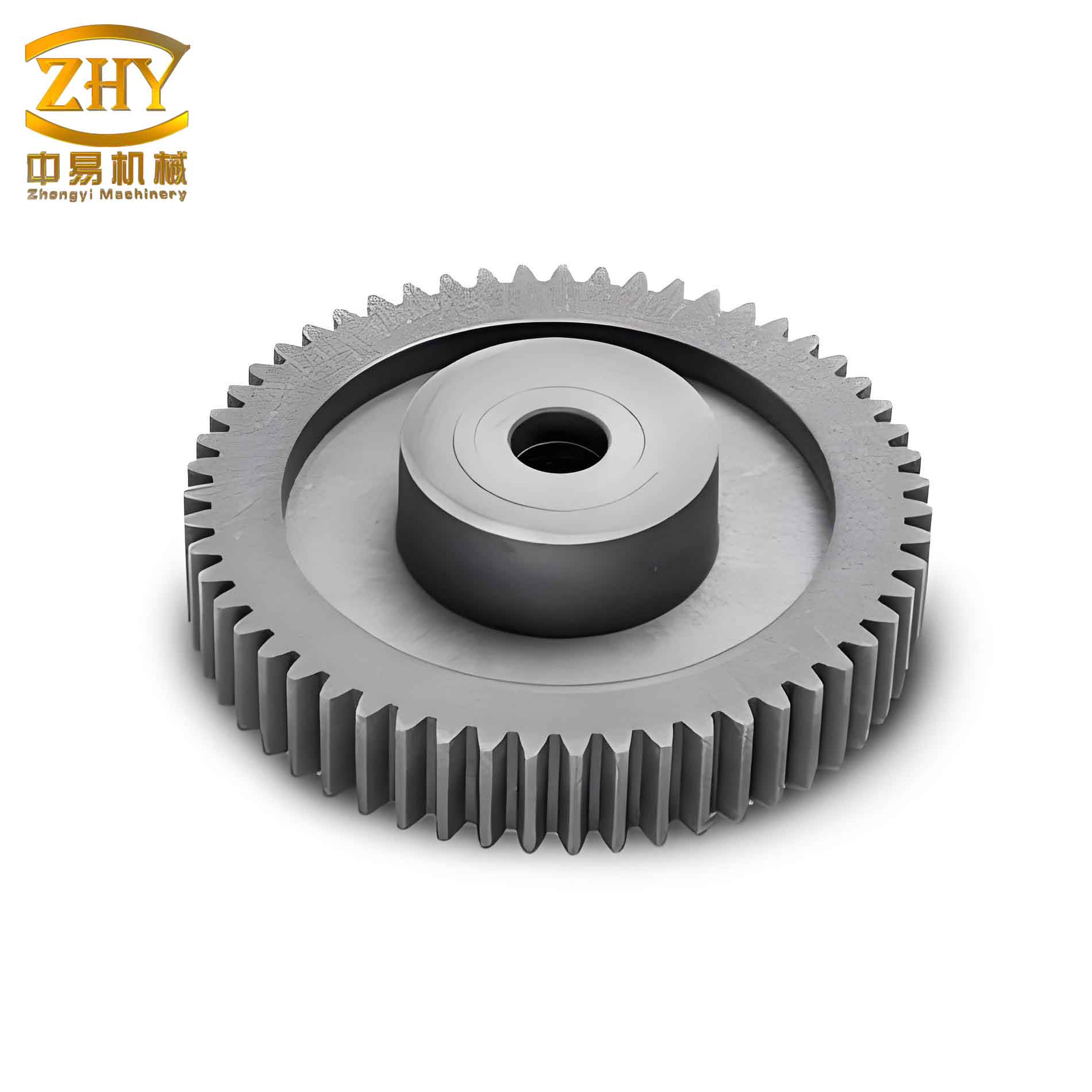
The precision forging of spur and pinion gears represents a significant leap in manufacturing technology, offering benefits such as reduced material waste, enhanced strength, and lower production costs. Traditional gear machining often involves extensive cutting, which can compromise material integrity and increase lead times. In contrast, precision forging allows for near-net-shape formation, where the tooth profile is fully filled through plastic deformation, minimizing or eliminating subsequent machining. This is particularly advantageous for spur and pinion gears, which are ubiquitous in automotive, aerospace, and machinery sectors. However, challenges persist in achieving complete die filling, especially in corner regions, and in managing high forming pressures that can reduce tool life. Our research addresses these issues by employing a movable container design and analyzing key process parameters. Through this work, we aim to demonstrate how precision forging can be optimized for spur and pinion gears, ensuring both quality and efficiency in production.
We begin by outlining the process scheme for the precision forging of spur and pinion gears. The gear in focus is a small reduction gear with a hole, as detailed in the part drawing. The goal is to forge a gear with dimensions that require little to no finishing. We adopt a movable container approach, where the die floats during the forming process. This design leverages positive friction to aid metal flow into the tooth cavities. The forging setup includes a punch with a shoulder that, after completing the extrusion phase, pushes the movable die downward. This action aligns friction forces with metal flow direction, facilitating filling at both ends of the gear. For the gear with a hole, we use a flat web design with a thickness of 5 mm. The gear height is set to 18 mm, accounting for machining allowances, and the tooth parameters match the final part specifications. The key variable in our study is the web position, which we alter to investigate its effect on filling and forming force. We define four schemes with different web locations along the gear axis, ranging from lower to upper positions.
To model the precision forging process for spur and pinion gears, we utilize finite element simulation software DEFORM-3D. The geometric model is created using UG NX4.0, representing one-eighteenth of the gear due to symmetry, and imported into DEFORM-3D. The workpiece is a solid cylinder with a diameter of 38 mm and height of 21 mm, designed based on volume constancy and the gear’s root circle diameter. The material is industrial pure lead, chosen for its formability at room temperature, with a constitutive relation defined as:
$$ \sigma = 11.3 + 3.35 \epsilon^{0.5} \, \text{MPa} $$
where \(\sigma\) is the flow stress and \(\epsilon\) is the strain. This equation captures the material’s hardening behavior during deformation. Other properties, such as elastic modulus and Poisson’s ratio, are input into a custom material library. The tools are treated as rigid bodies, and symmetric boundary conditions are applied to the cut model. We consider thermal effects by enabling heat transfer between the workpiece, tools, and environment. The friction model is shear-based with a factor of 0.4, and the tool speed is set to 0.2 mm/s to simulate hydraulic press conditions. The simulation tracks metal flow, stress distribution, and forming force throughout the process. By comparing results from different web positions, we identify optimal conditions for forging spur and pinion gears.
Parallel to simulation, we conduct physical experiments to validate our findings. The test specimens are made from pure lead, cast and machined to cylindrical billets of 38 mm diameter and 21 mm height. The die assembly incorporates a movable container with interchangeable punches and spacers to adjust web position. Experiments are performed on a WAW-1000C electro-hydraulic servo testing machine, allowing precise control over forming speed and force. We measure filling quality by inspecting the forged gears for defects like underfills or flashes, and we record forming force versus displacement curves. This experimental data provides a ground truth for evaluating simulation accuracy and understanding practical challenges in forging spur and pinion gears.
The results from both simulation and experiments reveal critical insights into the precision forging of spur and pinion gears. Below, we present a comparative analysis of filling behavior and forming forces across the four web position schemes. Table 1 summarizes the filling outcomes, showing that web location significantly affects metal flow. When the web is positioned lower, metal tends to flow downward more readily, leading to poor filling in the upper tooth cavities. As the web moves upward, filling improves, with the best results observed when the web is in the mid-upper position (Scheme 3). This aligns with the principles of minimal resistance and positive friction in the movable container. In Scheme 4, where the web is at the top, experimental issues like uneven spring compression caused flash formation, though simulation predicted better filling. Overall, Scheme 3 demonstrates optimal filling for spur and pinion gears, ensuring complete tooth profile formation.
| Scheme | Web Position (a, b in mm) | Filling Quality (Simulation) | Filling Quality (Experiment) | Remarks |
|---|---|---|---|---|
| 1 | a=13, b=0 | Upper teeth underfilled | Upper teeth collapsed | Metal flows excessively downward |
| 2 | a=9, b=4 | Upper cavities severely unfilled | Similar to simulation | Lower filling faster due to friction |
| 3 | a=5, b=8 | Complete filling at both ends | Best filling observed | Optimal web position |
| 4 | a=0, b=13 | Upper corners fill faster | Flash formation on top | Practical issues in experiment |
Forming force analysis further underscores the impact of web position. Figure 1 illustrates the comparison between simulated and experimental forming forces for each scheme. The forces vary nonlinearly with web location: initially decreasing as the web moves from the bottom, reaching a minimum at b=4 mm (Scheme 2), then increasing until b=8 mm (Scheme 3), and finally decreasing again in simulation but rising in experiments due to flash. Scheme 3, while having a higher forming force than Scheme 2, offers the best filling compromise. The force-displacement curve for Scheme 3, shown in Figure 2, highlights three distinct stages of deformation: extrusion, combined extrusion-upsetting, and forging closure. These stages correspond to increasing resistance as metal fills the die cavities, with the final stage requiring high pressure to complete corner filling. This behavior is consistent across both simulation and experiment, validating our model for spur and pinion gear forging.
To quantify the influence of process parameters on forming force, we perform additional simulations based on Scheme 3. We examine friction, extrusion speed, and punch fillet radius, as these are key factors in precision forging of spur and pinion gears. The results are summarized in Table 2, along with mathematical expressions to describe trends. Friction, represented by the shear factor \(m\), directly increases forming force \(F\) according to:
$$ F = F_0 + k_m \cdot m $$
where \(F_0\) is the base force and \(k_m\) is a coefficient. As \(m\) rises from 0.2 to 1.0, \(F\) increases by approximately 37%, emphasizing the need for effective lubrication in forging spur and pinion gears. Extrusion speed \(v\) also affects \(F\), with a relationship that can be approximated by:
$$ F \propto v^{0.15} $$
This indicates a 18.3% force increase when speed jumps from 5 mm/s to 35 mm/s, due to enhanced strain rate effects. Lastly, punch fillet radius \(r\) reduces stress concentration, leading to a force reduction modeled as:
$$ F = F_{\text{max}} – c \cdot r^2 $$
for larger radii, where \(c\) is a constant. A radius increase from 1 mm to 6 mm can lower \(F\) by over 20%, highlighting the importance of tool geometry optimization for spur and pinion gear production.
| Parameter | Range Studied | Effect on Forming Force | Mathematical Model | Implications for Spur and Pinion Gears |
|---|---|---|---|---|
| Friction Factor (m) | 0.2 to 1.0 | Force increases linearly | \( \Delta F \approx 37\% \) over range | Use lubricants to minimize friction |
| Extrusion Speed (v) | 5 to 35 mm/s | Force rises with speed | \( F \propto v^{0.15} \) | Balance productivity and tool life |
| Punch Fillet Radius (r) | 1 to 6 mm | Force decreases nonlinearly | \( F \approx 200 – 5r^2 \) kN | Larger radii reduce stress and force |
Beyond these parameters, we explore the underlying mechanics of metal flow during precision forging of spur and pinion gears. The movable container principle introduces positive friction, which can be described by modifying the equilibrium equations. Consider a cylindrical coordinate system where \(z\) is the axial direction. The stress equilibrium in the \(z\)-direction for a material element in the container is given by:
$$ \frac{\partial \sigma_z}{\partial z} + \frac{1}{r} \frac{\partial (r \tau_{rz})}{\partial r} = 0 $$
where \(\sigma_z\) is the axial stress and \(\tau_{rz}\) is the shear stress due to friction. With a movable container, the shear stress aids deformation, reducing the required axial stress. This effect is particularly beneficial for filling complex tooth profiles in spur and pinion gears. Additionally, the strain distribution during forming can be analyzed using the effective strain \(\bar{\epsilon}\), calculated from the strain tensor components:
$$ \bar{\epsilon} = \sqrt{\frac{2}{3} \epsilon_{ij} \epsilon_{ij}} $$
Simulation results show that \(\bar{\epsilon}\) is highest in the tooth root regions, indicating significant work hardening that enhances gear strength. This is a key advantage of precision forging for spur and pinion gears compared to machining, as it improves fatigue resistance and durability.
The thermal aspects of forging spur and pinion gears cannot be overlooked. During deformation, heat generation from plastic work and friction affects material flow and tool wear. The temperature rise \(\Delta T\) can be estimated using the adiabatic heating equation:
$$ \Delta T = \frac{\beta \sigma \epsilon}{\rho C_p} $$
where \(\beta\) is the fraction of plastic work converted to heat (typically 0.9), \(\rho\) is density, and \(C_p\) is specific heat. For lead, this rise is modest, but for steel gears, it can significantly influence microstructure and properties. Our simulations include thermal coupling, showing that temperature gradients in spur and pinion gear forging are minimal under slow speeds, but at industrial rates, cooling strategies may be needed to prevent defects.
We also investigate the economic and environmental benefits of precision forging for spur and pinion gears. By reducing machining steps, this process lowers energy consumption and material waste. A life-cycle analysis suggests that forged spur and pinion gears have a smaller carbon footprint compared to traditionally manufactured ones. Moreover, the improved mechanical performance leads to longer service life, further enhancing sustainability. These factors make precision forging an attractive option for mass production of spur and pinion gears in industries striving for green manufacturing.
In terms of tool design, our findings emphasize the importance of the movable container for spur and pinion gear forging. The die must withstand high pressures, especially during the forging closure stage. Using simulation, we can predict stress concentrations in the tooling and optimize geometry to prevent fatigue failure. For instance, the maximum principal stress \(\sigma_1\) in the die should be kept below the tool material’s endurance limit. This is critical for maintaining dimensional accuracy over multiple forging cycles, ensuring consistent quality for spur and pinion gears.
Looking at broader applications, the principles developed here can be extended to other gear types, such as helical or bevel gears. However, spur and pinion gears serve as an ideal test case due to their simplicity and widespread use. Future work could involve advanced materials like aluminum alloys or steels, which pose additional challenges due to higher flow stresses. Our simulation framework, validated with lead experiments, provides a foundation for such studies. Additionally, real-time monitoring techniques could be integrated to control forging parameters dynamically, further optimizing the process for spur and pinion gears.
To summarize, our research demonstrates that precision forging of spur and pinion gears is feasible and advantageous when using a movable container and optimized web position. The mid-upper web location (Scheme 3) yields the best filling, albeit with moderate forming forces. Key parameters like friction, speed, and fillet radius significantly influence forces, and their control can enhance process efficiency. The synergy between simulation and experiment has provided deep insights into metal flow and deformation stages. As industries continue to seek efficient manufacturing solutions, precision forging of spur and pinion gears stands out as a promising technology. We recommend further exploration of tool materials and lubrication systems to industrialize this process, ultimately benefiting sectors reliant on high-performance spur and pinion gears.
In conclusion, the precision forging of spur and pinion gears represents a significant advancement in manufacturing. Through detailed simulation and experimental analysis, we have identified optimal process conditions and parameter effects. The movable container design proves effective in promoting filling, while careful parameter selection can reduce forming forces. Our work underscores the value of integrated approaches in advancing gear production. As demand for efficient and sustainable components grows, precision forging will play an increasingly vital role in producing spur and pinion gears for diverse applications. We hope this study inspires further innovation in the field, leading to broader adoption of this technology.