
The pursuit of lightweighting in automotive, aerospace, and machinery industries has consistently driven the demand for high-performance aluminum alloy components. Among these, spur and pinion gears are critical transmission elements where replacing traditional steel with aluminum offers significant weight reduction potential. However, manufacturing complex, high-integrity aluminum gears with consistent mechanical properties presents a considerable challenge. Conventional casting methods often introduce defects like shrinkage porosity and gas entrapment, while machining from wrought stock is wasteful and can compromise the material’s flow lines.
Squeeze casting, a hybrid process combining casting and forging principles, has emerged as a promising near-net-shape technology. It involves applying a high pressure to the solidifying melt within the die cavity. This pressure promotes better cavity filling, suppresses gas pore formation, feeds shrinkage, and can even induce some plastic deformation in the mushy zone. The result is a component with a denser microstructure, finer grains, and mechanical properties that can approach those of forged parts. For heat-treatable 6xxx series aluminum alloys like 6082, known for their good strength-to-weight ratio and corrosion resistance but also for a wide solidification range prone to defects, squeeze casting is particularly attractive.
This article investigates the squeeze casting process for manufacturing a standard spur and pinion gear from 6082 aluminum alloy. We analyze the critical influence of forming pressure on the macro-forming quality, microstructural homogeneity, and resulting mechanical properties. Furthermore, the optimization of post-casting heat treatment (T6) to achieve peak strength is explored. The goal is to establish a process-structure-property relationship for the integrated control of shape and performance in complex aluminum components like spur and pinion gears.
Methodology: Experimentation and Analysis
The base material used was a 6082 aluminum alloy. The chemical composition was verified using X-ray fluorescence spectrometry and is presented in Table 1.
| Si | Fe | Cu | Mn | Mg | Cr | Zn | Ti | Al |
|---|---|---|---|---|---|---|---|---|
| 1.0 | 0.5 | 0.1 | 0.65 | 0.9 | 0.25 | 0.2 | 0.1 | Bal. |
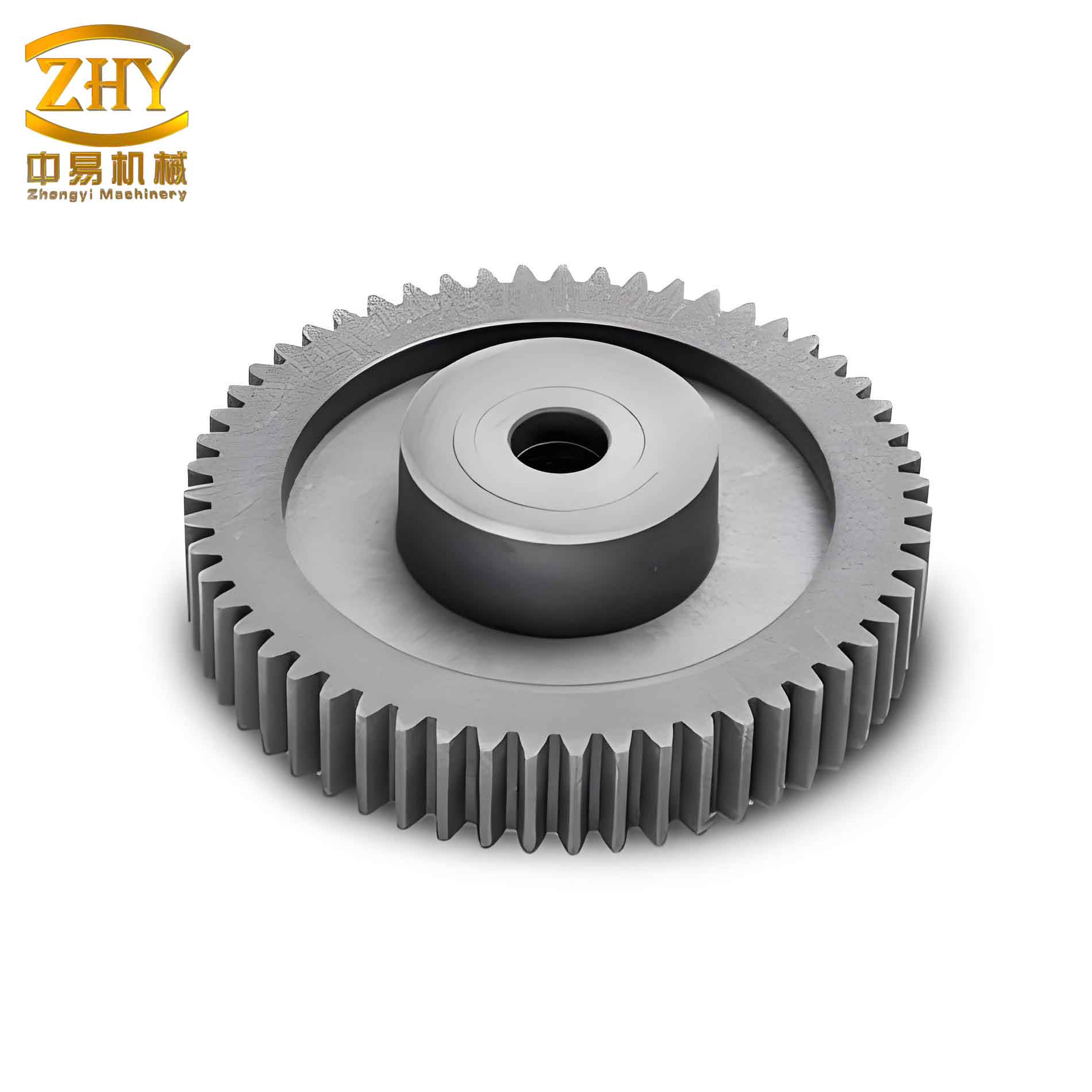
The target component was a standard spur gear with a module of 3 and 17 teeth. Key geometric parameters are summarized in Table 2. The projected area was calculated to be 1,988.82 mm², which is essential for determining the actual pressure on the melt.
| Module | Number of Teeth | Pressure Angle (°) | Pitch Diameter (mm) | Root Diameter (mm) | Tip Diameter (mm) |
|---|---|---|---|---|---|
| 3 | 17 | 20 | 50.1 | 43.6 | 57.0 |
The squeeze casting trials were conducted on a 1000 kN hydraulic press. A critical aspect of the die design was the incorporation of a “floating die” system. This system allows the entire die cavity to move downward with the punch during the final pressing stage, significantly improving the metal flow and pressure transmission into the complex tooth profiles of the spur and pinion gear. The dies were preheated to 300°C and coated with a graphite-based lubricant.
The process sequence was as follows:
- Melting: 240g of 6082 alloy was melted at 740°C in a resistance furnace.
- Degassing: The melt was degassed using C₂Cl₆ tablets.
- Pouring: The melt was poured into the preheated die cavity.
- Squeezing: The punch advanced rapidly, contacted the floating die, and then applied pressure at a slower rate. The pressure was held for 30 seconds.
- Ejection: The punch retracted, and ejector pins pushed the solidified spur and pinion gear out of the die.
The nominal applied loads were 100, 200, 300, 400, 500, and 600 kN. The actual forming pressure on the melt (\( P_{actual} \)) is the net pressure after accounting for the counter-pressure from the die’s elastic support system (springs). It can be calculated as:
$$ P_{actual} = \frac{F_{punch}}{A_{projected}} – P_{spring} $$
Where \( F_{punch} \) is the press load, \( A_{projected} \) is the gear’s area, and \( P_{spring} \) is the specific pressure from the springs (calculated to be ~20 MPa). Thus, the actual forming pressures corresponding to the applied loads were approximately 30, 80, 130, 180, 230, and 280 MPa. Table 3 summarizes the key process parameters.
| Parameter | Value / Condition |
|---|---|
| Alloy | 6082 Al |
| Melt Temperature | 740 °C |
| Die Temperature | 300 °C |
| Applied Load Range | 100 – 600 kN |
| Actual Forming Pressure Range | 30 – 280 MPa |
| Pressure Holding Time | 30 s |
Metallographic samples were taken from both the central hub and the tooth root (edge) regions of the produced spur and pinion gears. Samples were prepared by standard grinding, polishing, and electrolytic etching. Microstructural analysis was performed using optical microscopy, and grain size was measured via the linear intercept method. Vickers microhardness mapping was conducted across different locations on the gear cross-section (e.g., tooth tip, root, core) to assess homogeneity.
Gears produced under the optimal pressure (230 MPa) were subjected to T6 heat treatment:
- Homogenization: 560°C for 6 hours, followed by water quenching.
- Solution Treatment: 545°C for 50 minutes, followed by water quenching.
- Artificial Aging: 160°C for varying durations (2, 4, 6, 8 hours).
Tensile test specimens were machined from the gear hub in the longitudinal direction. Fractography was performed using scanning electron microscopy (SEM) to analyze the failure mechanisms.
Results and Discussion: The Role of Pressure and Heat Treatment
1. Macro-Forming Quality and Defect Suppression
The macroscopic quality of the spur and pinion gear was profoundly affected by the forming pressure. At the lowest pressure (30 MPa), severe defects were evident. A large shrinkage cavity was present in the central hub, and several teeth exhibited incomplete filling, particularly at the tips and fillets. This is characteristic of insufficient metallostatic and feeding pressure to counteract the volumetric shrinkage during solidification and to overcome the rapid heat loss in the thin, complex tooth sections.
As the forming pressure increased to 130 MPa, these macro-defects were virtually eliminated. The gear contour became sharp and complete. Further increase to 230 and 280 MPa yielded gears with excellent surface finish and dimensional fidelity. The mechanism is twofold. First, the applied pressure dramatically improves the melt’s flowability, enabling complete filling of the intricate spur and pinion gear cavity before a solid skin forms. Second, and more critically, the high pressure acts throughout solidification. It enhances the heat transfer coefficient at the metal-die interface by ensuring intimate contact, increases the melting point of the alloy, and most importantly, provides continuous liquid and mushy-state feeding to compensate for shrinkage. The pressure can be understood through the Clausius-Clapeyron relation, which describes the shift in equilibrium temperature (\(\Delta T_m\)) with pressure (\(\Delta p\)):
$$ \frac{\Delta T_m}{\Delta p} = \frac{T_m (V_{m,L} – V_{m,S})}{\Delta H_m} $$
where \( T_m \) is the equilibrium melting temperature, \( V_{m,L} \) and \( V_{m,S} \) are the molar volumes of the liquid and solid, and \( \Delta H_m \) is the latent heat of fusion. The positive shift in \( T_m \) increases the undercooling, promoting nucleation. Furthermore, the pressure can plastically deform the initially formed solid shell, breaking dendrite arms and providing solid-state feeding, which is especially effective in preventing internal porosity in the last-to-freeze regions like the gear’s central hub.
2. Microstructural Evolution and Homogenization
The microstructure of the as-cast gears transitioned from coarse, dendritic morphology to a much finer, equiaxed structure with increasing pressure. At 30 MPa, both the center and edge of the spur and pinion gear showed large columnar dendrites with secondary arms, indicative of a relatively slow, directional solidification. Micro-porosity and inter-dendritic shrinkage were also visible.
At 130 MPa, the grain structure was significantly refined. At 230 MPa, the microstructure consisted of fine, equiaxed α-Al grains with a more uniform distribution of intermetallic phases in the interdendritic regions. Notably, the difference in grain size between the rapidly cooled edge (tooth root) and the slower-cooled center diminished with increasing pressure, as shown in Table 4.
| Actual Forming Pressure (MPa) | Grain Size at Center (µm) | Grain Size at Edge (µm) | % Reduction from 30 MPa (Center/Edge) |
|---|---|---|---|
| 30 | 127.1 | 123.1 | – |
| 80 | 118.5 | 115.3 | 6.8 / 6.3 |
| 130 | 110.2 | 106.8 | 13.3 / 13.2 |
| 180 | 101.5 | 99.2 | 20.1 / 19.4 |
| 230 | 96.8 | 94.9 | 23.8 / 22.9 |
| 280 | 95.1 | 93.5 | 25.2 / 24.0 |
The grain refinement is attributed to the combined effects of increased undercooling (from the pressure-induced melting point elevation), a higher nucleation rate, and enhanced heat extraction due to better die contact. The pressure also causes fragmentation of dendrites in the mushy zone, providing additional nucleation sites. The convergence of grain size between center and edge indicates improved thermal and pressure uniformity throughout the component, a critical factor for the consistent performance of a spur and pinion gear where every tooth must carry load.
3. Mechanical Properties and Hardness Distribution
The microhardness of the gears increased steadily with forming pressure, plateauing above 230 MPa. This trend directly correlates with the grain refinement, as described by the Hall-Petch relationship:
$$ H_V = H_0 + k_{H} d^{-1/2} $$
where \( H_V \) is the Vickers hardness, \( H_0 \) and \( k_{H} \) are material constants, and \( d \) is the average grain diameter. Finer grains create more grain boundary area, which acts as a stronger barrier to dislocation motion, increasing strength and hardness. Furthermore, the potential for slight plastic deformation (work hardening) in the solid shell under high pressure contributes to the hardness, especially at the edges.
The hardness mapping of a gear formed at 230 MPa (Table 5) reveals a high level of homogeneity. The highest hardness values were recorded at locations in direct contact with the top/bottom die faces and the tooth profile, where cooling rates and pressure effects were maximized. The core regions showed slightly lower but still consistent values, with a maximum variation of only ~5 HV across the entire gear cross-section. This uniformity is essential for a spur and pinion gear to ensure even wear and load distribution during service.
| Location on Gear Cross-section | Average Vickers Hardness (HV) | Remarks |
|---|---|---|
| Tooth Tip (Contact with top die) | 60.6 | Fastest cooling, high pressure |
| Tooth Root / Flank | 58.9 | Complex geometry, good cooling |
| Mid-Radius Region | 57.8 | Intermediate cooling |
| Gear Center (Hub Core) | 56.5 | Slowest cooling, last to solidify |
4. Optimization of Heat Treatment (T6)
The squeeze-cast spur and pinion gear exhibited excellent response to T6 heat treatment. The homogenization stage dissolved coarse, as-cast intermetallics (like Mg₂Si and β-Al₅FeSi), promoting chemical uniformity. The subsequent solution treatment created a supersaturated solid solution. Artificial aging at 160°C then precipitated fine, coherent strengthening phases.
The aging curve (Figure 1, represented descriptively) showed a clear peak. Strength increased with aging time up to 6 hours, after which it began to decrease (over-aging). Ductility, as expected, gradually decreased with aging time. The peak-aged condition (160°C for 6h) yielded optimal tensile properties for the squeeze-cast material, as summarized in Table 6.
The precipitation sequence in 6082 alloy is generally: SSSS → GP zones → β” → β’ → β (Mg₂Si). The peak strength coincides with a high density of fine, coherent β” precipitates. The Avrami-type equation often describes the kinetics of such age-hardening:
$$ y = 1 – \exp(-k t^n) $$
where \( y \) is the fraction transformed, \( k \) is a rate constant, \( t \) is time, and \( n \) is the Avrami exponent. Over-aging occurs as the metastable β” phases coarsen and transform into the semi-coherent β’ and finally the non-coherent equilibrium β phase, which provides less effective strengthening. SEM fractography of tensile specimens confirmed this: peak-aged samples showed a dimpled rupture morphology indicative of ductile fracture, while over-aged samples displayed larger dimples and some cleavage features, correlating with reduced ductility.
| Property | Value | Note |
|---|---|---|
| Ultimate Tensile Strength (UTS) | 335 MPa | Approaching forged alloy performance |
| Elongation at Break | 11.8 % | Good combination of strength and ductility |
| Yield Strength (0.2% Offset) | ~290 MPa (Estimated) | High load-bearing capacity |
These properties demonstrate that squeeze casting, followed by optimized T6 treatment, can produce spur and pinion gears with a mechanical performance that is competitive with more traditional and costly forging routes, while offering the net-shape advantages of casting.
Conclusion and Outlook
This study demonstrates the viability of squeeze casting as a robust manufacturing route for high-integrity, heat-treatable aluminum alloy spur and pinion gears. The key findings are:
- Forming Pressure is Critical: Increasing the actual forming pressure up to an optimal range (~230 MPa) is essential. It eliminates macro-defects (shrinkage, misruns), refines the microstructure through enhanced undercooling and dendrite fragmentation, and significantly improves the homogeneity of mechanical properties across the complex geometry of the gear.
- Microstructural Homogeneity: The pressure-mediated solidification reduces the grain size disparity between rapidly cooled surfaces (teeth) and the slower-cooled core. This leads to a uniform hardness distribution, which is crucial for the balanced performance and durability of a spur and pinion gear in service.
- Excellent Heat Treatment Response: The squeeze-cast 6082 alloy responds well to standard T6 treatment. A peak aging condition at 160°C for 6 hours was identified, producing a fine dispersion of β” precipitates that yield a tensile strength of 335 MPa with 11.8% elongation – properties that are close to those achievable in forged components.
The successful integration of squeeze casting with subsequent heat treatment enables true shape-and-performance integration for complex aluminum components. For spur and pinion gears, this means achieving near-net-shape production with high strength, good ductility, and consistent quality, all of which are paramount for demanding lightweight transmission applications. Future work could focus on advanced die design for multi-cavity production, integration of real-time process monitoring, and exploring the fatigue and wear performance of these squeeze-cast gears under simulated operating conditions.