
In the realm of aero-engine development, the relentless pursuit of higher thrust-to-weight ratios imposes stringent demands on every component, especially those involved in power transmission. Among these, spur and pinion gears play a pivotal role within accessory gearboxes, responsible for driving critical engine accessories. The performance, reliability, and longevity of these spur and pinion gears are intrinsically linked to their geometric accuracy and surface finish. As operational speeds and loads increase, traditional design and manufacturing tolerances become inadequate, leading to issues such as excessive noise, vibration, premature wear, and even catastrophic failure. This article, from an engineering design perspective, comprehensively explores the precision design of involute spur and pinion gears for aero-engine applications. It delves into the profound impact of gear accuracy grades and tooth surface roughness on dynamic behavior, contact fatigue strength, and scuffing (galling) resistance. The discussion is substantiated with analytical models, computational data, and comparative tables, providing a foundational framework for optimizing spur and pinion gear design in high-performance aviation propulsion systems.
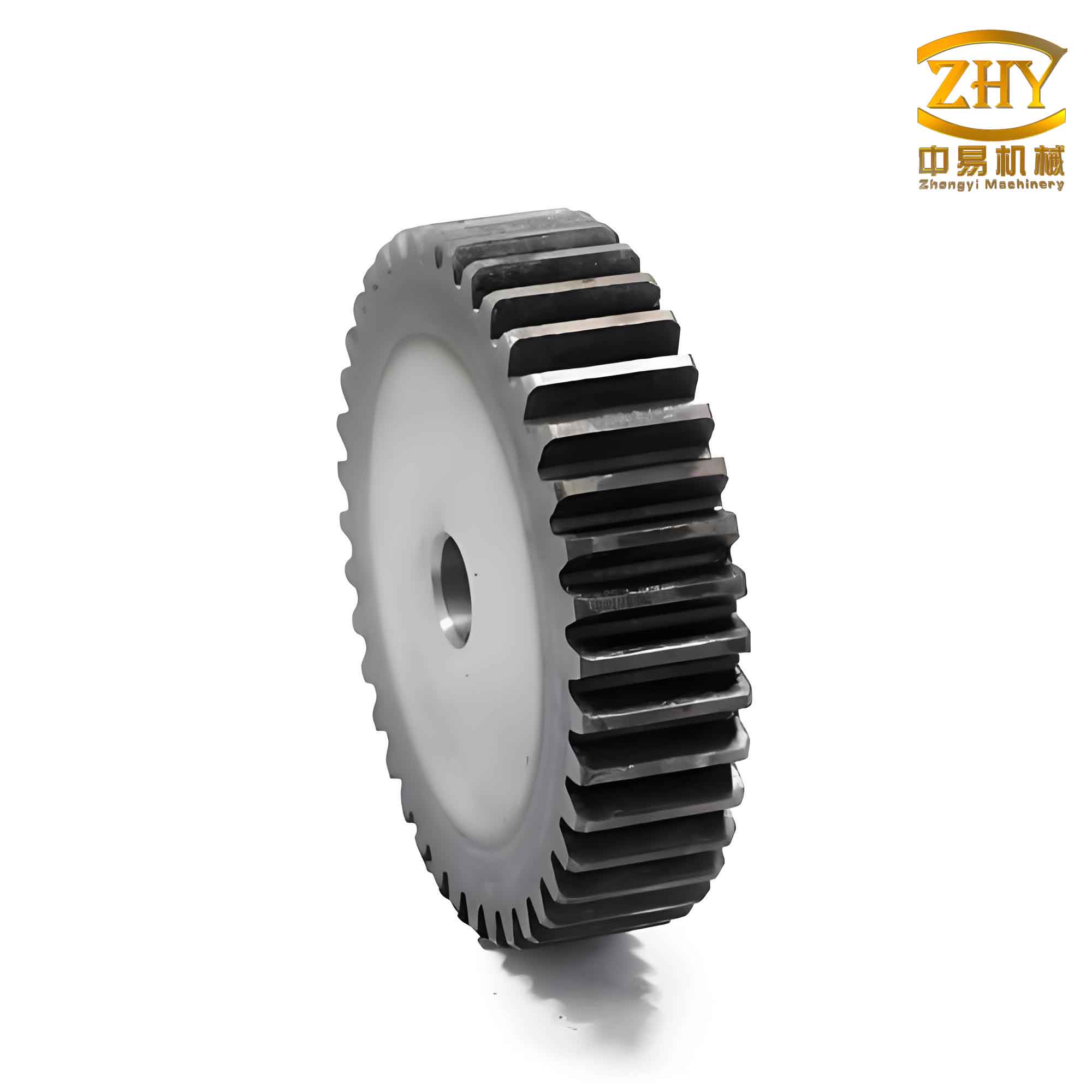
The meshing action of a spur and pinion gear pair is deceptively simple in principle yet complex in its dynamic realization. The straight teeth of these gears engage along lines parallel to their axes, transmitting torque through rolling and sliding contact. However, imperfections inherent in manufacturing—deviations in tooth profile, pitch, and alignment—disrupt this ideal interaction. For spur and pinion gears operating at high rotational speeds, these minute errors can excite significant dynamic forces. The consequences are multifaceted: increased stress amplitudes that accelerate contact fatigue, impact loads that degrade tooth surfaces, and elevated friction that raises the risk of adhesive wear or scuffing. Therefore, specifying the appropriate gear accuracy is not merely a matter of meeting a drawing callout; it is a fundamental system-level decision affecting the entire transmission’s acoustics, durability, and efficiency. This analysis begins by examining how accuracy grades are selected and quantified for spur and pinion gears.
Gear accuracy is systematically categorized into groups governing different aspects of performance. For spur and pinion gears, these are typically defined by international (ISO), national (e.g., AGMA, DIN), or sector-specific (e.g., aerospace) standards. The three primary tolerance groups are: Group I (Governing motion accuracy over one revolution), Group II (Governing smoothness of motion, noise, and vibration), and Group III (Governing load distribution across the tooth face). Each group contains specific tolerance items, such as cumulative pitch error (Fp) in Group I, single pitch error (fpt) and profile form error (ffα) in Group II, and helix slope error (fHβ) in Group III. The selection of an accuracy grade, often denoted by a number like 5, 6, or 7 (with lower numbers indicating higher precision), sets the allowable limits for these errors. For critical aero-engine spur and pinion gears, the dominant factor in grade selection is often the pitch line velocity. A widely referenced guideline, as seen in aerospace practice, establishes the relationship shown in Table 1.
| Pitch Line Velocity, v (m/s) | Minimum Accuracy Grade for Spur and Pinion Gears | Typical Application Context |
|---|---|---|
| v > 50 | 3 | High-speed compressor drive stages, auxiliary power unit drives |
| 40 < v ≤ 50 | 4 | Main accessory gearbox high-speed shafts, fuel pump drives |
| 20 < v ≤ 40 | 5 | Intermediate speed gears in accessory gearboxes, generator drives |
| 15 < v ≤ 20 | 6 | Lower speed accessory drives, actuator mechanisms |
| v ≤ 15 | 7 or 8 | Slow-moving mechanisms, non-critical positioning drives |
Applying this criterion to a modern turbofan engine’s accessory gearbox reveals a significant design imperative. Many spur and pinion gear pairs, particularly those on the high-speed input shaft or driving high-RPM accessories like hydraulic pumps, operate well above 40 m/s. This mandates accuracy grades of 4 or higher. However, legacy designs or cost-constrained programs might specify a composite grade like 6-5-5 (where the first digit corresponds to Group I, the second to Group II, and the third to Group III tolerances). While this may seem adequate on paper, a detailed dynamic analysis exposes its shortcomings. The core issue lies in the generation of “mesh impact” due to base pitch errors. When a tooth pair of a spur and pinion gear engages, the ideal condition requires the base pitch of the driving gear to equal that of the driven gear. Manufacturing errors, primarily profile deviations and single pitch errors, create a mismatch, leading to a sudden acceleration or deceleration at the instant of contact. This kinematic disturbance translates into a dynamic impact force. A simplified model for estimating the disengagement impact force in a spur and pinion gear pair, considering the instantaneous kinematics and tooth compliance, can be expressed as:
$$F_{impact} = \frac{\Delta V_n \cdot \sqrt{J_1 J_2}}{\sqrt{J_2 r_{b1}’^2 + J_1 r_{b2}’^2}} \cdot \sqrt{\frac{1}{q_s b}}$$
Here, \( \Delta V_n \) represents the relative velocity difference in the direction normal to the tooth surfaces at the point of impact—a direct consequence of base pitch error. \( J_1 \) and \( J_2 \) are the mass moments of inertia of the spur gear and pinion gear, respectively. \( r_{b1}’ \) and \( r_{b2}’ \) are the instantaneous base circle radii at the contact point. The term \( q_s \) denotes the combined local contact compliance of the two mating teeth, and \( b \) is the face width. This equation highlights that the impact force is proportional to the velocity disturbance \( \Delta V_n \), which is itself a function of gear accuracy parameters like profile error (fα) and pitch error (fpt). To illustrate the magnitude of this effect, consider an analysis of three representative spur and pinion gear pairs from an accessory gearbox, assuming a 6-5-5 accuracy grade. The calculated normal loads and resulting impact forces during mesh-in and mesh-out are presented in Table 2.
| Spur and Pinion Gear Pair Identifier | Steady-State Normal Load, F_n (N) | Mesh-In Impact Force, F_in (N) | Mesh-Out Impact Force, F_out (N) | Peak Load Increase (F_n + F_impact)/F_n | Primary Error Contributors |
|---|---|---|---|---|---|
| Pair α (High-Speed Stage) | 2256.7 | 888.7 | 828.6 | ~1.39 | Profile Error, Base Pitch Deviation |
| Pair β (Intermediate Stage) | 3451.3 | 1136.8 | 1114.5 | ~1.33 | Profile Error, Adjacent Pitch Error |
| Pair γ (Intermediate Stage) | 3451.3 | 1094.3 | 1041.0 | ~1.32 | Profile Error, Lead Error |
The data unequivocally shows that for these spur and pinion gears, dynamic impact can transiently increase the tooth load by over 30%. This has a cascading effect: it raises the dynamic factor (Kv) in strength calculations, elevates bending and contact stress amplitudes, accelerates surface fatigue (pitting), and increases the flash temperature at the contact, thereby elevating the risk of scuffing. Consequently, moving to a higher accuracy grade, say from 6 to 5 or 4, directly reduces the permissible profile and pitch errors, thereby diminishing \( \Delta V_n \) and the resultant impact forces. The quantitative relationship between accuracy grade and key tolerance values for spur and pinion gears is encapsulated in Table 3, derived from aerospace gear standards. Tightening these tolerances is a direct path to smoother operation and reduced dynamic loading.
| Tolerance Item (Symbol) | Error Characteristic | Grade 6 | Grade 5 | Grade 4 | Approx. Improvement from Grade 6 to 5 |
|---|---|---|---|---|---|
| Total Cumulative Pitch Error (Fp) | Motion accuracy over one revolution | 32 | 20 | 12 | 37.5% reduction |
| Tooth-to-Tooth Composite Error (fi’) | Smoothness, single tooth engagement | 14 | 9 | 6 | 35.7% reduction |
| Profile Form Error (ffα) | Deviation from ideal involute | 8 | 5 | 3 | 37.5% reduction |
| Single Pitch Deviation (fpt) | Error between adjacent teeth | ±6 | ±4 | ±2.5 | ~33% reduction |
| Helix Slope Error (fHβ) | Lead angle deviation across face width | 9 | 6 | 4 | 33.3% reduction |
While geometric accuracy governs the macro-scale engagement conditions, the micro-scale topography of the tooth surface—quantified by parameters like arithmetic mean roughness (Ra)—is equally critical for the performance of spur and pinion gears. The surface roughness directly influences the real area of contact, the severity of stress concentrations at asperity peaks, the efficiency of elastohydrodynamic lubricant film formation, and the friction-induced heat generation. In the context of contact fatigue (pitting) and scuffing failure modes, surface finish is a dominant factor. The allowable contact stress for spur and pinion gears, as per standardized rating methods (e.g., ISO 6336), incorporates a roughness factor (ZR). The calculation of contact stress (σH) and the permissible contact stress (σHP) involves several steps:
The nominal contact stress at the pitch point is given by:
$$\sigma_{H0} = Z_H Z_E Z_{\varepsilon} Z_{\beta} \sqrt{ \frac{F_t}{b d_1} \cdot \frac{u \pm 1}{u} }$$
Where \(Z_H\) is the zone factor accounting for tooth geometry at the pitch point, \(Z_E\) is the elasticity factor \(\left( \sqrt{ \frac{1}{\pi \left( \frac{1-\nu_1^2}{E_1} + \frac{1-\nu_2^2}{E_2} \right) }} \right)\), \(Z_{\varepsilon}\) is the contact ratio factor, \(Z_{\beta}\) is the spiral angle factor (1 for spur and pinion gears), \(F_t\) is the nominal tangential load, \(b\) is the face width, \(d_1\) is the reference diameter of the pinion gear, and \(u\) is the gear ratio (\(z_2/z_1\)). The calculated contact stress is then:
$$\sigma_H = \sigma_{H0} \sqrt{K_A K_V K_{H\beta} K_{H\alpha}}$$
with \(K_A\) (application factor), \(K_V\) (dynamic factor), \(K_{H\beta}\) (face load factor), and \(K_{H\alpha}\) (transverse load factor). The permissible contact stress is determined from the material’s endurance limit:
$$\sigma_{HP} = \frac{\sigma_{Hlim} Z_N Z_L Z_V Z_R Z_W}{S_{Hmin}}$$
Here, \(\sigma_{Hlim}\) is the contact fatigue limit of the material, \(Z_N\) is the life factor, \(Z_L\) is the lubricant factor, \(Z_V\) is the velocity factor, \(Z_R\) is the crucial roughness factor, \(Z_W\) is the hardness ratio factor, and \(S_{Hmin}\) is the minimum safety factor. The roughness factor \(Z_R\) is empirically correlated with the relative mean peak-to-valley roughness \(R_z\) (often related to Ra) and the dimensions of the contact ellipse. For ground or super-finished spur and pinion gears, a common approximation is:
$$Z_R \approx \left( \frac{R_{z0}}{R_z} \right)^{0.15} \quad \text{or} \quad Z_R \approx C_R – m_R \cdot \log_{10}(R_a)$$
where \(R_{z0}\) is a reference roughness, and \(C_R\), \(m_R\) are constants. This relationship indicates that reducing surface roughness directly increases \(Z_R\), thereby raising \(\sigma_{HP}\). A quantitative assessment for a typical aero-engine spur and pinion gear material (e.g., case-hardened steel) shows the effect clearly. When the surface roughness is improved from Ra 0.8 μm (a common legacy specification) to Ra 0.4 μm (a modern aerospace standard), the factor \(Z_R\) increases by approximately 5-7%. This translates directly into a similar percentage increase in the permissible contact stress, enhancing the pitting resistance safety factor.
The influence of surface roughness on scuffing (or micro-pitting) resistance is even more pronounced. Scuffing is a severe adhesive wear failure triggered when the localized flash temperature at the contacting asperities exceeds a critical value, causing the lubricant film to collapse and metal-to-metal welding. The integral temperature method, widely used for scuffing risk assessment, calculates a weighted average temperature along the path of contact. The key formula for the integral temperature \(\theta_{int}\) is:
$$\theta_{int} = \theta_M + C_2 \cdot \theta_{flaint}$$
\(\theta_M\) is the bulk temperature of the gear tooth, and \(\theta_{flaint}\) is the weighted average flash temperature. The factor \(C_2\) is a weighting constant. The average flash temperature is derived from the flash temperature at specific points, such as the pinion tip (point E), which often experiences the highest sliding velocity:
$$\theta_{flaint} = \theta_{flaE} \cdot X_{\varepsilon} X_{Q} X_{ca}$$
\(X_{\varepsilon}\), \(X_{Q}\), and \(X_{ca}\) are factors for contact ratio, load sharing, and tip relief, respectively. The flash temperature at the pinion tip for a spur and pinion gear pair can be modeled as:
$$\theta_{flaE} = \mu_m \, X_M \, X_{BE} \sqrt{ \frac{W_t \, |v_{gE} – v_{pE}|}{a’} }$$
In this expression, \(\mu_m\) is the mean coefficient of friction, a parameter highly sensitive to surface roughness and lubricant condition. Smoother surfaces (lower Ra) promote the formation of a thicker elastohydrodynamic lubrication (EHL) film, thereby reducing the boundary friction component and \(\mu_m\). \(X_M\) is a material- and lubricant-dependent thermal flash coefficient. \(X_{BE}\) is a geometric factor for the contact point E. \(W_t\) is the unit load per millimeter of face width (\(F_t/b\)). \(v_{gE}\) and \(v_{pE}\) are the rolling/sliding velocities of the gear and pinion at point E, and \(a’\) is the operating center distance. The scuffing safety factor is then:
$$S_{int} = \frac{\theta_{Sint}}{\theta_{int}}$$
where \(\theta_{Sint}\) is the critical integral temperature for the specific material and lubricant combination. Reducing surface roughness lowers \(\mu_m\) and can also positively influence the flash temperature via other embedded factors. A systematic comparison for two critical spur and pinion gear pairs, evaluating safety factors against both contact fatigue (pitting) and scuffing, demonstrates the significant benefit of improved finish, as summarized in Table 4.
| Performance Metric | Spur and Pinion Gear Pair Configuration | Safety Factor at Ra 0.8 μm | Safety Factor at Ra 0.4 μm | Percentage Improvement (%) | Implied Impact on Design (e.g., Allowable Load or Life) |
|---|---|---|---|---|---|
| Contact Fatigue (Pitting) Safety Factor (SH) | Pair β (High Load) | 1.1788 | 1.2506 | +6.1 | Potential for ~6% higher transmitted power or extended life |
| Pair γ (High Speed) | 1.0855 | 1.1474 | +5.7 | Improved margin in high-speed, stressed conditions | |
| Scuffing Resistance Safety Factor (Sint) | Pair β (High Load) | 1.5339 | 1.6992 | +10.8 | Substantially reduced risk of adhesive failure under peak loads |
| Pair γ (High Speed) | 1.2857 | 1.4353 | +11.6 | Enhanced reliability during transient high-sliding events |
The data in Table 4 underscores a critical design insight: improving the surface finish of spur and pinion gears from Ra 0.8 μm to Ra 0.4 μm yields a modest but valuable gain in contact fatigue resistance (~6%) and a more substantial gain in scuffing resistance (10-11%). In the high-stakes environment of aero-engine operation, where failure is not an option, this margin can be the difference between a robust design and one prone to in-service issues like tooth flank scuffing or micro-pitting. This explains the progressive tightening of surface finish requirements in global aerospace practice. A comparative survey of surface roughness specifications for spur and pinion gears across different engine generations and origins reveals a clear trend, as illustrated in Table 5.
| Engine Generation / Origin | Typical Specified Surface Roughness, Ra (μm) | Manufacturing Process Typically Employed | Primary Driver for Specification |
|---|---|---|---|
| Legacy Domestic Engines (1980s-1990s) | 0.8 – 1.6 | Grinding (sometimes with subsequent honing) | Cost, manufacturing capability |
| Contemporary Russian & Western Engines (2000s-present) | 0.4 – 0.6 | Precision grinding followed by honing or superfinishing | Performance, reliability, life cycle cost |
| Next-Generation / Research Engines (2020s+) | 0.2 – 0.3 (Target) | Advanced grinding, superfinishing, isotropic finishing processes | Efficiency (reduced friction loss), extreme durability, noise reduction |
Achieving these stringent levels of both geometric accuracy and surface finish for spur and pinion gears demands a synergistic approach to design, material selection, and manufacturing. The process chain typically involves: precision hobbing or shaping of the gear teeth from a high-strength, case-hardenable steel blank; controlled carburizing or nitriding to develop a hard, wear-resistant surface layer with a tough core; precision grinding of the tooth flanks to achieve the required profile, lead, and pitch accuracy; and finally, a finishing operation like honing, superfinishing, or abrasive flow machining to attain the desired Ra value and create a favorable surface texture with plateaued peaks and lubricant-retaining valleys. For the highest-performance spur and pinion gears, profile and lead modifications (crowning, tip/root relief) are also meticulously applied via CNC grinding to compensate for deflections under load and further optimize the meshing conditions, minimizing edge loading and impact even in the presence of residual errors.
In conclusion, the precision design of involute spur and pinion gears for aero-engines is a multi-faceted engineering challenge where accuracy grade and surface roughness are not isolated specifications but interconnected levers for optimizing performance and reliability. The analysis presented demonstrates that for high-speed spur and pinion gear applications, accuracy grades of 5 or higher (as dictated by pitch line velocity) are essential to control dynamic impact loads, which can otherwise surge by over 30%. Concurrently, specifying a surface roughness of Ra 0.4 μm or finer delivers a dual benefit: a tangible increase in contact fatigue strength (around 6%) and a more pronounced improvement in scuffing resistance (10-11%). These enhancements are critical for meeting the demanding durability and efficiency targets of modern and future aero-engines. Therefore, the design philosophy for spur and pinion gears must evolve from simply selecting values from historical tables to a holistic, analysis-driven process that integrates dynamic simulation, strength rating, and manufacturing capability. By embracing higher precision standards and advanced finishing technologies for spur and pinion gears, engineers can unlock greater power density, longer service intervals, and higher overall system reliability in the vital transmission systems that keep aircraft engines operating safely and efficiently.
Future advancements will likely involve the integration of real-time health monitoring sensors into gear systems, providing data to validate and refine these design models further. Additionally, research into novel gear materials, advanced surface coatings (like diamond-like carbon), and optimized lubricants will work in concert with precision manufacturing to push the boundaries of what is possible for spur and pinion gear performance. The journey towards ever-more efficient and powerful aero-engines will continue to be underpinned by the meticulous science and art of gear accuracy design.