
In my extensive work on mechanical transmission systems, I have consistently focused on improving the design efficiency and performance of spur and pinion gear sets. These components are fundamental in numerous industrial applications, from automotive drivetrains to aerospace mechanisms, where weight reduction and strength optimization are critical. Traditional optimization approaches often rely on simplified models that approximate the physical geometry of spur and pinion gear assemblies, but these approximations can lead to significant errors after multiple iterations in algorithmic searches. This inaccuracy ultimately compromises the global optimum solution. Therefore, I propose a novel method to establish a high-fidelity objective function that closely mirrors the actual physical model of spur and pinion gear systems. By incorporating detailed factors such as unequal tooth widths, keyways, top clearances, and specific geometric parameters like addendum and dedendum heights, this approach ensures greater accuracy in optimization outcomes. In this article, I will detail the mathematical formulation, integration with genetic algorithms, and validation through finite element analysis, demonstrating a substantial weight reduction compared to conventional methods.
The design of spur and pinion gear pairs involves complex interdependencies among parameters like module, number of teeth, face width, and shaft dimensions. In many prior studies, optimization efforts have utilized approximate models to reduce computational complexity. For instance, the gear volume or weight is often represented using basic cylindrical models based on pitch diameters, neglecting intricate features like webs, lightening holes, and keyways. While these simplifications may suffice for preliminary design, they fail to capture the true mass distribution, leading to suboptimal results when subjected to iterative optimization algorithms like genetic algorithms. My research addresses this gap by developing a high-fidelity objective function that accounts for these nuances, thereby enhancing the reliability of optimization for spur and pinion gear configurations.
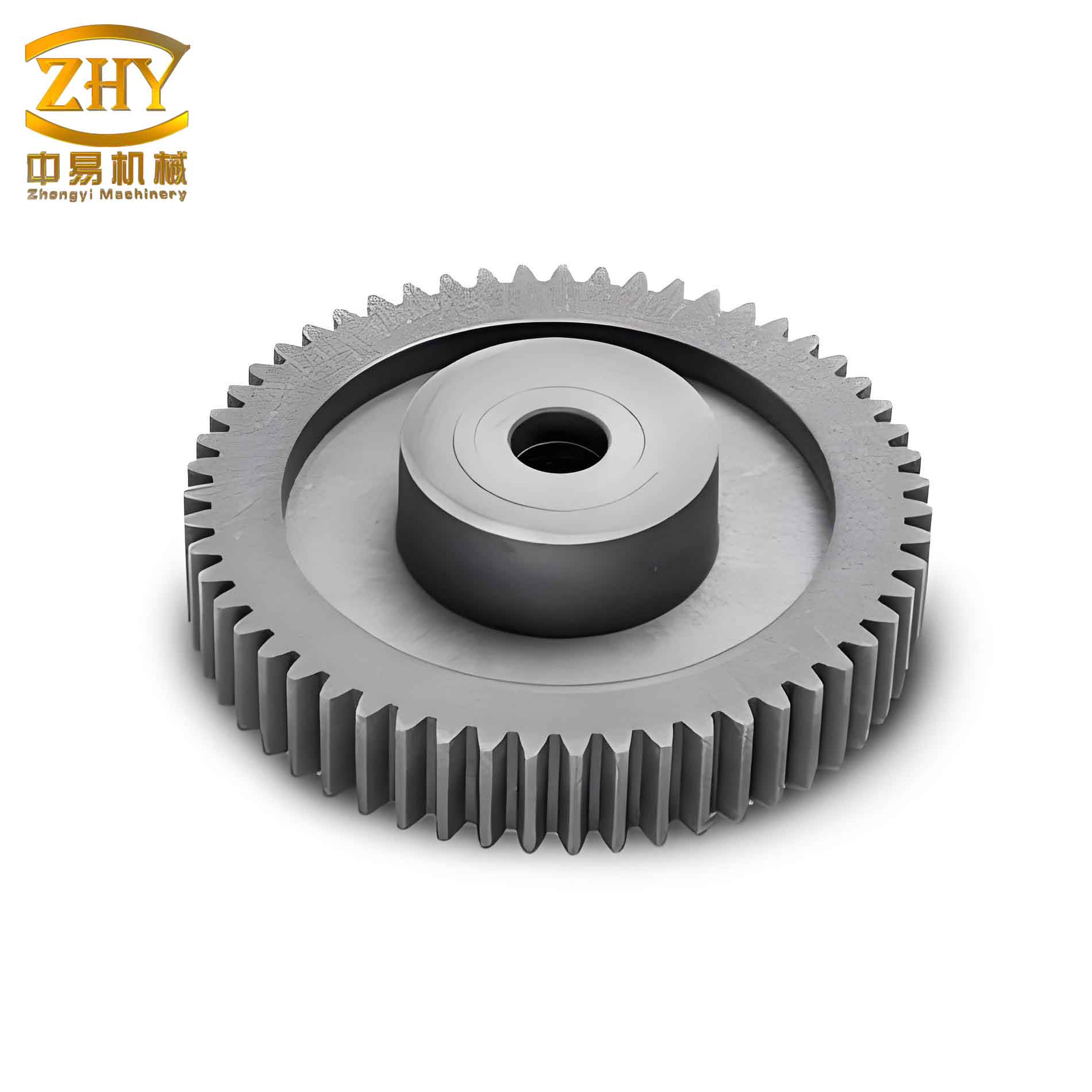
To illustrate the typical geometry considered, below is a representation of a spur and pinion gear mesh, highlighting key dimensions such as face widths, web thickness, and lightening holes. This visualization underscores the complexity that must be modeled accurately for effective optimization.
In conventional optimization of spur and pinion gear sets, the objective function is frequently derived from simplified volume calculations. For example, the total weight might be estimated as the sum of two cylinders based on pitch diameters and face widths. Some advanced models include web and lightening hole masses, but they often overlook practical aspects like differential face widths between the pinion and gear. In practice, the face width of the pinion is usually 5–10 mm larger than that of the gear to ensure proper alignment and load distribution. Additionally, factors such as top clearance (the space between the tooth tip of one gear and the root of the mating gear) and keyways for shaft connections contribute to the overall mass but are commonly omitted. These omissions reduce the fidelity of the model, causing the optimization algorithm to converge on solutions that may not be truly optimal when manufactured.
My high-fidelity objective function rectifies these issues by integrating a comprehensive set of geometric parameters. Let me define the key variables involved in the spur and pinion gear system:
- \( m \): module (selected from standard series)
- \( Z_1 \): number of teeth on the pinion (integer)
- \( Z_2 \): number of teeth on the gear, where \( Z_2 = \alpha Z_1 \) with \( \alpha \) as the gear ratio
- \( b_1 \): face width of the pinion (floating-point)
- \( b_2 \): face width of the gear, typically \( b_2 = b_1 – 5 \) mm to account for assembly precision
- \( D_1 \): pitch diameter of the pinion, \( D_1 = m Z_1 \)
- \( D_2 \): pitch diameter of the gear, \( D_2 = m Z_2 \)
- \( h_a \): addendum height, usually \( h_a = m \) (with addendum coefficient of 1)
- \( h_f \): dedendum height, typically \( h_f = 1.25 m \) (with dedendum coefficient of 1.25)
- \( d_0 \): hub diameter of the gear, approximated as \( d_0 \approx 1.6 d_2 \), where \( d_2 \) is the gear shaft diameter
- \( l_w \): rim thickness, often \( l_w = 2.5 m \)
- \( D_3 \): inner diameter of the gear edge, \( D_3 = D_2 – 2 l_w – 2 h_f \)
- \( d_p \): diameter of lightening holes, \( d_p = 0.25 (D_3 – d_0) \)
- \( n \): number of lightening holes, commonly \( n = 6 \)
- \( b_w \): web thickness, \( b_w = 3.5 m \)
- Keyway dimensions: for shaft diameters of 22–30 mm, keyway width \( w_k = 8 \) mm for the pinion and 10 mm for the gear, with depth \( t_k = 3.3 \) mm
The density of the gear material, denoted as \( \rho \), is typically 7.8 g/cm³ for alloy steels like 17Cr2Ni2Mo. Using these parameters, the high-fidelity objective function for total weight \( F(x) \) is formulated as follows:
$$ F(x) = \frac{\pi}{4} \rho \left[ (D_2^2 – d_0^2) (b_2 – b_w) – n d_p^2 b_w \right] + \frac{\pi}{4} \rho (d_1^2 b_1 + d_2^2 b_2) – \pi \rho m^2 b_1 \times 0.8 \times 0.125 + \frac{1}{2} \rho (b_1 \times 3.3 \times 8 + b_2 \times 3.3 \times 10) $$
In this equation, the first term represents the weight of the gear web after subtracting lightening holes, the second term accounts for the shaft segments within the gear widths, the third term approximates the weight of the top clearance volume (with a correction factor of 0.8 for accuracy), and the fourth term includes the keyway weights based on their dimensions. This detailed formulation ensures that the objective function closely matches the physical spur and pinion gear assembly, minimizing errors during optimization iterations.
To further clarify the parameter ranges and design constraints, I have summarized them in the table below. This table serves as a reference for the optimization process, highlighting the variables and their bounds.
| Parameter | Description | Range or Value |
|---|---|---|
| \( m \) | Module | 2.5, 2.75, 3, 3.5, 4 (standard series) |
| \( Z_1 \) | Pinion teeth number | 18 to 25 (integer) |
| \( b_1 \) | Pinion face width (mm) | 25 to 40 |
| \( d_1 \) | Pinion shaft diameter (mm) | 20 to 40 |
| \( d_2 \) | Gear shaft diameter (mm) | 20 to 40 |
| \( \alpha \) | Gear ratio | 4 (for this case study) |
| \( \rho \) | Material density (g/cm³) | 7.8 |
Optimization of spur and pinion gear sets must also satisfy multiple constraints to ensure functional integrity. These constraints are derived from strength criteria and design specifications. The primary constraints include bending strength, contact stress, torsional strength of hubs, and center distance tolerance. Using standard gear design formulas, I express these constraints mathematically.
First, the bending stress \( \sigma_F \) in both the pinion and gear must not exceed the allowable bending stress \( [\sigma_F] \). For the pinion, the constraint is:
$$ g_1(x) = \sigma_{F1} = \frac{K_F F_{t1} Y_{Fa} Y_{Sa} Y_{\epsilon}}{b_1 m} \leq [\sigma_F] $$
where \( K_F = K_A K_V K_{F\alpha} K_{F\beta} \) is the load factor for bending, \( F_{t1} = \frac{2 T_1}{D_1} \) is the tangential force, \( T_1 \) is the pinion torque, \( Y_{Fa} \) and \( Y_{Sa} \) are the tooth form factor and stress correction factor, and \( Y_{\epsilon} = 0.25 + \frac{0.75}{\epsilon_{\alpha}} \) is the contact ratio factor with \( \epsilon_{\alpha} \) as the transverse contact ratio. Similar constraints apply to the gear. For the material 17Cr2Ni2Mo, \( [\sigma_F] = 224.16 \) MPa.
Second, the contact stress \( \sigma_H \) at the tooth interface must be below the allowable contact stress \( [\sigma_H] \). The constraint is given by:
$$ g_2(x) = \sigma_H = Z_H Z_E Z_{\epsilon} \sqrt{\frac{2 K_H T_1}{d_1^2 b_1 \phi_d} \cdot \frac{\alpha + 1}{\alpha}} \leq [\sigma_H] $$
Here, \( Z_H = 2.5 \) is the zone factor, \( Z_E = 189.8 \) MPa\(^{1/2}\) is the elasticity factor, \( Z_{\epsilon} = \sqrt{\frac{4 – \epsilon_{\alpha}}{3}} \) is the contact ratio factor, \( K_H = K_A K_V K_{H\alpha} K_{H\beta} \) is the load factor for contact, and \( \phi_d = \frac{b_1}{d_1} \) is the face width ratio. The allowable contact stress \( [\sigma_H] = 766.77 \) MPa for the selected material.
Third, the torsional shear stress in the pinion and gear hubs must be within permissible limits. For the pinion hub with shaft diameter \( d_1 \):
$$ g_3(x) = \tau_{T1} = \frac{9550000 P}{0.2 d_1^3 n_1} \leq [\tau_T] $$
and for the gear hub with shaft diameter \( d_2 \):
$$ g_4(x) = \tau_{T2} = \frac{9550000 P}{0.2 d_2^3 n_1} \leq [\tau_T] $$
where \( P \) is the transmitted power in kW, \( n_1 \) is the pinion speed in rpm, and \( [\tau_T] \) is the allowable shear stress, typically derived from material properties.
Fourth, the center distance \( C \) between the spur and pinion gear axes must match the design value within a tolerance \( \epsilon \):
$$ g_5(x) = \frac{D_1 + D_2}{2} = C \pm \epsilon $$
In my case study, the design center distance is \( C = 140 \) mm with a small tolerance.
With the objective function and constraints defined, I employ a genetic algorithm (GA) to perform the optimization. GA is a population-based metaheuristic inspired by natural selection, which is effective for global optimization in complex spaces like spur and pinion gear design. The algorithm operates on a population of candidate solutions, each represented as a chromosome encoding the design variables: \( b_1 \), \( d_1 \), \( d_2 \), \( Z_1 \), and \( m \). The fitness of each individual is evaluated as the reciprocal of the objective function value (since we aim to minimize weight), and selection, crossover, and mutation operators are applied to generate successive generations.
I configure the GA with the following parameters based on preliminary trials and literature recommendations:
- Population size: 250 individuals
- Number of generations: 500
- Crossover rate: 0.6
- Mutation rate: 0.1
- Selection method: Tournament selection
- Encoding: Binary strings for continuous variables, integer representation for discrete ones like \( Z_1 \) and \( m \).
The optimization process iteratively improves the solutions, gradually converging towards a minimum weight design that satisfies all constraints. The use of a high-fidelity objective function ensures that the GA explores a search space that accurately reflects the physical spur and pinion gear system, leading to more reliable outcomes.
To demonstrate the effectiveness of my approach, I conduct a case study with initial design parameters matching those in traditional studies for comparison. The input conditions are:
- Gear ratio \( \alpha = 4 \)
- Transmitted power \( P = 750 \) W
- Pinion speed \( n_1 = 1500 \) rpm
- Initial pinion face width \( b_1 = 35 \) mm
- Initial pinion shaft diameter \( d_1 = 23 \) mm
- Initial gear shaft diameter \( d_2 = 26 \) mm
- Initial pinion teeth number \( Z_1 = 22 \)
- Initial module \( m = 2.5 \)
- Design center distance \( C = 140 \) mm
After running the GA optimization with the high-fidelity objective function, I obtain the following optimal set of parameters:
| Parameter | Optimal Value |
|---|---|
| \( b_1 \) (mm) | 35.8528 |
| \( d_1 \) (mm) | 22.893 |
| \( d_2 \) (mm) | 25.8032 |
| \( Z_1 \) | 22 |
| \( m \) | 2.5 |
| Total Weight (g) | 446.27 |
For practical manufacturing, these values are rounded to: \( b_1 = 35 \) mm, \( d_1 = 23 \) mm, \( d_2 = 26 \) mm, \( Z_1 = 22 \), and \( m = 2.5 \). Compared to traditional optimization results reported in literature, which yielded a weight of approximately 505 g under the same conditions, my high-fidelity approach achieves a reduction of 11.67%. This significant improvement highlights the importance of an accurate objective function in spur and pinion gear optimization.
To validate the structural integrity of the optimized spur and pinion gear design, I perform a finite element analysis (FEA) using ANSYS. The gear geometry is modeled in SolidWorks based on the optimal parameters, then imported into ANSYS for meshing and simulation. The mesh is refined at the tooth contact regions to capture stress concentrations accurately, as shown in the earlier image. The loading conditions correspond to the design inputs: torque on the pinion and reaction on the gear.
The FEA results reveal the von Mises stress distribution and deformation patterns. Key findings include:
- Maximum contact stress at the tooth interface: 520 MPa, well below the allowable 766.77 MPa.
- Maximum bending stress at the tooth root: 198 MPa, under the allowable 224.16 MPa.
- Stress in the gear hub: 85 MPa, within safe limits for torsional shear.
- Overall deformation under load: 0.02 mm, negligible for operational performance.
These results confirm that the optimized spur and pinion gear set meets all strength requirements while being lighter. The deformation and stress contours further demonstrate that the design is robust under typical operating conditions. This validation step is crucial, as it bridges the gap between theoretical optimization and practical application, ensuring that the high-fidelity model translates into a viable physical component.
The integration of a high-fidelity objective function with genetic algorithms offers a powerful framework for spur and pinion gear optimization. By accounting for detailed geometric features, my approach minimizes the error propagation that plagues traditional methods, leading to more accurate global optimum solutions. The case study demonstrates a tangible weight reduction of 11.67%, which can translate into material savings and improved efficiency in real-world systems. Furthermore, the FEA validation underscores the structural adequacy of the optimized design, providing confidence in its implementation.
In conclusion, the pursuit of optimal spur and pinion gear designs necessitates models that closely emulate physical reality. My research underscores the critical role of objective function fidelity in computational optimization. Future work could extend this methodology to helical gears, planetary gear sets, or dynamic loading conditions, further advancing the field of gear design. For engineers and researchers, adopting such high-fidelity models can lead to significant performance enhancements and cost reductions, ultimately driving innovation in mechanical transmission systems.
Throughout this article, I have emphasized the importance of precision in modeling spur and pinion gear assemblies. The mathematical formulations, algorithmic strategies, and validation techniques presented here provide a comprehensive toolkit for achieving optimal designs. As industries continue to demand lighter and stronger components, approaches like the one I describe will become increasingly valuable, paving the way for next-generation gear systems that excel in both efficiency and reliability.