
In mechanical transmission systems, spur and pinion gears are fundamental components widely used in applications ranging from precision instruments to heavy machinery. The lubrication performance of these gears directly impacts their efficiency, durability, and reliability. Thermal effects, often overlooked in traditional analyses, play a critical role in modifying the lubrication regime, especially under starved conditions. In this study, I explore the influence of thermal effects on the oil supply conditions for spur and pinion gears, focusing on the elastohydrodynamic lubrication (EHL) behavior at key meshing points: the engagement point, pitch point, and disengagement point. By developing a comprehensive thermo-elastohydrodynamic model, I aim to elucidate how thermal interactions alter film thickness and pressure distributions under varying oil supply levels, revealing phenomena such as thermal oscillations and critical oil supply thresholds. This analysis not only enhances our understanding of gear tribology but also provides insights for optimizing lubrication systems in spur and pinion gear designs.
The importance of thermal effects in gear lubrication cannot be overstated. As spur and pinion gears operate under high loads and speeds, frictional heating generates significant temperature rises in the contact zone, affecting lubricant viscosity and density. This, in turn, influences the film formation and load-carrying capacity. Traditional isothermal EHL models may underestimate or overestimate film thickness in starved conditions, leading to inefficient design or premature failure. Here, I integrate thermal equations into the EHL framework to capture these dynamics. The model considers the transient nature of gear meshing, where the contact geometry and kinematics change continuously along the path of action. By employing a multi-grid numerical method, I solve the coupled system of equations to obtain pressure and temperature fields, allowing for a detailed examination of film thickness variations with oil supply.
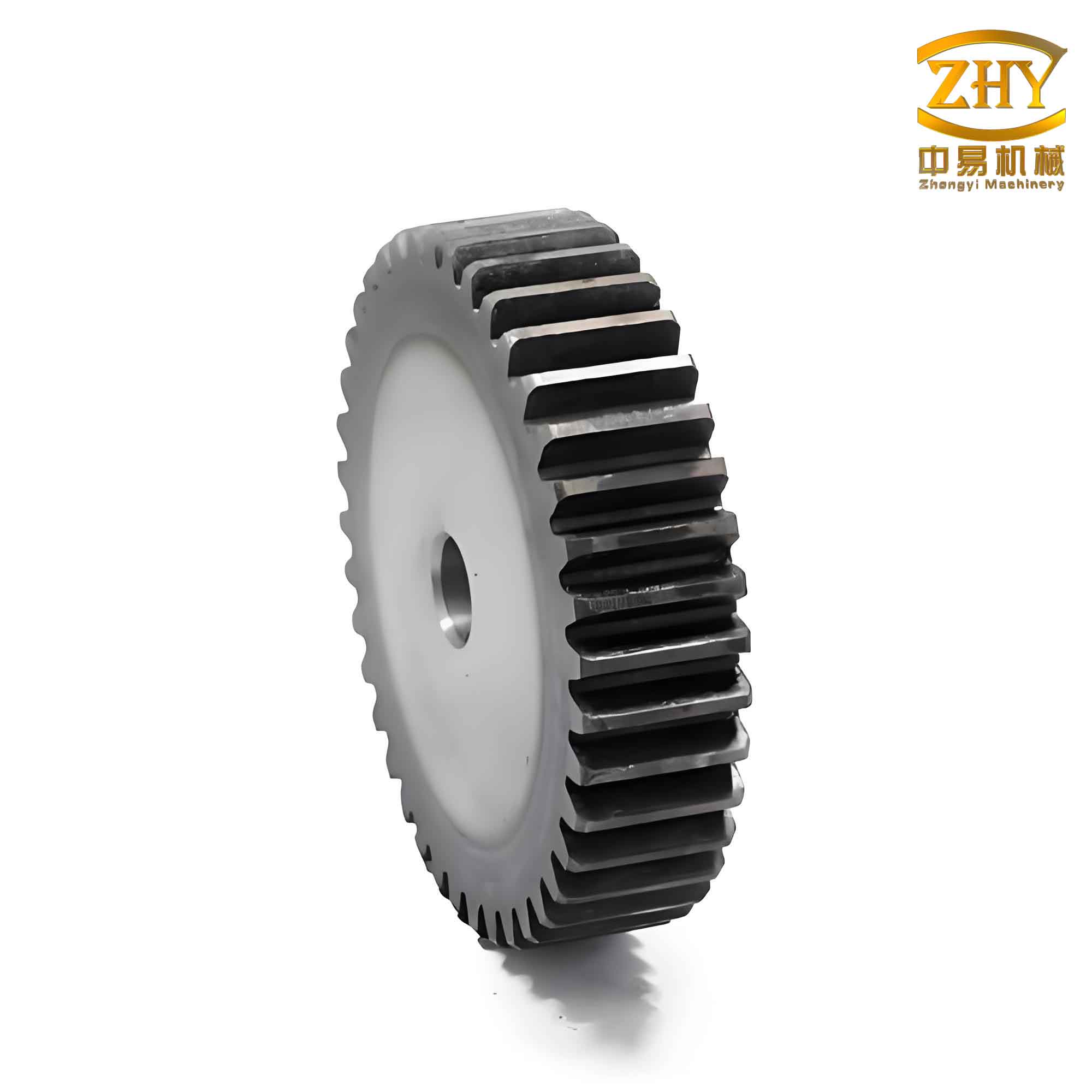
To model the spur and pinion gear system, I start with the geometric and kinematic parameters. The gears are assumed to be standard involute spur gears with perfect alignment. The contact between teeth is simplified as a line contact problem, equivalent to two cylinders with time-varying radii of curvature. The reduced radius of curvature \( R \) and entrainment velocity \( u \) are functions of the position along the meshing line. For a pair of spur and pinion gears, these parameters can be expressed as:
$$ R = \frac{R_1 R_2}{R_1 + R_2}, \quad u = \frac{u_1 + u_2}{2} $$
where \( R_1 \) and \( R_2 \) are the instantaneous radii of curvature for the pinion and gear, respectively, and \( u_1 \) and \( u_2 \) are the surface velocities. The load per unit length \( w \) is derived from the transmitted torque and contact ratio. The lubricant is assumed to be a Newtonian fluid with temperature-dependent properties. The governing equations for thermo-elastohydrodynamic lubrication include the Reynolds equation, elasticity equation, energy equation, and constitutive relations for viscosity and density. The generalized Reynolds equation accounting for thermal effects is:
$$ \frac{\partial}{\partial x} \left( \frac{\rho h^3}{\eta} \frac{\partial p}{\partial x} \right) = 12 u \frac{\partial (\rho h)}{\partial x} $$
where \( p \) is pressure, \( h \) is film thickness, \( \rho \) is density, and \( \eta \) is viscosity. The film thickness equation incorporates elastic deformation:
$$ h(x) = h_0 + \frac{x^2}{2R} – \frac{2}{\pi E’} \int_{-\infty}^{\infty} p(s) \ln |x-s| \, ds $$
with \( h_0 \) as the central film thickness offset, and \( E’ \) as the equivalent elastic modulus. The energy equation for the lubricant film, considering heat conduction and viscous dissipation, is:
$$ \rho c \left( u \frac{\partial T}{\partial x} + w \frac{\partial T}{\partial z} \right) = k \frac{\partial^2 T}{\partial z^2} + \eta \left( \frac{\partial u}{\partial z} \right)^2 $$
where \( T \) is temperature, \( c \) is specific heat, \( k \) is thermal conductivity, and \( w \) is the velocity component in the z-direction. For the solid gears, the heat conduction equations are:
$$ \rho_1 c_1 u_1 \frac{\partial T_1}{\partial x} = k_1 \frac{\partial^2 T_1}{\partial z^2}, \quad \rho_2 c_2 u_2 \frac{\partial T_2}{\partial x} = k_2 \frac{\partial^2 T_2}{\partial z^2} $$
The viscosity-pressure-temperature relation is given by the Roelands equation:
$$ \eta = \eta_0 \exp \left\{ (\ln \eta_0 + 9.67) \left[ -1 + (1 + 5.1 \times 10^{-9} p)^{z_0} \left( \frac{T – 138}{T_0 – 138} \right)^{-s_0} \right] \right\} $$
and the density-pressure-temperature relation is:
$$ \rho = \rho_0 \left[ 1 + \frac{0.6 \times 10^{-9} p}{1 + 1.7 \times 10^{-9} p} – 0.00065 (T – T_0) \right] $$
where subscript 0 denotes ambient conditions. These equations form a strongly nonlinear system that requires numerical solution. I employ a multi-grid method with progressive refinement to achieve convergence efficiently. The computational domain spans from the inlet to the outlet, with the oil supply condition defined by the inlet meniscus position \( x_{\text{in}} \). By varying \( x_{\text{in}} \), I simulate different oil supply levels, from starved to fully flooded conditions.
The parameters for the spur and pinion gear system and lubricant are summarized in Table 1. These values are based on typical industrial applications, ensuring relevance to real-world scenarios.
| Parameter | Symbol | Value | Unit |
|---|---|---|---|
| Module | m | 3 | mm |
| Number of teeth (pinion) | z_1 | 20 | – |
| Number of teeth (gear) | z_2 | 40 | – |
| Pressure angle | α | 20 | ° |
| Face width | b | 20 | mm |
| Elastic modulus | E | 2.2 × 10¹¹ | Pa |
| Poisson’s ratio | ν | 0.3 | – |
| Density (gear material) | ρ_g | 7850 | kg/m³ |
| Ambient viscosity | η_0 | 0.04 | Pa·s |
| Ambient density (lubricant) | ρ_0 | 870 | kg/m³ |
| Specific heat (lubricant) | c | 2000 | J/(kg·K) |
| Thermal conductivity (lubricant) | k | 0.14 | W/(m·K) |
| Ambient temperature | T_0 | 313 | K |
| Input torque | T_in | 100 | N·m |
| Rotational speed (pinion) | n_1 | 1500 | rpm |
Using the multi-grid method, I obtain numerical solutions for pressure and film thickness at the engagement point, pitch point, and disengagement point of the spur and pinion gear mesh. The oil supply condition is characterized by the dimensionless inlet position \( -x_{\text{in}}/b \), where \( b \) is the semi-width of the Hertzian contact. As \( -x_{\text{in}}/b \) increases, the oil supply becomes more abundant. I analyze the effective oil film thickness \( h_{\text{oil}} \) and central film thickness \( h_{\text{cen}} \) as functions of \( -x_{\text{in}}/b \). The results reveal distinct behaviors at each meshing point due to thermal effects.
At the engagement point, where the teeth first make contact, the film thickness variations are shown in Table 2. For \( -x_{\text{in}}/b \) values from 1.0 to 10.5, \( h_{\text{oil}} \) and \( h_{\text{cen}} \) exhibit complex trends. Under severe starvation (\( -x_{\text{in}}/b \approx 1 \)), both thicknesses are low, but as \( -x_{\text{in}}/b \) increases, \( h_{\text{oil}} \) rises rapidly, reaching a peak at \( -x_{\text{in}}/b = 2.0 \). Beyond this, \( h_{\text{oil}} \) stabilizes, indicating a saturation effect. Interestingly, \( h_{\text{cen}} \) shows oscillations in the starved region, with local maxima and minima. This thermal oscillation phenomenon is attributed to the interplay between viscous heating and heat conduction, which temporarily enhances film formation even under limited oil supply. At \( -x_{\text{in}}/b = 5.50 \), both thicknesses maximize, and further increases do not alter them, defining a critical oil supply point.
| \( -x_{\text{in}}/b \) | \( h_{\text{oil}} \) (μm) | \( h_{\text{cen}} \) (μm) | Observation |
|---|---|---|---|
| 1.0 | 0.05 | 0.03 | Severe starvation |
| 1.5 | 0.12 | 0.08 | Rapid increase |
| 2.0 | 0.18 | 0.15 | Peak \( h_{\text{oil}} \) |
| 3.0 | 0.17 | 0.14 | Stabilization |
| 5.5 | 0.19 | 0.17 | Maximum both |
| 7.0 | 0.19 | 0.17 | No change |
| 10.5 | 0.19 | 0.17 | Critical point reached |
The pressure and film thickness distributions at the engagement point are further analyzed. Under starved conditions (\( -x_{\text{in}}/b = 1.5 \)), the thermal effect reduces film thickness slightly compared to isothermal cases, but the second pressure peak diminishes. In fully flooded conditions (\( -x_{\text{in}}/b = 10.0 \)), thermal effects have minimal impact on film thickness, yet the pressure profile flattens. This suggests that for spur and pinion gears, thermal considerations are crucial in starved regimes but less so in abundant oil supply.
At the pitch point, where the relative sliding velocity is zero, the film thickness behavior differs. As shown in Table 3, \( h_{\text{oil}} \) and \( h_{\text{cen}} \) increase with \( -x_{\text{in}}/b \) until a critical point around \( -x_{\text{in}}/b = 3.50 \). Similar oscillations occur in the starved region, but the discrepancy between \( h_{\text{oil}} \) and \( h_{\text{cen}} \) narrows. This indicates that thermal effects homogenize the film thickness distribution at the pitch point. Under starved conditions, thermal heating actually increases film thickness, contrary to the engagement point, while in flooded conditions, it slightly decreases thickness. This reversal highlights the complex thermal mechanics at different meshing phases of spur and pinion gears.
| \( -x_{\text{in}}/b \) | \( h_{\text{oil}} \) (μm) | \( h_{\text{cen}} \) (μm) | Observation |
|---|---|---|---|
| 1.0 | 0.06 | 0.04 | Starved |
| 2.0 | 0.14 | 0.12 | Increasing |
| 3.5 | 0.20 | 0.19 | Critical point |
| 5.0 | 0.20 | 0.19 | Stable |
| 7.0 | 0.20 | 0.19 | No change |
The pressure distributions at the pitch point show that thermal effects reduce the second pressure peak in both starved and flooded conditions. This reduction can mitigate stress concentrations, potentially improving the fatigue life of spur and pinion gears. The film thickness profiles become smoother, suggesting enhanced lubrication efficiency due to thermal averaging.
At the disengagement point, where teeth separate, the film thickness trends are simpler. As per Table 4, both \( h_{\text{oil}} \) and \( h_{\text{cen}} \) rise until \( -x_{\text{in}}/b = 5.50 \), then plateau. Thermal effects have negligible impact on film thickness here, but they still influence pressure distributions by suppressing secondary peaks. This implies that for spur and pinion gears, the disengagement point is less sensitive to thermal variations, possibly because the contact load decreases as teeth exit mesh.
| \( -x_{\text{in}}/b \) | \( h_{\text{oil}} \) (μm) | \( h_{\text{cen}} \) (μm) | Observation |
|---|---|---|---|
| 1.0 | 0.04 | 0.02 | Starved |
| 3.0 | 0.15 | 0.13 | Growth |
| 5.5 | 0.21 | 0.20 | Maximum |
| 8.0 | 0.21 | 0.20 | Stable |
The overall discussion centers on the critical oil supply point, which I define as the minimum \( -x_{\text{in}}/b \) beyond which film thickness ceases to increase. For spur and pinion gears, this point varies with meshing position: around 2.0 at engagement, 3.5 at pitch, and 5.5 at disengagement. Exceeding these values wastes lubricant without improving lubrication. The thermal oscillations in starved regions are mathematically explained by perturbations in the energy equation. Consider a simplified form:
$$ \frac{d^2 T}{dz^2} = -\frac{\eta}{k} \left( \frac{du}{dz} \right)^2 $$
Integrating this under boundary conditions yields temperature fluctuations that affect viscosity locally, causing film thickness oscillations. This phenomenon can be modeled as:
$$ \Delta h \propto \int \left( \frac{\partial \eta}{\partial T} \Delta T \right) dx $$
where \( \Delta T \) is the temperature variation. In spur and pinion gears, these oscillations may enhance lubrication temporarily, but they also introduce instability that requires careful design.
To generalize the findings, I derive dimensionless groups that govern the thermo-EHL behavior in spur and pinion gears. The thermal load parameter \( \Lambda \) is defined as:
$$ \Lambda = \frac{\eta_0 u^2}{k T_0} $$
and the starvation parameter \( S \) as:
$$ S = \frac{x_{\text{in}}}{b} $$
Plotting \( h_{\text{cen}} / R \) against \( \Lambda \) and \( S \) reveals universal curves for different gear sizes. For example, at high \( \Lambda \), thermal effects dominate, reducing film thickness except in starved regimes where oscillations occur. This insight aids in scaling lubrication systems for various spur and pinion gear applications.
In practical terms, the results suggest that for spur and pinion gears operating under starved conditions, thermal effects should not be ignored, as they can improve film thickness through oscillations. However, excessive oil supply beyond the critical point is inefficient. Designers should optimize oil injection positions to target the engagement and pitch points, where thermal sensitivity is highest. Computational models like the one developed here can predict critical points for specific gear parameters, enabling tailored lubrication strategies.
In conclusion, this analysis of spur and pinion gears considering thermal effects reveals complex interactions between oil supply and film formation. Thermal oscillations in starved regions can enhance lubrication, while critical oil supply points exist beyond which no benefit accrues. The engagement and pitch points are most affected, highlighting the need for localized thermal management. Future work could extend this model to include non-Newtonian lubricants or micropitting effects, further advancing the tribology of spur and pinion gears. By integrating thermal analyses into gear design, we can achieve more efficient and durable transmission systems, underscoring the importance of multidisciplinary approaches in mechanical engineering.