
In modern mechanical engineering, the spur and pinion gear remains one of the most fundamental and widely utilized components for power transmission. Their performance, durability, and reliability are paramount, directly influencing the operational efficiency and service life of entire machinery systems, from heavy industrial equipment to advanced automotive drivetrains. As economic development drives the demand for larger and more heavily loaded machinery, the requirement for large-scale, high-performance spur and pinion gears has surged. Enhancing the quality and longevity of these gears can yield substantial economic benefits for the heavy machinery sector. The primary failure modes of spur and pinion gears are typically categorized into two types: tooth breakage due to bending stress, and various forms of surface damage—such as pitting, spalling, plastic deformation, and wear—caused by contact stress. Notably, for large gears, a significant proportion of failures are attributed to surface damage under contact stress, where wear-induced destruction of the correct geometric meshing relationship often leads to even shorter service life.
Heat treatment is a critical process in gear manufacturing, dictating the final microstructure and mechanical properties. For large spur and pinion gears, conventional through-hardening methods can be energy-intensive and may introduce excessive distortion. Localized induction heating offers a targeted and efficient alternative, allowing for the selective strengthening of specific, high-stress regions like the tooth flank and root. This process involves using an alternating electromagnetic field generated by an induction coil to rapidly heat a confined surface layer of the gear tooth, which is subsequently quenched to form a hard martensitic case while maintaining a tough core. The precision and efficiency of this method hinge on a deep understanding of the complex multi-physics phenomena involved.
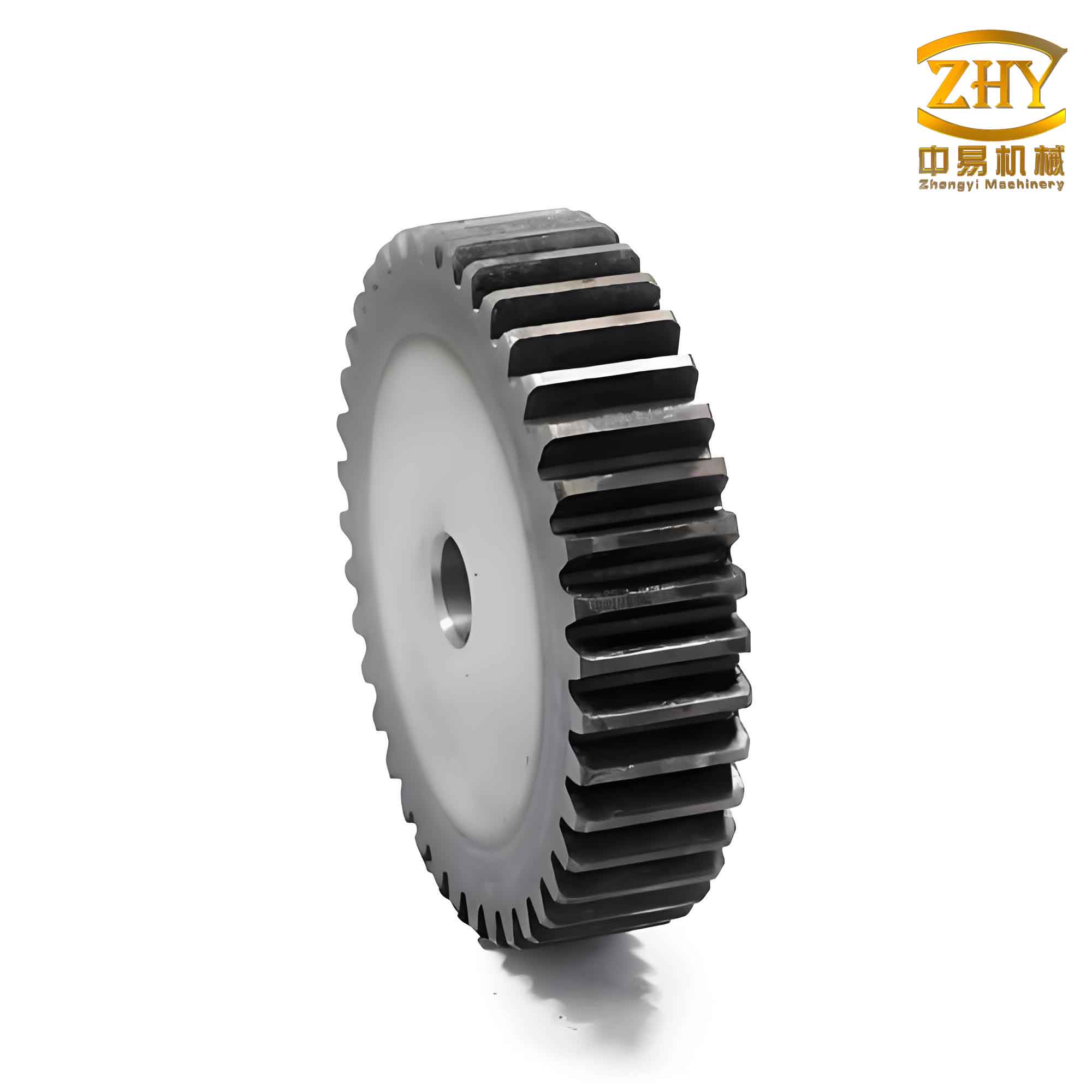
To optimize the quality of induction heat treatment, researchers globally have turned to finite element analysis (FEA) for simulating the process. Studies have modeled coupled electromagnetic-thermal-structural fields in moving induction heating setups for steel plates, revealing temperature and stress distribution patterns influenced by edge effects. Other works have numerically investigated the impact of ferromagnetic concentrator (magnetizer) geometry on localized heating, identifying optimal dimensions for heating rate and temperature uniformity. For instance, research on induction heating for injection molds showed that a specific magnetizer spacing resulted in the highest temperature uniformity on the workpiece’s inner surface. The advancement of such simulation techniques has directly facilitated the application of induction hardening to large transmission components like spur and pinion gears, racks, and ring gears. Simulations of quenching processes for carburized gears have provided guidance on temperature and residual stress fields, while studies on large gear racks have compared quenching processes to prevent cracking. Research specific to internal ring gears for wind turbines has optimized induction coil placement and travel speed to minimize temperature gradient. Building upon this foundation, this analysis employs a sophisticated FEA approach to simulate the local induction heating process of a large spur and pinion gear, focusing not only on the transient temperature field but also on the evolving thermal stress field and their respective uniformities under different heating configurations.
Mathematical Foundation for Multi-Physics Simulation
The induction heating process is a highly nonlinear, transient, and coupled phenomenon involving electromagnetic fields, heat transfer, and thermo-elasto-plastic deformation. Accurately modeling this for a spur and pinion gear requires solving the governing equations for each physical domain and their interactions.
1. Electromagnetic Field and Heat Generation
The core principle is electromagnetic induction. A time-harmonic alternating current in the coil generates a time-varying magnetic field, which induces eddy currents within the conductive gear material (typically steel). The flow of these eddy currents, resisted by the material’s electrical resistivity, results in Joule heating (Q). The heat generation rate per unit volume is given by:
$$ Q = \frac{1}{2} \rho |J|^2 $$
where $\rho$ is the electrical resistivity and $J$ is the induced current density phasor. The distribution of $J$ is governed by Maxwell’s equations and is highly concentrated near the surface due to the “skin effect.” The skin depth $\delta$, which dictates the thickness of the heated layer, is:
$$ \delta = \sqrt{\frac{\rho}{\pi \mu f}} $$
Here, $f$ is the frequency of the alternating current and $\mu$ is the magnetic permeability. Crucially, for ferromagnetic steels like the AISI 1045 commonly used for spur and pinion gears, $\mu$ is high at temperatures below the Curie point (~768°C), leading to a shallow skin depth and concentrated surface heating. Above the Curie temperature, the material becomes paramagnetic ($\mu \approx \mu_0$), causing a sudden increase in skin depth and a significant drop in heating efficiency.
2. Transient Temperature Field
The temperature distribution $T(x,y,z,t)$ within the spur and pinion gear is governed by the three-dimensional nonlinear transient heat conduction equation:
$$ \frac{\partial}{\partial x} \left( \lambda \frac{\partial T}{\partial x} \right) + \frac{\partial}{\partial y} \left( \lambda \frac{\partial T}{\partial y} \right) + \frac{\partial}{\partial z} \left( \lambda \frac{\partial T}{\partial z} \right) + Q = \rho_m c_p \frac{\partial T}{\partial t} $$
where $\lambda$ is the temperature-dependent thermal conductivity, $\rho_m$ is the material density, $c_p$ is the temperature-dependent specific heat capacity, and $Q$ is the internal heat generation rate from Joule heating. To solve this equation, initial and boundary conditions are required. The initial condition is typically the ambient temperature:
$$ T(x,y,z,0) = T_{\infty} $$
The boundary condition on the gear surface accounts for both convective and radiative heat losses to the environment:
$$ -\lambda \frac{\partial T}{\partial n} = h (T – T_{\infty}) + \epsilon \sigma_{SB} (T^4 – T_{\infty}^4) $$
where $h$ is the convective heat transfer coefficient, $\epsilon$ is the surface emissivity, $\sigma_{SB}$ is the Stefan-Boltzmann constant, and $n$ is the surface normal direction.
3. Transient Thermal Stress Field
The non-uniform temperature field induces thermal strains, which, when constrained by the cooler material in the gear’s interior, generate thermal stresses. Modeling this requires a thermo-elasto-plastic constitutive model. The total strain increment $d\{\varepsilon\}$ is decomposed into elastic $d\{\varepsilon^e\}$, plastic $d\{\varepsilon^p\}$, and thermal $d\{\varepsilon^{th}\}$ components:
$$ d\{\varepsilon\} = d\{\varepsilon^e\} + d\{\varepsilon^p\} + d\{\varepsilon^{th}\} $$
The thermal strain increment is $d\{\varepsilon^{th}\} = \alpha \cdot dT \cdot \{I\}$, where $\alpha$ is the coefficient of thermal expansion and $\{I\}$ is the identity vector. The stress-strain relationship in incremental form, using the Prandtl-Reuss flow rule and the von Mises yield criterion with isotropic hardening, is expressed differently for elastic and plastic regimes. For the elastic regime:
$$ d\{\sigma\} = [D^e] (d\{\varepsilon\} – d\{\varepsilon^{th}\}) $$
For the plastic regime:
$$ d\{\sigma\} = [D^{ep}] (d\{\varepsilon\} – d\{\varepsilon^{th}\}) + d\{\sigma^{th}\} $$
Here, $[D^e]$ is the elastic stiffness matrix, $[D^{ep}]$ is the elasto-plastic stiffness matrix ($[D^{ep}] = [D^e] – [D^p]$, where $[D^p]$ is the plastic matrix), and $d\{\sigma^{th}\}$ is an adjustment term accounting for temperature-dependent yield stress changes. The yield condition is:
$$ \bar{\sigma} = H(\int d\bar{\varepsilon}^p, T) $$
where $\bar{\sigma}$ is the von Mises equivalent stress, $H$ is the hardening function, and $\int d\bar{\varepsilon}^p$ is the accumulated equivalent plastic strain.
4. Metrics for Uniformity Assessment
To quantitatively compare the effectiveness of different heating schemes for the spur and pinion gear, statistical metrics for temperature and stress uniformity are essential. For a set of $N$ data points (e.g., temperatures at selected nodes) with values $X_i$ and mean value $\bar{X}$, the standard deviation $\sigma_X$ is:
$$ \sigma_X = \sqrt{ \frac{1}{N} \sum_{i=1}^{N} (X_i – \bar{X})^2 } $$
The uniformity $\eta_X$ (often expressed as a percentage) is then defined as:
$$ \eta_X = \left( 1 – \frac{\sigma_X}{\bar{X}} \right) \times 100\% $$
A higher uniformity percentage indicates a more homogeneous distribution of temperature or stress within the region of interest, which is generally desirable for consistent hardening results in a spur and pinion gear.
Finite Element Modeling of Gear Induction Heating
The simulation was conducted using a sequentially coupled approach. First, the electromagnetic field was solved to obtain the time-averaged heat generation ($Q$) distribution. This heat source was then imported into a transient thermal analysis to calculate the temperature history. Finally, the temperature history was used as a thermal load in a transient structural analysis to compute the thermal stresses.
The subject was a large spur and pinion gear with a module of 40 mm, 35 teeth, and a face width of 80 mm, modeled from AISI 1045 steel. Due to symmetry and to reduce computational cost, a single-tooth segment was analyzed. A key aspect was mesh refinement: a fine, uniform mesh was applied to a 4 mm thick surface layer on the tooth flank to capture steep thermal and stress gradients, while a coarser, graded mesh was used for the core. The induction system consisted of a multi-turn copper coil and U-shaped ferrite magnetizers to concentrate the magnetic flux on the target tooth flank area.
Two distinct heating schemes (coil placements) were investigated, as summarized in the table below:
| Feature | Scheme 1 | Scheme 2 |
|---|---|---|
| Coil Orientation | Coil length aligned with the gear axis (z-direction). | Coil length aligned perpendicular to the gear axis (across the tooth face width). |
| Primary Heating Direction | Heating band oriented along the tooth height (y-direction). | Heating band oriented along the tooth face width (z-direction). |
| Target Region | Central band along the tooth flank’s height. | Central band across the tooth flank’s width. |
| Analysis Plane | Mid-plane along the face width (x-z plane). | Mid-plane along the tooth height (x-y plane). |
Material properties for AISI 1045 steel, including resistivity, permeability, thermal conductivity, specific heat, Young’s modulus, yield strength, and thermal expansion coefficient, were defined as nonlinear functions of temperature to ensure simulation accuracy.
Simulation Results and Discussion
Transient Temperature Field Evolution
The temperature fields for both schemes after 5 seconds of heating reveal distinct patterns. In both cases, the highest temperature zone is concentrated directly beneath the inductor. For Scheme 1, the hot zone forms a band along the tooth height; for Scheme 2, it forms a band across the tooth width. The temperature evolution at specific observation points (O at the center, and points A-E radiating outwards) shows a rapid initial rise. The central point O reaches the Curie temperature (~768°C) at approximately 1.7 seconds, after which its heating rate drastically slows due to the loss of ferromagnetism. Points farther from O heat more slowly, with those outside the magnetizer’s projection showing significantly lower heating rates. In the depth direction (from surface O inwards), heating rates decrease rapidly with distance due to the skin effect.
The following table summarizes key temperature metrics at selected points and times for Scheme 1:
| Observation Point | Location Relative to O | Temp. at 1s (°C) | Temp. at 2.5s (°C) | Temp. at 5s (°C) |
|---|---|---|---|---|
| O (Center) | Surface, Projection Center | 520 | 810 | 853 |
| B1 | Surface, +8 mm along tooth height | 280 | 605 | 750 |
| D1 | Surface, +24 mm along tooth height | 95 | 215 | 385 |
| 1mm below O | 1 mm below surface at O | 205 | 570 | 710 |
| 3mm below O | 3 mm below surface at O | 50 | 135 | 295 |
The evolution of temperature uniformity $\eta_T$ for the heated surface region is critical. Both schemes start at 100% uniformity (ambient temperature). Uniformity plummets initially as the center heats much faster than the edges. As heating continues and thermal conduction begins to redistribute energy, and as the central zone passes the Curie point, the rate of uniformity decline slows, eventually reversing. After about 2.7 seconds, $\eta_T$ stabilizes. At the 5-second mark, Scheme 1 achieves a final temperature uniformity of 92.62%, while Scheme 2 achieves 90.28%. This indicates that for this specific spur and pinion gear geometry and coil setup, aligning the coil along the gear axis (Scheme 1) produces a slightly more uniform surface temperature distribution.
Transient Thermal Stress Field Evolution
The development of thermal stress is more complex than temperature. The stress at all observation points follows a characteristic trend: a rapid initial increase to a peak, followed by a decline and eventual stabilization. Point O, for example, experiences a steep rise in compressive stress (in the surface plane) as the hot surface layer attempts to expand but is constrained by cooler underlying material. It reaches a maximum von Mises stress of approximately 354-355 MPa around 0.4 seconds, which exceeds the temperature-depressed yield strength of the material at that instant, initiating localized plastic deformation (yielding). As temperature continues to rise, the material’s yield strength further decreases, and stress relaxation via plastic flow occurs, leading to the observed stress reduction. Points farther from O experience lower stress magnitudes and a delayed, less pronounced peak. Points in the cooler regions (like D1, E1) have a higher yield strength and can sustain higher elastic stresses without yielding, hence their peak stress can be higher relative to their temperature.
The following table compares key stress parameters between the two schemes for the central surface point O:
| Parameter | Scheme 1 | Scheme 2 |
|---|---|---|
| Peak Von Mises Stress at O | 354.16 MPa | 355.11 MPa |
| Time to Peak Stress | ~0.4 s | ~0.4 s |
| Stress at O (5s) | ~180 MPa | ~175 MPa |
| Final Stress Uniformity $\eta_S$ (5s) | 91.78% | 97.90% |
The evolution of stress uniformity $\eta_S$ reveals a fascinating and non-intuitive pattern. Unlike temperature uniformity, it does not change monotonically. It drops sharply initially due to disparate stress build-up rates. Then, as some points (like O) yield and their stress decreases while others are still in the elastic loading phase, the stresses can temporarily become more similar, causing a brief increase in $\eta_S$. Subsequently, as different zones undergo yielding and relaxation at different times, $\eta_S$ may fluctuate before converging. Importantly, after 4 seconds of heating, both schemes achieve good stress uniformity. Notably, at 5 seconds, Scheme 2 demonstrates a significantly higher stress uniformity (97.9%) compared to Scheme 1 (91.78%), which is the inverse of their temperature uniformity ranking.
Discussion and Implications for Spur and Pinion Gear Manufacturing
The simulation results yield several important insights for the induction hardening of large spur and pinion gears:
1. Efficiency and Targeted Heating: The use of a focused inductor with magnetic concentrators proves highly efficient for localized heating of a spur and pinion gear tooth flank. The rapid heating to austenitizing temperatures (above the Ac3 point) within a few seconds minimizes heat spread to the gear core, reducing the risk of excessive distortion—a critical concern for large, precision spur and pinion gears.
2. The Curie Point Transition: The distinct change in heating rate observed at the Curie temperature is a dominant feature. Process design must account for this. The initial high permeability stage is crucial for creating a sharp, shallow heat-affected zone ideal for case hardening. The subsequent low-efficiency heating phase must be managed to achieve sufficient austenitization depth without excessive overall energy input.
3. Decoupling of Temperature and Stress Uniformity: A paramount finding is that temperature uniformity and thermal stress uniformity do not evolve synchronously. A heating scheme (Scheme 1) that yields better final temperature uniformity does not guarantee better final stress uniformity. For a spur and pinion gear, the transient stress state prior to quenching can influence the final residual stress profile and potentially the risk of distortion or cracking. Therefore, optimization of the induction heating process should consider both thermal and mechanical field uniformities, with the priority depending on the specific gear application and quenching method.
4. Scheme Selection: The choice between Scheme 1 and 2 for a spur and pinion gear depends on the design priorities. If the primary goal is exceptionally uniform austenitization temperature before quenching (to ensure consistent hardness depth), Scheme 1 might be favored. If minimizing thermal stress gradients during the heating phase is critical (e.g., for a complex gear geometry prone to distortion), Scheme 2 shows a clear advantage based on this simulation. In practice, a scanning induction hardening process, where the inductor moves along the tooth profile, might be employed, and the insights from these stationary simulations form the basis for optimizing such dynamic processes.
5. Predictive Power of Simulation: This work underscores the vital role of coupled multi-physics FEA as a predictive tool in the manufacturing of high-performance spur and pinion gears. It allows engineers to virtually test different inductor geometries, power settings, frequencies, and heating patterns before physical trials, saving significant time and cost while enabling the development of robust, high-quality hardening processes.
Conclusion
This detailed numerical investigation into the local induction heating process of a large-scale spur and pinion gear provides a comprehensive view of the coupled electromagnetic-thermal-structural phenomena. The simulations successfully capture the rapid, nonlinear heating, the significant influence of the ferromagnetic-to-paramagnetic transition at the Curie point, and the complex development of thermal stresses leading to localized yielding.
Key quantitative findings include the attainment of austenitizing temperatures in under 2 seconds, peak surface thermal stresses of ~355 MPa occurring within 0.4 seconds, and final (5s) temperature uniformities of 92.62% and 90.28% for Schemes 1 and 2, respectively. Most significantly, the analysis reveals that thermal stress uniformity follows a different evolutionary path than temperature uniformity, with Scheme 2 achieving a superior final stress uniformity of 97.9% compared to 91.78% for Scheme 1.
For manufacturers of critical power transmission components like spur and pinion gears, these insights are invaluable. They highlight that process optimization must extend beyond achieving a target temperature profile to include management of the transient thermo-mechanical state. The methodology and findings presented here serve as a foundational guide for designing and refining localized induction hardening processes, ultimately contributing to the production of more durable, reliable, and efficient large spur and pinion gears for demanding industrial applications. Future work will involve coupling these heating simulations with subsequent quenching and microstructure transformation models to predict the final hardness and residual stress states in the hardened spur and pinion gear tooth.