
In mechanical transmission systems, involute spur gears are widely used due to their advantages such as ease of machining, high transmission ratios, insensitivity to installation errors, and long service life. However, traditional parametric modeling methods for spur and pinion gear pairs, which often rely on simplified tooth profile equations, may introduce significant errors when studying contact characteristics. These errors can adversely affect the accuracy of finite element simulations and dynamic analyses, particularly in applications requiring high precision, such as automotive transmissions or industrial machinery. In this study, I propose a joint modeling approach that combines MATLAB and SolidWorks to generate highly accurate tooth profiles for spur and pinion gears. This method focuses on creating precise point cloud models of the gear tooth profiles, including the often-neglected transition curve region, which is critical for bending strength analysis. By comparing the contact stress results from theoretical calculations, finite element simulations, and dynamic simulations between joint-modeled and parametrically modeled gear pairs, I demonstrate the superiority of the joint modeling approach in achieving more reliable and accurate outcomes for contact特性 research.
The tooth profile of an involute spur gear consists of four distinct segments: the addendum circle, the involute curve, the transition curve, and the dedendum circle. Each segment plays a vital role in the overall performance of spur and pinion gear systems. The involute curve is primarily responsible for the meshing action and contact characteristics, while the transition curve, though not directly involved in meshing, significantly influences the gear’s bending strength and fatigue life. Traditional parametric modeling often approximates the transition curve with a simple arc or an extension of the involute curve, leading to inaccuracies in stress analysis. To address this, I derived precise mathematical equations for both the involute and transition curves based on gear cutting processes, such as those involving rack-type cutting tools. These equations form the foundation for generating accurate point cloud data in MATLAB.
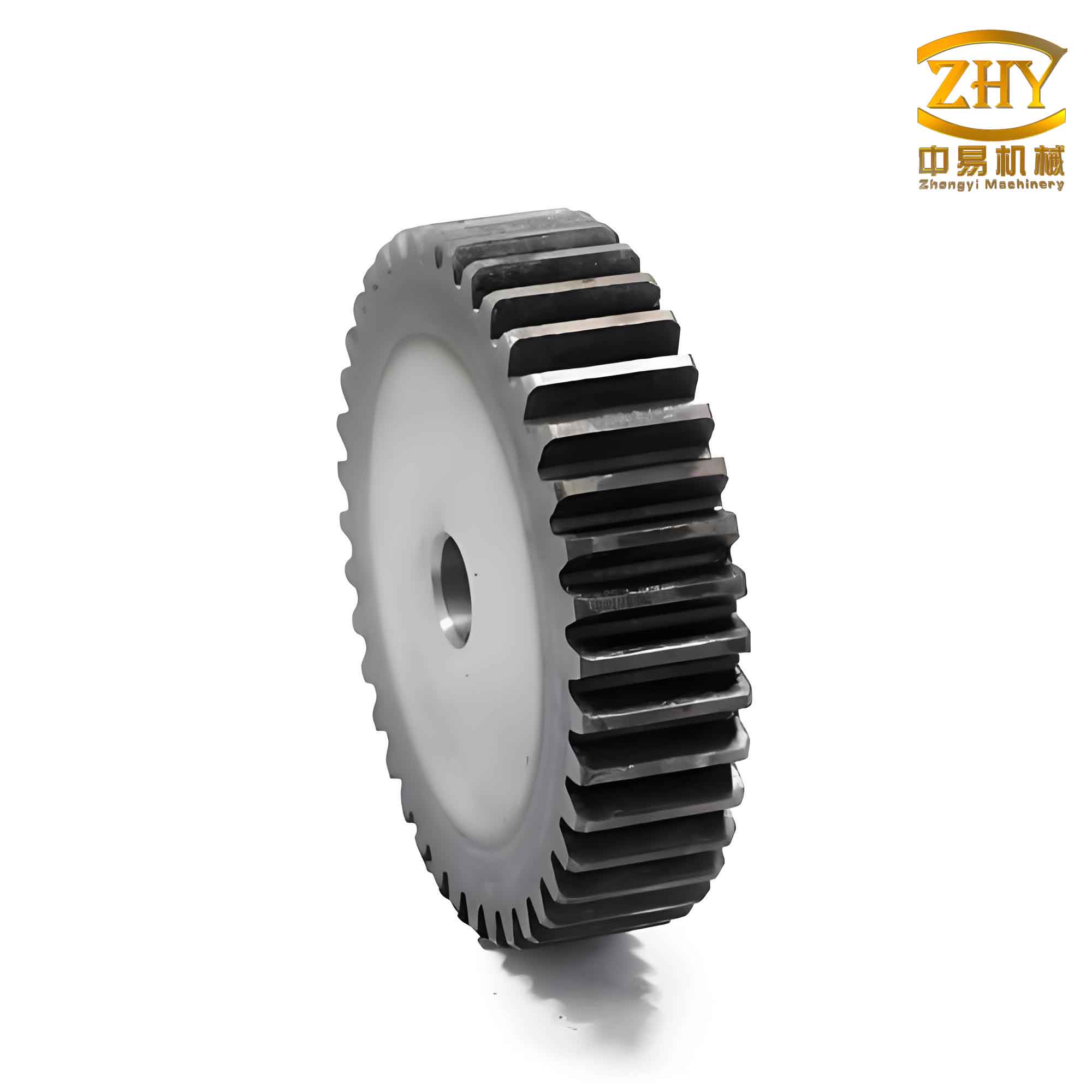
The involute curve in a spur and pinion gear can be represented in Cartesian coordinates using the following parametric equations derived from gear geometry. For a gear with base radius \(r_b\) and pressure angle \(\alpha\), the coordinates \((x, y)\) of points on the involute are given by:
$$ x = r_b (\cos(\theta) + \theta \sin(\theta)), $$
$$ y = r_b (\sin(\theta) – \theta \cos(\theta)), $$
where \(\theta\) is the roll angle parameter ranging from the start of the involute at the base circle to the end at the addendum circle. This formulation ensures an exact representation of the tooth flank for spur and pinion gear applications. For the transition curve, which results from the tool tip radius during gear generation, I employed an extended epicycloid equation. Assuming a tool with tip radius \(\rho\) and specific geometric offsets, the transition curve coordinates can be expressed as:
$$ x_t = (r + \rho) \cos(\phi) – a_1 \cos(\alpha’) – \rho \cos(\alpha’ + \phi), $$
$$ y_t = (r + \rho) \sin(\phi) – a_1 \sin(\alpha’) – \rho \sin(\alpha’ + \phi), $$
where \(r\) is the pitch radius of the spur gear, \(a_1\) is the distance from the tool tip center to the midline, \(\alpha’\) is the angle between the normal line and the tool pitch line, and \(\phi\) is a parameter derived from tool geometry. These equations account for the precise shape of the tooth root, which is essential for accurate stress analysis in spur and pinion gear systems.
To implement this, I developed a MATLAB script that computes these equations for a given set of gear parameters. The script generates dense point clouds for both the involute and transition curves, ensuring high resolution for accurate modeling. Key gear parameters, such as module, pressure angle, number of teeth, and addendum coefficients, are input into the program. The output is a set of text files containing XYZ coordinates for the tooth profile points. This point cloud data serves as the basis for constructing the gear geometry in SolidWorks. Below is a summary of the fundamental gear parameters used in this study for the spur and pinion gear pair:
| Parameter | Symbol | Value for Pinion | Value for Gear | Unit |
|---|---|---|---|---|
| Module | \(m\) | 2 | 2 | mm |
| Pressure Angle | \(\alpha\) | 20 | 20 | degrees |
| Number of Teeth | \(z\) | 19 | 23 | – |
| Face Width | \(b\) | 10 | 10 | mm |
| Addendum Coefficient | \(h_a^*\) | 1.0 | 1.0 | – |
| Dedendum Coefficient | \(c^*\) | 0.25 | 0.25 | – |
| Pitch Diameter | \(d\) | 38 | 46 | mm |
| Base Diameter | \(d_b\) | 35.708 | 43.232 | mm |
| Addendum Diameter | \(d_a\) | 42 | 50 | mm |
| Dedendum Diameter | \(d_f\) | 33 | 41 | mm |
These parameters are critical for defining the geometry of the spur and pinion gear pair. The MATLAB program calculates additional derived parameters, such as the contact ratio, which influences the load distribution during meshing. The contact ratio \(\varepsilon_\alpha\) is determined by the overlap of tooth engagements and is computed using standard gear theory formulas:
$$ \varepsilon_\alpha = \frac{1}{2\pi} \left[ \sqrt{d_{a1}^2 – d_{b1}^2} + \sqrt{d_{a2}^2 – d_{b2}^2} – a \sin(\alpha) \right] / (m \cos(\alpha)), $$
where \(d_{a1}\) and \(d_{a2}\) are the addendum diameters of the pinion and gear, \(d_{b1}\) and \(d_{b2}\) are their base diameters, and \(a\) is the center distance. For the given spur and pinion gear pair, the contact ratio is approximately 1.7, indicating smooth and continuous meshing with multiple tooth contact zones.
Once the point cloud data is generated, I import it into SolidWorks using the “Curve Through XYZ Points” feature to create precise sketch profiles for each tooth. This process involves mapping the points to form closed contours for the involute and transition curves, which are then extruded to form solid gear bodies. The resulting three-dimensional models exhibit exact tooth geometries, including the nuanced transition curves that are often approximated in parametric modeling. In contrast, parametric modeling in SolidWorks typically uses built-in gear tools or simplified equations that may not accurately capture the root fillet, leading to discrepancies in stress analysis. The joint modeling approach ensures that every aspect of the spur and pinion gear tooth is represented faithfully, which is essential for subsequent simulations.
After constructing the gear pair, I proceed to theoretical contact stress calculations based on Hertzian contact theory. The contact stress between meshing teeth of a spur and pinion gear pair is a critical factor in design, as it affects pitting resistance and fatigue life. The Hertz formula for contact stress \(\sigma_H\) is given by:
$$ \sigma_H = \sqrt{\frac{F}{\pi B} \cdot \frac{1}{\frac{1-\mu_1^2}{E_1} + \frac{1-\mu_2^2}{E_2}} \cdot \frac{1}{\rho}}, $$
where \(F\) is the normal load per unit width, \(B\) is the length of the contact line, \(\mu_1\) and \(\mu_2\) are Poisson’s ratios for the pinion and gear materials, \(E_1\) and \(E_2\) are their elastic moduli, and \(\rho\) is the equivalent curvature radius at the contact point. For spur and pinion gears, the normal load \(F\) is derived from the transmitted torque \(T\) and pitch diameter \(d\):
$$ F = \frac{2T}{d \cos(\alpha)}. $$
The contact line length \(B\) depends on the face width \(b\) and contact ratio \(\varepsilon_\alpha\), calculated as \(B = b \cdot \varepsilon_\alpha\). The equivalent curvature radius \(\rho\) for two cylinders in contact (approximating gear teeth) is:
$$ \frac{1}{\rho} = \frac{1}{\rho_1} + \frac{1}{\rho_2}, $$
where \(\rho_1\) and \(\rho_2\) are the radii of curvature at the contact point for the pinion and gear, respectively. For a spur and pinion gear pair meshing at the pitch point, these radii can be expressed as \(\rho_1 = \frac{d_1}{2} \sin(\alpha)\) and \(\rho_2 = \frac{d_2}{2} \sin(\alpha)\). Using the gear parameters from the table above, along with an applied torque of 8948.777 N·mm on the pinion, material properties of steel (elastic modulus \(E = 206,000\) MPa, Poisson’s ratio \(\mu = 0.3\)), and a face width of 10 mm, I compute the theoretical contact stress. The results are summarized below:
| Calculation Parameter | Symbol | Value | Unit |
|---|---|---|---|
| Normal Load | \(F\) | 501.215 | N |
| Contact Line Length | \(B\) | 12.346 | mm |
| Equivalent Curvature Radius | \(\rho\) | 6.523 | mm |
| Theoretical Contact Stress | \(\sigma_H\) | 374.935 | MPa |
This theoretical value serves as a benchmark for evaluating the accuracy of finite element simulations. The precise modeling of the spur and pinion gear tooth profiles is expected to yield simulation results closer to this benchmark compared to parametric modeling.
For finite element analysis (FEA), I import the joint-modeled and parametrically modeled spur and pinion gear assemblies into ANSYS Workbench. Both assemblies are configured with identical boundary conditions to ensure a fair comparison. The pinion is subjected to a torque of 8948.777 N·mm, while the gear is fixed in all degrees of freedom. The contact between teeth is defined as frictional with a coefficient of 0.1, and the contact algorithm is set to the generalized Lagrangian method to handle nonlinear behavior accurately. Mesh generation is critical for reliable results; I use a fine mesh with element sizes of 0.1 mm, with localized refinements at the contact regions to capture stress concentrations. The mesh statistics for both models are comparable, with approximately 500,000 nodes and 300,000 elements. The material properties are assigned as linear elastic isotropic steel with \(E = 206,000\) MPa and \(\mu = 0.3\). The FEA setup simulates a static contact scenario at the position of maximum single-tooth engagement to assess peak contact stresses.
The FEA results for the joint-modeled spur and pinion gear pair show a maximum contact stress of 370.31 MPa, which deviates from the theoretical value by only 1.17%. In contrast, the parametrically modeled gear pair yields a maximum contact stress of 423.05 MPa, with a deviation of 12.97%. This significant difference underscores the importance of accurate tooth profile modeling, especially for the transition curve, which affects stress distribution in the root region. The table below compares the results:
| Model Type | FEA Contact Stress (MPa) | Deviation from Theory | Normal Load from FEA (N) |
|---|---|---|---|
| Joint Modeling | 370.31 | 1.17% | 493.4952 |
| Parametric Modeling | 423.05 | 12.97% | 480.4726 |
The normal loads extracted from FEA also align closely with theoretical predictions, further validating the joint modeling approach. The slight variations in normal load are due to mesh discretization and contact algorithm settings, but the joint-modeled spur and pinion gear pair demonstrates superior consistency.
To complement the static analysis, I conduct dynamic simulations using Adams View to evaluate the meshing behavior of the spur and pinion gear pair under operational conditions. Both gear assemblies are imported into Adams, with the pinion assigned a rotational velocity of 1750 rpm (corresponding to the input power of 1.64 kW) and the gear connected to a resistive torque of 8948.777 N·mm. The contact force is calculated using a impact-based contact model with stiffness and damping parameters derived from the material properties. The simulation runs for 5 seconds with 500 steps, capturing dynamic effects such as vibration and load fluctuations. The results indicate that the joint-modeled spur and pinion gear pair exhibits smoother force transmission, with lower amplitude oscillations in the contact force compared to the parametrically modeled pair. The dynamic contact force for the joint-modeled gear averages 493.4952 N, deviating from the theoretical normal load by 1.54%, while the parametric model averages 480.4726 N with a deviation of 4.12%. These findings highlight the enhanced dynamic stability achieved through precise tooth profiling, which minimizes冲击 and wear in spur and pinion gear systems.
The improved accuracy of the joint modeling method can be attributed to several factors. First, the use of exact mathematical equations for both the involute and transition curves eliminates approximations that are common in parametric modeling. Second, the point cloud generation in MATLAB allows for arbitrary resolution, enabling the capture of fine geometric details. Third, the seamless integration with SolidWorks ensures that the digital model faithfully represents the physical gear geometry. This is particularly important for advanced analyses such as fatigue life prediction or noise-vibration-harshness (NVH) studies, where small geometric inaccuracies can lead to erroneous conclusions. In industrial applications, such as automotive transmissions or wind turbine gearboxes, the precise modeling of spur and pinion gears can contribute to more reliable designs and optimized performance.
To further illustrate the mathematical rigor of the approach, I derive additional formulas related to gear geometry. For instance, the base circle diameter \(d_b\) is fundamental to involute generation and is calculated as:
$$ d_b = m z \cos(\alpha). $$
The addendum and dedendum diameters are given by:
$$ d_a = m (z + 2 h_a^*), $$
$$ d_f = m (z – 2 h_a^* – 2 c^*). $$
These equations are embedded in the MATLAB script to automate parameter computation. Moreover, the transition curve formulation accounts for tool geometry variations, which can be adapted for different manufacturing processes. For example, if a gear is cut using a hob with specific tip radius parameters, the equations can be modified accordingly. This flexibility makes the joint modeling approach applicable to a wide range of spur and pinion gear designs.
In terms of simulation accuracy, the contact stress results from FEA are influenced by factors such as mesh density, contact formulation, and boundary conditions. I performed a mesh sensitivity study to ensure convergence, refining the mesh until the change in contact stress was less than 1%. The joint-modeled spur and pinion gear pair required fewer refinements due to its smoother geometry, whereas the parametric model showed oscillations in stress values with mesh changes, indicating geometric discontinuities. This reinforces the notion that precise modeling reduces numerical uncertainties in simulations.
The dynamics of spur and pinion gear meshing involve complex interactions, including time-varying stiffness and damping effects. The equations of motion for a gear pair can be expressed as:
$$ I_1 \ddot{\theta}_1 + c (\dot{\theta}_1 – \dot{\theta}_2) + k(t) (\theta_1 – \theta_2) = T_1, $$
$$ I_2 \ddot{\theta}_2 – c (\dot{\theta}_1 – \dot{\theta}_2) – k(t) (\theta_1 – \theta_2) = -T_2, $$
where \(I_1\) and \(I_2\) are moments of inertia, \(c\) is damping, \(k(t)\) is time-varying mesh stiffness, and \(T_1\) and \(T_2\) are torques on the pinion and gear, respectively. The mesh stiffness \(k(t)\) depends on tooth geometry and contact conditions, which are more accurately represented in the joint-modeled spur and pinion gear pair. This leads to more realistic dynamic simulations, as evidenced by the reduced force fluctuations in Adams results.
From a practical standpoint, the joint modeling methodology offers significant benefits for engineers designing spur and pinion gear systems. By leveraging MATLAB for computational geometry and SolidWorks for solid modeling, it bridges the gap between theoretical design and simulation-ready models. This workflow can be extended to other gear types, such as helical or bevel gears, with appropriate modifications to the equations. Additionally, the point cloud data can be used for additive manufacturing or reverse engineering applications, where exact tooth profiles are crucial.
In conclusion, the joint modeling approach combining MATLAB and SolidWorks produces highly accurate three-dimensional models of spur and pinion gears that are superior to traditional parametric modeling methods. The precise representation of tooth profiles, including the involute and transition curves, leads to finite element and dynamic simulation results that closely match theoretical contact stress calculations. This accuracy is essential for reliable contact特性 analysis, bending strength evaluation, and overall gear design optimization. The methodology demonstrated in this study can be adopted in various industrial contexts to enhance the performance and durability of spur and pinion gear transmissions. Future work may involve extending this approach to include thermal effects, lubrication analysis, or multi-physics simulations for comprehensive gear system design.