
The pursuit of net-shape or near-net-shape manufacturing for complex components like spur and pinion gears represents a significant frontier in advanced manufacturing. Among various techniques, cold precision forging stands out due to its exceptional material savings, elimination of secondary machining operations, and the superior mechanical properties imparted to the forged component, such as continuous grain flow and increased strength. The spur and pinion gear, a fundamental power transmission element, is a prime candidate for this technology. However, the cold closed-die forging of spur and pinion gears is fraught with persistent technical challenges that have limited its widespread adoption.
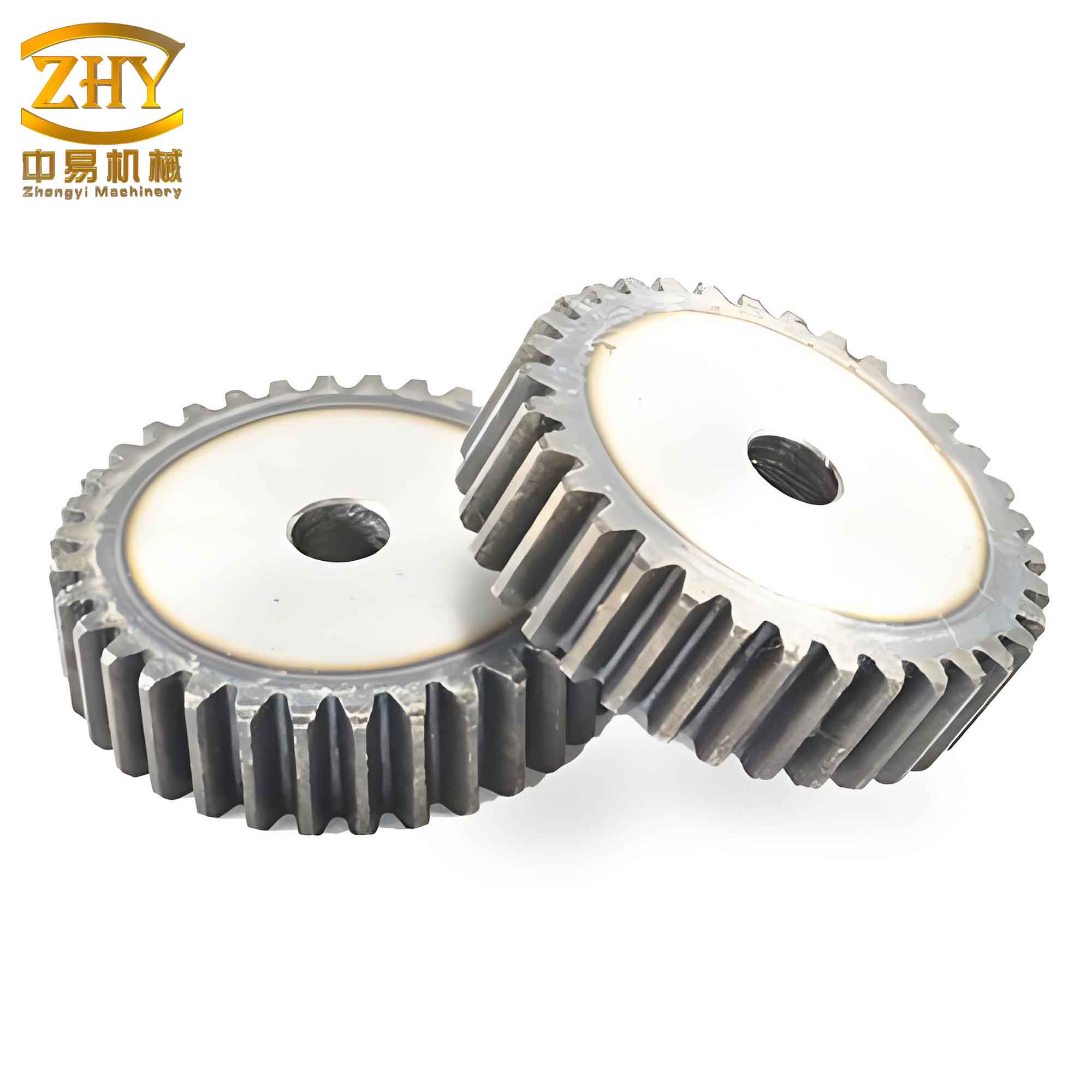
The primary obstacles include the extreme difficulty in completely filling the intricate, deep tooth cavities—especially the corner radii—due to significant frictional resistance and high hydrostatic pressure requirements. Consequently, this leads to prohibitively high forming forces and specific pressures on the tooling. These high stresses dramatically reduce die life, making the process economically unviable for many applications. Traditional solutions, such as the use of floating dies to introduce beneficial axial friction, have offered some improvement but often fall short in sufficiently lowering the peak loads to levels that standard die steels can withstand reliably over long production runs. The quest for a more robust and efficient forging strategy for spur and pinion gears therefore remains critical.
In this investigation, I propose and analyze a novel two-step forging process designed to overcome these limitations. The core innovation lies in the second step: a Localized Loading Process. This approach fundamentally changes the stress state and metal flow during the final forming stage, offering a pathway to superior gear quality and dramatically improved process economics. The complete process sequence is: Billet Preparation → Conventional Closed-Die Pre-forging (with a floating die) → Intermediate Annealing → Localized Loading Final Forging. The effectiveness of this methodology is rigorously evaluated and compared against a conventional two-step closed-die forging process through detailed three-dimensional finite element analysis (FEA).
Process Fundamentals and Numerical Modeling
The proposed localized loading process strategically decouples the tooth filling operation from the overall billet compression. The first step, conventional closed-die pre-forging, is conducted with a floating die. The objective here is not to fill the teeth completely, but to achieve a strategic pre-form. The process is stopped when the forming load reaches a predetermined, safe limit for the die material (e.g., ~1500 MPa specific pressure). This results in a pre-form where material has been gathered and partially distributed into the tooth cavities, as shown in the simulation result. After an intermediate annealing to recrystallize the strain-hardened material, the pre-form enters the final forging stage.
The final forging die assembly features a critical distinction: the upper punch is not solid but annular or ring-shaped. This design enables localized loading. As the punch descends, it contacts and applies pressure only to the land area of the gear’s teeth, not the central hub or shaft section. The central part of the workpiece, which will form a pinion or hub feature, is essentially a free surface during this phase. The final filling of the tooth corners and the simultaneous backward extrusion of the central hub occur under this localized pressure. This contrasts sharply with the conventional final forging, where a solid upper punch compresses the entire top surface of the pre-form, leading to a rapid exponential rise in load during the final corner filling stage.
To quantify and compare the processes, a detailed 3D finite element model was developed. The gear model had a module of 2, 18 teeth, a pressure angle of 20°, and a height of 12 mm with a central boss. A two-tooth sector model was utilized, leveraging symmetry to reduce computational cost while maintaining accuracy. The workpiece material was modeled as a plastic von Mises material, specifically AISI 1010 steel, with its room-temperature stress-strain curve defined in the software library. The dies were treated as rigid bodies. The key simulation parameters are summarized in the table below:
| Parameter | Value / Description |
|---|---|
| Workpiece Material | AISI 1010 (10# Steel) |
| Workpiece Initial Size | Ø30 mm × 19.4 mm |
| Die Material Model | Rigid |
| Friction Factor (Shear) | m = 0.12 |
| Forging Temperature | 20°C (Isothermal) |
| Punch Speed | 5 mm/s |
| Pre-forging Stop Load | 150 kN |
The mathematical foundation for plastic deformation is governed by the yield criterion and flow rules. For the cold forging of a spur and pinion gear, the von Mises yield criterion is applicable:
$$ \sigma_e = \sqrt{\frac{1}{2}\left[(\sigma_1 – \sigma_2)^2 + (\sigma_2 – \sigma_3)^2 + (\sigma_3 – \sigma_1)^2\right]} = \bar{\sigma}(\bar{\varepsilon}, \dot{\bar{\varepsilon}}) $$
where $\sigma_e$ is the equivalent stress, $\sigma_1, \sigma_2, \sigma_3$ are the principal stresses, $\bar{\sigma}$ is the flow stress, $\bar{\varepsilon}$ is the equivalent strain, and $\dot{\bar{\varepsilon}}$ is the equivalent strain rate. The constitutive relation $\bar{\sigma}(\bar{\varepsilon}, \dot{\bar{\varepsilon}})$ for AISI 1010 captures the strain-hardening behavior critical for accurate load prediction.
Simulation Results and Comparative Analysis
Pre-forging Outcome
The pre-forging simulation, halted at 150 kN, successfully created a pre-form with significant material accumulation in the tooth region. The specific pressure was approximately 1364 MPa. This stage prepared the geometry for the final forming without subjecting the dies to critical stress levels, which is a primary advantage of the two-step approach for manufacturing a high-quality spur and pinion gear.
Final Forging: Filling and Deformation
Both processes—localized loading (Process A) and conventional closed-die (Process B)—were capable of completely filling the tooth cavities. However, the mechanisms and outcomes differed substantially.
In Process A (Localized Loading), the deformation during the final stage is a constrained upsetting of the tooth ring. The metal flow initiates at the top of the teeth, progressively moving downward as the annular punch advances. The central boss is formed by backward extrusion, which requires a relatively lower and stable force compared to corner filling under high confinement. The equivalent strain distribution in the fully formed spur and pinion gear showed intense and relatively uniform deformation throughout the entire tooth profile, indicating excellent grain refinement and potential for enhanced mechanical properties in the final spur and pinion gear.
In Process B (Conventional), the final stage involves compressing the entire pre-form. While the floating die aids lower tooth filling, the final filling of the upper and lower tooth corners occurs under conditions of extreme triaxial compression with minimal free material flow. This leads to the characteristic steep rise in the load-stroke curve.
The following table compares key outcomes from the FEA for the final forging stage:
| Aspect | Process A: Localized Loading | Process B: Conventional Closed-Die |
|---|---|---|
| Tooth Filling Completeness | Excellent, full fill | Excellent, full fill (with potential for flash) |
| Equivalent Strain in Teeth | High and uniform | Lower, gradient from tip to root |
| Final Forming Force | 63 kN | 356 kN |
| Specific Pressure on Punch | ~1517 MPa | ~3232 MPa |
| Forming Mechanism in Final Stage | Constrained upsetting + backward extrusion | High-triaxiality compression |
Forming Load Analysis
The load-stroke curves provide the most compelling evidence for the superiority of the localized loading process for spur and pinion gear production. In Process B, after an initial phase of boss formation similar to Process A, the curve exhibits a sharp, near-vertical increase as the tooth corners are finalized. This is because the material is fully constrained, and deformation requires extremely high hydrostatic pressure. The final load of 356 kN corresponds to a specific pressure exceeding 3200 MPa, a value that poses a severe challenge to even premium die materials like powdered high-speed steels, drastically limiting tool life.
In stark contrast, the load curve for Process A rises gradually and stabilizes. The final load of 63 kN is only about 18% of that required in Process B. The specific pressure of ~1517 MPa is well within the sustainable range for conventional cold-work tool steels. This radical reduction in load is attributed directly to the change in stress state. The forming force in the final stage is primarily dictated by the force needed for backward extrusion of the central hub and the constrained upsetting of the tooth ring, both of which are more favorable than fully confined corner compression. The relationship for the final stage force in Process A can be conceptually simplified as a combination:
$$ F_{final} \approx F_{upset(teeth)} + F_{extrude(boss)} $$
where $F_{extrude(boss)}$ is significantly lower than the force $F_{corner-fill}$ required in Process B’s final phase, which can be approximated by:
$$ F_{corner-fill} \propto \bar{\sigma} \cdot A \cdot \left(1 + \frac{\mu \cdot d}{3h}\right) \cdot Q $$
Here, $A$ is the contact area, $\mu$ is the friction coefficient, $d$ and $h$ are characteristic diameter and height, and $Q$ is a rapidly increasing stress multiplier factor (often > 3) for complex, confined shapes like the tip of a spur and pinion gear tooth.
Mechanical Advantages and Material Flow Considerations
The profound load reduction stems from fundamental mechanics. In a fully closed die, the material’s plastic flow during final filling is driven by a massive increase in mean stress (hydrostatic pressure), while the deviatoric stress component (responsible for shape change) increases only marginally. The condition for plastic flow is barely met, making the process inefficient and tool-intensive. Localized loading alters this by creating a more controlled flow path. The pressure applied to the tooth ring creates a lateral compressive stress field that aids in filling the die corners, while the ability of the central material to flow axially (backward extrusion) relieves overall pressure.
Furthermore, the enhanced and more uniform equivalent strain in the teeth of the spur and pinion gear forged by localized loading is a critical quality differentiator. Higher strain implies greater work hardening and more extensive recrystallization during any subsequent heat treatment, leading to improved fatigue resistance and wear performance—key attributes for a power transmission spur and pinion gear. The process effectively creates a component where the most critically stressed regions (the gear teeth) have the best possible microstructure.
Conclusions and Industrial Implications
The numerical investigation conclusively demonstrates that the two-step cold forging process incorporating a localized loading final stage is a highly effective solution for manufacturing precision spur and pinion gears. The key findings are:
- Superior Formability: The process achieves complete filling of the complex tooth cavity of a spur and pinion gear.
- Radical Load Reduction: It reduces the final forging force and specific die pressure by over 80% compared to the conventional closed-die process. This is the single most important factor for feasible production, as it directly translates to longer die life, lower press capacity requirements, and reduced manufacturing costs.
- Enhanced Product Quality: The localized loading induces higher and more uniform plastic deformation in the tooth profiles of the spur and pinion gear, promising superior mechanical properties in the finished component.
- Controlled Deformation Path: The process sequence—pre-forming followed by localized upsetting/extrusion—provides a more manageable and predictable metal flow, reducing the risk of defects and improving process robustness.
The implementation of this process requires careful design of the pre-form geometry and the annular punch. The pre-form must gather enough material in the tooth region to allow for complete filling during the second stage without causing excessive folding or underfill. Die design, particularly for the floating die and the punch supporting the central boss during backward extrusion, must ensure alignment and structural integrity.
In summary, the localized loading method represents a significant technological advancement in cold precision forging. It directly addresses the core economic and technical barriers that have hindered the adoption of this efficient manufacturing route for high-volume production of critical components like spur and pinion gears. By enabling the use of standard tool steels and lower-tonnage presses while delivering a superior product, this process has the potential to transform the manufacturing landscape for a wide array of precision metallic gears and other complex, axisymmetric components with protruding features.