
In my extensive experience with gear design, particularly for involute spur gears, I have found that the selection of modulus and tooth number is paramount to achieving efficient, reliable, and quiet operation. These parameters directly influence the load-carrying capacity, longevity, and performance of gear systems. As I delve into this topic, I will emphasize the critical aspects of modulus and tooth number choice for spur and pinion gears, incorporating empirical data, formulas, and practical insights. The design of spur and pinion gears involves a delicate balance between mechanical strength, geometric constraints, and manufacturing feasibility. Throughout this discussion, I will refer to spur and pinion gears to highlight their specific applications in various machinery.
The modulus, denoted as m, is a fundamental parameter that defines the size of gear teeth. It is typically determined based on the bending strength requirements under operational loads. In my practice, I often advocate for a smaller modulus when possible, as it reduces the relative sliding rate between meshing teeth, minimizes material removal during cutting, enhances productivity, lowers costs, and increases the contact ratio. However, this approach assumes high manufacturing precision; otherwise, smaller teeth may be prone to fracture under load. For spur and pinion gears in high-reliability or low-speed applications, a larger modulus is preferable to ensure durability. The impact of modulus on noise is significant: for high-precision spur and pinion gears, a larger modulus reduces noise due to fewer teeth meshing per unit time, as derived from the pitch diameter formula $$d = m z$$. Conversely, for low-precision or heavily loaded spur and pinion gears, tooth deformation can amplify errors, increasing noise from higher impact velocities at the tooth tips.
Moreover, an increased modulus elevates the sliding velocity at the tooth tip, which can lead to scuffing or pitting, especially in high-speed spur and pinion gears made from materials like steel. To mitigate this, I recommend selecting a smaller modulus for such scenarios. Empirical guidelines for modulus selection based on load conditions are summarized in Table 1. These values are derived from center distance a (in mm), which is calculated as $$a = \frac{m(z_1 + z_2)}{2}$$ for spur and pinion gears. It is essential to use standard modulus values to ensure compatibility and ease of manufacturing. Table 2 presents the standard modulus series, where Series I is preferred for spur and pinion gear design, and Series II should be avoided unless necessary. For power transmission spur and pinion gears, the modulus should not be less than 2 mm to withstand operational stresses.
| Load Condition | Recommended Modulus Range | Notes |
|---|---|---|
| Steady Load | m = (0.007 to 0.01)a | 适用于平稳工况的 spur and pinion gears |
| Moderate Impact | m = (0.01 to 0.015)a | For spur and pinion gears with intermittent shocks |
| Heavy Impact | m = (0.015 to 0.02)a | For spur and pinion gears in harsh environments |
The relationship between modulus and gear geometry is crucial. For instance, the pitch diameter d is given by $$d = m z$$, and the addendum diameter can be expressed as $$d_a = m(z + 2)$$ for standard spur and pinion gears. These formulas help in visualizing the gear dimensions. To aid in understanding, consider the following illustration of typical spur and pinion gears:
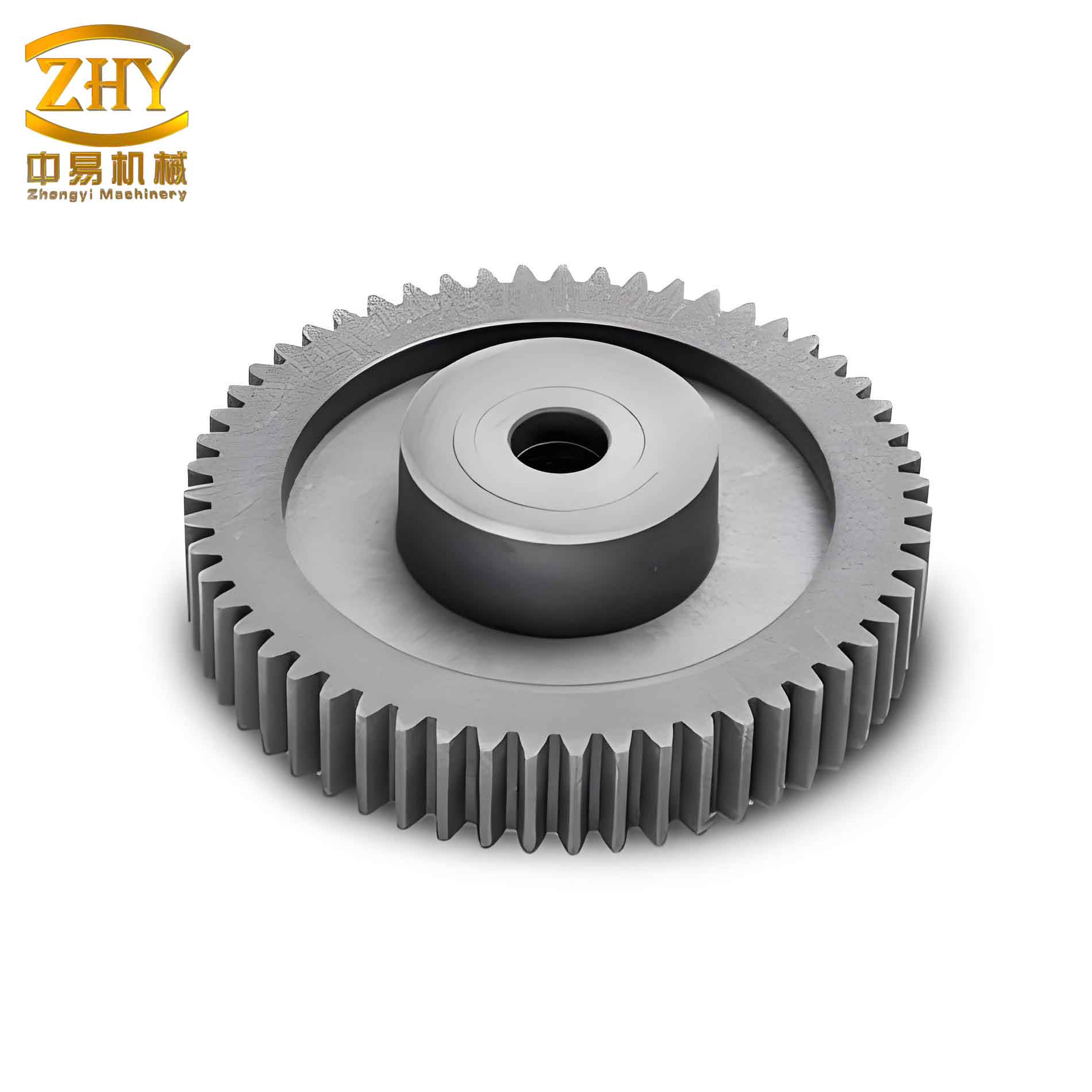
Moving on to tooth number selection, denoted as z, it is intrinsically linked to modulus. For a fixed pitch diameter, increasing modulus reduces tooth number, which affects the contact ratio $$ \epsilon $$, a measure of transmission smoothness. The contact ratio for spur and pinion gears can be approximated by $$ \epsilon = \frac{ \sqrt{ r_{a1}^2 – r_{b1}^2 } + \sqrt{ r_{a2}^2 – r_{b2}^2 } – a \sin \alpha }{ p_b } $$, where $$ r_a $$ is addendum radius, $$ r_b $$ is base radius, $$ \alpha $$ is pressure angle, and $$ p_b $$ is base pitch. In my designs, I aim to maximize tooth number within strength limits to enhance $$ \epsilon $$ for spur and pinion gears. Key considerations include: (1) The total number of teeth $$ z_\Sigma = z_1 + z_2 $$ should range from 100 to 200 for most spur and pinion gears, with prime numbers or small common divisors between $$ z_1 $$ and $$ z_2 $$ to avoid repetitive wear patterns. (2) For tooth numbers over 100 primes or above 200, manufacturing constraints like gear hobbing and indexing must be evaluated for spur and pinion gears. (3) The tooth numbers of spur and pinion gears should have no common divisors with those of cutting tools to ensure uniform wear. (4) Economically, higher tooth counts favor hobbing and shaving, while lower counts may suit grinding for spur and pinion gears.
To guide the selection, I rely on empirical data from industry experience. Table 3 provides recommended tooth numbers for the small gear (pinion) in spur and pinion gear pairs, based on material hardness and tooth ratio u, where $$ u = \frac{z_2}{z_1} $$. These values balance root and surface strength while avoiding undercutting. For spur and pinion gears, the pinion tooth number $$ z_1 $$ is critical as it experiences more cycles. The bending stress $$ \sigma_b $$ in spur and pinion gears can be estimated using the Lewis formula: $$ \sigma_b = \frac{F_t}{b m Y} $$, where $$ F_t $$ is tangential force, b is face width, and Y is the Lewis form factor. This highlights the importance of modulus and tooth geometry in spur and pinion gear design.
| Series I (Preferred) | Series II (Avoid if Possible) | Series I (Continued) | Series II (Continued) | Series I (Continued) | Series II (Continued) |
|---|---|---|---|---|---|
| 1 | 1.125 | 4.5 | — | 16 | 14 |
| 1.25 | 1.375 | 5 | 5.5 | 20 | 18 |
| 1.5 | 1.75 | 6 | 6.5 | 25 | 22 |
| 2 | 2.25 | 7 | — | 32 | 28 |
| 2.5 | 2.75 | 8 | 9 | 40 | 36 |
| 3 | 3.5 | 10 | 11 | 50 | 45 |
| — | — | 12 | — | — | — |
The interaction between modulus and tooth number also influences the sliding velocity $$ v_s $$ at the tooth contact, which for spur and pinion gears can be expressed as $$ v_s = v \left( \frac{1}{z_1} + \frac{1}{z_2} \right) $$ at the pitch point, where v is pitch line velocity. High sliding velocities in spur and pinion gears can cause thermal damage, underscoring the need for careful parameter selection. In my analysis, I often use the specific sliding ratio $$ \theta $$ to evaluate spur and pinion gear performance: $$ \theta = \frac{v_s}{v} $$. For durable spur and pinion gears, $$ \theta $$ should be minimized through optimal modulus and tooth number choices.
| Material and Hardness | Tooth Ratio u | Pinion Tooth Number z1 Range | Additional Notes for Spur and Pinion Gears |
|---|---|---|---|
| Case-hardened (58-63 HRC) | 1–1.9 | 29–55 | For high-strength spur and pinion gears in automotive applications |
| Case-hardened (58-63 HRC) | 2–3.9 | 27–45 | 适用于中等负载的 spur and pinion gears |
| Case-hardened (58-63 HRC) | 4–8 | 25–50 | For heavy-duty spur and pinion gears with high reduction ratios |
| Nitrided (Surface-hardened) | 1–1.9 | 24–40 | For spur and pinion gears requiring wear resistance |
| Nitrided (Surface-hardened) | 2–3.9 | 23–40 | Common in industrial spur and pinion gear sets |
| Nitrided (Surface-hardened) | 4–8 | 21–35 | For compact spur and pinion gear designs |
| Cast Iron | 1–1.9 | 26–45 | For economical spur and pinion gears in open gearing |
| Cast Iron | 2–3.9 | 22–45 | 适用于低速 spur and pinion gears |
| Cast Iron | 4–8 | 20–35 | For rugged spur and pinion gear applications |
| Quenched and Tempered Steel (<230 HBS) | 1–1.9 | 21–32 | For general-purpose spur and pinion gears |
| Quenched and Tempered Steel (<230 HBS) | 2–3.9 | 19–31 | 常用于传动 spur and pinion gears |
| Quenched and Tempered Steel (<230 HBS) | 4–8 | 16–26 | For high-torque spur and pinion gears |
| Quenched and Tempered Steel (>300 HBS) | 1–1.9 | 19–29 | For hardened spur and pinion gears in precision machinery |
| Quenched and Tempered Steel (>300 HBS) | 2–3.9 | 16–25 | 适用于耐用的 spur and pinion gears |
| Quenched and Tempered Steel (>300 HBS) | 4–8 | 14–22 | For miniature spur and pinion gear systems |
In addition to static strength, dynamic factors like vibration and noise must be considered for spur and pinion gears. The meshing frequency $$ f_m $$ of spur and pinion gears is given by $$ f_m = \frac{n z}{60} $$, where n is rotational speed in RPM. A higher tooth count in spur and pinion gears can reduce $$ f_m $$, potentially lowering noise if precision is maintained. I also evaluate the bending safety factor $$ S_b $$ for spur and pinion gears using $$ S_b = \frac{\sigma_{b,\text{allow}}}{\sigma_b} $$, where $$ \sigma_{b,\text{allow}} $$ is allowable bending stress derived from material properties. For spur and pinion gears in critical applications, $$ S_b $$ should exceed 2.0.
Manufacturing processes further influence parameter selection. For spur and pinion gears with tooth numbers below 20, hardening distortions can increase grinding allowances, making production challenging. Thus, I prefer tooth numbers above 20 for spur and pinion gears whenever feasible. The total cost of spur and pinion gears includes material, machining, and heat treatment; optimizing modulus and tooth number can yield savings. For example, selecting a smaller modulus for spur and pinion gears may reduce weight and material use, but only if strength criteria are met.
To illustrate the design process, consider a case where I design a pair of spur and pinion gears for a conveyor system with center distance a = 200 mm and tooth ratio u = 3. Assuming moderate impact loads, from Table 1, m = (0.01 to 0.015)a = 2 to 3 mm. Choosing m = 2.5 mm from Series I, and using $$ a = \frac{m(z_1 + z_2)}{2} $$ and $$ u = z_2 / z_1 $$, I solve for $$ z_1 $$ and $$ z_2 $$. With a = 200 mm, m = 2.5 mm, then $$ z_1 + z_2 = \frac{2a}{m} = 160 $$. Given u = 3, $$ z_2 = 3z_1 $$, so $$ z_1 + 3z_1 = 160 $$, yielding $$ z_1 = 40 $$ and $$ z_2 = 120 $$. Checking Table 3 for quenched steel (>300 HBS) and u=3, $$ z_1 $$ range is 16–25, so my design may need adjustment for strength; perhaps increase modulus to m=3 mm, leading to $$ z_1 + z_2 = 133.33 $$, approximated to $$ z_1 = 33 $$ and $$ z_2 = 99 $$, which falls within recommended ranges. This iterative process is common in spur and pinion gear design.
Furthermore, the pitting resistance of spur and pinion gears depends on surface durability, calculated via the contact stress $$ \sigma_H $$ using the Hertzian formula: $$ \sigma_H = Z_E \sqrt{ \frac{F_t}{b d_1} \cdot \frac{u+1}{u} } $$, where $$ Z_E $$ is elasticity factor and $$ d_1 $$ is pinion pitch diameter. For spur and pinion gears, ensuring $$ \sigma_H $$ below allowable limits is crucial to prevent wear. The safety factor for pitting $$ S_H $$ is $$ S_H = \frac{\sigma_{H,\text{allow}}}{\sigma_H} $$. In my projects, I aim for $$ S_H > 1.5 $$ for spur and pinion gears in continuous operation.
Environmental factors also play a role; for instance, spur and pinion gears in dusty or corrosive environments may require larger moduli to compensate for wear. Lubrication conditions affect the choice: for poorly lubricated spur and pinion gears, a larger modulus can reduce specific pressure. I often use the film thickness parameter $$ \Lambda $$ to assess lubrication effectiveness in spur and pinion gears: $$ \Lambda = \frac{h_{\min}}{\sqrt{R_q1^2 + R_q2^2}} $$, where $$ h_{\min} $$ is minimum film thickness and $$ R_q $$ is surface roughness. Optimal modulus and tooth finish can improve $$ \Lambda $$ for spur and pinion gears.
In summary, the design of spur and pinion gears revolves around meticulous selection of modulus and tooth number, balancing strength, noise, wear, and cost. Through formulas like $$ d = m z $$ and empirical tables, I guide decisions to achieve robust performance. Spur and pinion gears are ubiquitous in machinery, and their reliability hinges on these parameters. As I conclude, I stress the importance of iterative analysis and adherence to standards for successful spur and pinion gear applications. Future advancements in materials and manufacturing may further refine these choices, but the fundamental principles discussed here will remain relevant for spur and pinion gear design.