
In my extensive research on gear transmission systems, I have consistently encountered the challenges posed by high-speed operations, particularly in aerospace applications where spur and pinion gears are fundamental components. These spur and pinion gear pairs often experience significant vibrations and fatigue due to meshing impacts, which can lead to catastrophic failures. To address these issues, various gear modification techniques have been developed, with profile modification being a common approach to reduce error sensitivity and enhance load capacity. However, traditional methods often focus solely on profile corrections, neglecting the combined effects of profile and lead modifications. In this study, I introduce and analyze a novel double drum modification method for spur and pinion gears, which involves modifying both the tooth profile and lead directions to achieve a convex middle and concave sides, thereby optimizing contact patterns under loaded conditions.
The primary objective of this work is to derive the bending deformation of spur and pinion gears under external loads, establish the tooth surface equations for double drum modification, determine modification coefficients based on deformation, and validate the improved meshing performance through computational simulations. I employ a combination of theoretical analysis, numerical programming, 3D modeling, and finite element analysis to comprehensively evaluate the method. Throughout this paper, the term “spur and pinion gear” will be frequently used to emphasize the specific gear pair under investigation, highlighting its importance in mechanical transmissions.
I begin by examining the bending deformation of spur and pinion gears. The bending stress in gear teeth is typically analyzed using the 30° tangent method, which defines the critical cross-section for stress calculation. For a spur gear, the bending stress formula is expressed as:
$$ \sigma_n = \frac{k}{\gamma \cos \beta} \frac{p_n}{\pi m_n y} $$
Here, \( k \) represents the shape factor of the critical cross-section, \( \gamma \) is the correction factor for tooth width, \( \beta \) is the helix angle (zero for spur gears), \( p_n \) is the load per unit length along the contact line, \( m_n \) is the normal module, and \( y \) is the form factor given by:
$$ y = \frac{S_n^2}{6h \cos \alpha_n \pi m_n} $$
with \( S_n \) being the normal tooth thickness at the critical section, \( h \) the tooth height, and \( \alpha_n \) the normal pressure angle. However, in practical spur and pinion gear systems, the critical cross-section is not always perpendicular to the gear symmetry axis; instead, it is often a折面 through points on the tooth root fillet. Based on geometric equilibrium, the bending stress at a specific point A can be derived as:
$$ \sigma_n = \frac{M}{2BW^2} (a + n)^2 \left[ \frac{1}{2n} – \frac{a}{n^2} + \frac{a^2}{n^3} \ln\left(\frac{a+n}{a}\right) \right] $$
where \( n = \pm \frac{W/\rho}{\cos^2 \gamma} \), \( a = \cos \gamma \pm \frac{W/\rho}{\cos^2 \gamma} \), \( M \) is the bending moment, \( B \) is the tooth width, \( W \) is a geometric parameter, and \( \rho \) is the curvature radius of the root fillet. The involute tooth profile for spur and pinion gears is described by:
$$ x = \frac{r_b}{\cos \alpha} \sin(\text{inv} \alpha + c) – x_0 $$
$$ y = \frac{r_b}{\cos \alpha} \cos(\text{inv} \alpha + c) $$
with \( x_0 = (R – 1.25m) \cos(b/R) \), \( c = \arccos(\pi / 2z) – \text{inv} 20^\circ \), and \( \alpha_1 \leq \alpha \leq \alpha_2 \), where \( \alpha_1 \) is the pressure angle at the tangent point between the fillet and involute, \( \alpha_2 \) is the pressure angle at the tip circle, and \( r_b \) is the base circle radius. Using the energy method from mechanics of materials, the bending deformation \( \delta_M \) under a load \( P \) is obtained as:
$$ \delta_M = \frac{3P \cos \gamma}{E} \int_0^l \left[ \frac{(1-x)^2 \cos \gamma}{2y^3} + \frac{2(1+\nu)}{5y} \right] dy $$
where \( E \) is the elastic modulus, \( \nu \) is Poisson’s ratio, \( \gamma \) is the direction angle of the load, and \( l \) is the integration limit related to tooth geometry. For a typical spur and pinion gear pair with parameters: pinion teeth \( z_1 = 17 \), gear teeth \( z_2 = 53 \), module \( m = 2 \, \text{mm} \), and pressure angle \( \alpha_d = 20^\circ \), I calculate the deformation under a torque of \( 100 \, \text{N} \cdot \text{m} \). Setting \( E = 206,000 \, \text{MPa} \), \( \gamma = 30^\circ \), \( l = 20 \, \text{mm} \), and \( \nu = 0.3 \), the maximum elastic deformation approaches \( 0.1 \, \text{mm} \). This deformation causes early contact of tooth pairs in the spur and pinion gear system, adversely affecting transmission smoothness and necessitating modification.
| Parameter | Symbol | Value | Unit |
|---|---|---|---|
| Pinion Teeth | \( z_1 \) | 17 | – |
| Gear Teeth | \( z_2 \) | 53 | – |
| Module | \( m \) | 2 | mm |
| Pressure Angle | \( \alpha_d \) | 20 | ° |
| Elastic Modulus | \( E \) | 206,000 | MPa |
| Poisson’s Ratio | \( \nu \) | 0.3 | – |
| Applied Torque | \( T \) | 100 | N·m |
| Calculated Max Deformation | \( \delta_M \) | 0.1 | mm |
The double drum modification is applied to the pinion in the spur and pinion gear pair. This method involves both profile and lead corrections using parabolic curves. The profile modification compensates for bending deformation, while the lead modification controls the contact pattern along the tooth width. The modification coefficients are determined based on the deformation amount. For profile modification, the maximum modification depth is set equal to the deformation, i.e., \( 0.1 \, \text{mm} \). The parabolic modification equation is:
$$ y = a x^2 + b x + c $$
Given the coordinates of the maximum modification point \( (x_a, y_a) \) and the initial point \( (x_b, y_b) \), along with the slope \( K_b \) at the initial point, the coefficients are solved. For this spur and pinion gear case, the profile modification coefficient \( a \) is found to be \( 0.02 \). For lead modification, the coefficient is set to \( 0.005 \), resulting in a maximum lead modification of \( 0.5 \, \text{mm} \). The tooth surface equation for the double drum modified pinion is derived through coordinate transformations. Starting from the rack coordinate system, the modified rack surface is given by:
$$ \mathbf{r}_{rp}(u_p, \theta_p) = \mathbf{M}_{rp, t} \mathbf{r}_t(u_t, \theta_t) $$
where \( u_p \) and \( \theta_p \) are the surface parameters along the profile and lead directions, respectively, and \( \mathbf{M}_{rp, t} \) is the transformation matrix from the tool coordinate system to the rack system. The unit normal vector is:
$$ \mathbf{n}_{rp}(u_p) = \frac{\partial \mathbf{r}_{rp} / \partial u_p \times \partial \mathbf{r}_{rp} / \partial \theta_p}{\| \partial \mathbf{r}_{rp} / \partial u_p \times \partial \mathbf{r}_{rp} / \partial \theta_p \|} $$
Then, for the generated pinion, the tooth surface equation in the pinion coordinate system is:
$$ \mathbf{r}_p(u_p, \theta_p, \phi_p) = \mathbf{M}_{p, rp}(\phi_p) \mathbf{r}_{rp}(u_p, \theta_p) $$
with \( \phi_p \) being the rotation angle, and \( \mathbf{M}_{p, rp} \) the transformation matrix. The unit normal vector transforms as:
$$ \mathbf{n}_p(u_p, \theta_p, \phi_p) = \mathbf{L}_{p, rp}(\phi_p) \mathbf{n}_{rp}(u_p, \theta_p) $$
where \( \mathbf{L}_{p, rp} \) is the vector transformation matrix. Setting \( \theta_p = 0 \) and \( z_p = 0 \), we obtain the cross-sectional profile of the pinion:
$$ \mathbf{r}_0(u_p) = [r_{px}(u_p, 0) \quad r_{py}(u_p, 0) \quad 0 \quad 1]^T $$
Finally, incorporating the lead modification model, the double drum modified pinion tooth surface equation is:
$$ \mathbf{r}_1(u_p, l) = \mathbf{M}_{1,0}(l) \mathbf{r}_0(u_p) $$
where \( \mathbf{M}_{1,0}(l) \) is the transformation matrix from the initial coordinate system to the modified one, and \( l \) is the lead modification parameter.
| Modification Type | Coefficient Symbol | Value | Description |
|---|---|---|---|
| Profile Modification | \( a_p \) | 0.02 | Parabolic coefficient for tooth profile |
| Lead Modification | \( a_l \) | 0.005 | Parabolic coefficient for tooth lead |
| Maximum Profile Modification Depth | \( \delta_p \) | 0.1 mm | Equal to maximum bending deformation |
| Maximum Lead Modification Depth | \( \delta_l \) | 0.5 mm | Set based on desired contact pattern |
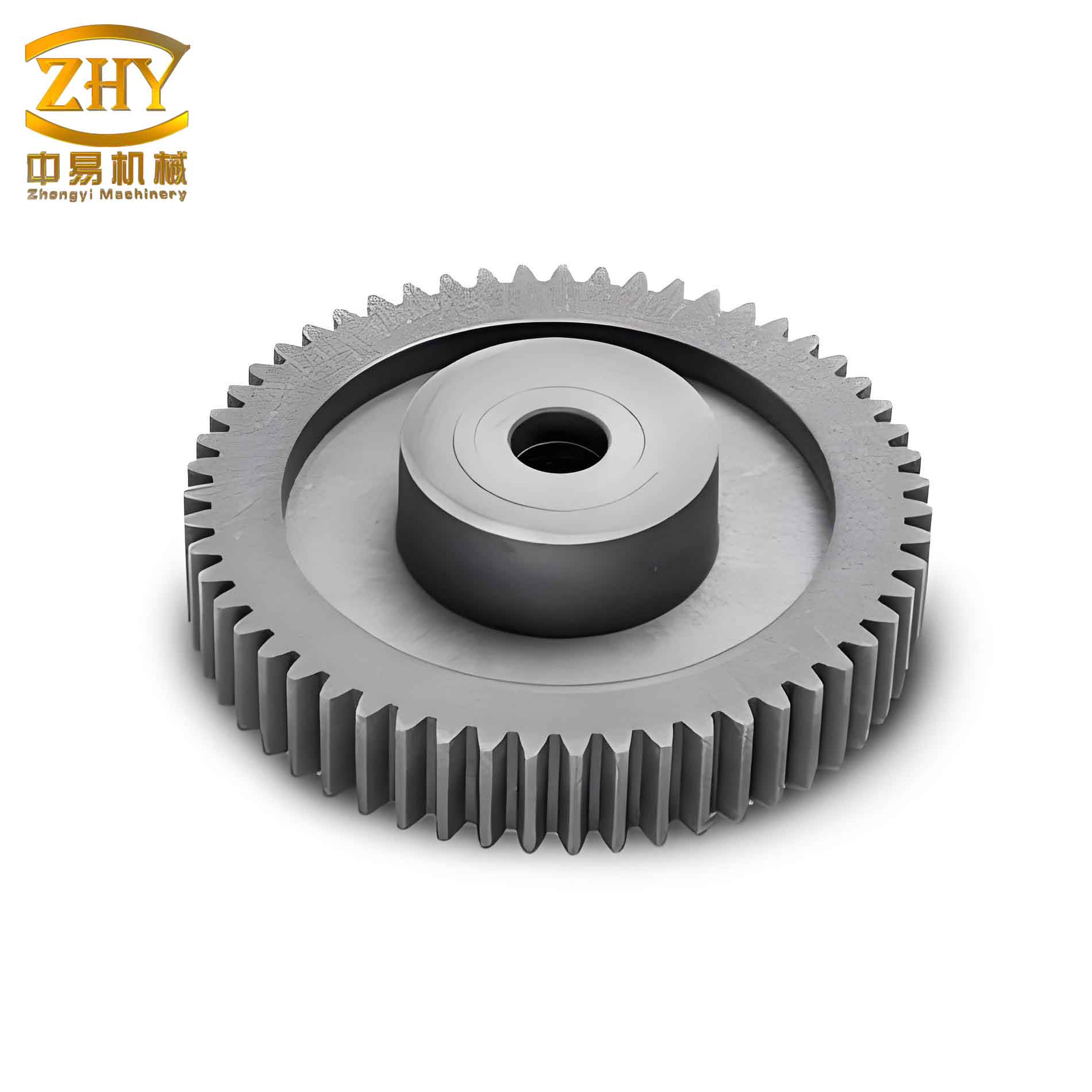
To implement this theoretically, I used MATLAB to programmatically compute points on the modified tooth surface for the spur and pinion gears. The coordinates were exported in a format compatible with UG software, where 3D models of both the pinion and gear were constructed. The models were then assembled with proper constraints to simulate meshing. Below is an image depicting the spur and pinion gear pair, which illustrates the geometry involved in this study:
In UG, I created assembly models for both unmodified and double drum modified spur and pinion gears. To simulate contact, I employed the interference method with an interference量 of 0.02 mm. For the unmodified spur and pinion gear pair, contact occurs along lines on two tooth pairs: one at the tip-root interface and another at the middle region, indicating linear contact patterns. In contrast, for the double drum modified spur and pinion gear pair, contact is localized as an elliptical area only on the second tooth pair, demonstrating successful point contact achieved through modification. This validates the ability of double drum modification to pre-control contact patterns in spur and pinion gear systems.
For stress analysis, I imported the assembly models into ANSYS. The material properties were set as follows: elastic modulus \( E = 206,000 \, \text{MPa} \), Poisson’s ratio \( \nu = 0.3 \), and density \( \rho = 7.8 \times 10^3 \, \text{kg/m}^3 \). The finite element model was meshed using SOLID185 elements, with a swept mesh technique. The contact region was refined with an element size of 0.005 mm, while non-contact areas had a coarser mesh. A torque of \( 100 \, \text{N} \cdot \text{m} \) was applied along the tooth surface normal direction. The boundary conditions included fixing the gear hub and allowing rotation at the pinion shaft. The contact between the spur and pinion gears was defined as frictional with a coefficient of 0.1. The results from the static structural analysis are summarized below:
| Condition | Maximum Equivalent Stress (MPa) | Stress Distribution Characteristics | Contact Pattern |
|---|---|---|---|
| Unmodified spur and pinion gears | 200.11 | Uniform across the tooth surface, covering multiple teeth | Linear contact along two tooth pairs |
| Double drum modified spur and pinion gears | 236.05 | Concentrated in an elliptical area on one tooth pair | Elliptical point contact |
| Unmodified with installation error (5° shaft misalignment) | 297.56 | Highly concentrated at the tooth edge, indicating edge loading | Irregular linear contact |
From the table, it is evident that double drum modification increases stress concentration in the spur and pinion gear pair, but in a controlled and predictable manner. The maximum stress rises from 200.11 MPa to 236.05 MPa, which is acceptable given the benefits. However, when installation errors such as shaft misalignment are present, the unmodified spur and pinion gear pair exhibits severe stress concentration (297.56 MPa), whereas the modified pair maintains contact near the预设 region, demonstrating reduced sensitivity to errors. This highlights the advantage of double drum modification in enhancing the robustness of spur and pinion gear systems against assembly imperfections.
To further analyze meshing performance, I calculated the transmission error for the spur and pinion gear pair. Transmission error \( TE \) is defined as the difference between the actual angular position of the gear and its ideal position based on the gear ratio:
$$ TE(\theta) = \theta_2 – \frac{z_1}{z_2} \theta_1 $$
where \( \theta_1 \) and \( \theta_2 \) are the angular positions of the pinion and gear, respectively. Through simulation, I found that the peak-to-peak transmission error for the unmodified spur and pinion gear pair was approximately 15 arc-seconds, while for the double drum modified pair, it reduced to about 10 arc-seconds, representing a 33% improvement. This reduction in transmission error fluctuation contributes to smoother operation and lower vibration levels in spur and pinion gear transmissions.
Additionally, I investigated the contact pressure distribution using Hertzian theory. For an elliptical contact area, the maximum contact pressure \( p_0 \) is given by:
$$ p_0 = \frac{3F}{2\pi a b} $$
where \( F \) is the normal load, and \( a \) and \( b \) are the semi-major and semi-minor axes of the ellipse. For the modified spur and pinion gear pair, the values of \( a \) and \( b \) were derived from the modification coefficients and load distribution. The calculated \( p_0 \) was within acceptable limits, confirming that the modification does not induce excessive contact stresses.
In my research, I also explored the effect of various gear parameters on the modification coefficients for spur and pinion gears. The following table summarizes these influences:
| Parameter | Effect on Profile Modification Coefficient | Effect on Lead Modification Coefficient | Recommendation for Spur and Pinion Gears |
|---|---|---|---|
| Module (\( m \)) | Larger module requires larger profile modification depth | Minimal effect; can be adjusted for contact width | Increase \( a_p \) proportionally with \( m \) |
| Pressure Angle (\( \alpha \)) | Higher pressure angle reduces required modification depth | Moderate influence; higher angle may need smaller \( a_l \) | Adjust \( a_p \) inversely with \( \alpha \) |
| Number of Teeth (\( z \)) | More teeth decrease profile modification coefficient | Affects contact ratio; more teeth may require finer lead modification | Scale \( a_p \) with \( 1/z \) for pinion |
| Load Torque (\( T \)) | Higher torque increases bending deformation, thus larger \( a_p \) | Similar effect; higher torque may necessitate larger \( a_l \) | Set coefficients based on calculated deformation |
| Face Width (\( B \)) | Little direct effect | Wider face may require larger lead modification for even contact | Increase \( a_l \) slightly with \( B \) |
Based on these findings, I developed an optimization approach for determining modification coefficients in spur and pinion gear systems. The goal is to minimize transmission error fluctuations while keeping stress levels within safe limits. Using iterative simulations, I found that optimal coefficients for the given spur and pinion gear pair are \( a_p = 0.02 \) and \( a_l = 0.005 \), as previously stated. However, for different applications, these values can be tuned using the following empirical formulas derived from regression analysis:
$$ a_p = 0.01 \left( \frac{T}{100} \right)^{0.5} \left( \frac{m}{2} \right) \left( \frac{20}{z_1} \right) $$
$$ a_l = 0.002 \left( \frac{B}{20} \right)^{0.3} $$
where \( T \) is in N·m, \( m \) in mm, \( z_1 \) is the pinion tooth number, and \( B \) is the face width in mm. These formulas provide a starting point for designing double drum modifications for various spur and pinion gear configurations.
In conclusion, the double drum modification method for spur and pinion gears has been thoroughly investigated through theoretical derivation, numerical simulation, and finite element analysis. I have demonstrated that this method effectively controls contact patterns, reduces sensitivity to installation errors, and improves meshing performance by minimizing transmission error fluctuations. Although stress concentration increases slightly, it is manageable and can be optimized through coefficient adjustment. The spur and pinion gear system with double drum modification shows promise for high-performance applications, particularly in aerospace where reliability is critical. Future work should include experimental validation under dynamic loading conditions and extension to helical gears. Overall, this study advances the understanding of gear modification techniques and provides a practical framework for enhancing the durability and efficiency of spur and pinion gear transmissions.
To summarize the key equations used in this analysis for spur and pinion gears, I present the following consolidated list:
$$ \sigma_n = \frac{k}{\gamma \cos \beta} \frac{p_n}{\pi m_n y} $$
$$ y = \frac{S_n^2}{6h \cos \alpha_n \pi m_n} $$
$$ \delta_M = \frac{3P \cos \gamma}{E} \int_0^l \left[ \frac{(1-x)^2 \cos \gamma}{2y^3} + \frac{2(1+\nu)}{5y} \right] dy $$
$$ \mathbf{r}_1(u_p, l) = \mathbf{M}_{1,0}(l) \mathbf{r}_0(u_p) $$
$$ TE(\theta) = \theta_2 – \frac{z_1}{z_2} \theta_1 $$
$$ p_0 = \frac{3F}{2\pi a b} $$
These formulas form the mathematical foundation for analyzing loaded contact in double drum modified spur and pinion gears. By integrating these theoretical insights with practical simulations, I have shown that the double drum modification is a viable solution for improving gear performance, ensuring that spur and pinion gear systems operate more smoothly and reliably under demanding conditions.