
In the realm of modern manufacturing, cold precision forging has emerged as a pivotal technology for producing high-strength, high-accuracy components with superior surface finish. Among these components, spur and pinion gears are critical in various mechanical systems, including automotive transmissions, industrial machinery, and aerospace applications. The demand for efficient production of spur and pinion gears has driven research into advanced forming techniques. Cold precision forging offers significant advantages such as near-net-shape fabrication, reduced material waste, enhanced mechanical properties due to work hardening, and high production rates. However, the practical implementation of cold forging for spur and pinion gears faces formidable challenges, including high forming loads, difficult die filling, and premature die failure. These issues have hindered the transition from laboratory-scale experiments to industrial-scale production. In this article, I will elaborate on a novel process and die design aimed at overcoming these barriers, with a focus on spur and pinion gears, which are essential for motion transmission in countless devices.
The core innovation lies in the development of a divided flow method specifically tailored for spur and pinion gears. This method, known as the dentiform cavity分流工艺 (material flow division in the tooth cavity), addresses the critical problem of excessive forming pressure. Traditional closed-die forging for spur and pinion gears requires complete filling of intricate tooth profiles, leading to extreme stresses on dies and high energy consumption. By introducing a分流型腔 (flow division cavity) at the apex of the standard tooth cavity in the die, as illustrated in the process model, the material is allowed to flow into this auxiliary space during the final stages of deformation. This design ensures that the最难充填的上下角隅及齿顶棱线部位 (the most difficult-to-fill corners and crest lines of the teeth) are adequately filled without imposing excessive pressure. Essentially, the分流型腔 acts as a pressure relief mechanism, reducing the overall forming load by up to 46% compared to conventional封闭式冷锻 (closed-die cold forging). For spur and pinion gears, this translates to lower tooling costs, extended die life, and improved feasibility for mass production.
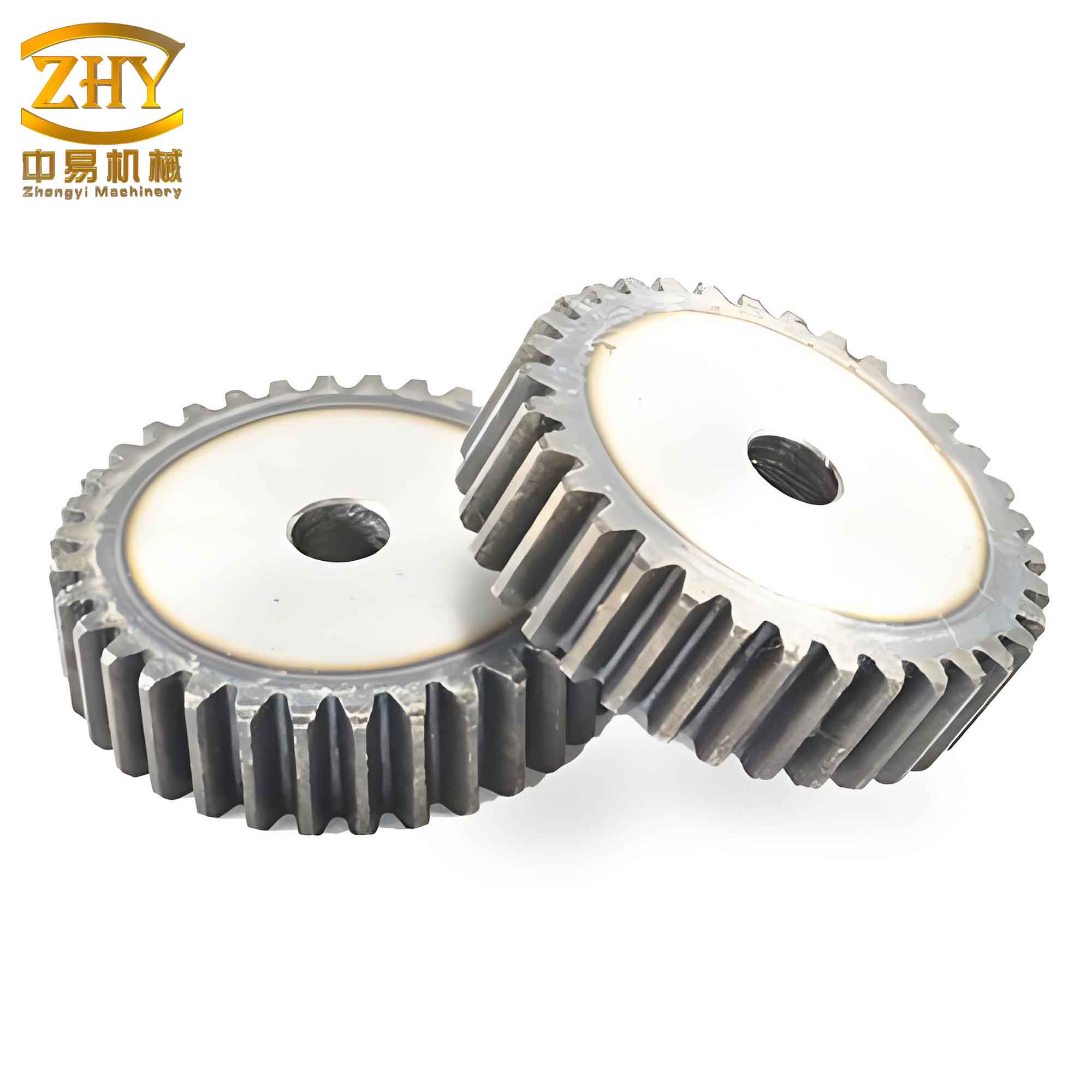
To quantify the benefits, let’s consider the mechanics behind cold forging of spur and pinion gears. The forming load, $P$, can be expressed using the slab method or upper-bound theory. For axisymmetric forging, a simplified formula is:
$$ P = \sigma_y \cdot A \cdot \left(1 + \frac{\mu \cdot d}{3h}\right) $$
where $\sigma_y$ is the yield stress of the material, $A$ is the contact area, $\mu$ is the friction coefficient, $d$ is the diameter, and $h$ is the height. In the context of spur and pinion gears, the geometry is complex, and finite element analysis (FEA) becomes indispensable. The divided flow method modifies the contact area $A$ by introducing free surfaces, thereby reducing the term $\left(1 + \frac{\mu \cdot d}{3h}\right)$. For a spur gear with parameters such as 18 teeth, module 2 mm, and height 10 mm, using a cylindrical billet of diameter接近齿根圆直径 (close to the root circle diameter), approximately Ø30 mm × 14 mm, the reduction in load is substantial. The material flow stress, $\sigma_f$, for common gear steels like 20CrMnTi or AISI-4120 can be modeled using the Hollomon equation:
$$ \sigma_f = K \cdot \varepsilon^n $$
where $K$ is the strength coefficient, $\varepsilon$ is the true strain, and $n$ is the strain-hardening exponent. For 20CrMnTi, typical values are $K = 1500 \, \text{MPa}$ and $n = 0.2$. The divided flow method alleviates the peak strain concentrations, further mitigating die stress.
The die set design for this process is tailored for批量生产 (batch production). A浮动凹模 (floating die) configuration is employed, supported by three springs and guided by拉杆 (tie rods) to ensure smooth operation and easy ejection. The overall structure, as depicted in the schematic, includes an upper die seat, upper pad, flange, upper die sleeve, upper punch, tie rods, spring fixing rods, floating die, springs, lower die seat, lower pad, lower punch fixing plate, guide pillars, lower punch, and the forged gear. The sequence of operations is as follows: the billet is placed in the die cavity; the upper die descends, guiding the upper punch into the die; the floating die moves downward with the punch, facilitating成形 (forming); after forging, the upper die retracts, a ring piece is manually placed on the die surface; the upper die descends again to eject the forging via the lower punch; and finally, the die resets via the tie rods. This design addresses practical issues like debris accumulation and ensures reliable production cycles for spur and pinion gears.
Key components of the die set require meticulous design and strength verification. The浮动凹模 is constructed as a three-layer prestressed assembly to withstand high pressures, which can reach up to 2800 MPa during cold forging of spur and pinion gears. The prestressing induces compressive radial stresses in the inner layers, counteracting the tensile stresses from forming. The dimensions are optimized based on thick-walled cylinder theory. The radial stress, $\sigma_r$, and hoop stress, $\sigma_\theta$, in a composite cylinder under internal pressure $p_i$ and interference fits can be derived from Lame’s equations:
$$ \sigma_r = \frac{p_i \cdot r_i^2}{r_o^2 – r_i^2} \left(1 – \frac{r_o^2}{r^2}\right) $$
$$ \sigma_\theta = \frac{p_i \cdot r_i^2}{r_o^2 – r_i^2} \left(1 + \frac{r_o^2}{r^2}\right) $$
where $r_i$ and $r_o$ are the inner and outer radii, and $r$ is the radial distance. For a three-layer die, the interference fits are calculated to ensure yield criteria are not exceeded. The materials selected are SK11 for the inner ring, D2 for the middle ring, and AISI-5120 for the outer ring, balancing cost and performance. FEA using DEFORM-3D confirms the stress distribution. The equivalent stress, $\sigma_{eq}$, based on the von Mises criterion, is given by:
$$ \sigma_{eq} = \sqrt{\frac{1}{2}\left[(\sigma_1 – \sigma_2)^2 + (\sigma_2 – \sigma_3)^2 + (\sigma_3 – \sigma_1)^2\right]} $$
where $\sigma_1$, $\sigma_2$, $\sigma_3$ are principal stresses. The results show maximum equivalent stresses of 2500 MPa in the inner ring and 1600 MPa in the middle ring, with compressive stresses dominating in the inner layer, validating the design for spur and pinion gear forging.
The lower punch, which directly contacts the forging, is designed with a truncated cone structure to reduce stress concentration. The maximum pressure on the punch face, $p_{max}$, can be estimated from the forming load and contact area. For a spur and pinion gear with tooth engagement, the pressure distribution is non-uniform. FEA indicates a peak equivalent stress of 2920 MPa at the tooth-root transition, but the material W18Cr4V with a hardness of HRC 62 can endure this. The compressive stress on the punch bottom is analyzed at points along the radius, as summarized in Table 1.
| Point Location | Radial Position (mm) | Maximum Compressive Stress (MPa) |
|---|---|---|
| P1 (Center) | 0 | 760 |
| P2 | 5 | 620 |
| P3 | 10 | 480 |
| P4 | 15 | 350 |
This gradient ensures that the underlying垫板 (pad plate) experiences manageable stresses, allowing the use of普通材料 (common materials) for cost-effective production of spur and pinion gears.
Experimental validation is conducted using 20CrMnTi billets subjected to phosphating and皂化处理 (soap lubrication) to reduce friction. The润滑层 (lubricant layer) critical for cold forging is achieved through this surface treatment, which provides a支撑层 (support layer) and吸附层 (adsorbed layer) to minimize die wear. The friction coefficient, $\mu$, is set to 0.1 in simulations, reflecting the effectiveness of this treatment. Experiments are performed on a 10000 kN hydraulic press, with the load limited to 2400 kN to protect the dies. The forming stages are compared between simulation and experiment, as detailed in Table 2.
| Forming Stage | Load (kN) | Simulation Observation | Experimental Observation |
|---|---|---|---|
| Initial Deformation | 1500 | Billet bulging, partial tooth filling | Similar bulging, material flow into cavities |
| Intermediate Stage | 2000 | Most teeth filled, except top corners | Consistent filling, lower end better than upper |
| Final Stage | 2200 | Tooth crests exceed standard profile | Complete forming with minimal flash |
The results demonstrate excellent agreement, confirming that the divided flow method successfully forges spur and pinion gears with reduced loads. The forged gears exhibit full tooth profiles with free surfaces at the crests, requiring only minor finishing such as turning or grinding of the outer diameter, but no齿形加工 (tooth profile machining). This is a significant advantage for high-volume production of spur and pinion gears.
Further analysis of the material behavior during cold forging of spur and pinion gears involves strain rate effects. The flow stress can be extended to account for strain rate, $\dot{\varepsilon}$, using the Johnson-Cook model:
$$ \sigma_f = (A + B \varepsilon^n) \left(1 + C \ln \frac{\dot{\varepsilon}}{\dot{\varepsilon}_0}\right) $$
where $A$, $B$, $C$, $n$ are material constants, and $\dot{\varepsilon}_0$ is a reference strain rate. For 20CrMnTi, typical values are $A = 800 \, \text{MPa}$, $B = 600 \, \text{MPa}$, $C = 0.015$, and $n = 0.2$. In cold forging, strain rates are moderate, but this model helps in simulating dynamic effects. The divided flow method reduces the effective strain rate in critical regions, further lowering die stress.
Die life prediction is crucial for economical production of spur and pinion gears. The fatigue life of dies can be estimated using the Coffin-Manson equation for low-cycle fatigue:
$$ \frac{\Delta \varepsilon_p}{2} = \varepsilon_f’ (2N_f)^c $$
where $\Delta \varepsilon_p$ is the plastic strain range, $\varepsilon_f’$ is the fatigue ductility coefficient, $N_f$ is the number of cycles to failure, and $c$ is the fatigue ductility exponent. For die materials like SK11, $\varepsilon_f’ \approx 0.3$ and $c \approx -0.6$. By reducing the stress amplitude through the divided flow method, $N_f$ increases significantly, enhancing die longevity for spur and pinion gear forging.
Thermal effects, though less prominent in cold forging, can arise from plastic work conversion to heat. The temperature rise, $\Delta T$, can be approximated by:
$$ \Delta T = \frac{\eta \cdot \sigma_f \cdot \varepsilon}{\rho \cdot c_p} $$
where $\eta$ is the fraction of work converted to heat (typically 0.9), $\rho$ is density, and $c_p$ is specific heat. For steel, $\rho = 7850 \, \text{kg/m}^3$ and $c_p = 460 \, \text{J/kg·K}$. In spur and pinion gear forging, the divided flow method reduces the work done, thus minimizing temperature rise and associated die thermal stresses.
Quality assessment of forged spur and pinion gears includes dimensional accuracy and mechanical properties. The tooth profile error, $\delta$, can be defined as the deviation from the ideal involute curve. For a gear with module $m$ and pressure angle $\alpha$, the involute equation in parametric form is:
$$ x = r_b (\cos \theta + \theta \sin \theta) $$
$$ y = r_b (\sin \theta – \theta \cos \theta) $$
where $r_b = \frac{m \cdot z}{2} \cos \alpha$ is the base radius, $z$ is the number of teeth, and $\theta$ is the roll angle. Experimental measurements on forged gears show that $\delta$ is within 0.05 mm, meeting precision standards for spur and pinion gears. Additionally, hardness tests reveal an increase from 200 HV in the billet to 350 HV in the forged gear due to work hardening, enhancing wear resistance.
The economic implications of this die design are substantial. By enabling cold precision forging of spur and pinion gears with lower loads and longer die life, production costs are reduced. A cost model can be expressed as:
$$ C_{total} = C_{material} + C_{tooling} + C_{energy} + C_{labor} $$
where $C_{tooling}$ is amortized over the number of parts, $N$. The divided flow method increases $N$ by extending die life, thus lowering $C_{tooling}$ per gear. For high-volume orders of spur and pinion gears, this results in significant savings.
In summary, the divided flow method and associated die set design represent a breakthrough in cold precision forging for spur and pinion gears. The process effectively reduces forming loads, improves die filling, and enhances die durability. Through FEA and experimental validation, the design has been proven robust and practical for batch production. Future work could explore applications to helical gears or bevel gears, but the core principles remain relevant for a wide range of gear types. The successful implementation of this technology paves the way for broader adoption of cold forging in the gear manufacturing industry, offering a sustainable and efficient alternative to traditional machining methods. As demand for high-performance spur and pinion gears continues to grow, innovations like this will play a crucial role in meeting production challenges while maintaining quality and cost-effectiveness.