
In the field of mechanical engineering, the heat treatment of gear components is critical for enhancing their durability and performance. Specifically, the quenching process for spur and pinion gear assemblies—such as those used in transmissions and machinery—often leads to challenges like distortion and cracking due to thermal and transformational stresses. As an engineer focused on optimizing gear manufacturing, I utilized ANSYS Workbench to simulate the quenching process of a 45 steel spur and pinion gear. This simulation aims to analyze temperature fields, thermal stresses, and deformations, providing insights to mitigate defects. The spur and pinion gear, with its straightforward geometry, serves as an ideal model for studying heat treatment effects, and this analysis can be extended to more complex gear systems.
The core objective is to leverage finite element analysis (FEA) to predict the behavior of spur and pinion gear during quenching. By modeling the transient thermal and structural responses, I can identify stress concentration zones and deformation patterns, which are pivotal for improving the quality of spur and pinion gear production. This approach aligns with industry trends toward digital twins and simulation-driven design, where virtual testing reduces costly experimental trials. Throughout this article, I will detail the methodology, results, and implications, emphasizing the role of simulation in advancing spur and pinion gear technology.
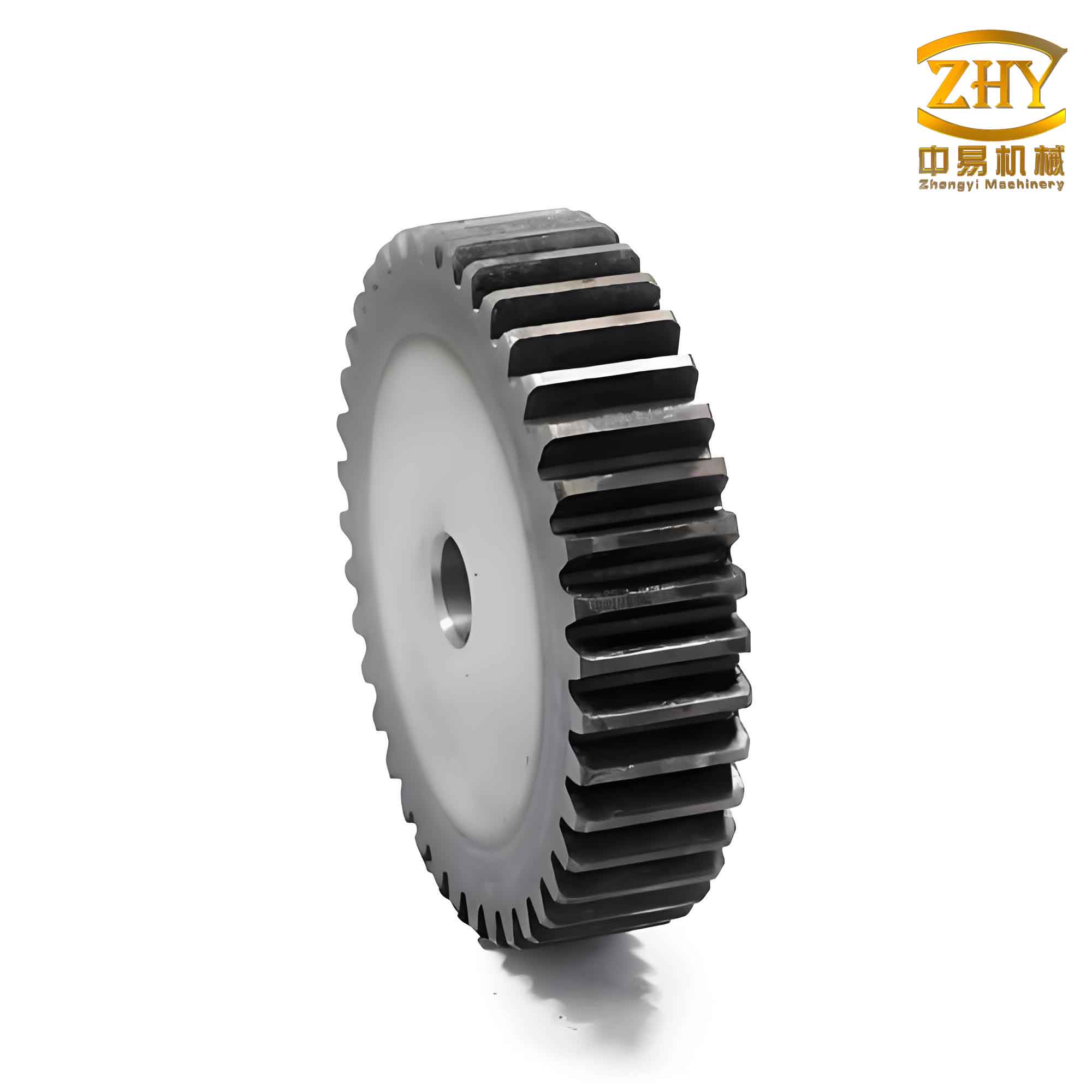
To begin, I established the finite element model in ANSYS Workbench. The spur and pinion gear was designed as a standard cylindrical gear with a module of 4 mm, 31 teeth, a pitch diameter of 124 mm, and a face width of 130 mm. Using CAD software, I created a 3D solid model and imported it via IGES format into ANSYS Workbench. The quenching setup included the gear submerged in a water tank—a cube with 500 mm sides—to replicate industrial conditions. The initial temperature of the spur and pinion gear was set at 900°C, while the water and ambient air were at 20°C. Boundary conditions accounted for convective heat transfer on the tank surfaces (excluding the bottom) with an air convection coefficient of 0.5 W/(m·°C). The material properties of 45 steel, crucial for accurate simulation, were defined based on standard data, as summarized in Table 1. These properties vary with temperature, influencing the thermal and mechanical responses of the spur and pinion gear during quenching.
| Temperature (°C) | Density (kg/m³) | Specific Heat (J/(g·°C)) | Thermal Conductivity (W/(m·K)) | Elastic Modulus (10¹¹ Pa) | Poisson’s Ratio | Thermal Expansion Coefficient (10⁻⁶/°C) |
|---|---|---|---|---|---|---|
| 20 | 7850 | 0.480 | 50.2 | 2.1 | 0.27 | 11.2 (at 100°C) |
| 100 | 7860 | 0.500 (approx.) | 48.0 (approx.) | 2.0 (approx.) | 0.27 | 11.2 |
| 300 | 7860 | 0.550 (approx.) | 45.0 (approx.) | 1.8 (approx.) | 0.27 | 12.6 |
| 500 | 7860 | 0.600 (approx.) | 40.0 (approx.) | 1.5 (approx.) | 0.27 | 14.0 |
The thermal analysis relied on transient heat conduction equations, governed by Fourier’s law. For the spur and pinion gear, the energy balance can be expressed as:
$$ \rho C_p \frac{\partial T}{\partial t} = \nabla \cdot (k \nabla T) $$
where \( \rho \) is density, \( C_p \) is specific heat, \( T \) is temperature, \( t \) is time, and \( k \) is thermal conductivity. This equation was solved numerically in ANSYS Workbench to simulate the cooling process. The water properties included a density of 1000 kg/m³, thermal conductivity of 0.6 W/(m·K), and specific heat of 4100 J/(kg·K). Mesh generation was critical for accuracy; I used a tetrahedral mesh with refinement in the gear teeth and keyway areas, as these regions are prone to high stresses in spur and pinion gear. The mesh independence was verified to ensure reliable results, with a total element count exceeding 500,000 for the combined gear-tank system.
Moving to the temperature field simulation, I monitored the spur and pinion gear over various time intervals: 5 s, 30 s, 100 s, and 500 s. The results revealed that the highest temperatures consistently occurred at the gear’s core, indicating slower cooling rates due to the gear’s substantial volume. For instance, after 500 s, the core temperature was approximately 334°C, which lies within the martensite transformation range (Ms to Mf). This slow cooling, attributed to the limited tank capacity, could lead to partial bainite formation, adversely affecting the hardness and toughness of the spur and pinion gear. The temperature distribution can be modeled using a simplified lumped-capacity approach for comparison:
$$ T(t) = T_{\infty} + (T_0 – T_{\infty}) e^{-hA t / (\rho V C_p)} $$
where \( T_{\infty} \) is the ambient temperature, \( T_0 \) is the initial temperature, \( h \) is the convective heat transfer coefficient, \( A \) is surface area, and \( V \) is volume. However, for complex geometries like spur and pinion gear, FEA provides more precise insights. The temperature gradients near the teeth tips were steep, causing rapid heat extraction and setting the stage for thermal stresses.
To quantify the heat transfer, I calculated the Biot number for the spur and pinion gear to assess the validity of lumped analysis. For a typical gear dimension, the Biot number is:
$$ Bi = \frac{h L_c}{k} $$
where \( L_c \) is the characteristic length (volume/surface area). Given the high thermal conductivity of steel, the Biot number was low (<0.1), suggesting uniform temperature, but the geometric complexities of spur and pinion gear necessitate full FEA. The simulation output highlighted that water, as a quenching medium, provided intense cooling on the gear surfaces, but the core lagged, potentially leading to microstructure inhomogeneities. This is a key consideration for spur and pinion gear manufacturing, where consistent properties are essential for load-bearing capacity.
Next, I conducted the stress field and total deformation analysis by coupling the thermal results with structural mechanics. The induced stresses in the spur and pinion gear stem from both thermal gradients (thermal stress) and phase transformations (transformational stress). The total stress can be decomposed as:
$$ \sigma_{\text{total}} = \sigma_{\text{thermal}} + \sigma_{\text{transformation}} $$
where thermal stress is derived from the temperature-dependent strain, given by:
$$ \sigma_{\text{thermal}} = E \alpha \Delta T $$
with \( E \) as Young’s modulus, \( \alpha \) as the thermal expansion coefficient, and \( \Delta T \) as the temperature difference. The transformational stress accounts for volume changes during martensite formation. In ANSYS Workbench, I imported the temperature field into a static structural analysis to compute equivalent von Mises stress and total deformation. The results, as shown in Table 2 for key time points, indicate that stress concentrations peaked at the tooth tips and keyway regions of the spur and pinion gear, aligning with areas of rapid cooling. These zones, colored yellow-green in contour plots, are predicted sites for quenching cracks or distortion.
| Time (s) | Max Equivalent Stress (MPa) | Max Total Deformation (mm) | Critical Locations on Spur and Pinion Gear |
|---|---|---|---|
| 5 | 450 | 0.15 | Tooth tips, keyway |
| 30 | 420 | 0.14 | Tooth tips, inner rim |
| 100 | 380 | 0.12 | Tooth tips, keyway |
| 500 | 350 | 0.10 | Tooth tips, inner rim |
The deformation patterns revealed that the tooth tips exhibited the largest displacement, likely due to localized expansion or contraction. This deformation can compromise the meshing accuracy of spur and pinion gear in assemblies, leading to noise, wear, and failure. The reduction in stress over time, as seen in Table 2, suggests stress relaxation during prolonged immersion, but residual stresses remain. To mitigate this, I analyzed the effect of quenching parameters using a sensitivity approach. For example, the cooling rate \( \dot{T} \) influences stress magnitude, and it can be optimized for spur and pinion gear by adjusting water temperature or agitation. A simple model for stress evolution is:
$$ \frac{d\sigma}{dt} = -C \sigma + E \alpha \dot{T} $$
where \( C \) is a relaxation constant. Simulation data showed that faster surface cooling increased stress gradients, emphasizing the need for controlled quenching to balance hardness and distortion in spur and pinion gear.
Furthermore, I explored the microstructure transformation aspects. The martensite start temperature \( M_s \) for 45 steel is around 350°C, and the simulation indicated that the core temperature remained above \( M_s \) for extended periods. This delay can be quantified using the Avrami equation for transformation kinetics:
$$ f = 1 – \exp(-k t^n) $$
where \( f \) is the transformed fraction, \( k \) is a rate constant, and \( n \) is an exponent. For spur and pinion gear, incomplete martensite formation could result in mixed microstructures, reducing fatigue resistance. To address this, I proposed increasing tank size or using agitated water to enhance heat removal. Additionally, post-quenching treatments like tempering or artificial aging can relieve stresses. The effectiveness of aging can be estimated by a stress relaxation model:
$$ \sigma(t) = \sigma_0 \exp(-t/\tau) $$
with \( \tau \) as the relaxation time. Implementing such treatments can significantly improve the dimensional stability of spur and pinion gear.
In conclusion, this ANSYS Workbench simulation provided a comprehensive view of the quenching process for spur and pinion gear. The temperature field analysis highlighted slow core cooling, which risks undesirable microstructure in spur and pinion gear. The stress and deformation results identified tooth tips and keyways as critical zones, guiding design modifications or process adjustments. For instance, fillet radii optimization or preheating the quenching medium could reduce thermal shocks. Future work could involve multi-scale modeling to link microstructure evolution with mechanical properties, or extending the analysis to helical or bevel gears. Ultimately, this FEA approach empowers engineers to predict and prevent defects, enhancing the reliability and lifespan of spur and pinion gear in demanding applications. By integrating simulation into the production cycle, manufacturers can achieve higher precision and lower costs, solidifying the role of digital tools in advancing gear technology.
To summarize the key equations used in this simulation for spur and pinion gear analysis, I compiled them below:
Heat conduction: $$ \rho C_p \frac{\partial T}{\partial t} = \nabla \cdot (k \nabla T) $$
Lumped temperature approximation: $$ T(t) = T_{\infty} + (T_0 – T_{\infty}) e^{-hA t / (\rho V C_p)} $$
Biot number: $$ Bi = \frac{h L_c}{k} $$
Thermal stress: $$ \sigma_{\text{thermal}} = E \alpha \Delta T $$
Stress evolution: $$ \frac{d\sigma}{dt} = -C \sigma + E \alpha \dot{T} $$
Transformation kinetics: $$ f = 1 – \exp(-k t^n) $$
Stress relaxation: $$ \sigma(t) = \sigma_0 \exp(-t/\tau) $$
These formulas, combined with FEA, enable a robust simulation framework for spur and pinion gear quenching. By repeatedly analyzing spur and pinion gear under various conditions, I can refine heat treatment protocols to minimize distortions and cracks, ensuring that spur and pinion gear meet stringent performance standards in automotive, aerospace, and industrial machinery.