
The precision and integrity of spur and pinion gears are fundamental to the performance, efficiency, and longevity of mechanical transmission systems. As one of the most ubiquitous components in machinery, any defect in a spur and pinion gear—such as a missing tooth, chipped tooth, or dimensional inaccuracy—can lead to increased noise, vibration, and catastrophic system failure. Traditionally, the inspection of these critical components has relied on specialized, high-cost gear measuring instruments or manual methods using mechanical gauges. These approaches are not only capital-intensive and require skilled operators but are also inherently slow, creating a significant bottleneck in modern high-speed production lines. The pursuit of automated, rapid, and accurate inspection methods is therefore of paramount importance in industrial quality control.
Machine vision presents a compelling solution for the automated inspection of spur and pinion gears. However, existing research in this domain often encounters specific limitations. Methods based on detecting intersections with virtual circles for tooth counting fail when significant tooth breakage occurs. Techniques relying on the centroid of the gear’s binary image for establishing a reference center become inaccurate when the gear has missing teeth, as the centroid shifts. Other approaches may require complex template matching, extensive training of classifiers like Support Vector Machines for different gear types, or are not fully automated. This analysis delves into a novel, robust methodology for spur and pinion gear inspection that overcomes these challenges by leveraging the geometric properties of the gear’s outer contour, specifically its minimum convex hull and convexity defects.
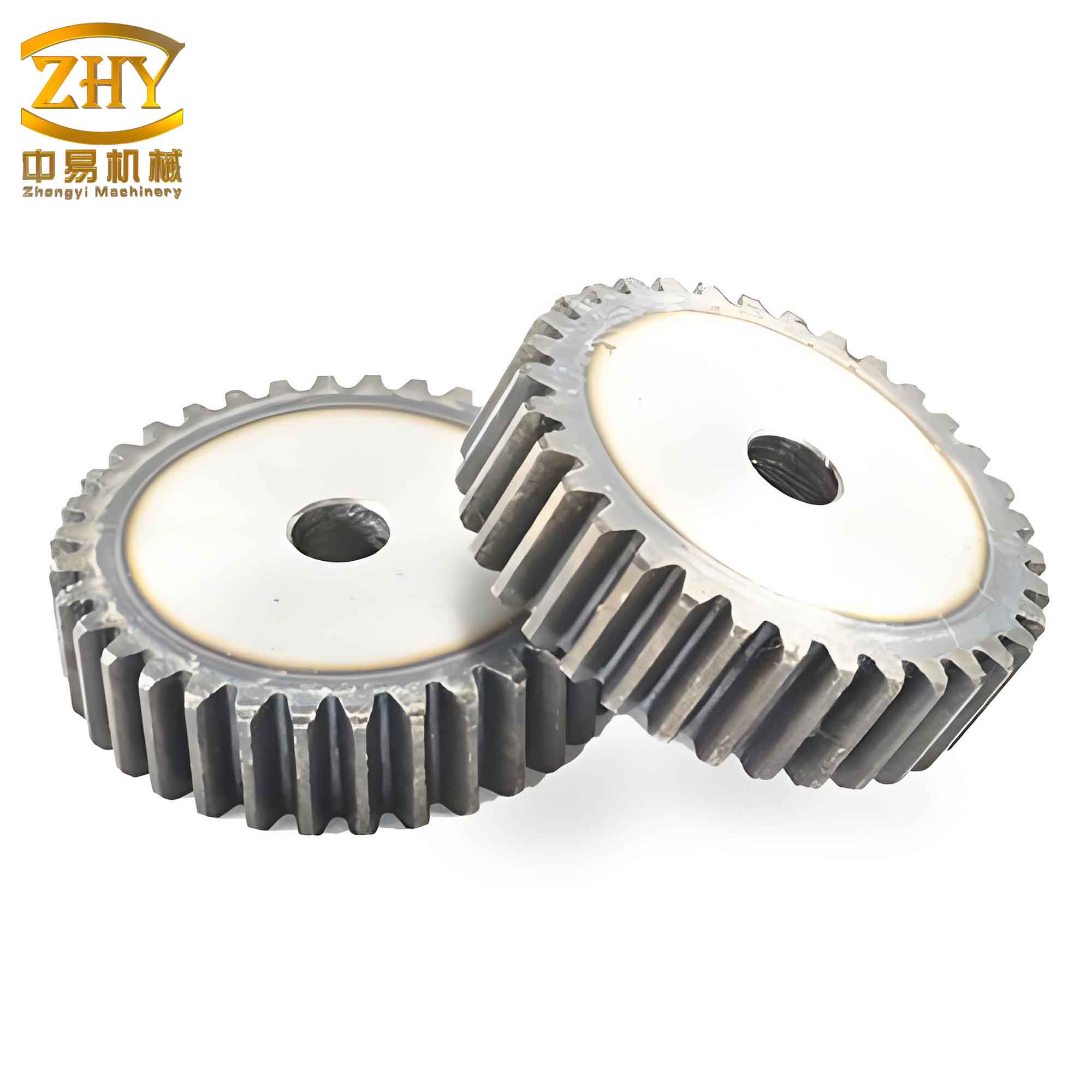
The core premise of the proposed method is that the outer contour of a spur and pinion gear encapsulates all essential information regarding its shape, including the number of teeth, the presence of defects, and the dimensions of the characteristic circles (addendum and dedendum circles). By analyzing this contour’s convex hull—the smallest convex polygon that encloses all contour points—and the concavities (defects) between the hull and the actual contour, one can derive precise measurements robustly, even in the presence of minor defects. The complete algorithmic pipeline can be systematically broken down into several key stages: image preprocessing and contour extraction, convex hull and defect analysis for tooth counting and defect identification, and finally, high-precision fitting of the gear’s feature circles.
Image Preprocessing and Outer Contour Acquisition
The initial step in any machine vision inspection system is to obtain a clean, well-defined representation of the object of interest from the captured image. For a spur and pinion gear, this begins with converting the color image to grayscale. To suppress noise and smooth the image while preserving edge information, a discrete 2D Gaussian filter is applied. For a $(2k+1) \times (2k+1)$ kernel, the weight $H_{i,j}$ at position $(i, j)$ is given by:
$$H_{i,j} = \frac{1}{2\pi\sigma^2} e^{-\frac{(i-k-1)^2 + (j-k-1)^2}{2\sigma^2}}$$
Typically, a $3 \times 3$ kernel $(k=1)$ with $\sigma=1$ is effective. The filtered pixel value $G(i,j)$ is the convolution of the input image $F$ with this kernel: $G(i,j) = \sum_{k,l} F(i+k, j+l) H(k,l)$.
Subsequently, the smoothed grayscale image must be segmented to separate the spur and pinion gear from the background. Otsu’s method is employed for automatic global threshold selection. It assumes the image contains two classes of pixels (foreground gear and background) and calculates the optimal threshold $T$ that maximizes the inter-class variance $\sigma^2_B(T)$:
$$\sigma^2_B(T) = \omega_A(T) (\mu_A(T) – \mu_T)^2 + \omega_B(T) (\mu_B(T) – \mu_T)^2$$
where $\omega_A$, $\mu_A$ are the probability and mean of class A (pixels with intensity $<=T$), $\omega_B$, $\mu_B$ are for class B (intensity $>T$), and $\mu_T$ is the total image mean. The search for $T$ can be accelerated by restricting it to the range between the two peaks of the gear image’s typical bimodal histogram.
With a binary image obtained, the next critical task is to extract the single-pixel-wide outer contour of the spur and pinion gear. A connected-component contour tracing algorithm is used. It starts from the leftmost-bottommost white pixel and follows the 8-connected boundary in a counter-clockwise direction until it returns to the starting point. The sequence of contour points, $Seq_{outline} = \{P_0, P_1, …, P_n\}$, is stored. This ordered sequence is the fundamental dataset upon which all subsequent geometric analyses are performed. Contours with unrealistic perimeters (likely from noise) are discarded.
Convex Hull-Based Tooth Counting and Missing Tooth Identification
The unique geometry of a spur and pinion gear allows for an elegant solution to tooth counting and defect detection via convex hull analysis. The convex hull $S$ of a set of points $X$ in a real vector space is defined as the set of all convex combinations:
$$S = \left\{ \sum_{j=1}^{n} t_j x_j \,|\, x_j \in X, \sum_{j=1}^{n} t_j = 1, t_j \in [0,1] \right\}$$
For a spur and pinion gear’s outer contour, the convex hull vertices will predominantly lie on the tips (addendum) of the teeth. The spaces between these vertices and the actual contour—known as convexity defects—correspond to the gaps between teeth (the dedendum space).
Efficient Convex Hull Fitting for Spur and Pinion Gears
While standard algorithms like Graham Scan exist, an optimized “gift-wrapping” approach is particularly efficient for spur and pinion gear contours due to their regular structure. The algorithm starts with the lowest point $P_0$ and iteratively finds the next hull vertex $H_{next}$ that is the “most counter-clockwise” relative to the current edge. The key optimization is that the search for $H_{next}$ does not need to scan the entire $Seq_{outline}$. Given an estimated tooth count $Z_{est}$ (or a conservative guess like 10), the search area is limited to approximately $4 \times n / Z_{est}$ points ahead of the current vertex, as adjacent hull vertices on a spur and pinion gear cannot be arbitrarily far apart. The next vertex $H_{next}$ is found by maximizing the cross-product for points $P_v$ and $P_w$ in the search window relative to the current hull point $H_u$:
$$\overrightarrow{H_u P_v} \times \overrightarrow{H_u P_w} = (x_v – x_u)(y_w – y_u) – (x_w – x_u)(y_v – y_u)$$
A negative cross-product indicates $P_w$ is more counter-clockwise than $P_v$. The process terminates upon returning to $P_0$, yielding the convex hull point sequence $Seq_{convex} = \{H_0, H_1, …, H_m\}$.
Tooth Counting via Convexity Defect Analysis
For every pair of adjacent convex hull vertices $(H_a, H_{a+1})$, the corresponding convexity defect $Defect_a$ consists of all contour points between them in $Seq_{outline}$. The depth of a point $P_i$ within this defect to the hull segment $\overline{H_a H_{a+1}}$ is its perpendicular distance:
$$Depth_i = \frac{| (y_a – y_{a+1})x_i + (x_{a+1} – x_a)y_i + (x_a y_{a+1} – x_{a+1} y_a) |}{\sqrt{(y_a – y_{a+1})^2 + (x_{a+1} – x_a)^2}}$$
The point with the maximum depth $Depth_{max}(a)$ is the deepest point of the defect, which typically lies at the root of the tooth gap for a healthy spur and pinion gear. However, not all defects correspond to real tooth gaps. Sometimes, multiple hull vertices may lie on a single tooth (e.g., on very flat or wide teeth), creating shallow “pseudo-defects.”
To filter these out, a depth threshold range $(T_{min}, T_{max})$ is established based on the gear’s nominal module. True tooth gap defects will have a $Depth_{max}$ within this range. The final tooth count $Z$ is precisely the number of convexity defects that pass this depth filter, as each valid defect corresponds to one tooth gap, and for a standard spur and pinion gear, the number of teeth equals the number of gaps.
Identification of Missing or Broken Teeth
The detection of missing or broken teeth in a spur and pinion gear leverages the relationship between convex hull vertices. In a healthy gear, the distance $L(a, a+1)$ between adjacent hull vertices $H_a$ and $H_{a+1}$ is relatively constant, as each spans one tooth:
$$L(a, a+1) = \sqrt{(x_a – x_{a+1})^2 + (y_a – y_{a+1})^2}$$
When a tooth is missing, the convex hull bridges the gap, connecting the vertices on the tips of the teeth adjacent to the missing one. This causes the distance $L$ for the defect spanning the missing tooth to be significantly larger than the typical distance. By calculating all $L$ values and finding the minimum $L_{min}$ (representing the typical tooth span), any $L(a, a+1)$ that satisfies the following condition indicates a missing tooth location:
$$L(a, a+1) – L_{min} > \frac{3 \times L_{min}}{4}$$
The number of such large $L$ values directly indicates the number of missing/broken teeth. This method is robust for identifying single or multiple adjacent missing teeth in a spur and pinion gear.
| Algorithm Step | Key Operation | Mathematical Foundation | Output for Spur and Pinion Gear |
|---|---|---|---|
| 1. Contour Extraction | 8-connected boundary tracing | Pixel connectivity rules | Ordered point sequence $Seq_{outline}$ |
| 2. Convex Hull Fitting | Optimized gift-wrapping | Vector cross-product: $\vec{u} \times \vec{v}$ | Convex vertex sequence $Seq_{convex}$ |
| 3. Defect Detection | Depth calculation for contour points between hull vertices | Point-to-line distance formula | Set of defects with $Depth_{max}$ |
| 4. Tooth Counting | Threshold filtering of $Depth_{max}$ | Statistical range $(T_{min}, T_{max})$ | Tooth count $Z$ |
| 5. Missing Tooth ID | Analysis of inter-vertex distances $L$ | Distance metric and anomaly detection: $L > k \cdot L_{min}$ | Locations and count of missing teeth |
Precision Measurement of Characteristic Circles
Beyond counting teeth, accurately measuring the addendum (tip) circle and dedendum (root) circle diameters is crucial for verifying the geometric integrity of a spur and pinion gear. Traditional methods that rely on the gear’s centroid are prone to error if teeth are missing. The proposed method uses the previously extracted geometric features—the convex hull vertices and the defect deepest points—to achieve highly accurate and robust circle fitting.
Addendum Circle Fitting using Convex Hull Vertices
The vertices of the convex hull $Seq_{convex}$ are excellent candidates for points lying on the addendum circle. A robust fitting process involves:
- Robust Initial Estimation: The sequence $Seq_{convex}$ is divided into three approximately equal arcs: $M_1, M_2, M_3$. From each arc, one point is selected, and the unique circle passing through these three points is calculated. By sampling different triplets across these arcs, a population of candidate circles is generated.
- Non-linear Least Squares Optimization: From this population, the circle parameters (center $(a_0, b_0)$ and radius $r_a$) that minimize the sum of squared geometric distances from all convex hull vertices to the circle are selected. For a candidate circle $i$ with center $(a_i, b_i)$ and radius $r_i$, the distance from a hull vertex $(x_k, y_k)$ is $R_{k-i} = \sqrt{(x_k – a_i)^2 + (y_k – b_i)^2}$. The error is $\delta_{k-i} = R_{k-i} – r_i$. The optimal fit minimizes $Q_i = \sum_{k=0}^{m} \delta_{k-i}^2$.
This two-step approach ensures the addendum circle fit is accurate and resilient to outliers, even if a hull vertex is slightly off due to minor imperfections.
Dedendum Circle Fitting using Defect Deepest Points
The deepest points of the validated convexity defects form a set $Seq_{deep}$ that lies close to the dedendum circle. Crucially, for a standard spur and pinion gear, the addendum and dedendum circles are concentric. This provides a powerful constraint. The dedendum circle fitting thus becomes a one-dimensional optimization problem: find the radius $r_f$ that minimizes the error, given a fixed center $(a_0, b_0)$ from the addendum circle fit.
The objective function for the constrained least-squares fit is:
$$F(a_0, b_0, r_f) = \sum_{i=1}^{n} \left( \sqrt{(x_i – a_0)^2 + (y_i – b_0)^2} – r_f \right)^2$$
where $(x_i, y_i)$ are points in $Seq_{deep}$. The optimal $r_f$ that minimizes $F$ is simply the mean distance from the fixed center $(a_0, b_0)$ to all points in $Seq_{deep}$:
$$r_f = \frac{1}{n} \sum_{i=1}^{n} \sqrt{(x_i – a_0)^2 + (y_i – b_0)^2}$$
This method guarantees that the fitted dedendum circle is perfectly concentric with the addendum circle, adhering to the fundamental geometry of a spur and pinion gear, and is highly robust against missing teeth, as the deepest points from remaining teeth provide ample data for a stable fit.
Experimental Validation and Performance Analysis
The efficacy of the proposed minimum convex hull-based method for spur and pinion gear inspection was rigorously validated through extensive experiments. The platform consisted of an Intel Core i3 2.4 GHz computer with 4 GB RAM, with algorithms implemented in C++.
Tooth Counting and Defect Identification Accuracy
A dataset comprising 330 images each of qualified and defective spur and pinion gears (with missing teeth) was used. The performance metrics are summarized below:
| Gear Type | Correct Detections | False Negatives (Missed Defect) | False Positives (False Defect) | Correct Rate | Avg. Time (ms) |
|---|---|---|---|---|---|
| Qualified Spur and Pinion Gears | 327 | 0 | 3 | 99.09% | 18.17 |
| Defective Spur and Pinion Gears | 323 | 2 | 5 | 97.88% | 18.99 |
| Overall (Spur and Pinion Gears) | 650 | 2 | 8 | 98.48% | 18.58 |
The algorithm achieved an overall correct rate of 98.48%, with a critically low false negative rate (missing an actual defect) of only 0.30%. This is superior to previously reported methods based on mutual information (98%) or SVM classifiers (97.8%). The average processing time of under 19 milliseconds per spur and pinion gear demonstrates real-time capability suitable for production line integration.
Characteristic Circle Measurement Precision and Speed
The accuracy and robustness of the feature circle fitting were tested on a spur and pinion gear with module 0.5, 42 teeth, a nominal addendum diameter $D_a = 22.00$ mm, and dedendum diameter $D_f = 19.75$ mm. The proposed method was compared against two common alternatives: the centroid-based method and the Hough transform-based method (which detects the central bore).
| Method / Test Case | Fitted $D_a$ (mm) | Fitted $D_f$ (mm) | $D_a$ Error (μm) | $D_f$ Error (μm) | Avg. Time (ms) |
|---|---|---|---|---|---|
| Centroid-Based | |||||
| a) Qualified Spur and Pinion Gear | 22.1178 | 19.4268 | 117.8 | 323.2 | 13.36 |
| b) Spur and Pinion Gear with 1 Missing Tooth | 22.1413 | 19.3553 | 141.3 | 394.7 | 13.77 |
| c) Spur and Pinion Gear with 2 Missing Teeth | 22.1806 | 19.3091 | 180.6 | 440.9 | 12.48 |
| Hough Transform (Bore) | |||||
| a) Qualified Spur and Pinion Gear | 22.0082 | 19.7977 | 8.2 | 47.7 | 56.73 |
| b) Spur and Pinion Gear with 1 Missing Tooth | 22.0153 | 19.7852 | 15.3 | 35.2 | 63.06 |
| c) Spur and Pinion Gear with 2 Missing Teeth | 22.0129 | 19.7904 | 12.9 | 40.4 | 61.16 |
| Proposed Convex Hull Method | |||||
| a) Qualified Spur and Pinion Gear | 22.0072 | 19.7257 | 7.2 | 24.3 | 1.65 |
| b) Spur and Pinion Gear with 1 Missing Tooth | 22.0055 | 19.7228 | 5.5 | 27.2 | 1.55 |
| c) Spur and Pinion Gear with 2 Missing Teeth | 22.0054 | 19.7226 | 5.4 | 27.4 | 1.62 |
The results are conclusive. The centroid-based method fails catastrophically in the presence of missing teeth, with errors exceeding 440 μm, as the shifted centroid corrupts all subsequent measurements. The Hough transform method, while accurate (errors ~8-48 μm), is computationally expensive (>56 ms) and has a fundamental limitation: it requires a clear, circular central bore, which is not present in all spur and pinion gear designs (e.g., gears on shafts, or those with keyways).
In contrast, the proposed convex hull-based method for spur and pinion gear inspection delivers the highest precision (addendum circle error < 8 μm, dedendum circle error < 28 μm) and remarkable consistency regardless of missing teeth. Its speed, at approximately 1.65 ms for the final fitting step (after the ~18 ms contour/hull analysis), is an order of magnitude faster than the Hough method. This combination of sub-pixel accuracy, defect robustness, and real-time performance makes it an exceptionally powerful tool for the automated quality control of spur and pinion gears.
Conclusion
This comprehensive analysis has detailed a novel, robust, and highly efficient machine vision methodology for the automated inspection of spur and pinion gears. By fundamentally leveraging the geometric properties of the gear’s minimum convex hull and its associated convexity defects, the method solves several key challenges in automated gear metrology. It provides a highly accurate and fast means of counting teeth and identifying missing or broken teeth with a 98.48% success rate and sub-20 ms processing time. Furthermore, it introduces a robust algorithm for precisely fitting the addendum and dedendum circles, achieving micron-level accuracy that is unaffected by common defects like missing teeth, and does so at computational speeds far exceeding traditional methods like the Hough transform.
The technique’s reliance solely on the external contour makes it universally applicable to any spur and pinion gear, irrespective of the presence or shape of a central bore. Its performance demonstrates a significant advancement over existing centroid-based or template-matching approaches, offering a practical, high-performance solution that can be seamlessly integrated into industrial production lines for 100% inline inspection of spur and pinion gears, ensuring the reliability and quality of countless mechanical transmission systems.