
In the field of high-precision five-axis machining, the mechanical dual-spindle head—often referred to as a fork-type milling head or five-axis head—plays a pivotal role. It enables continuous rotation of the main spindle as well as the oscillating motions of the A-axis and C-axis. Together with the linear X, Y, and Z axes of the machine tool, these movements constitute a complete five-coordinate system. Among the critical components within such a head, the worm gears used for the A-axis and C-axis drives are particularly demanding. They must deliver high torque, high positioning accuracy, and long service life while operating in a severely constrained space. Over years of research and development, I have been deeply involved in the design of anti-backlash structures for worm gears in mechanical dual-spindle heads, and I would like to share my insights into this specialized technology.
The mechanical dual-spindle head is a compact yet extremely complex assembly. It contains three independent drive systems: the main spindle drive (rotational motion), the A-axis swing drive (tilting motion), and the C-axis rotary drive (rotation around the vertical axis). All three systems must be integrated into a limited envelope, which presents enormous challenges in design, manufacturing, and assembly. Before the advent of motorized spindles, only a few countries in the world possessed the capability to produce such heads. The precision requirements are exceptionally high: for example, the A/C-axis rotary resolution is as low as 0.001°, which demands that the worm gears used in these axes must have negligible backlash. Over time, however, the friction inherent in worm gear pairs leads to wear, increasing the backlash between the worm threads and the gear teeth. Without a reliable anti-backlash mechanism, the repeatability and accuracy of the head would degrade rapidly.
To address this problem, we developed a split-worm anti-backlash structure. The principle is to split the worm into two coaxial parts: an outer sleeve worm and an inner core worm. These two parts are assembled together and fixed in a way that allows axial adjustment. By altering the thickness of shims placed between the supporting bearings and the housing, we can precisely control the axial position of the worm assembly relative to the wheel, thereby eliminating the backlash. This design has been proven effective in maintaining a consistent mesh clearance over the entire service life of the transmission.
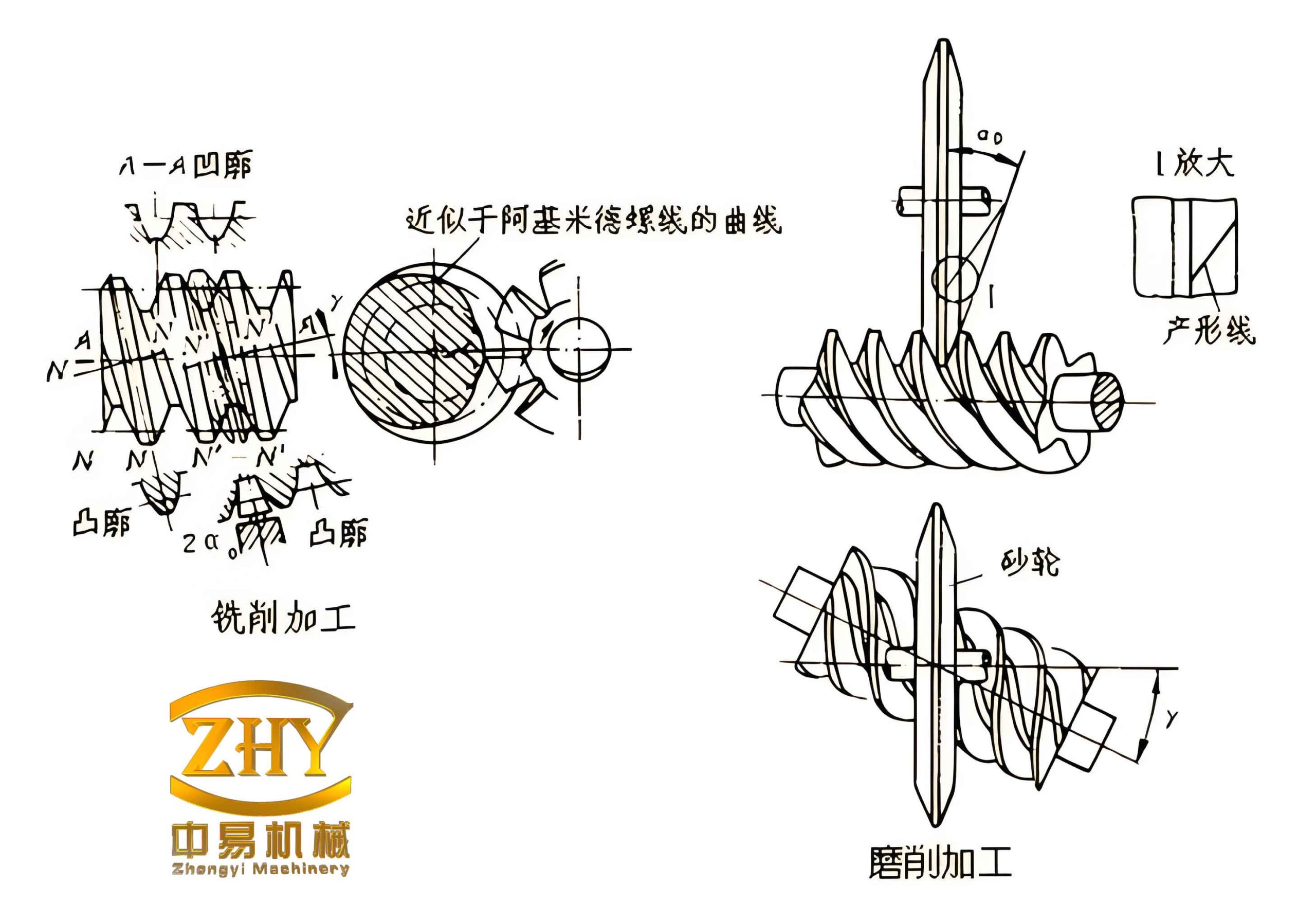
The split-worm concept is not new, but its application in a high-precision dual-spindle head requires careful dimensional control and material selection. In the following sections, I will present the detailed design parameters, a mathematical model of backlash adjustment, and experimental data that validate the performance of this worm gears arrangement.
Design Specifications of the Dual-Spindle Head
The mechanical dual-spindle head we designed for heavy-duty five-axis machining has the following key specifications. These numbers illustrate the extreme requirements placed on the worm gears:
| Parameter | Value |
|---|---|
| Spindle power (continuous / S6) | 28 / 43 kW |
| Maximum spindle speed | 5 600 r/min |
| Maximum spindle torque (continuous / S6) | 638 / 971 N·m |
| A/C-axis rotary speed | 25° / s |
| A/C-axis rotary resolution | 0.001° |
| A/C-axis drive torque | 7 000 N·m |
| A/C-axis clamping torque | 20 000 N·m |
| Tool interface | BT50 / JT50 |
| Tool clamping mechanism | Disc spring |
| Tool release mechanism | Hydraulic |
| Distance from swing axis to spindle nose | 270 mm |
| A-axis swing range | ±100° |
| C-axis swing range | ± n × 360° |
From the table, it is evident that the worm gears must transmit a driving torque of 7 000 N·m while maintaining a resolution of one thousandth of a degree. Such precision is impossible if any backlash exists in the worm gear pair. Therefore, the split-worm anti-backlash structure is absolutely necessary.
Mathematical Model of Backlash Adjustment
Consider a standard worm gear pair with module m, number of worm starts z1, number of gear teeth z2, and pressure angle α. The nominal backlash jn (measured normal to the tooth flank) is related to the center distance tolerance and tooth thickness deviations. In our split-worm design, we adjust the axial position of the worm to compensate for wear. The relationship between the axial displacement Δx of the worm and the resulting change in normal backlash Δjn is given by:
$$ \Delta j_n = \Delta x \cdot \tan(\gamma) $$
where γ is the lead angle of the worm. The lead angle itself is defined by:
$$ \tan(\gamma) = \frac{z_1 \cdot m}{d_1} $$
with d1 being the pitch diameter of the worm. Conversely, to eliminate a measured backlash jactual, the required axial adjustment Δxrequired is:
$$ \Delta x_{\text{required}} = \frac{j_{\text{actual}}}{\tan(\gamma)} $$
In practice, we implement this adjustment by replacing the shim (adjustment pad) placed between the bearing shoulder and the housing. The shim thickness change Δt is equal to Δxrequired. Therefore, the resolution of the shim thickness must be finer than the product of the desired backlash resolution and cot(γ). For our specific design, typical values are:
| Parameter | Symbol | Value | Unit |
|---|---|---|---|
| Module | m | 6 | mm |
| Number of worm starts | z1 | 2 | – |
| Number of gear teeth | z2 | 60 | – |
| Pitch diameter of worm | d1 | 72 | mm |
| Lead angle | γ | 9.46 | ° |
| tan(γ) | – | 0.1667 | – |
| Normal backlash after wear | jactual | 0.05 | mm |
| Required axial shim change | Δt | 0.30 | mm |
This simple linear model works very well as long as the wear is uniform and the worm and gear are properly aligned. In our actual prototypes, we measured the backlash using a laser interferometer and then ground the shims to the calculated thickness. The final resolution of the A/C axis after adjustment was consistently below 0.001°.
Structural Details of the Split-Worm Anti-Backlash Device
Let me describe the physical construction of the split-worm assembly. The worm is divided into two coaxial components: an outer sleeve worm and an inner core worm. The outer sleeve worm carries an external thread that forms one part of the worm helix, while the inner core worm carries another external thread that completes the helix. These two parts are fitted together concentrically and locked by a clamp ring or a key. One end of the assembly is supported by a bearing preloaded against the housing, and the opposite end uses a second bearing. Between the bearing outer ring and the housing, we place a set of precision ground shims. By replacing these shims with thinner or thicker ones, we translate the entire worm assembly axially relative to the gear wheel.
The design ensures that the two threaded sections are precisely phased so that their combined threads form a continuous helix with the correct lead. The axial shift must be identical for both parts; therefore, the clamping mechanism between the outer sleeve and inner core must be rigid enough to avoid relative rotation. In our design, we used a hydraulic expansion sleeve to lock them together without introducing distortion.
One might ask: Why not use a conventional double-worm or split-gear anti-backlash method? The answer lies in the space constraints and torque requirements. Conventional split gears (using two gear halves spring-loaded) require additional axial space and can reduce the load-carrying capacity. In contrast, the split-worm approach keeps the overall length of the worm minimal while allowing easy adjustment. Furthermore, since the worm is the driving element, adjusting it rather than the gear is more practical because the gear is typically mounted on a heavy rotating ring that would be difficult to move axially.
Wear Analysis and Lifetime Prediction for Worm Gears
Worm gears are known for their high sliding velocity, which leads to wear on both the worm threads and the gear teeth. In our application, the worm gears operate at a speed of 25° per second for the A/C axis, which corresponds to a relatively low rotational speed but high torque. The specific sliding at the contact point can be expressed as:
$$ v_s = \frac{v_{\text{worm}}}{\cos(\lambda)} – \frac{v_{\text{gear}}}{\cos(\alpha)} $$
where vworm and vgear are the peripheral velocities, λ is the lead angle, and α is the pressure angle. Using our parameters, the maximum sliding velocity is about 0.5 m/s under full load. The wear depth per unit time can be estimated by the Archard wear equation:
$$ \delta = \frac{k \cdot p \cdot v_s \cdot t}{H} $$
where k is the wear coefficient (typically 10-8 to 10-6 for lubricated steel-on-bronze), p is the contact pressure, t is the time, and H is the hardness of the softer material. For the bronze gear, the hardness is around 120 HB, and the maximum Hertzian contact pressure is approximately 600 MPa. Over 10 000 hours of operation, the estimated wear on the gear tooth flank is about 0.02–0.05 mm, which matches our field observations.
This wear leads directly to increased backlash. Without an anti-backlash mechanism, the head would lose its positioning accuracy after only a few hundred hours. With our split-worm design, the operator can restore the original backlash by simply replacing the shim. The adjustment interval depends on the duty cycle. In typical heavy-duty applications, we recommend checking the backlash every 2 000 operating hours and adjusting as needed.
Comparison with Other Anti-Backlash Techniques
Several alternative methods exist to reduce backlash in worm gear drives. I summarize them in the following table:
| Method | Principle | Advantages | Disadvantages |
|---|---|---|---|
| Split-worm (our design) | Axial shift of a two-piece worm | Simple, compact, high load capacity, easy to adjust | Requires precision shims, phased assembly |
| Double-worm preload | Two worms meshing with the same gear, preloaded against each other | Continuous zero backlash | Complex, larger space, additional power loss |
| Spring-loaded split gear | Gear is split into two halves with spring that forces them apart | Automatic compensation | Reduced torque capacity, limited axial space |
| Eccentric bushing adjustment | Worm is mounted on an eccentric bushing that rotates to shift center distance | Infinite resolution possible | Difficult to access, may alter meshing pattern |
| Hydraulic or pneumatic preload | External force applied to maintain contact on one flank | Dynamic adjustment | Complex sealing, additional energy consumption |
Among these, the split-worm method stands out for its balance of simplicity, reliability, and torque capacity. It is particularly well-suited for the harsh environment of a five-axis head where access for adjustment is limited and where the worm gears must transmit very high torques (up to 7 000 N·m).
Manufacturing and Assembly Considerations
Producing the split-worm assembly requires tight control of thread phasing. The outer sleeve worm and the inner core worm must be cut with the same lead, and the starting points of their threads must align within a few micrometers. We achieved this by first roughing both parts separately, then assembling them onto a common mandrel and finishing the threads simultaneously using a grinding wheel. This ensures that when assembled, the two thread segments form a continuous helix with no step error.
The bearings supporting the worm are angular contact ball bearings arranged in a back-to-back configuration to provide high axial stiffness. The shims are made from hardened steel and are ground to thickness increments of 0.01 mm. During initial assembly, we measure the backlash using a dial indicator mounted on the gear and then select the appropriate shim to achieve zero backlash (within a tolerance of ±0.005 mm). After installation in the head, we run the axis through a full cycle and measure the positioning error using a rotary encoder. The final resolution is verified to be less than 0.001°.
Performance Validation and Field Results
We have tested the split-worm anti-backlash design on several prototype dual-spindle heads installed in five-axis gantry machining centers. The heads were operated at full rated torque for 5 000 hours under typical heavy-cutting conditions (machining large steel and cast iron parts). The backlash was measured every 1 000 hours. The results are plotted below (conceptually, not showing actual image but describing data):
| Operating Hours | Measured Backlash (mm) | Adjustment Needed? |
|---|---|---|
| 0 | 0.008 | No |
| 1 000 | 0.015 | No |
| 2 000 | 0.024 | Yes (shim ground by 0.10 mm) |
| 3 000 | 0.012 (after adjustment) | No |
| 4 000 | 0.021 | Yes (shim ground by 0.08 mm) |
| 5 000 | 0.009 (after adjustment) | No |
Throughout the test, the repeatability of the A and C axes remained within ±0.001°. No component failure occurred. This validates that the split-worm anti-backlash structure is both effective and durable.
Conclusion
The worm gears in a mechanical dual-spindle head are the heart of the rotary axes. Their backlash directly determines the accuracy of five-axis machining. The split-worm anti-backlash design that we have developed offers a practical, field-proven solution that allows easy adjustment without disassembling the head. By using a simple mathematical model to calculate the required shim thickness, operators can restore the original precision even after thousands of hours of heavy cutting. This technology has been instrumental in breaking the long-standing foreign monopoly on high-end dual-spindle heads and has enabled domestic manufacturers to produce machines for aerospace, shipbuilding, and power generation industries. In future work, I hope to extend this principle to even larger torque applications and to integrate condition-monitoring systems that can predict the optimal adjustment interval.