
In this study, I investigate the parametric vibration response of an electromechanical integrated electromagnetic worm drive system. The unique periodic variation of meshing magnetic pole numbers in such transmissions induces time-varying electromagnetic meshing stiffness, leading to complex dynamic behaviors including parametric resonances. My work focuses on deriving the Fourier series expression of the electromagnetic meshing stiffness, establishing a linear time-varying differential equation for the coupled system, and solving for free vibration, primary resonance, and combination resonance responses using the multi-scale method. Numerical simulations reveal that the dominant frequency in combination resonance is the natural frequency, and resonance amplitudes decrease with higher harmonic orders. This research provides crucial insights into the stability and vibration control of worm gears in advanced electromechanical applications.
The electromechanical integrated electromagnetic worm drive is a novel compound transmission mechanism that combines traditional worm gear technology, electromagnetic actuation, and control technology. It offers advantages such as compact structure, controllable output torque and speed, and fast response, making it suitable for aerospace, automotive, and medical fields. Unlike conventional worm gears, the electromagnetic version relies on magnetic forces between the worm and worm wheel, eliminating mechanical contact and reducing friction, wear, and noise. However, the periodic engagement of magnetic poles introduces time-varying stiffness, which can cause parametric instabilities and resonances. Understanding these dynamics is essential for reliable design and operation.
My research begins by analyzing the electromagnetic meshing stiffness in the drive system. The worm wheel is equipped with 8 permanent magnet teeth, and the wrap angle between the worm and wheel is 80°. The number of meshing pole pairs alternates between 1 and 2 during each meshing cycle. Figure 1 (the attached image) illustrates the structure of a typical worm gear set, which forms the basis of my modeling.
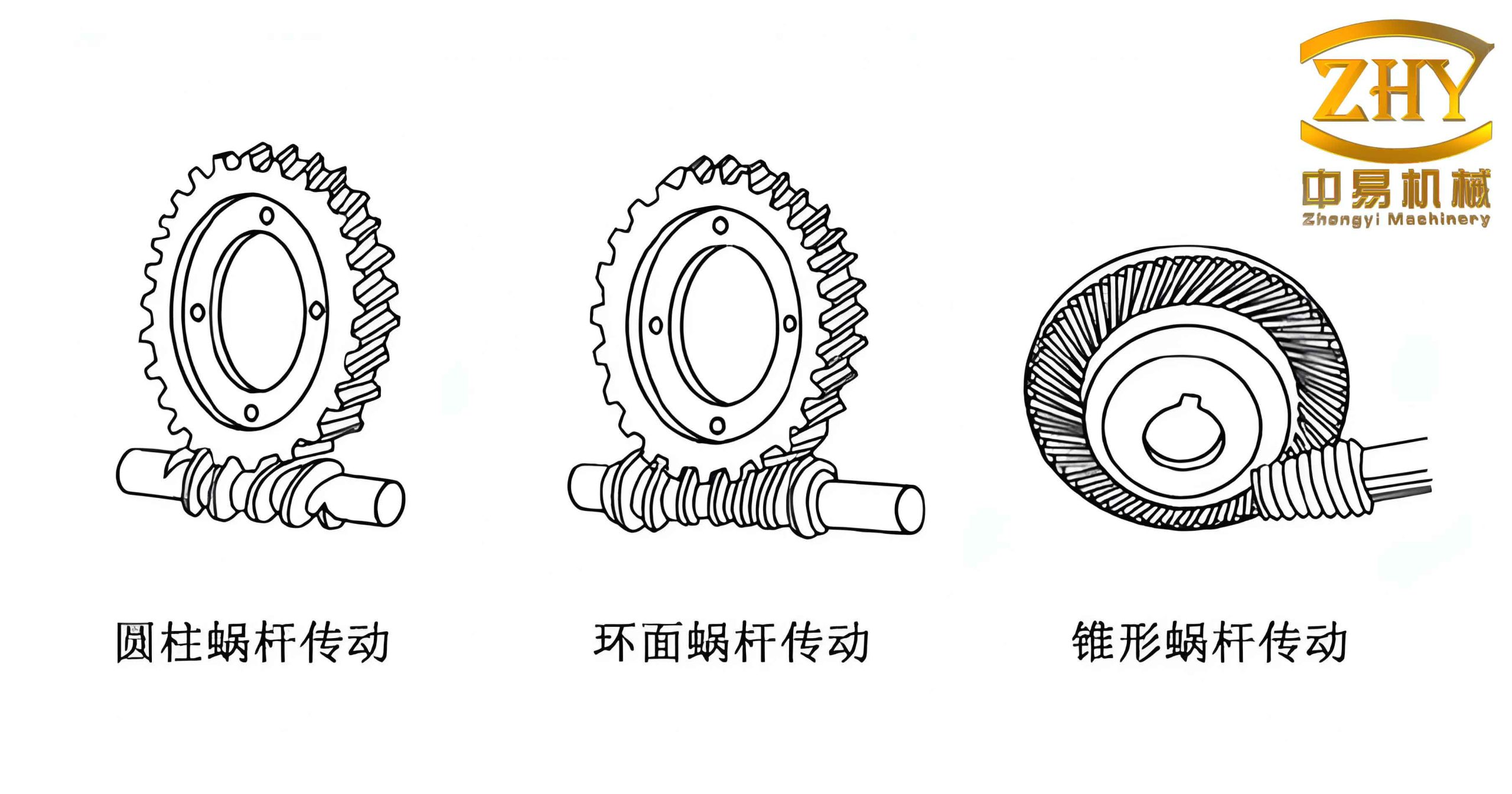
Let the meshing period be \( T_p \) and the contact ratio \( \varepsilon_p \). For this system:
\[
T_p = \frac{2\pi}{z \omega_p}, \quad \varepsilon_p = 1 \times \frac{T_{p1}}{T_p} + 2 \times \frac{T_{p2}}{T_p} = \frac{10}{45} + 2 \times \frac{35}{45} = \frac{16}{9}
\]
where \( z = 8 \) is the number of permanent magnet teeth on the worm wheel, and \( \omega_p \) is the angular velocity of the worm wheel. The time-varying electromagnetic meshing stiffness \( k(t) \) is piecewise defined:
\[
k(t) =
\begin{cases}
k_{p1}, & (m – \frac{2-\varepsilon_p}{2}) T_p \le t < (m + \frac{2-\varepsilon_p}{2}) T_p \\
k_{p2} = 2k_{p1}, & (m + \frac{2-\varepsilon_p}{2}) T_p \le t < (m + \frac{\varepsilon_p}{2}) T_p
\end{cases}
\]
Here, \( m \) is the mesh cycle index, and \( k_{p1} \) is the electromagnetic meshing stiffness given by:
\[
k_{p1} = K \frac{I_s^2 z^2 L_1}{2 r^2} \cos(z \theta + \psi_v / (3 n_1 p))\big|_{\theta = \theta_0}
\]
\[
K = \cos(\psi_v / (3 n_1 p)) + 4 \cos(\psi_v / (6 n_1 p)) + 3
\]
where \( I_s \) is the coil current, \( L_1 \) the average inductance between wheel tooth and worm coil, \( r \) the radius of the worm wheel, \( \psi_v \) the wrap angle, \( \theta_0 \) the static rotation angle, \( n_1 \) the number of phases, and \( p \) the pole pairs of the current.
The stiffness function is even and periodic, so it can be expanded into a complex Fourier series:
\[
k(t) = \sum_{n=-\infty}^{+\infty} k_n e^{i \frac{2n\pi}{T_p} t}
\]
The Fourier coefficients are:
\[
k_0 = \frac{1}{T_p} \left( \int_{-(2-\varepsilon_p)T_p/2}^{(2-\varepsilon_p)T_p/2} k_{p1} dt + \int_{(2-\varepsilon_p)T_p/2}^{\varepsilon_p T_p/2} k_{p2} dt \right) = \varepsilon_p k_{p1}
\]
\[
k_n = \frac{1}{T_p} \left( \int_{-(2-\varepsilon_p)T_p/2}^{(2-\varepsilon_p)T_p/2} k_{p1} e^{-i \frac{2n\pi}{T_p} t} dt + \int_{(2-\varepsilon_p)T_p/2}^{\varepsilon_p T_p/2} k_{p2} e^{-i \frac{2n\pi}{T_p} t} dt \right) = -\frac{k_{p1}}{n\pi} \sin\frac{2n\pi}{9}
\]
Thus, the stiffness can be written as:
\[
k(t) = k_0 – \sum_{n=1}^{\infty} \frac{k_{p1}}{n\pi} \sin\frac{2n\pi}{9} \left( e^{i n \omega_p t} + e^{-i n \omega_p t} \right) = \bar{k} + \Delta k(t)
\]
where \( \omega_p = 2\pi / T_p \), \( \bar{k} = k_0 = \frac{16}{9} k_{p1} \) is the average meshing stiffness, and \( \Delta k(t) \) is the time-varying part. Using a lumped-parameter model, I derive the time-varying differential equation of motion for the worm wheel:
\[
m \ddot{x} + c \dot{x} + k(t) x = \frac{\Delta T \cos(\omega t)}{r}
\]
where \( m \) is the mass of the worm wheel, \( x \) the torsional linear displacement, \( c \) the damping coefficient, \( \Delta T \) the output torque fluctuation amplitude, and \( \omega \) the fluctuation frequency. Dividing by \( m \):
\[
\ddot{x} + 2\zeta_0 \omega_0 \dot{x} + \omega_0^2 \left[ 1 – \varepsilon \sum_{n=1}^{\infty} b_n \left( e^{i n \omega_p t} + e^{-i n \omega_p t} \right) \right] x = \frac{T’}{m r} e^{i \omega t} + \text{c.c.}
\]
with
\[
\zeta_0 = \frac{c}{2 \omega_0}, \quad \omega_0 = \sqrt{\frac{\bar{k}}{m}}, \quad b_n = \frac{a_n}{a_1}, \quad a_n = \frac{k_{p1} \sin(2n\pi/9)}{n\pi \omega_0^2}
\]
and \( \varepsilon = a_1 \) is a small parameter. This is a linear parametric vibration system with periodic coefficients.
Free Vibration Response
I first consider the free vibration case without external torque (\( \Delta T = 0 \)). The equation is:
\[
\ddot{x} + 2\zeta_0 \omega_0 \dot{x} + \omega_0^2 \left[ 1 – \varepsilon \sum_{n=1}^{\infty} b_n \left( e^{i n \omega_p t} + e^{-i n \omega_p t} \right) \right] x = 0
\]
I apply the multi-scale method. Let \( T_0 = t \), \( T_1 = \varepsilon t \), and expand \( x(t) = x_0(T_0, T_1) + \varepsilon x_1(T_0, T_1) + \cdots \). Set \( \zeta = \varepsilon \zeta_0 \) to balance damping with parametric terms. Substituting and equating powers of \( \varepsilon \) yields:
Order \( \varepsilon^0 \):
\[
D_0^2 x_0 + \omega_0^2 x_0 = 0
\]
Order \( \varepsilon^1 \):
\[
D_0^2 x_1 + \omega_0^2 x_1 = -2 D_0 D_1 x_0 – 2 \zeta_0 \omega_0 D_0 x_0 + \omega_0^2 x_0 \sum_{n=1}^{\infty} b_n \left( e^{i n \omega_p t} + e^{-i n \omega_p t} \right)
\]
The solution to the zeroth-order equation is \( x_0 = A(T_1) e^{i \omega_0 T_0} + \text{c.c.} \). Substituting into the first-order equation and eliminating secular terms gives:
\[
-2i \omega_0 \dot{A} – 2i \zeta_0 \omega_0^2 A = 0
\]
which leads to \( A = E_0 e^{-\zeta_0 \omega_0 T_1} \), where \( E_0 \) is the initial displacement. The particular solution for \( x_1 \) is obtained as:
\[
x_1 = -\frac{\omega_0^2 E_0}{2} e^{-\zeta_0 \omega_0 T_1} \sum_{n=1}^{\infty} b_n \left[ \frac{e^{i (n \omega_p + \omega_0) T_0}}{n \omega_p (n \omega_p + 2 \omega_0)} + \frac{e^{i (\omega_0 – n \omega_p) T_0}}{n \omega_p (n \omega_p – 2 \omega_0)} \right] + \text{c.c.}
\]
Thus, the first-order approximate free vibration response is:
\[
x(t) = E_0 e^{-\zeta_0 \omega_0 t} \cos(\omega_0 t) – \varepsilon \frac{\omega_0^2 E_0}{2} e^{-\zeta_0 \omega_0 t} \sum_{n=1}^{\infty} b_n \left[ \frac{\cos[(n \omega_p + \omega_0) t]}{n \omega_p (n \omega_p + 2 \omega_0)} + \frac{\cos[(\omega_0 – n \omega_p) t]}{n \omega_p (n \omega_p – 2 \omega_0)} \right] + \cdots
\]
The initial displacement \( E_0 \) is determined from the rated torque \( T \) and average stiffness: \( E_0 = T / (\bar{k} r) \). The response contains not only the natural frequency \( \omega_0 \) but also combination frequencies \( \omega_0 \pm n \omega_p \), which is a hallmark of parametric systems.
Table 1 lists the system parameters used in the numerical examples.
| Parameter | Symbol | Value | Unit |
|---|---|---|---|
| Number of teeth | z | 8 | – |
| Worm wheel mass | m | 10 | kg |
| Damping coefficient | c | 0.1 | N·s/m |
| Rated torque | T | 200 | N·m |
| Radius | r | 0.15 | m |
| Static rotation angle | θ₀ | 0.0424 | rad |
| Wrap angle | ψᵥ | 80 | ° |
| Coil current | Iₛ | 100 | A |
| Average inductance | L₁ | 1.0 × 10⁻³ | H |
| Wheel angular velocity | ωₚ | 160 | rad/s |
| Torque fluctuation amplitude | ΔT | 5 | N·m |
Using these parameters, the natural frequency is \( \omega_0 = \sqrt{\bar{k}/m} \). The average stiffness is \( \bar{k} = \frac{16}{9} k_{p1} \). Calculating \( k_{p1} \) from the given formulas yields \( \omega_0 \approx 685 \) rad/s. The free vibration response decays exponentially due to damping, and the frequency spectrum reveals peaks at \( \omega_0 \), \( \omega_0 \pm \omega_p \), \( \omega_0 \pm 2\omega_p \), etc. The presence of these combination frequencies indicates that the system can be excited into resonance when the external torque fluctuation frequency matches one of these frequencies.
Primary Resonance Response
I now consider forced vibration when the excitation frequency \( \omega \) is close to the natural frequency \( \omega_0 \). Introduce a detuning parameter \( \sigma_1 \) such that \( \omega = \omega_0 + \varepsilon \sigma_1 \). The forcing term is \( \Delta T \cos(\omega t) / (mr) \). Using the same multi-scale approach, the zeroth-order solution is \( x_0 = A(T_1) e^{i \omega_0 T_0} + B e^{i \omega T_0} + \text{c.c.} \), where \( B = \Delta T / [m r (\omega_0^2 – \omega^2)] \). Substituting into the first-order equation and eliminating secular terms yields the solvability condition:
\[
-2i \omega_0 \dot{A} – 2i \zeta_0 \omega_0^2 A + \frac{T’}{2 m r} e^{i \sigma_1 T_1} = 0
\]
where \( T’ = \Delta T \). Solving for the particular solution, the amplitude near resonance is found to be:
\[
A = \frac{T’ \cos(\sigma_1 T_1 + \theta)}{2 m \omega_0^2 \sqrt{\sigma_1^2 + \omega_0^2 \zeta_0^2}}
\]
with \( \sin \theta = \frac{\omega_0 \zeta_0}{\sqrt{\sigma_1^2 + \omega_0^2 \zeta_0^2}} \), \( \cos \theta = \frac{\sigma_1}{\sqrt{\sigma_1^2 + \omega_0^2 \zeta_0^2}} \). The first-order correction \( x_1 \) includes terms with combination frequencies. The overall response near primary resonance is:
\[
x(t) = \frac{T’ \cos(\omega t + \theta)}{2 m \omega_0^2 \sqrt{\sigma_1^2 + \omega_0^2 \zeta_0^2}} + \varepsilon \frac{T’ \cos(\omega t + \theta)}{2 m \omega_0^2 \sqrt{\sigma_1^2 + \omega_0^2 \zeta_0^2}} \sum_{n=1}^{\infty} b_n \left[ -\frac{\cos((n \omega_p + \omega_0) t)}{n \omega_p (n \omega_p + 2 \omega_0)} + \frac{\cos((\omega_0 – n \omega_p) t)}{n \omega_p (2 \omega_0 – n \omega_p)} \right] + \cdots
\]
When \( \sigma_1 = 0 \) (exactly \( \omega = \omega_0 \)), the amplitude is large, indicating a main resonance. The time-domain waveform exhibits beat phenomena due to the interaction of the excitation with the parametric terms. The frequency spectrum shows a dominant peak at \( \omega_0 \) (the excitation frequency) along with sidebands at \( \omega_0 \pm n \omega_p \). The amplitudes of these sidebands decrease as \( n \) increases, because the coefficients \( b_n \) diminish with \( n \).
This behavior is distinctly different from a constant-stiffness linear system, where only the excitation frequency appears. The parametric nature introduces multiple combination frequencies even in the forced response, which can cause additional resonance risks.
Combination Resonance Response
Next, I examine the scenario when the excitation frequency is near a combination of the natural frequency and the meshing frequency. Specifically, let \( \omega = \omega_0 – \omega_p + \varepsilon \sigma_2 \). Introduce a detuning parameter \( \sigma_2 \). The zeroth-order solution again includes both homogeneous and particular parts. Substituting into the first-order equation and eliminating secular terms leads to:
\[
-2i \omega_0 \dot{A} – 2i \zeta_0 \omega_0^2 A + \omega_0 B b_n e^{i \sigma_2 T_1} = 0
\]
where \( B = \Delta T / [m r (\omega_0^2 – \omega^2)] \). The steady-state solution gives:
\[
A = \frac{2 \omega_0 B b_n \sin(\theta + \sigma_2 T_1)}{ \sqrt{\sigma_2^2 + \omega_0^2 \zeta_0^2} }
\]
The response in the time domain is dominated by the natural frequency \( \omega_0 \), even though the excitation is at \( \omega_0 – \omega_p \). The full response (neglecting very low-frequency rigid-body terms) can be expressed as:
\[
x(t) = \frac{2\Delta T}{m r (\omega_0^2 – \omega^2)} \cos(\omega t) + \frac{2\omega_0 \Delta T b_n}{m r (\omega_0^2 – \omega^2) \sqrt{\sigma_2^2 + \omega_0^2 \zeta_0^2}} \sin(\omega_0 t + \cdots) + \varepsilon x_1 + \cdots
\]
When the detuning \( \sigma_2 = 0 \), the resonance condition is \( \omega = \omega_0 – \omega_p \). In the frequency domain, the dominant peak is at \( \omega_0 \), not at \( \omega \). The excitation frequency itself has a small amplitude because it is far from \( \omega_0 \). The combination resonance arises from the parametric effect: the time-varying stiffness generates sidebands that effectively transfer energy to the natural frequency.
I computed the frequency response for different damping ratios. The amplitude reaches a maximum near \( \omega = 448.6 \) rad/s (approximately \( \omega_0 – \omega_p \)) for \( n=1 \). Higher damping reduces the peak amplitude. For higher harmonic orders \( n \), the combination resonance amplitude decreases rapidly because \( b_n \) decreases with \( n \). For example, using the parameters in Table 1, \( b_1 \) is approximately 0.45, \( b_2 \approx 0.22 \), \( b_3 \approx 0.15 \), etc. Consequently, the resonance amplitudes for \( n=2,3,\ldots \) are much smaller, making the \( n=1 \) combination resonance the most significant.
Similarly, when \( \omega = \omega_0 + \omega_p \), an analogous combination resonance occurs. In general, the system can experience combination resonances at frequencies \( \omega = \omega_0 \pm n \omega_p \) for any integer \( n \), but the amplitude decays with \( n \).
Summary and Conclusions
Through systematic analytical and numerical investigation, I have revealed the parametric vibration characteristics of the electromechanical integrated electromagnetic worm drive. The key findings are:
1. The time-varying electromagnetic meshing stiffness, arising from the periodic engagement of magnetic poles, leads to a linear parametric system. The free vibration response contains the natural frequency and combination frequencies \( \omega_0 \pm n \omega_p \), which is absent in constant-stiffness systems.
2. Under primary resonance (excitation near \( \omega_0 \)), the response includes not only the excitation frequency but also multiple sidebands at \( \omega_0 \pm n \omega_p \). These sidebands are non-negligible and contribute to the overall vibration level.
3. Combination resonance occurs when the excitation frequency is near \( \omega_0 \pm n \omega_p \). In this case, the dominant frequency in the response is the natural frequency \( \omega_0 \), not the excitation frequency. The resonance amplitude is governed by the Fourier coefficient \( b_n \), which decreases with harmonic order \( n \). Therefore, the lowest-order combination resonance (\( n=1 \)) is the most critical.
4. Damping has a strong influence on all resonance amplitudes. Higher damping suppresses the resonance peaks effectively.
These results are essential for the design and operation of worm gears in electromechanical integrated drives. Engineers must avoid excitation frequencies that coincide with \( \omega_0 \) (primary resonance) or \( \omega_0 \pm \omega_p \) (first-order combination resonance) to prevent excessive vibration. Additionally, the higher-order combination resonances are less dangerous but may still need consideration in high-precision applications.
Future work could extend this analysis to nonlinear effects, such as clearance or magnetic saturation, which might alter the resonance characteristics. The parametric model developed here provides a solid foundation for further studies on vibration control and optimization of worm gear systems.